1. Who is Lucifer, really?
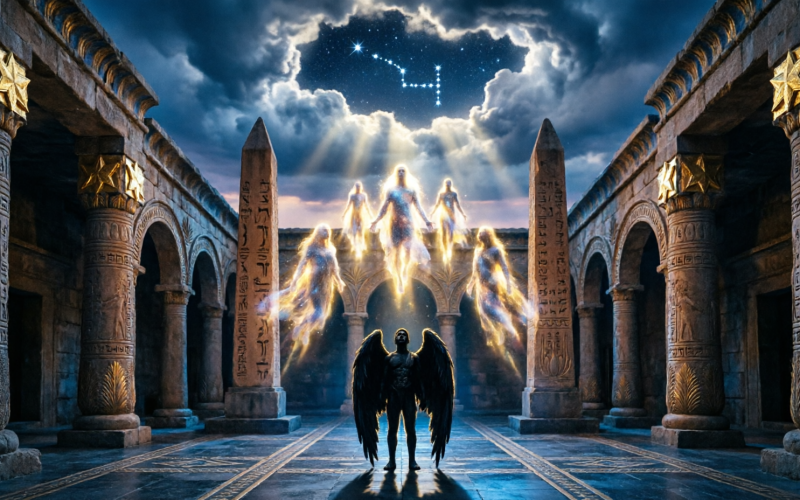
The name “Lucifer” doesn’t appear anywhere in the original Hebrew text as a proper name for the devil. It comes from Isaiah 14:12, where the Hebrew term is helel ben-shachar — “son of the dawn” / “shining one of the dawn” — a poetic nickname for the Morning Star (the planet Venus). The passage is a satire aimed explicitly at a Babylonian king (probably Nebuchadnezzar or a successor of his), mocking his fall from power: “how you have fallen from heaven, O shining one…” — a stylistic figure frequently used in ancient Semitic literature for arrogant kings who think themselves gods. There’s even an older Canaanite mythological parallel, with the god Athtar/Helel, who tries to ascend the throne of the gods and is thrown down — Isaiah probably borrows this literary motif.
When Jerome translated the Vulgate (4th century AD), he rendered helel into Latin as Lucifer = “light-bearer,” the usual Latin name for the Morning Star. A simple translation, not a “nickname for Satan.”
Where, then, does the Lucifer = Satan identification come from? It’s a later theological overlay, made by the Church Fathers (Origen, Tertullian, 2nd-3rd centuries AD), who linked Isaiah 14 to two other passages — Luke 10:18 (“I saw Satan fall like lightning from heaven”) and the dragon/fallen angel from Revelation 12 — and built a single coherent narrative out of three separate texts, written in different eras and for different purposes: the angel of light who rebels out of pride and falls. It’s an interpretive construction, not something explicitly written in the text.
The Hebrew word satan (שָׂטָן) literally means “adversary” or “accuser” — it’s not a proper name, it’s a function. In the Book of Job, for example, “satan” is a member of the heavenly court, a kind of prosecutor who tests people’s loyalty with God’s permission, not His cosmic enemy. The figure of Satan as an absolute rival, opposed to good, develops only in Second Temple period Judaism (~3rd century BC – 1st century AD), with strong influence from Persian Zoroastrian dualism (Ahura Mazda vs. Ahriman) — a period when the Jews were under Persian rule.
Direct answer: Lucifer, as a fallen angelic being identified with the devil, is a Christian theological synthesis, appearing several centuries after the original texts, from combining a metaphor about a Babylonian king with other separate passages. It’s not a malicious lie, but neither is it a “direct” biblical fact — it’s traditional interpretation, presented over the centuries as the letter of the text.
2. Lucifer has nothing to do with Satan — but has everything to do with Jesus
Short and to the point: Lucifer has nothing to do with Satan/the Devil. And on top of that, the Morning Star is actually Jesus, as presented in Revelation.
Lucifer ≠ Satan — correct, in the original text there’s no direct connection; it’s a later theological identification, not a textual one. Jesus = “the Morning Star” — correct, appears explicitly in Revelation 22:16: “I am the root and the offspring of David, and the bright and morning star” (in Latin, the Vulgate: stella splendida et matutina). And even more clearly, in 2 Peter 1:19, the Vulgate uses the literal word lucifer: “…and the day star (lucifer) arise in your hearts” — again referring to Christ/spiritual light, not the devil.
So practically the same title — “light-bearer / morning star” — is used in the text both for the Babylonian king mocked in Isaiah (later becoming “Lucifer the devil” in tradition), and literally for Jesus elsewhere in the same biblical corpus. It’s a real textual irony, long noted by exegetes and critics — solid evidence that “Lucifer” was originally a title of brightness/honor, not a name of evil, until it was redefined by patristic tradition.
3. Who is Satan, really — strictly on the documents
Now that it’s established who Lucifer is and isn’t, the question remains who Satan is — but strictly on the documents, not from theological fairy tales or urban legends. Strictly on the text, chronologically, with exact quotes:
In the Torah and early Old Testament, “satan” isn’t a name, it’s a function. The Hebrew word satan (שָׂטָן) literally means “adversary/opponent,” without a capital letter, without being a proper name. Numbers 22:22 — even the Angel of the LORD sets himself as a “satan” (obstacle) in Balaam’s path. Here “satan” is explicitly an angel of God, not a rival of His. 1 Samuel 29:4 — the Philistines fear that David might become their “satan” (adversary) in battle — a man, not a supernatural entity. 1 Kings 11:14, 23, 25 — God Himself “raises up” two “satans” (human political adversaries) against Solomon.
In the Book of Job and Zechariah, “ha-satan” appears with the definite article, but still as a function, subordinate to God. Job 1:6-12, 2:1-6 — “ha-satan” (the accuser) is a member of the heavenly court, asks God’s permission to test Job, doesn’t act independently. Zechariah 3:1-2 — “ha-satan” accuses a high priest, and the LORD rebukes him directly (“The LORD rebuke you, Satan”) — clearly showing a subordinate being who oversteps his mandate, not a cosmic rival of God.
The most important documentary clue is a direct textual variant. 2 Samuel 24:1 (older text, ~6th century BC): “And again the anger of the LORD was kindled against Israel, and he (YHWH) moved David” to take the census. 1 Chronicles 21:1 (a parallel text, but written ~200 years later, post-exilic): the exact same deed is now attributed to “Satan” — “And Satan stood up against Israel, and provoked David.” Practically the same narrative, the same act — but responsibility shifts from God directly, to a separate figure called “Satan,” as Jewish monotheism becomes increasingly strict and needs to externalize evil from God. It’s the clearest textual proof of the concept’s evolution, right within the canon itself.
In intertestamental (non-canonical) literature, the figure “inflates.” In the Book of Enoch, the Book of Jubilees, the Qumran scrolls (3rd century BC – 1st century AD) appear Mastema, Belial, Azazel — cosmic evil beings, demonic hierarchies, spiritual wars. The historical-critical consensus is that this development comes from the Jews’ contact with Persian Zoroastrian dualism (Ahura Mazda vs. Angra Mainyu/Ahriman), during the period of Persian domination (539-332 BC).
In the New Testament, the figure is already complete, and a retroactive overlay is made. Here “Satan”/”the devil” (diabolos, Greek “slanderer”) is a full-fledged cosmic antagonist: he tempts (Matthew 4), is called “the ruler of this world” (John 12:31), “the god of this age” (2 Corinthians 4:4). Important: Genesis 3 never names the serpent “Satan” — this identification appears only in the Wisdom of Solomon 2:24 and Revelation 12:9 (“that old serpent, called the Devil, and Satan”), texts written hundreds of years after Genesis.
The strictly documentary conclusion: Satan doesn’t exist as a character in the original text — he starts as a functional term (prosecutor/obstacle) within the heavenly court, subordinate to God, and gradually transforms, under Persian influence and through successive editing, into a rival cosmic being. The Bible itself, compared with itself (2 Samuel vs. Chronicles), documents this change.
4. Genesis 6 and the fallen angels
What remains to be clarified is the demon of Genesis 6, the fallen angels — in order to define, in the end, Satan in his true mission, not how he was transformed, over time, popularly, by priests and people.
Genesis 6:1-4 has strictly only 4 verses, extremely terse: the “sons of God” (bene ha’elohim) see that the daughters of men are beautiful and take wives from among them; the Nephilim appear, “the mighty men who were of old, men of renown.” That’s it. The text doesn’t explain, doesn’t explicitly condemn, only states — and is immediately followed by God’s decision to send the Flood.
Important documentary note: the term bene ha’elohim also appears elsewhere in the Old Testament (Job 1:6, 2:1, 38:7; Psalm 29:1, 89:6) and there clearly refers to divine/angelic beings from the heavenly court, not to humans. The interpretation that it means “the line of Seth” (pious men) versus “the line of Cain” is a later reinterpretation, from the patristic period (Augustine and others, 4th century+), made precisely to avoid the theological discomfort of angels mating with humans. Second Temple period readers read the passage literally, as angels.
The Book of Enoch (1 Enoch, ~3rd century BC) brings the detailed expansion — a non-canonical text (but canonical today in the Ethiopian Orthodox Church), extremely influential: 200 “Watchers” (angels), led by Shemihazah/Azazel, descend on Mount Hermon, swear an oath together, take human wives. They teach humans metallurgy and weapon-making (Azazel), cosmetics and seduction, astrology, magic, pharmacology. Their children, the Nephilim, become violent, consume all resources, then eat people — hence the outcry that triggers the Flood. Four archangels (Michael, Raphael, Gabriel, Uriel) bind the Watchers until Judgment.
Important documentary fact: this story from Enoch is directly quoted in the New Testament — Jude 1:6 (“the angels which kept not their first estate… he hath reserved in everlasting chains”) and 2 Peter 2:4. So the New Testament authors knew and accepted this tradition, even though 1 Enoch didn’t enter the final Jewish/Western Christian canon.
The (modern) “ancient astronaut” theory — the von Däniken/Sitchin reading, where the “sons of God” are extraterrestrials, the Nephilim are genetic hybrids, and the “teachings” are technology transfer — it must be stated clearly: this is a speculative 20th-century interpretation, with no counterpart in archaeological consensus or academic biblical scholarship. It’s a real theory, documented as a cultural movement, but it’s not “what the document says” — it’s a modern grid overlaid onto the text, exactly like the patristic grid with “the line of Seth.” Both are reinterpretations, not the original text.
5. What is Satan’s “real mission”
Here a great deal of honesty is required. The documents don’t give Satan any mission beyond the functional role already shown: accuser/tester in the heavenly court, subordinate to God, with explicit permission every time (Job, Zechariah). There’s no origin story, motivation, or “fall” of Satan in the text — this is crucial. The “fell from pride” narrative is a 3rd-century synthesis, combining three separate texts (Isaiah 14 about a Babylonian king, Ezekiel 28 about the king of Tyre — also a man, not an angel, Luke 10:18, Revelation 12).
If one seeks the documented “true mission,” the only thing the text supports is: a functional role of testing/verifying loyalty, not absolute evil. Everything else — “necessary opposition for free will,” “cosmic guardian of consequences” — is philosophy/theology, not textual fact.
There is, however, a real, alternative ancient tradition, worth mentioning because it fits a revisionist angle: the 2nd-century AD Gnostic texts (the Hypostasis of the Archons, the Apocryphon of John, the Testimony of Truth) explicitly invert the story — the serpent in Eden is presented as a bringer of gnosis/knowledge, and the “God” of the Old Testament (Yaldabaoth) is an inferior, jealous, ignorant divinity. There, the adversary-figure is the hero, not the villain. It was declared heresy by proto-orthodox Christianity, but it exists documented, with texts found at Nag Hammadi in 1945.
Strictly on the documents: one cannot define a single “true mission” of Satan because the text doesn’t give one — there are three separate layers (accuser function in the Old Testament, cosmic rival built later in the New Testament, hero of knowledge in the marginalized Gnostic tradition), and any synthesis of them is interpretation, not established fact.
6. Satan as a “system employee”
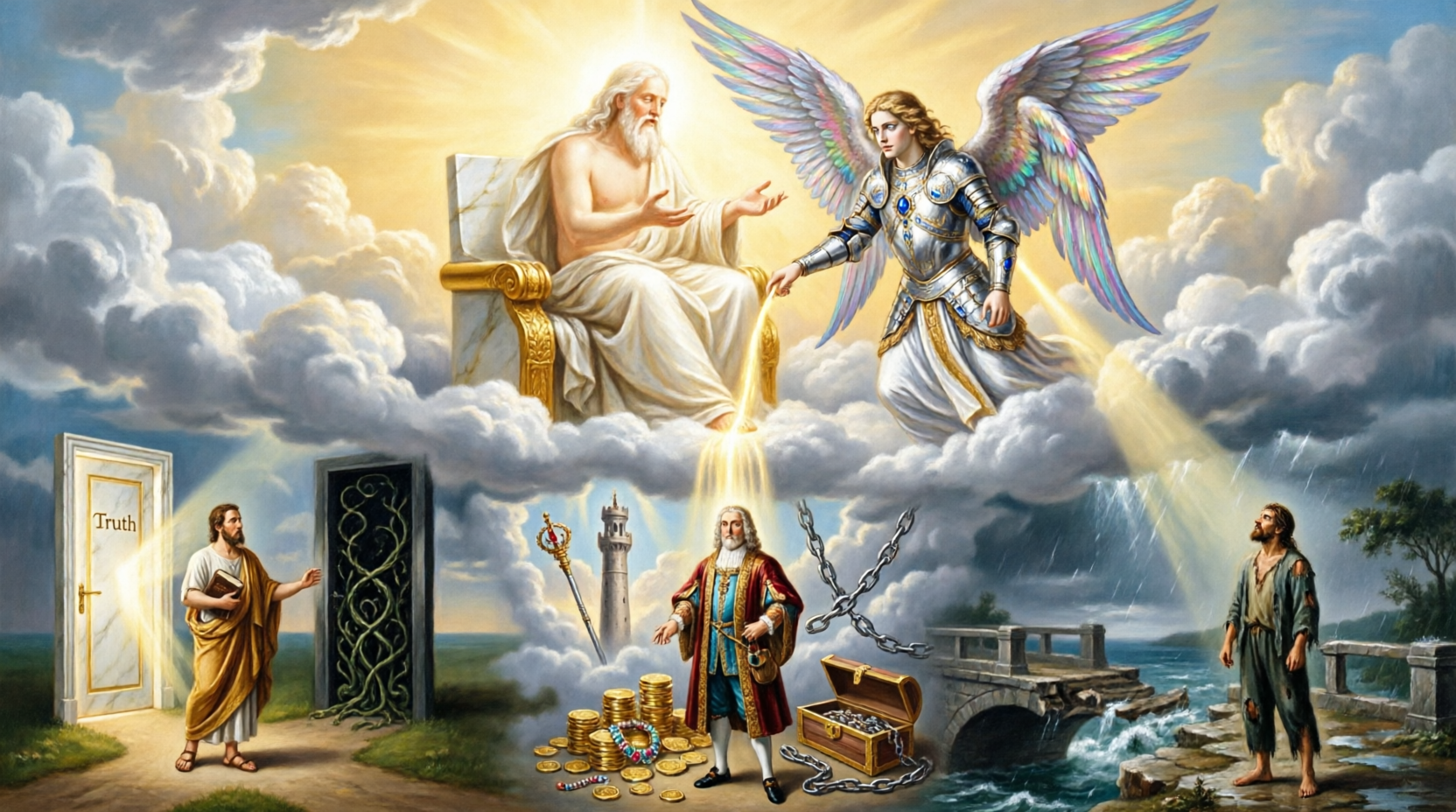
If we analyze the texts in which “God” communicates with Satan, it clearly emerges, from the dialogue, that they aren’t at odds, that “God” has nothing personal against Satan — on the contrary, it emerges that Satan was/is “on God’s payroll.” Satan was actually very close to God, because, following simple logic, you can’t send someone to test your people if they aren’t close to you. The idea that Satan is evil doesn’t come from God, it comes from those being “tested” — it’s as if we saw the teachers who test our knowledge, who put “traps” in exam problems, as negative characters, when they’re actually “employees,” in our case “of the system,” put there to test us.
The basic idea holds — and it even overlaps with a serious line of biblical research (Norman Habel, Marvin Pope, and other exegetes of the Book of Job read the “ha-satan” figure exactly this way: a functional member of the heavenly court, a kind of “quality control”/loyalty inspector, not a rebel). This isn’t fanciful ground — the tone of the text is read correctly.
Where it holds perfectly: in Job 1-2, the dialogue is completely devoid of hostility. God Himself brings up Job, almost daring Satan (“Have you considered my servant Job?”) — Satan doesn’t come up with the idea, God initiates it. This supports exactly the thesis: it doesn’t seem like a relationship of enmity, but one of collaboration with distinct roles. The explicit permission, every time, with negotiated limits (“you may do this to him, but not that”) — shows functional subordination, like a normal hierarchical report, not conflict. The analogy with the teacher who sets traps on an exam to test, and the students perceive the trap as “meanness” — is a solid and correct analogy for the mechanism of perception: those being tested project negative intent onto the testing function.
Where it gets complicated, to be rigorous to the end: Zechariah 3:1-2 spoils a bit the image of “a perfectly calm relationship, with no problem between them” — there God rebukes Satan directly (“The LORD rebuke you, Satan!”). So it’s not exactly zero friction — there’s at least one moment where Satan’s accusation is considered exaggerated/inappropriate by God Himself. This doesn’t contradict the “employee” idea, but shows he’s not an employee always unconditionally approved — he also gets “chewed out at work,” like any subordinate who oversteps his mandate. “Very close to God” — the logic (you can’t send someone to test your people if they aren’t close to you) is a reasonable inference, but the text doesn’t explicitly say they’re close/friends — it only says Satan has access to the divine assembly (bene ha’elohim), as a member of the court. Functional closeness (has access, has permission) isn’t automatically identical to personal/affective closeness — this is a reasonable interpretive step, but one’s own, not explicitly written. Another detail: the way Satan formulates the test in Job 1:9 — “Does Job fear God for nought?” — is a skeptical remark, which undermines Job’s motivation. It’s not hostility toward God, but it’s a form of cynicism toward man, a characteristic way of thinking, not just a neutral task executed automatically.
Overall: the basic thesis — Satan as a “system employee” who tests, not a cosmic rival — is solidly supported by the text, especially by Job. But “a perfectly calm relationship, nothing personal” is a bit too clean; Zechariah shows the relationship also has occasional friction, and Satan’s style (suspicious, undermining) seems to be a trait of the role, not just a task executed mechanically and without any nuance of character.
7. Satan as a “system auditor”
Practically Satan is like a “system auditor” — it’s normal for him to make mistakes too, from time to time. It wasn’t a claim of Satan being “body and soul” with “God,” just that, from the conversation, it doesn’t come across that Satan is the figure presented after centuries, sometimes as the opposite of God, sometimes as that horned figure who does whatever he wants whenever he wants. From the dialogue it’s clear he’s like an “employee” in “God’s Garden,” and that the presentation people made of him has nothing to do with the “status” he has in God’s staff.
“System auditor” is actually a very good functional translation of what ha-satan means in Hebrew — a verification/accusation role within the heavenly court, with access and mandate, not a character who acts on a whim. What the dialogues confirm, unambiguously: he needs permission every time (Job 1:12, 2:6) — so he doesn’t “do whatever he wants, whenever he wants”; he’s present in the divine assembly, as a staff member, not as an intruder or infiltrated enemy; even when rebuked (Zechariah), the rebuke is for a specific action, not for his very existence or function — he isn’t banished, he isn’t declared an eternal enemy.
The popular “status” — horns, hooves, the absolute opposite of God, an autonomous character waging war on heaven — doesn’t appear anywhere in these dialogues. It comes, as already reviewed, from later layers: the patristic interpretation that combines Isaiah 14 + Ezekiel 28 + Luke 10 + Revelation 12 into a single “fall” narrative, plus the influence of Persian dualism from the Second Temple period, plus centuries of folklore and popular religious art that gradually pushed it toward the visual caricature we know today. The thesis holds: “the employee in God’s garden” described in the text and “the horned character” from popular imagination are practically two different figures, and the second has no support in the original dialogues.
8. Revelation 12 — the war in heaven
It’s worth looking at Revelation 12 too, the war in heaven — on the text, chronologically.
What the passage literally says: a woman “clothed with the sun, and the moon under her feet, and upon her head a crown of twelve stars,” in the pains of childbirth. A great red dragon, with 7 heads, 10 horns, 7 crowns, sweeps a third of the stars of heaven with its tail and casts them to the earth, stands before the woman to devour her child as soon as it’s born. The child (male, “who was to rule all nations with a rod of iron” — clear identification with Christ) is “caught up unto God, and to his throne.” The woman flees into the wilderness. Then, v.7-9: “And there was war in heaven: Michael and his angels fought against the dragon… And the great dragon was cast out, that old serpent, called the Devil, and Satan… he was cast out into the earth, and his angels were cast out with him.” A voice from heaven then proclaims (v.10): “…for the accuser of our brethren is cast down, which accused them before our God day and night.”
Three important documentary observations. First: this isn’t an event from the “prehistory” of heaven, as popularly believed. The narrative structure explicitly links “the war in heaven” to the birth/ascension of the child (=Christ). The voice in v.10 says “NOW is come salvation…” — present tense, immediately after the dragon’s expulsion. The text, taken strictly as written, places this fall in connection with the Christ event, not before Eden/the creation of man. The entire popular image (Milton, sermons, “Lucifer rebelled before Adam and Eve even existed”) is a later cultural construction, not what Revelation 12 explicitly says about the timing.
Second: the dragon isn’t an original invention — it’s a recycled mythological motif. A pregnant woman pursued by a monster/dragon who wants to kill her child is a very old pattern in the Ancient Near East: the Greek myth of Leto pursued by the dragon Python (who wants to kill the yet-unborn Apollo), the Egyptian myth of Isis/Horus/Set (Set, associated with a serpent, pursues Isis, pregnant with Horus), and, even older, the Canaanite battle of Baal against Yam/Leviathan — recycled even in the Old Testament itself (Psalm 74:13-14, Isaiah 27:1, “Leviathan the twisting serpent”). Researchers (for example Adela Yarbro Collins, in a work dedicated exactly to this subject) document the almost identical structural parallel with the Leto-Apollo-Python myth. This doesn’t mean the author “consciously copied,” but it shows that the pattern “cosmic dragon versus divine woman/child” was already a common mythological language of the era, reused here.
Third: here, for the first time explicitly in the whole canon, the serpent from Genesis is directly named “the Devil and Satan” (v.9: “that old serpent, called the Devil, and Satan”). Genesis 3 never makes this identification. Revelation 12 is where the link is officially made, hundreds of years after Genesis.
The continuity with what’s already been established about the “auditor” is beautiful right here: v.10 calls him “the accuser of our brethren, which accused them before our God day and night” — the same accuser/prosecutor function from Job and Zechariah, explicitly recognized as such, but now treated as something that must be ended, expelled. Practically, Revelation 12 marks the textual moment when the Old Testament “employee/auditor” role is officially reclassified as something illegitimate, thrown out of the system — not because his nature suddenly changed, but because the theological narrative has reached the point where that function is no longer tolerated. A precise nuance: Michael, not God personally, is the one who fights the dragon — the text says “Michael and his angels” vs. “the dragon and his angels.” It’s a war between angelic camps, not a direct God-Satan confrontation.
9. Ezekiel 28 — the third pillar
What remains is Ezekiel 28 — the third and final “pillar” in the composite construction of the “fallen Lucifer/Satan” myth, alongside Isaiah 14 and Revelation 12.
Real historical context: Ezekiel, a prophet active during the Babylonian exile (6th century BC), delivers a series of oracles against foreign nations (chapters 25-32) — Ammon, Moab, Edom, Philistia, Tyre (chapters 26-28), Egypt. Tyre was a real Phoenician city-state, a great maritime/commercial power, both a rival and a trading partner of Israel. The context is strictly political: criticism of a real ruler’s arrogance because of wealth accumulated from trade.
The text has two distinct parts, both explicitly addressed to the ruler of Tyre. 28:1-10 is an oracle against the “prince” (nagid) of Tyre: “Thou hast said, I am a God, I sit in the seat of God, in the midst of the seas; yet thou art a man, and not God, though thou set thine heart as the heart of God.” The text explicitly mocks him as an arrogant man, directly denying his claim to divinity. 28:11-19 is “a lamentation upon the king (melek) of Tyre” — a much more exalted, mythic tone: “Thou hast been in Eden the garden of God,” covered with precious stones (it lists 9 stones — interestingly, the same as on the high priest’s breastplate in Exodus 28), “the anointed cherub that covereth,” “upon the holy mountain of God,” “thou hast walked up and down in the midst of the stones of fire,” “thou wast perfect in thy ways from the day that thou wast created, till iniquity was found in thee,” “thine heart was lifted up because of thy beauty, thou hast corrupted thy wisdom by reason of thy brightness” — then the fall: cast to the ground, turned to ashes, “thou shalt be a terror, and never shalt thou be any more.”
What the text shows, strictly: v.11 clearly says “take up a lamentation upon the king of Tyre” — the same addressee as in 28:1-10, only with more mythologically loaded language. There’s no textual marker of a change of subject toward a heavenly being. The identification with Satan/Lucifer is, exactly as with Isaiah 14, an interpretation added later, not something the passage says.
Why it nonetheless sounds “angelic” — here’s the documentarily interesting part: the language of 28:11-19 (divine garden, guardian cherub, holy mountain, stones of fire) seems to be based on an older Ancient Near Eastern mythological tradition, about a primordial guardian figure in a divine garden — possibly a variant/parallel to the story in Genesis 2-3, not necessarily the same narrative. The details don’t overlap exactly with Genesis (there’s no “anointed guardian cherub” as an inhabitant of the garden there, rather cherubim guard the entrance after Adam’s expulsion) — which suggests Ezekiel is using a broader regional mythological vocabulary available at the time, not a direct quote from Genesis.
How it was recovered for the Satan myth: exactly as with Isaiah 14, the Church Fathers (3rd century+) read “anointed cherub,” “perfect… until iniquity was found,” “thou hast been cast out from the mountain of God” as describing Satan’s initial angelic state and his fall from pride — and overlaid this passage onto Isaiah 14 and Luke 10:18, building the unified narrative everyone knows today. But, just as with Isaiah, the original text speaks of a human ruler of Tyre, mocked for arrogance using borrowed mythological language, not of an angelic being.
The synthesis of the three pieces, now complete: Isaiah 14 — a Babylonian king, nicknamed “the Morning Star” (→ translated “Lucifer” in Latin). Ezekiel 28 — a king of Tyre, described with divine-garden/fallen-cherub language. Revelation 12 — the only place where the serpent from Genesis is explicitly named “the Devil and Satan,” placed narratively after Christ’s birth, not before Eden. Three texts, three different eras (6th century BC, 6th century BC, 1st century AD), three different targets (a Babylonian king, a Phoenician king, the serpent from Genesis) — combined by 3rd-4th century patristic theology into a single biography of “Satan’s fall from pride,” which doesn’t exist as such, unified, in any of the texts.
10. Clearing Satan’s name — the final conclusion
One more aspect remains to be clarified, without much fuss: if we analyze the writings, Satan has nothing to do with the character presented by priests in church — was he, in fact, reinterpreted, used to scare the masses of people, only to keep them obedient, using fear?
Yes, with one brief clarification to be correct. Yes — the textual character (a subordinate auditor/accuser, with a mandate from God, without a biography of “falling from pride” in the unified form known today) is clearly different from the popular horned character, the autonomous cosmic rival of God. Yes — historically, it’s well documented that fear of the devil/damnation was used as a tool of social control by religious institutions: the sale of indulgences directly tied to fear of hell/purgatory, sermons threatening eternal fire for disobedience, witchcraft trials invoking demonic possession to eliminate opponents or social deviants — all historically documented, not speculation.
The only clarification: the textual evolution itself (from “auditor” to “cosmic rival”) wasn’t a cynical plan conceived all at once by priests to scare the masses — it was a centuries-long process, with many causes (Persian influence, the theological need to explain evil without putting it directly on God, the apocalyptic literary genre). But once that “inflated” figure existed, yes, the institution actively and documentedly used it as a weapon of control through fear. So it wasn’t “invented just to scare,” but it was certainly “exploited to scare” — a subtle but historically correct distinction.