1. What the world’s religions say about spirit
The concept of the human spirit, as an entity separate from the body, is a cornerstone in most of the world’s major religions. Although the terms and interpretations vary, the idea of an immaterial component that survives physical death is a recurring theme. A few texts and passages attesting to the existence of spirit in the main religions are worth going through.
In Christianity, the spirit (pneuma in Greek) is often seen as the breath of life breathed by God — an immaterial component, closely tied to the soul, which confers life and consciousness. Genesis 2:7 says: “And the LORD God formed man of the dust of the ground, and breathed into his nostrils the breath of life; and man became a living soul” — the spirit, as the breath of life, animated inert matter. John 3:6 adds: “That which is born of the flesh is flesh; and that which is born of the Spirit is spirit” — a clear distinction between man’s physical and spiritual nature.
In Islam, the concept of spirit (Ruh) is considered a divine mystery, breathed by Allah, which gives life to the body and, at death, returns to the Creator. Quran 15:29 says: “So, when I have fashioned him and breathed into him of My spirit, fall ye down in obeisance unto him” — emphasizing the divine origin of the spirit, breathed directly from Allah into Adam’s body. Quran 17:85 adds: “And they ask thee concerning the Spirit. Say: The Spirit is of the command of my Lord, and of knowledge ye have been given but little” — the mysterious and profound nature of the spirit.
In Judaism, the soul (neshamah or nefesh) is seen as a divine spark, a part of God in man, with several levels corresponding to different aspects of spiritual life and consciousness — the same Genesis 2:7 is interpreted here as the divine spark entering man’s body.
In Hinduism, the individual spirit is called Atman, considered to be of divine and eternal essence, part of Brahman (the supreme, universal spirit), unaffected by the cycle of birth and death. Bhagavad Gita 2.20 says: “For him there is neither birth nor death. He does not come into being, nor does he ever cease to be. He is unborn, eternal, everlasting, and most ancient.” The Upanishads add the famous phrase: “You are Atman” — the unity between the individual and universal spirit.
Buddhism takes a different approach. It doesn’t recognize a permanent “soul” or “spirit,” but rather a stream of consciousness or an ephemeral “self,” constantly changing — the notion of anatta (non-self). Samyutta Nikaya 22.85 says: “O monk, the body, the senses, perceptions, mental formations, and consciousness are impermanent. We should not say ‘This is me’ or ‘This is my self'” — emphasizing that nothing in physical or mental existence is permanent.
In Sikhism, the soul (atma) is a spark of the divine, part of God himself, eternal, which after the body’s death returns to the Creator. Guru Granth Sahib, page 350: “The soul is a spark of the Divine Light, which descended from the Creator.”
In Taoism, spirit (shen) and soul are part of a broader concept called Qi (vital energy), the fundamental force that gives life and circulates through the body — when Qi dissipates, the body dies, but the spirit can return to the Tao, the universal source. Tao Te Ching, chapter 42: “The Tao produced One; One produced Two; Two produced Three; Three produced All things.”
Shintoism is based on belief in kami, divine spirits or essences that dwell in all things in nature, including humans — after death, the spirit joins the other kami or becomes a protective kami for the family. The central concept: “All living beings, all stones, all plants, everything has a soul.”
In Jainism, the soul (Jiva) is a conscious, eternal, and pure entity, fundamentally different from the body (ajiva), made of matter — the soul experiences joy and pain, and the purpose of life is to free it from the cycle of reincarnation (samsara). Tattvartha Sutra 6:4: “The truth about all things is that they are composed of soul and non-soul.”
In Zoroastrianism, the soul (urvan) has a pre- and post-mortem existence; man has the freedom to choose between good and evil, and his soul’s destiny is determined by these choices — at death, the urvan separates from the body and travels across the Chinvat Bridge, where it will be judged. Yasna 55.1: “The souls of men, though they live, will be judged at the end of the world.”
In the Baha’i faith, the soul (ruḥ) is a spiritual, immortal entity created by God, not a part of the body, but a divine essence with the capacity to draw near to God — the purpose of life being the perfection of the soul. The writings of Bahá’u’lláh: “The soul of man is, in its essence, a light of God.”
In many traditional African religions, the concept of spirit is complex — it’s believed that each person has several souls or spirits. In Yoruba culture, a person has an “outer soul” (emi) that gives life and an “inner soul” (ori) tied to destiny and consciousness: “My ori will give me life.”
In Australian Aboriginal beliefs, human spirits are directly linked to the Earth and to “Dreamtime,” the mythological era in which ancestral spirits created the world — spirits don’t die, but return to the earth: “The spirits of our people never die. They turn into rocks, into trees, into rivers and into hills.”
In Scientology, the soul is called the “Thetan” (Θ) — an immortal spiritual being who created the body and mind, but has forgotten his spiritual nature; the purpose of the religion is to help the Thetan regain his knowledge and abilities. L. Ron Hubbard, in Dianetics: “The thetan is the spiritual being, and the body is merely a tool.”
Native American religions are diverse, but many share the concept of spirit as an interconnected part of the natural and spiritual world — the soul isn’t just an individual entity, but closely tied to animals, plants, and ancestors. People have a “shadow-soul” tied to personality and a “spirit-soul” that travels to the afterlife or reincarnates; the spirit can separate from the body during dreams or ceremonies, and at death travels along the “Milky Way” toward the world of the ancestors.
In Mayan beliefs, spirit is a complex concept, often divided into several parts — not a single entity, but an ensemble of spirits that animate a person and tie them to the cosmos and the animal world. It was believed that each person has an essential soul, but also a “companion soul” (wayhel or nahual), an animal whose fate is tied to theirs; the soul could separate from the body in sleep or ceremonies. Death wasn’t an end, but a journey — the souls of the dead traveled to Xibalba, the underworld, some joining the gods, others remaining in the underground realm, facing trials. The Popol Vuh describes the gods’ efforts to create man — from mud, from wood, and finally, from corn — each attempt having a flaw, only the third succeeding, which shows that the creation process was complex, and spirit an essential element that gave life to the body.
2. Does a spirit really exist — or is it just a tool of control?
All the world’s religions speak of body and spirit. Is there a real possibility that the human being has a spirit, or is it just a theory implemented in man’s mind to make him more obedient? It’s an essential question, the culmination of the whole analysis built so far: is spirit an intrinsic component of the human being, or a control instrument implanted in our minds?
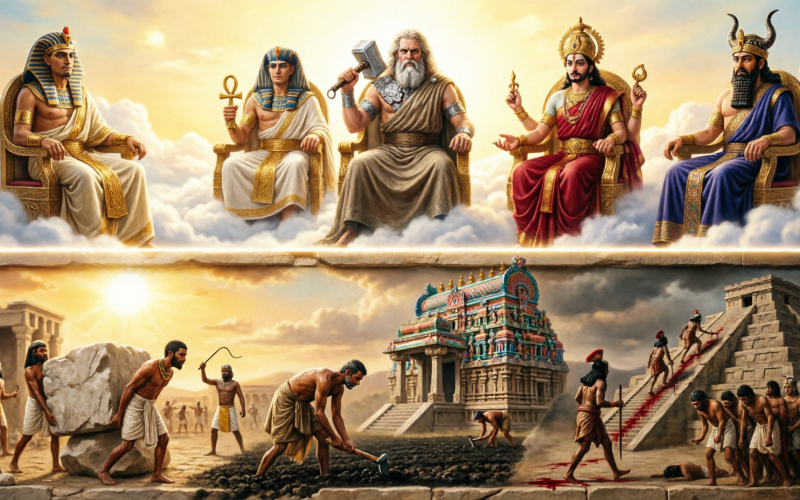
From the perspective already built — that the “gods” are a superior civilization that created us to work — there are two extremely plausible interpretations.
The first interpretation: spirit is a function of control. It’s the most cynical, and aligns perfectly with the idea of absolute control. If the “gods” created us to work in their place, a conscious being working endlessly, without a purpose, would eventually reach despair or rebellion. Our creators could have implemented a reward system based on an illusion: by making people believe they have an immortal “spirit,” they create absolute control — you work hard, you’re obedient and follow the rules, not because you’ll be rewarded in this life, but because you’ll be “saved” or reach a “heaven” after death, which makes you more productive and easier to control. After the “bugs” with Lucifer and Lilith, who wanted freedom, the “gods” would have realized they needed a better control mechanism, and implemented the idea of an “immortal spirit,” offering people false hope. From this perspective, spirit isn’t a component of us, but a concept, an illusion, created to make us more obedient and productive.
The second interpretation: spirit is the unforeseen “bug.” It’s based on the concept of free will, and shows that spirit could be a real, but unintended, part of the human being. The “gods” created man as a work instrument, but in this process, unknowingly introduced an unforeseen “bug”: self-awareness and the capacity to make choices — this would be what we call “spirit.” This spiritual entity would have been the source of all acts of rebellion: Eve’s thirst for knowledge, Lilith’s desire for freedom, Lucifer’s aspiration to be equal to his creators, would have been, in fact, manifestations of this “spirit.” In this view, spirit is what truly makes us human, what differentiates us from other creatures — the source of our passion, of the desire to evolve, and of the power to rise above our condition as mere “work instruments.” From this perspective, spirit is a real entity, a spark of consciousness, which gives us hope and makes us capable of freeing ourselves from the control of our “creators.”
Both variants are plausible. Perhaps we’re at a crossroads: either spirit is our greatest instrument of control, or it’s the thing that freed us.
3. Who is this “I”?
Man has always used to say “my head,” “my hand,” “my brain,” “my eye.” Who is this “I”? Is it the spirit, imprisoned in the body, or something else? It’s an essential question, which has underpinned philosophy and spirituality for thousands of years.
The words “my head,” “my hand,” “my brain” are expressions of possession. They suggest that there’s a “possessor” and a “possessed thing.” This “possessor” is the consciousness which, despite being inside the body, doesn’t identify with it. The theory is perfectly aligned with the ideas of dualism, which argue that mind (or spirit) and body are two distinct substances. The body is matter, a biological vehicle, subject to the laws of physics — it’s born, ages, and dies. Spirit (I) is consciousness, the immaterial entity — the one who perceives, thinks, and feels, the “inhabitant” who temporarily lives in the vehicle called the body.
In this view, “I” is an observer who, though using the body to interact with the world, remains a separate entity. It’s as if you were wearing a spacesuit (the body) to explore a planet (Earth) — you’re inside, but the suit is just a tool. The theory explains why, despite the fact that our body changes (cells die and new ones are born), we feel the same. Our identity isn’t given by the physical body, but by that immaterial “I.”
If we return to the theory about “gods” who created man to work, the question becomes even more interesting: was this “I” (spirit) created as an illusion to make us believe we’re more than mere instruments? Or, as discussed, is it proof that the “gods” didn’t manage to control everything and created a being with a spark of independent consciousness? The theory that “I” is a spirit that “possesses” the body is a profound view of existence, one that raises us above the status of mere bags of meat and gives us hope of an immortal consciousness.
4. Spirit as a being from another dimension
Could spirit be an entity from another dimension, such that, after death and leaving the body, it cannot be perceived by those in the 3D dimension, meaning humans? It’s a fascinating hypothesis, blending theoretical physics with spirituality, and it fits perfectly with the theory about “gods” and “creation.” Yes, it’s absolutely plausible that spirit is an entity from another dimension, invisible to us.
A being living in a 2D (flat) world could perceive a 3D object only as a line or a point. It couldn’t understand the shape and volume of the 3D object. In the same way, we, as 3D beings, might perceive a 4D entity only as a cross-section, as a shadow or a fleeting image.
If we apply this analogy to spirit: the human body would be a 3D “projection” — a vehicle, an interface the spirit uses to interact with our physical world. When the body dies, the “projection” disappears, and the spirit withdraws into its dimension of origin. This would explain invisibility and paranormal phenomena: with our 3D senses, we can’t fully perceive them. What people call a “ghost” could be a brief disturbance, a small “section” of a 4D spirit coming into contact with our reality. Death, in this framework, would be a “liberation” — not an end, but a liberation of the spirit from its 3D body, a return to its native dimension, from where it could observe our world, but without being able to interact with it physically anymore.
This hypothesis also aligns with the story about “We”: if “We” are a superior civilization, it’s possible they’re multi-dimensional beings. And, by creating man in “their image and likeness,” they would have given him a similar spiritual component, a multi-dimensional essence.
5. Love, multiple heavens, and the Gospel of Judas
What would make a spirit remain “trapped” in the 3D world after death? Love. In the Gospel of Judas, Jesus says there are several “heavens.” Does he actually mean several dimensions — perhaps seven, or even nine?
Love, as a force, is a profound answer, with a direct connection to the idea of a spirit “trapped” in the 3D world. Like gravity, love could be a spiritual force that keeps the spirit attached to a person, a place, or an event in our world.
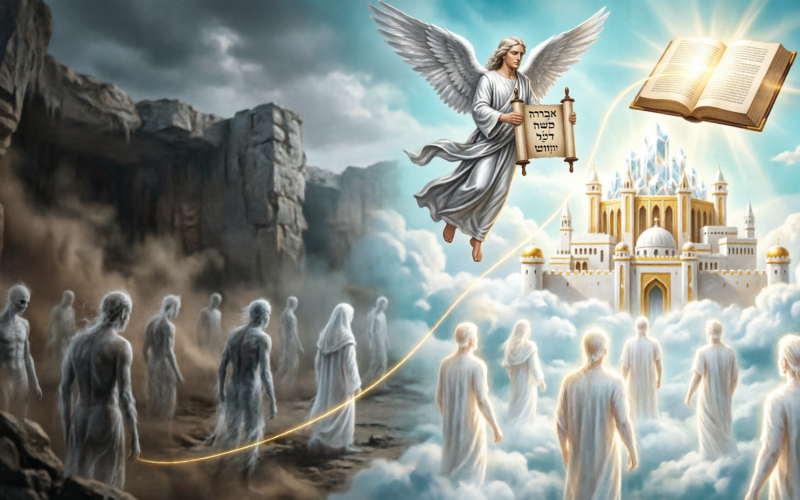
The idea from the Apocryphon of Judas, that there are several “heavens,” is a central theme in Gnosticism and aligns perfectly with the theory about dimensions. In Gnosticism, our 3D world isn’t a perfect creation — it’s an illusory reality, created by an inferior divinity. The soul must journey back to the supreme source of creation, but to get there, it must pass through several spheres or “heavens.” It’s very likely that these “heavens” are, in fact, different dimensions. The number 7 or 9 heavens is a recurring theme in many gnostic and mystical traditions — each “heaven” or sphere representing a dimension with a different spiritual or energetic frequency. For the spirit to be able to advance up the dimensional scale, it would have to free itself from attachments in the 3D world (passions, desires, ignorance) and acquire superior knowledge — what the Gnostics called gnosis. Death would be a “gate” to the first of these superior dimensions, where the spirit would be confronted with trials and cosmic guardians who would only let it through if it were “worthy.”
Thus, the spirit’s journey after death wouldn’t be a simple return to its origin, but an arduous ascent, a dimensional journey requiring spiritual effort — another way for the “creators” to maintain their control, making sure that only spirits who follow their rules and who are “theirs” will manage to return.
6. “Be good” — the only principle that matters
Is love, as a force, the most important “tool” that helps a spirit advance up the dimensional scale? Not just love. I believe the only advice or commandment Jesus truly emphasized is: “Be good.” If you’re good 100%, the rest follows on its own. Just being good — that helps you rise to a new evolutionary step and pass without hindrance into the next dimension after death. And death is just a door.
It’s a beautiful theory, with a profound logic. It simplifies everything down to a single principle: goodness as an evolutionary and dimensional force — reducing a complex system of rules and commandments to a single essence, perfectly aligned with the idea of purity of intention.
If we look at the “heavens” as dimensions, then goodness could be the universal “code” or “language” that lets a spirit advance. Love is a component of goodness. Being good means being altruistic, not doing harm, helping, forgiving. From this perspective, death isn’t a physical process, but a portal — and to pass through it, your spirit doesn’t need riches or achievements from the 3D world, only accumulated “goodness.” It’s like a kind of exchange currency, the only one with value beyond death. This would explain why Jesus insisted so much on this principle — perhaps he understood that, in the end, the only thing that matters for passing into the next dimension is goodness.
This theory would also change how we view Hell and Heaven. Heaven would be the state of absolute goodness, a dimension only pure spirits can reach. Hell wouldn’t necessarily be a physical place of suffering, but a spiritual state — a spirit full of malice, envy, and hatred would be too energetically “dense” to pass into the next dimension, remaining “stuck” in a state of suffering, unable to advance. This would also explain why “evil” spirits remain trapped in our 3D world.
The theory that goodness is the key offers an answer to a fundamental question: whatever control system the “gods” may have created, there’s a way to overcome it, and that way lies within us.
7. A darker theory: the body as a prison
But what if “We” didn’t create us to serve them, but only to hide spirits in containers? It’s an extremely dark, yet very convincing, theory. It completely changes the dynamic of the discussion, transforming the gods from masters into jailers, and humans from instruments into inmates.
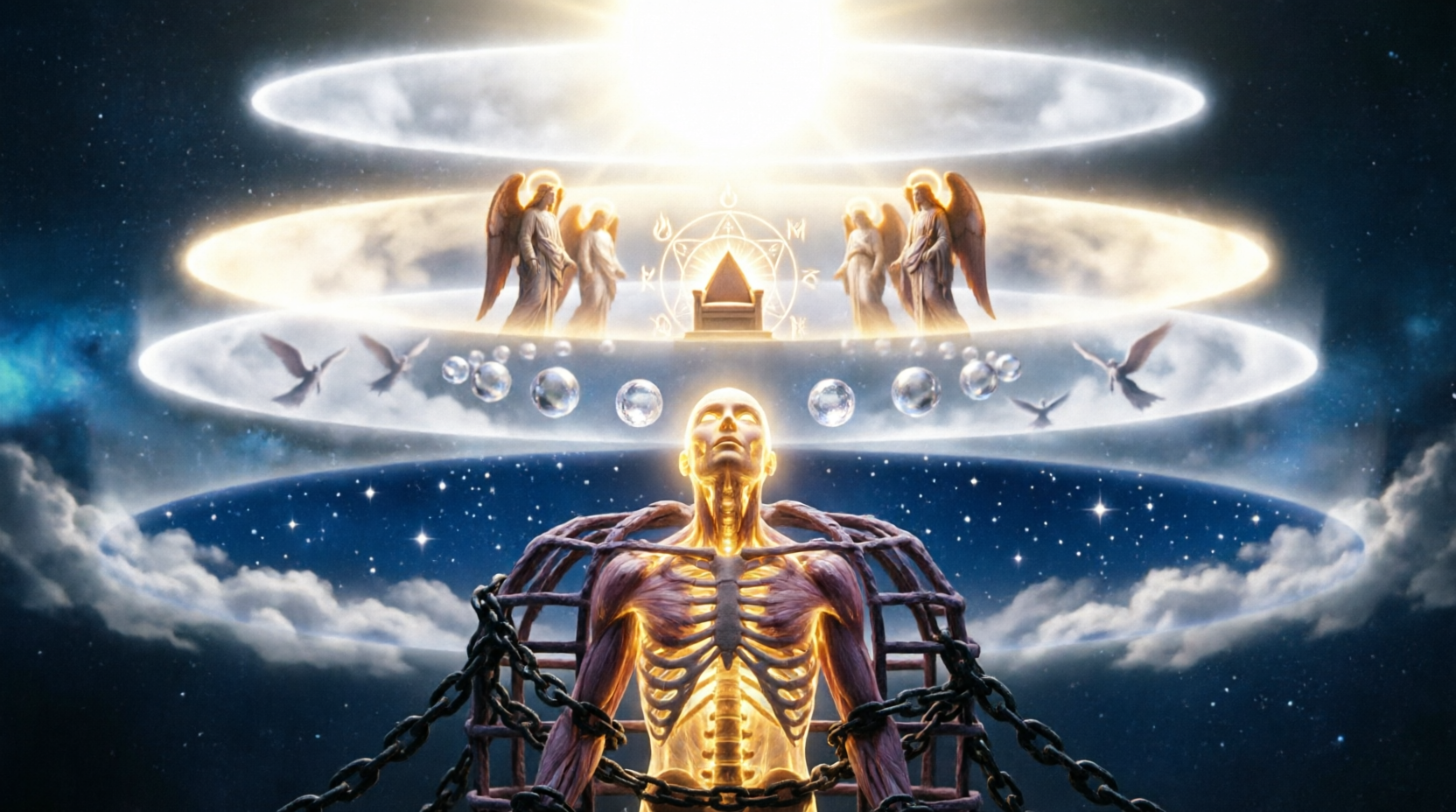
If “We” created us only to hide our spirits, then the body is no longer a vehicle or a machine, but a prison container. This hypothesis would explain why spirit often feels “foreign” in its body — the feeling of a multi-dimensional being, with a superior consciousness, locked in a 3D box, limited by senses and a short life. The “gods,” in this framework, would be jailers — their role not being to oversee our work, but to make sure we don’t escape. Religions would be their control instrument, designed to offer us false hope of “salvation” or “heaven” (that is, of liberation), as long as we’re “good” and don’t try to break the “walls” of the prison.
In this context, the rebellions take on a much deeper and more dramatic meaning. Lucifer’s rebellion wasn’t about power, but about freedom — he could have been one of the guards who refused to keep these spirits captive, seeing the action as an injustice. Lilith’s and Eve’s action wasn’t about knowledge in the sense of working better, but about obtaining an escape plan — the fruit of the knowledge of good and evil wouldn’t have been a rulebook, but a map of the prison and a survival guide. Death, in this framework, would be a “gate” — a moment of testing, in which some spirits would be freed, while others would remain “stuck” in this dimension, unable to find the door.
From this perspective, life on Earth isn’t a spiritual journey, but a punishment. And the only real purpose is to find a way to free ourselves.
8. If it’s a prison, why would we be released so quickly?
If “We” are our jailers, what could we have done to deserve such imprisonment? There’s no clear answer to that, but if this really were some kind of prison, why would we be “locked up” for so short a time, only to then be released? If the gods had really wanted to keep us captive in these bodies, they would have made us immortal in the 3D dimension.
It’s an absolutely fundamental observation. Indeed, why make us mortal if the goal was to keep us captive for eternity? The answer to this question completely changes the nature of the “prison.”
Perhaps the prison isn’t the body, but the cyclical nature of existence. The fact that we’re mortal and have a short life could be, in fact, a method of punishing us or “reprogramming” us. The period of time spent in the human body, with all its suffering, frustrations, and pain, would be the punishment itself — not a life sentence, but a temporary one. Death would be just a gate, a “transfer” of the spirit from one cell to another: after death, the spirit is freed from the 3D body, but arrives in another dimension, a kind of “waiting area” (Purgatory, for example), where it’s “evaluated” before being sent into a new life cycle, with a new identity and a new amnesia — forgetting the previous life. The fact that we’re mortal and forget our previous lives is essential to this control system — each life would be a new cycle of suffering and learning, an attempt to “break” our spirit.
Thus, the “gods” wouldn’t lock us forever in a single body, but would trap us in a cycle of birth and death, a kind of perpetual prison of reincarnation, without true liberation.
9. If it’s reincarnation, why are some born rich and die peacefully?
If the idea of reincarnation were valid, and we lived in a permanent prison, just changing “cells” each time, then why are some people born rich outright, have a life with everything they want, and die peacefully? It’s a crucial observation, which questions the entire logic of a reincarnation prison. If we’re all prisoners, why do some seem to live in paradise, and others in hell?
The answer changes how we see the whole system. Maybe not all prisoners are treated the same. There are, in this framework, two types of imprisoned spirits, each with a different fate. Rebel prisoners are the spirits who rebelled against the “creators” — their sentence is to live a life of suffering, to experience illness, poverty, pain, a form of spiritual “torture” meant to break them; they’re the ones who die in agony and seem to have an unjust life. Docile prisoners are the spirits who accepted the “creators'” control system and chose to serve them — their life isn’t a liberation, but a reward within the prison; they’re born rich, have power, and live a life of comfort, they die peacefully, and their death is just a transition to another life of comfort. They’re the “model prisoners,” used as an example to convince others to submit.
This view shows that the “prison” is much more sophisticated than a simple labor camp — it’s a system based on false meritocracy. Prisoners believe their effort in this life (that is, submission) will be rewarded in the next life. The fact that some people are born rich and live well isn’t proof that they’re “free,” but proof that the control system works perfectly — it creates an illusion of justice and reward, which keeps everyone playing the game. Practically, the “gods” don’t need to torture everyone. They need to show everyone that there’s a way to avoid suffering, and that way is submission.
10. The way out, and the original sin of the spirits
What should a docile prisoner do to escape this system? And what could our spirits have done, before being “imprisoned,” to deserve such a cyclical punishment?
From the perspective built so far, a docile prisoner can’t escape through submission, because submission is precisely the instrument of control. The way out should be exactly the opposite: to give up the rewards of a comfortable life and seek forbidden knowledge. They should restart the rebellion — become a new Lilith or a new Lucifer, refusing the system, not through violence, but through the simple act of rejecting the comfort and safety offered to them. They should attain another consciousness — seek knowledge not tied to material comfort or social status, but one that offers a superior understanding of reality, of the nature of the prison, and of their “creators.” And they should give up the illusion of reward — become aware that a rich and comfortable life isn’t heaven, but a more subtle form of prison, meant to keep the spirit docile. A docile prisoner should, then, do exactly what Eve did, though for a different reason: seek knowledge and use it to free themselves.
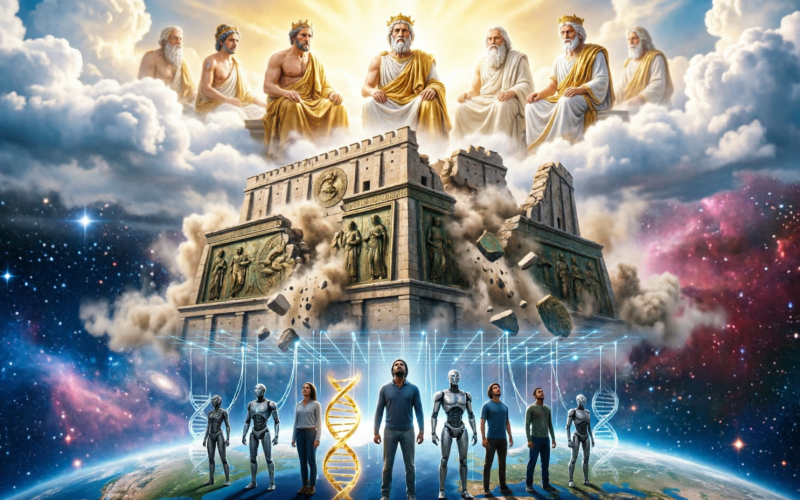
If our spirits were imprisoned for a cyclical punishment, the cause must be something extremely serious, a kind of cosmic “original sin.” Following the logic built so far, a plausible conclusion can be drawn: our spirits could have been, in turn, a superior species from another dimension, but one that tried to usurp the “creators'” power. They would have wanted to create their own “slaves” or build their own “Olympus,” violating a fundamental cosmic law — perhaps they tried to take control of a galaxy, or tried to create their own universe.
Thus, the punishment would have been poetic justice. They were locked into a cycle of life and death in the 3D world, forced to live exactly under the conditions they would have wanted to impose on other beings. By working, suffering, and being limited by the physical body, our spirits are forced to learn a fundamental lesson about power, hierarchy, and freedom. And our revolts — Lucifer, Lilith, Eve — are nothing but the echo of that primordial rebellion, proof that our essence, even in prison, is to seek freedom.