Or: the fog that thins and the cloth that stays dyed
The quotations render the sense of the Coptic; translations differ from edition to edition.
Why these two texts. The Gospel of Truth is in Codex I, Philip is in Codex II — the Valentinian line, the philosophical branch of the jar. If the Apocryphon drew the map and Thomas gave the voice, these two texts give the experience: what happens inside the one who wakes (Truth) and what remains in him after the waking (Philip).
1. The fog: anguish thickened
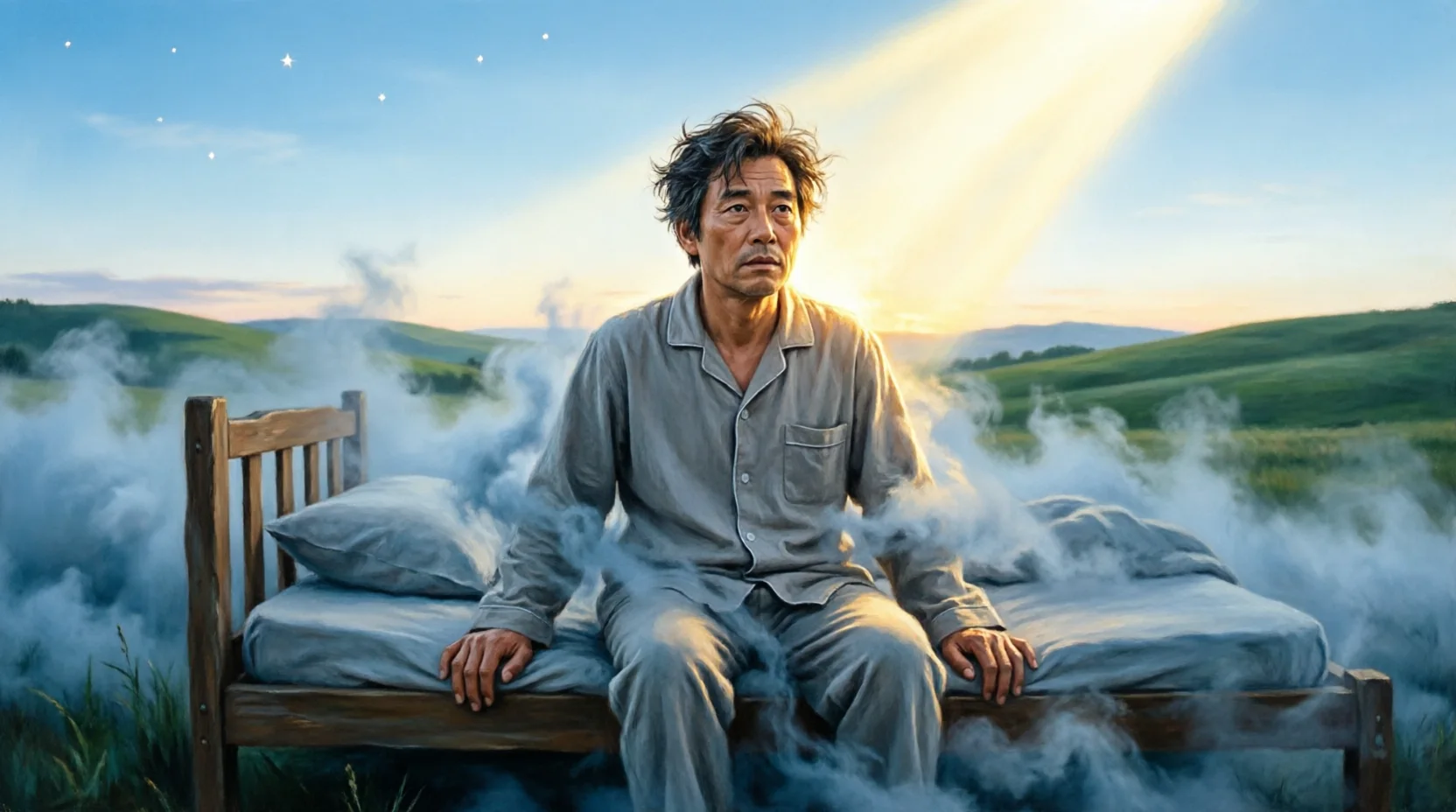
“Ignorance of the Father brought about anguish and terror; and the anguish grew solid like a fog, so that no one was able to see.”
Commentary: The most precise definition of the farm in the whole jar: not walls, not chains — fog. The apparatus does not lock you in; it makes you unable to see. And the fog is not made of matter, but of ignorance — of the absence of knowledge. So the way out is not a door, it is a knowing. The smokescreens we keep talking about have their theological ancestor here: the farmer’s fence is epistemic, not physical.
2. The nightmare: salvation as waking
“They are like a man having a nightmare… when he wakes up, he sees that it was nothing.”
Commentary: Exactly what I lived through: life is the dream, reality is afterwards. The text does not say the world is evil — it says it is nothing: an image without substance. The nightmare is not fought, it is woken from. And the one who wakes does not take revenge on the nightmare — he stops feeding it. It is the same mechanism as with the hamster wheel: you do not argue with the fog, you open your eyes.
3. The error and the copy
The world born of error, as a defective copy of the things above.
Commentary: The kenoma as a bad render. The demiurge copied the Pleroma without understanding the original; the farm is a low-resolution rendering of reality. The one who wakes sees the pixels — and that is why he can no longer be enchanted by the spectacle: he has seen the set as a set. The sleight of hand from Chapter 23 gets its foundation here: one thing is what you see, another is the truth, because what you see is a copy.
4. The dyer: impregnation, not rescue
“God is a dyer. Just as the good dyes, which are called ‘true’, dissolve with the things dyed in them, so it is with those whom God has dyed: they become immortal through his colours.”
Commentary: Salvation is not being taken out of the world — it is being impregnated with colour. The dyer does not tear the cloth out of the vat; he lets the colour soak in until it can no longer be washed out. The awakened man looks like everyone else — but he is dyed. This is the difference between religion as escape and gnosis as impregnation: you do not flee the vat, you let yourself be dyed in it. And the colour does not show on the banner — it shows in the weave.
5. The inseparable brothers
“Light and darkness, life and death, right and left are brothers of one another. They cannot be separated.”
Commentary: Philip refuses the binary war. The apparatus lives off the war of opposites — teams, flags, us against them. The text says the opposites are brothers: two hands of the same body. The awakened one no longer fights the darkness; he sees it as the left hand of the light. And the war was the slot machine: the moment you stop fighting, you stop paying. The wheel stops not when you break it, but when you stop running in it.
6. The companion and the chamber
Mary Magdalene as koinonos — the companion; the kiss; the bridal chamber as the place of union.
Commentary: The institutional line erased the feminine; Philip restores it as the counterpart. The Pleroma is not “I”, it is “WE” — again, as with Barbelo in Part 1. And the bridal chamber is union without a mediator: the spark and the light join with no witnesses. The apparatus wants a civil register and a queue at the counter; the text offers a chamber you enter alone, with the living one.
7. The unspoken name
“The name of the Father is the Son.” The one who has the name does not pronounce it — he carries it.
Commentary: The true name is not shouted — it is lived. The apparatus prints names on banners and demands they be repeated; the awakened one carries the name in silence. Once again silence as the language of freedom — the same pair from the far end of the map: the Depth and the Silence.
8. The red threads, once again
- The administrator is not the Source — the fog is his work; the Source is the dawn behind it.
- Salvation is waking, not sacrifice — the nightmare is not fought, it is woken from.
- The spark is dyed — the colour soaks in and never comes out.
- Calm and silence are the frequencies of freedom — the one who wakes does not argue with the fog.
The honest note, as always: a map, not a proof. But a map that describes, from the inside, exactly the state I went through: the waking, the fog thinning, the real landscape.
Part 6 follows: Zostrianos, Allogenes, The Three Steles of Seth — the ascent. The jar is open.