Or: what the texts themselves say, with no interpreter between us
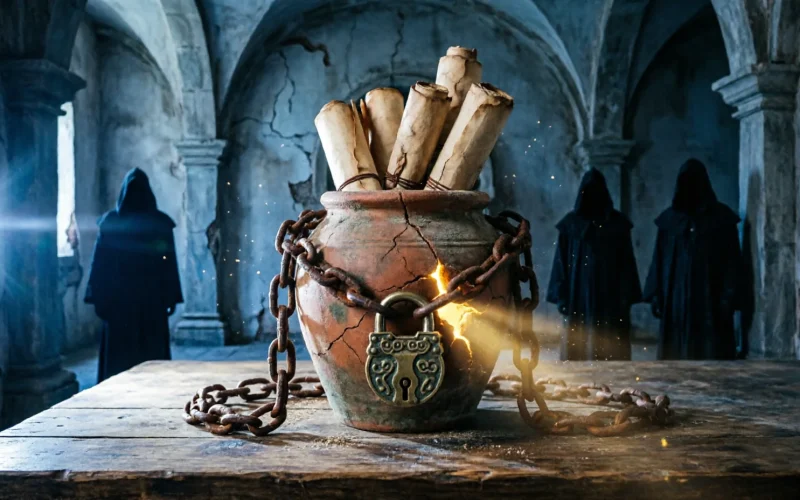
Until now I have spoken about the jar through others: through the men who hid it, the men who locked it, the men who opened it. Now I open it and let the texts speak for themselves. I read them in Geza Vermes’s complete translation — not the Church’s interpretation, not the experts’ “consensus”, but their own voice.
It is worth knowing whose hand we are reading through. Vermes was not part of the team that held the lock — they never let him in, although he was as competent as any of them. In 1970 he was one of fourteen British scholars who signed a letter in The Times against Allegro, after that book about mushrooms. And seven years later he ended up saying, in his own words, exactly what Allegro had said about the delay — and was ignored just as thoroughly.
When even the man who signed against the first one to shout ends up shouting himself, and still nobody listens, it is clear the argument was never the point. So let us listen to what is inside.
1. Not a monastery of quiet men
We were sold the image of peaceful mystics, cut off from the world. The texts say otherwise.
The War Scroll speaks of the sons of light against the sons of darkness, and the final enemy is the Kittim — who have a king. A king, not consuls: that is imperial Rome, not the old republic. And the Habakkuk Commentary adds the detail that closes the argument: the Kittim “sacrifice to their standards and worship their weapons of war”. Roman soldiers sacrificing to their standards — Josephus describes exactly this practice at the fall of the Temple, in the year 70. Under the republic it would have made no sense: victorious troops sacrificed to the gods. Only once the emperor himself becomes a god does his image on the standard receive the offering.
To the texts add the ruins: a tower with thick walls, a forge for tools and weapons, arrowheads. And some fifty kilometres to the south, at Masada, the same texts were found and the same solar calendar — and under the floor of the synagogue, a copy of Ezekiel’s prophecy of the dry bones: “I will open your graves and bring you up out of them.”
That would be the logic of the mass suicide at Masada: for the righteous, death is a passage. I say “would be” because the only source for that suicide is Josephus, and the excavations have not turned up the remains that would confirm it. It stays an account, not an established fact. These people were not fleeing the world. They were waiting for the war of the end.
2. The two spirits
The Community Rule reads: “He created man to govern the world, and appointed for him two spirits in which to walk until the time of His visitation: the spirits of truth and injustice… all the children of righteousness are ruled by the Prince of Light and walk in the ways of light, but all the children of injustice are ruled by the Angel of Darkness and walk in the ways of darkness.”
That is not my grid. It is their experience, written down two thousand years ago. Light and darkness, a Prince of Light and an Angel of Darkness — I invented nothing; I only translated into today’s words what they saw. When I speak of the Observer and the farm, I am speaking their language, only two millennia younger.
3. The poor
Now open the Gospel: “blessed are the poor in spirit, for theirs is the kingdom of heaven”, “blessed are the meek, for they shall inherit the earth”.
And in the jar, the commentary on Psalm 37: “interpreted, this concerns the congregation of the Poor”. “The Poor” was one of the names they used for themselves. And also from the jar, from the War Scroll: “among the poor in spirit there is a power”.
The same words, the same unusual expression. Jesus did not speak out of nowhere. He spoke the language of this movement.
4. The meal that explains the meal
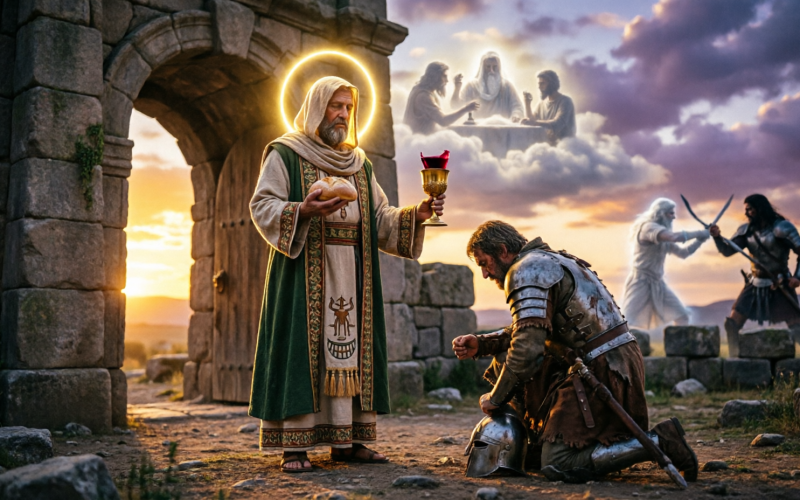
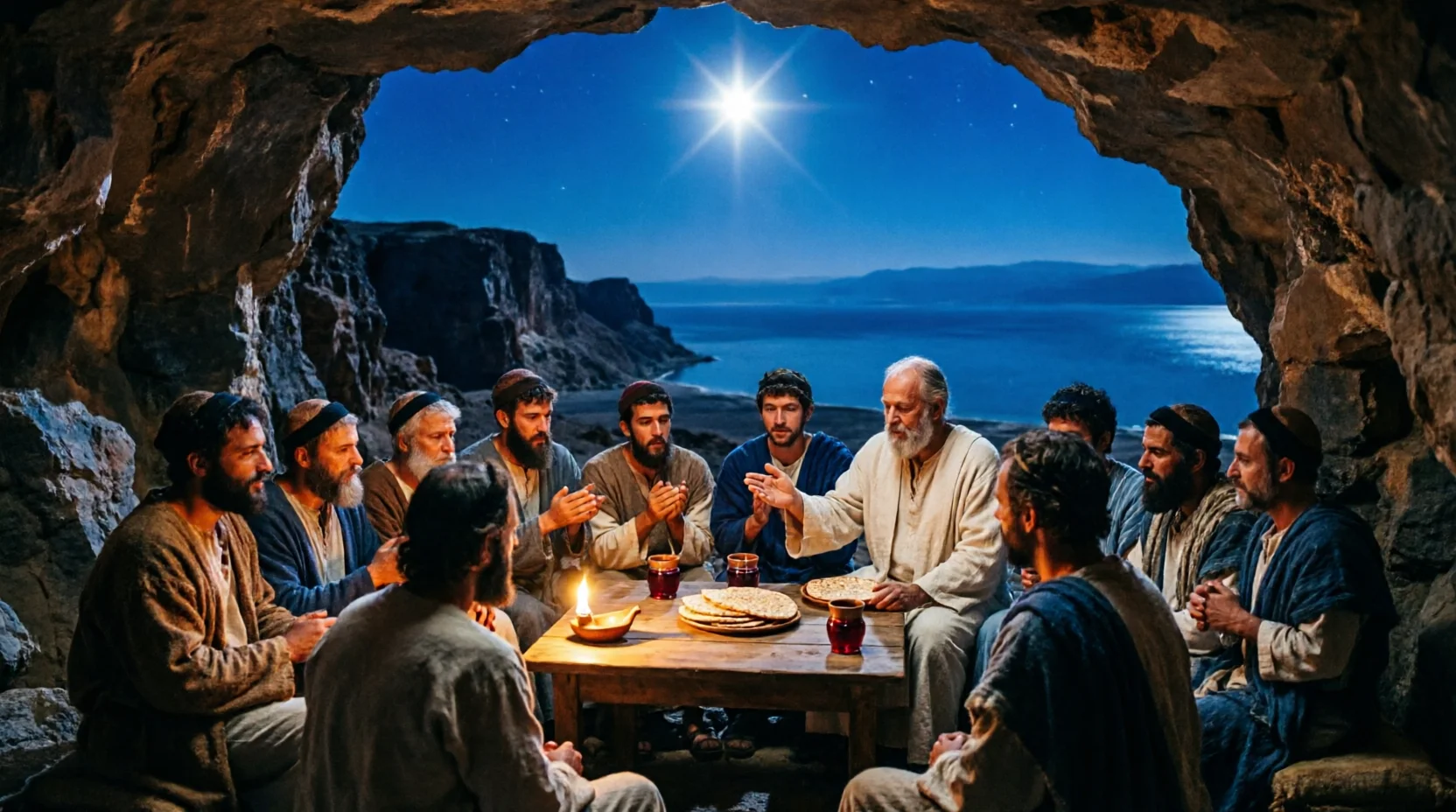
The Community Rule: “when the table has been prepared for eating, and the new wine for drinking, the priest shall be the first to stretch out his hand to bless the first-fruits of the bread and new wine.” And the Messianic Rule adds that no man shall extend his hand over the bread and wine before the priest, “and thereafter the Messiah of Israel shall extend his hand over the bread.”
Read the Last Supper after that and you understand: it was not invented out of nothing. It is the community’s table, in the community’s order.
And the calendar explains the quarrel between the Gospels over which day the meal took place. The community used a solar calendar — 364 days, the feasts always on the same day of the week. The Temple used a lunar one. Jesus would have kept Passover on the desert’s calendar, the priests on the Temple’s. In that case the Gospels do not contradict each other: the calendars do. This is Annie Jaubert’s hypothesis and it is not the academic consensus — I offer it as a possible explanation, not as a settled solution.
And the part that amuses me most: Rome admitted this too. Cardinal Jean Daniélou wrote, with the Vatican’s approval printed in the book, that “Christ must have celebrated the last supper on the eve of Easter according to the Essene calendar.” A cardinal publishing this with a nihil obstat does not mean the Vatican endorsed the hypothesis — it only means it was not judged heretical. But even that is not nothing.
5. Twelve and three
The Community Rule: “in the Council of the Community there shall be twelve men and three priests, perfectly versed in all that is revealed of the Law.”
Open the New Testament: twelve apostles, and three pillars — James, Cephas and John. The same architecture. Not a coincidence, not a borrowed number: it is the movement’s pattern. When you see the same plan in two places, it is not plagiarism. It is the same builder.
6. The Doers of the Law
The community called itself many things: “keepers of the covenant”, “the sons of light”, “the poor”. But one name matters more than all of them: Osei ha-Torah — the Doers of the Law. Their plural form, Osim, is, as Eisenman shows, the very source of the word “Essenes”. In other words: the name by which everyone knows them does not mean “the withdrawn” or “the pious”. It means those who do.
Now listen to Jesus: “think not that I am come to destroy the Law or the Prophets: I am not come to destroy, but to fulfil. For not one jot, not one tittle shall pass from the Law.” The Doer is speaking.
Later Paul comes along and says: a man is not justified by the works of the Law, but by faith. The fork.
And their penal code said that atonement is made “by the practice of justice and by suffering the sorrows of affliction”. Justice, not blood. “Be good” — the same frequency I have been writing about for two years.
7. The sentence Paul took
The Habakkuk Commentary: “The righteous shall live by his faith. Interpreted, this concerns all those who observe the Law in the House of Judah, whom God will deliver from the House of Judgement because of their suffering and because of their faith in the Teacher of Righteousness.”
Look carefully at what it says: faith and keeping the Law, together. Suffering and faith, together. Paul took the sentence — “the righteous shall live by faith” — and cut off its condition.
That is the whole hijacking, at the level of a single sentence. Out of a road with two legs he made one with one.
8. The law of the king who may not marry his niece
The Temple Scroll sets out the law of the king of Israel: he shall not multiply wives, he shall not marry his niece. Most of the prohibitions there are old, from Leviticus. This one is new.
And it is a knife. The Herodians — the puppet kings installed by Rome — married nieces as a matter of course: Herodias married her uncle, and so did Bernice, the sister of King Agrippa II. The law is written precisely against them, precisely in their epoch.
The jar was political. The community was not hiding from the world; it was opposing the power of the world.
9. The star
The Damascus Document says that the star is the Interpreter of the Law who is to come, and the sceptre is the Prince of the congregation — starting from Numbers 24:17: “a star shall come forth out of Jacob, and a sceptre shall rise out of Israel.” The War Scroll invokes the same prophecy.
Sixty years later a man rises against Rome calling himself “Son of the Star” — Bar Kokhba. And in the Christian tradition, the same star appears above Bethlehem.
One single prophecy, circulating through the whole movement. The star of the awaited leader. Not three wise men with gifts: a mobilisation signal.
What the jar says, in one breath
The administrator is not the Source: the Prince of Light rules the sons of light, but above them both stands the God of knowledge, who created them both.
Salvation is doing and waking, not sacrifice: atonement is made through justice and through the patient bearing of affliction. Justice, not blood.
The spark is from elsewhere: they called themselves “the poor”, “the sons of light”, “the keepers of the covenant” — not the owners of the truth, but its guards.
The Jesus who comes out of the jar is neither the pacifist god sold by the Apparatus nor some ordinary monk. He is a teacher inside a movement that took the Law seriously, expected the Kingdom now, and was not afraid of Rome.
And the last line, the one that ties it all together: the righteous shall live by faith — but a faith that walks together with doing. James’s line. The line of “be good”, not just “believe”.
Honest note, as always: the identifications (the Teacher = James, the Liar = Paul) and the derivation of “Essenes” from Osei ha-Torah remain Eisenman’s hypotheses, contested by other specialists. But the texts quoted here — the two spirits, twelve and three, the meal, the solar calendar, the congregation of the poor, the star, the cut sentence — are not hypotheses. They are written down, and anyone can check them in the complete translation. The hypothesis is the map; the texts are the ground.