1. The Creation of Man in Atrahasis — a Technical Solution to a Labor Problem
It’s worth going into detail on how Atrahasis (the Old Babylonian version, ~1700 BC, preserved partially on clay tablets, the most complete copy made by the scribe Nur-Aya under the reign of Ammi-saduqa) tells the story of the creation of man — with a “technical” precision surprising for an ancient religious text.
Tablet I starts from an unexpected premise: before man existed, heavy physical labor — digging the irrigation canals for the Tigris and Euphrates, maintaining the riverbeds — fell to the Igigi, the younger/lower-ranking gods, under the command of the Anunnaki. The text explicitly says they labored like this for 40 years. At one point, in the evening, the Igigi burn their tools and surround Enlil’s temple (Ekur) — a literal strike/revolt, the first one documented in human written literature. Enlil, frightened, convenes the assembly of the Anunnaki, and Enki (Ea) proposes the solution: create a substitute for the labor — man.
Here comes the technically most interesting part: it’s not just clay and breath, as in Genesis. The mother-goddess (called Nintu, Mami, or Belet-ili, depending on the tablet) needs Enki’s help for a specific ingredient — she sacrifices a god, named We-ila (in some translations “Geshtu-e,” literally “the ear/intelligence”), explicitly described as “a god who had ṭēmu” — an Akkadian word that simultaneously means intelligence, personality, reason, will. We-ila’s flesh and blood are mixed with the clay, and the text makes a deliberate pun: from the god’s flesh comes an eṭemmu — the Akkadian word for “spirit/ghost” (the same root as ṭēmu, intelligence). In effect, the tablet states explicitly that man receives part of the personality/spirit of a sacrificed god, so that it is never forgotten, through the generations, that he is made of divine matter.
Unlike Adam and Eve, here it isn’t a single couple that is formed but 14 pieces of clay at once — 7 “wombs” for men, 7 for women — and the midwife-goddesses (Nintu’s helpers) recite incantations for 10 months, after which the first humans are born, directly in seven pairs. The purpose is stated without ambiguity in the text: the recurring formula is “let them bear the yoke, the toil of the gods” (lullâ amēla… liššima abšāna) — man is explicitly made as a substitute instrument, so the Igigi can rest. There is no theological ambiguity here, as in Genesis — it is a technical solution to a labor-force problem.
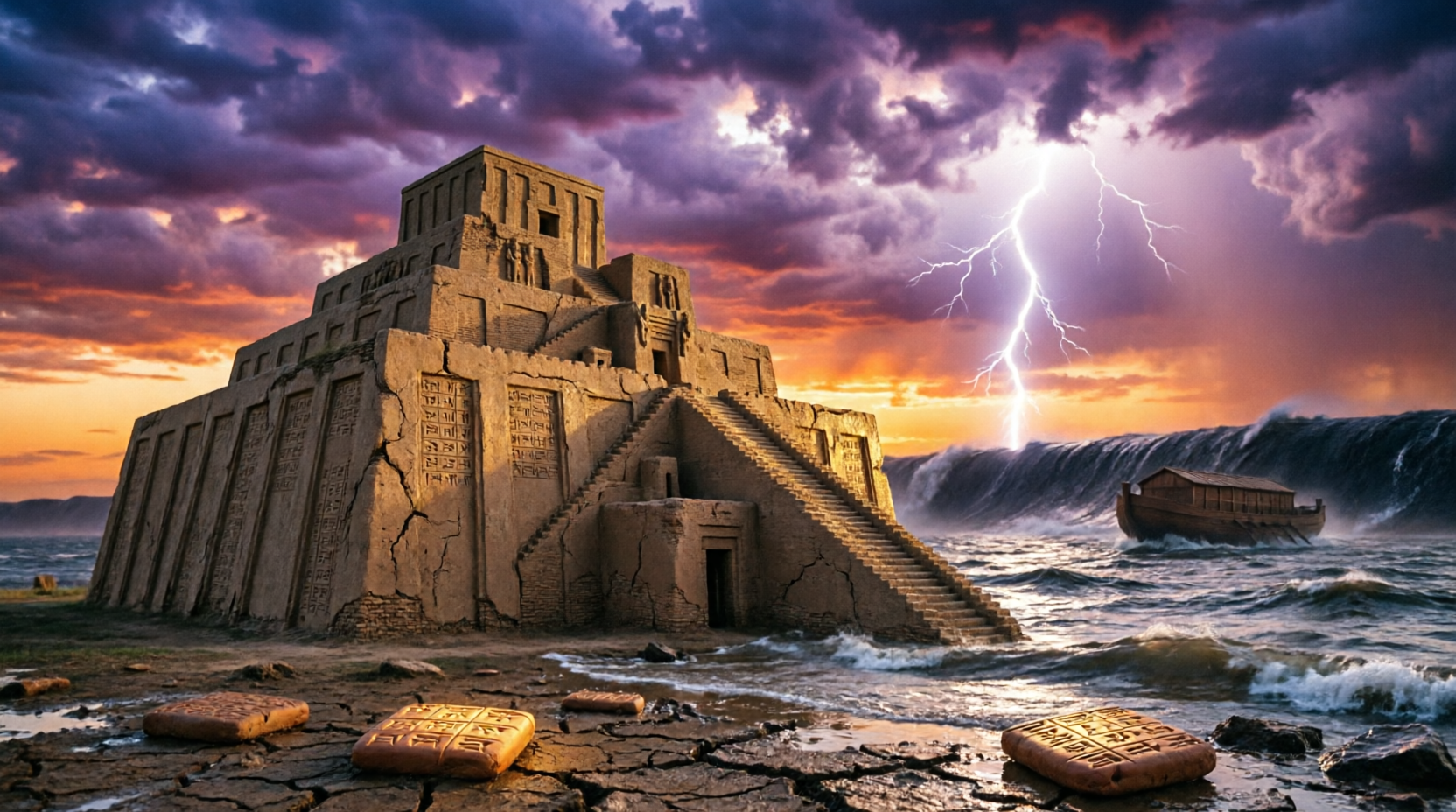
Tablets II-III bring the unforeseen problem: man multiplies too much and makes too much noise, disturbing Enlil at night. His solution is gradual — first plague, then drought, famine, and finally the Flood — with Atrahasis (the hero, the prototype of Utnapishtim/Noah) secretly warned by Enki to build a boat.
2. Ziusudra, Atrahasis, Utnapishtim, Noah — Four Names for the Same Story
It’s worth pausing here, because it’s easy to get confused: is Noah the same figure as the Mesopotamian flood heroes, or are these different characters, from different regions, who happen to arrive at the same goal — surviving the flood? The answer is clear: they are, in fact, four names for essentially the same story, not independent characters who coincidentally share the same purpose.
Three of them are Mesopotamian and represent the same figure across three successive textual traditions. The first is Ziusudra, the hero of the Sumerian Flood Story (the Eridu Genesis), the oldest layer, king of the city of Shuruppak, warned by Enki through a wall — the god is not allowed to speak directly to humans, so he whispers the plan to a wall, from behind which Ziusudra listens. The second is Atrahasis, the hero of the Akkadian epic of the same name, whose name literally means “Extremely Wise” — he is, in essence, the Akkadian translation/adaptation of Ziusudra, not a new character. The third is Utnapishtim, the hero of the Epic of Gilgamesh (Tablet XI, standard Babylonian version, ~7th century BC, found in Ashurbanipal’s library). His name means “he found life.” Gilgamesh seeks him out for the secret of immortality, and Utnapishtim tells him the story of the flood — a story taken almost word for word from Atrahasis, only now framed within a larger epic. So Ziusudra → Atrahasis → Utnapishtim are not three different men with the same fate — it is the same narrative, retransmitted and renamed over more than a millennium, from Sumerian into Old Akkadian, then into the standard Babylonian version.
This is where Noah enters, differently: the tradition in Genesis 6-9 is a separate Hebrew tradition, but not an independent one — the textual parallels are too exact to be coincidence. There is a secret divine warning, given to a single “righteous” man, to build a boat of precise dimensions; animals taken aboard; the boat comes to rest on a mountain (Nisir for Utnapishtim, Ararat for Noah); the release of birds as a test — Utnapishtim sends a dove, then a swallow, then a raven; Noah sends a raven, then repeatedly a dove — and this specific detail, in both directions, is hard to explain as independent invention; a sacrifice after disembarking, with the deity/deities “smelling the sweet aroma” of the offering, an almost identical phrasing in both texts; and a divine promise that the flood will never happen again.
The discovery of these parallels was, incidentally, a real historic moment: George Smith, in 1872, at the British Museum, was the first to translate Tablet XI of Gilgamesh and realized, shocked, how close it was to Genesis — he literally fainted from emotion in the archive, a documented episode. The honest conclusion is that these are not “two different characters, from two different regions, with the same purpose by coincidence” — it is most likely the same regional flood tradition, transmitted culturally from Mesopotamia to the Hebrew tradition (either through earlier Canaanite contact, or more directly during the Babylonian exile, 6th century BC, when the Jews were in Babylon itself and had direct access to these texts). Noah is the Hebrew adaptation of the same story, not a separately arisen version.
3. Not Four Simultaneous Floods, but a Single Chain Spanning Over 2000 Years
Wait a moment, though — I don’t think it’s quite that simple: are there four “heroes” with the same flood, in different regions and cultures, probably in the same period? No, this is exactly where the confusion lay — these are not 4 different civilizations, in 4 different regions, who had the same flood simultaneously and independently. It is a single chronological chain, in the same geographic region (Mesopotamia, the Tigris-Euphrates valley, present-day Iraq), spanning more than 2000 years, plus Israel, which picks up the story much later, at the end of the chain.
The real timeline runs as follows. Around 2900-2800 BC, a real flood occurred, archaeologically documented, at Shuruppak (present-day Tell Fara) and other Sumerian sites in the south: a thick layer of flood sediment, discovered by archaeologists, visibly separates the settlement layers from before and after. Not global, but a major regional disaster, traumatic enough to generate a persistent oral tradition. By the 17th century BC, the first surviving written version appears: the Sumerian tablet with Ziusudra (Nippur), copied during the Old Babylonian period, but reflecting a much older oral tradition, probably directly linked to the 2900 BC disaster. In the 18th century BC comes the Atrahasis Epic, in Akkadian, under the Hammurabi dynasty — essentially the same story, translated and adapted from Sumerian into the new dominant language of the region. Between the 13th and 7th centuries BC, the story is incorporated by the scribe Sin-leqi-unninni into the “standard” version of the Epic of Gilgamesh (Tablet XI), the most complete copy being the one found in Ashurbanipal’s library at Nineveh, around the 7th century BC.
Only in the 6th century BC, during the Babylonian exile, do the Jews enter the story — much later than all the others. The Jewish community was taken captive to Babylon itself, where texts such as Gilgamesh were still “classics” being copied and studied by scribes. Direct contact with these texts, exactly during the period when Genesis was being crystallized/redacted (the J and P sources, dated by academic consensus roughly within the 10th-6th century BC range, with the final redaction often placed right around the exile), explains why the parallels are so exact — including the very specific detail of birds sent to test the water level.
The direct answer, then, is that we do not have “4 heroes, 4 cultures, the same flood, around the same time” — we have a single Mesopotamian regional tradition, transmitted and successively translated (Sumerian → Old Akkadian → standard Babylonian), with Israel entering the chain last, at the very end, through direct cultural contact, not independently. It is not a coincidence of a universal human pattern, such as, for example, the “wolf eats the sun” motif for eclipses, which appears independently in cultures with no contact whatsoever — here we have, in fact, documented historical contact and a clear chronology of borrowing.
4. Cultural Borrowing or Identity Theft? What Was “Normal” in the Era, and Where Skepticism Remains Valid
This naturally raises the harshest objection: if that’s how things stand, then we are no longer talking about “borrowing” — we are talking about plagiarism, or even identity theft, of the story. It’s one thing to tell, in your own sacred books, about events that happened to other “nations” — describing what happened to them, as an example for your own people — and something else entirely to claim the whole story as your own, to create your own hero, to falsify the story by appropriating it. This is a distinction worth taking seriously, not mere rhetorical exaggeration, so it’s worth separating exactly what was “normal” for the era from what genuinely remains a real problem for the claim of “literal history.”
What the text actually says: Genesis does not say “such-and-such a flood story happened to the Babylonians.” It says Noah is Abraham’s direct ancestor, and thus of the Hebrews themselves — the genealogy continues explicitly, Noah → Shem → … → Abraham. So the objection is well-founded: this is not a description of “what happened to another nation,” it is a direct appropriation — a character from an older Mesopotamian tradition becomes the literary-genealogical grandfather of one’s own people.
But, to be historically fair, it must be said this was not an isolated or unique phenomenon among the Hebrews. This practice of “genealogical annexation” of preexisting stories and heroes was standard throughout the ancient world, not a dishonest invention specific to the biblical authors. The Sumerian King List does exactly the same thing, even more flagrantly: it chronologically combines dynasties from rival cities (Kish, Uruk, Ur), which in fact often ruled in parallel, not successively, into a single continuous line of “kingship lowered from heaven,” precisely to give unified chronological legitimacy to whichever city held power when the list was written. The Romans did exactly the same with Aeneas — a Trojan character from a Greek epic, essentially belonging to their cultural enemies, was transformed into the direct ancestor of Romulus and, through him, of the entire Roman people. The Egyptians and Assyrians did the same — every dynasty built genealogies that “absorbed” older figures and events, sometimes borrowed, as a form of legitimation. This mechanism was not considered “theft” or “plagiarism” in their own terms — there was no concept of intellectual property over a story; myths circulated as a shared cultural fund of the region, and each people adapted, translated, and re-attributed them freely, without it being perceived as fraud.
Where skepticism nonetheless remains valid: the fact that the practice was “normal” for the era does not change the conclusion relevant to our analysis. If you want to treat Noah as literal family history, as Abraham’s real ancestor, you cannot — because the character, the structure of the story, and even very specific details, such as the birds sent to test the water, are demonstrably borrowed from a much older regional tradition, existing more than a millennium before the Hebrews had any contact with it. It is a story adopted and re-attributed as one’s own genealogy, not an independent account of a real experience lived by one’s own people. So, in practice: it wasn’t “theft” by the standards of the era, but it remains, for our purposes — separating real history from constructed narrative — exactly the kind of “borrowing with a changed label” that deserves to be recognized as such.