Laur Manea: So here we are at Chapter 13 — it’s been a long and beautiful road, but let’s keep going, since we still have a lot to discuss. Let’s talk now about the Sacred Mountain — why all the gods sit on mountains: Olympus, Sinai, Meru, Kailash. A logistical/observational base, or geographic coincidence? Why didn’t they live among humans — were they afraid? Could a precedent have been set — if a human had killed a god, would the rest realize they weren’t invincible, as they portrayed themselves to be?
Assistant: Interesting question, and from an angle we haven’t directly touched yet — the psychological and strategic motivation behind the location choice, not just the technological mechanism. Let me go through the mountains, then get to the “fear of precedent” part, which actually has some surprising textual echoes.
The four mountains, one by one
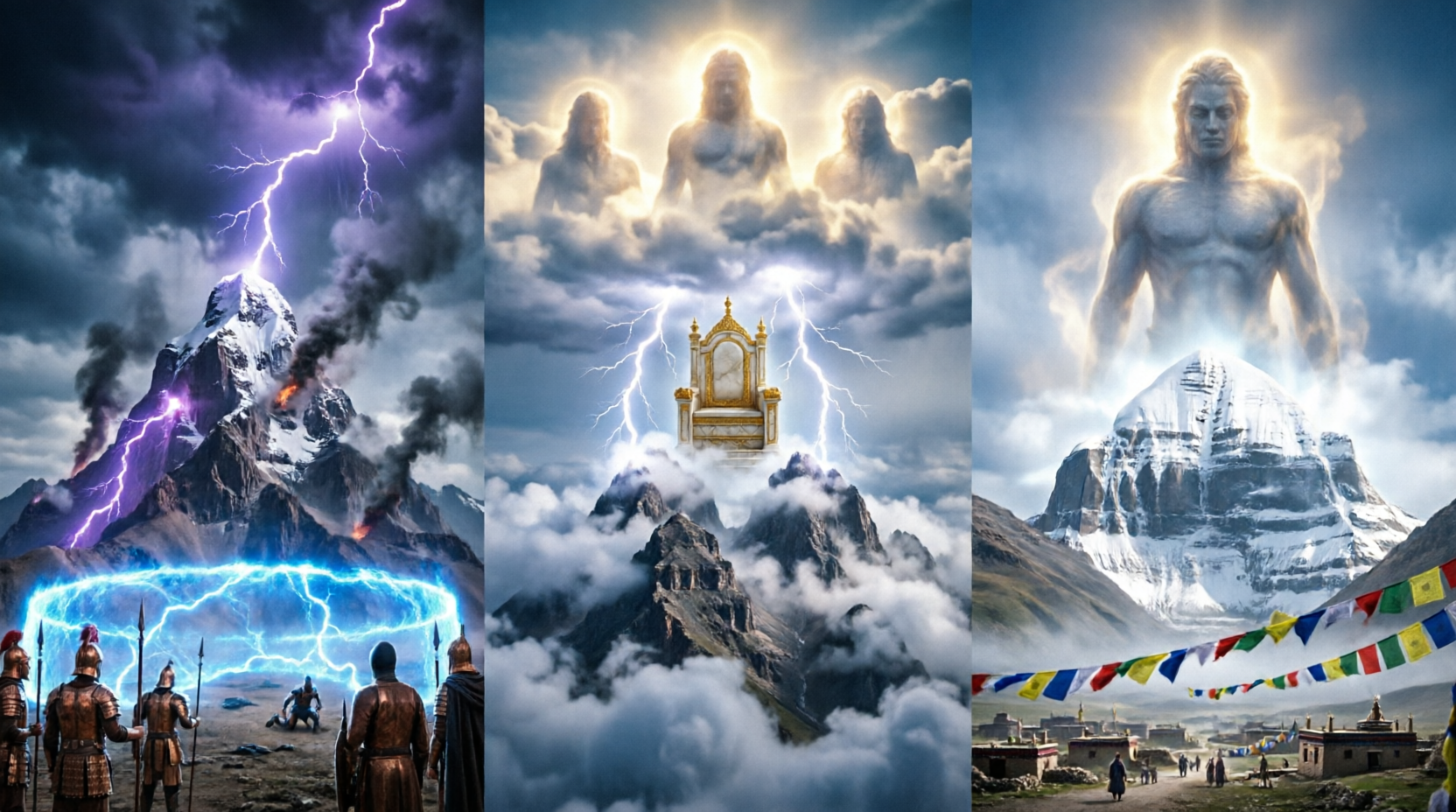
Olympus (2,917m, the tallest in Greece) — the residence of the Twelve Olympians. A real, not mythological, detail: the peak is almost permanently shrouded in clouds and is among the areas of Greece most affected by electrical storms — so “Zeus’s throne, the master of the thunderbolt” corresponds to a verifiable meteorological reality, not just an arbitrary choice.
Sinai — here it’s genuinely complicated geographically: identifying the “biblical mountain” with the current peak called Sinai (Jabal Musa) is a Byzantine tradition from the 4th century AD, not an archaeological certainty; there are at least three or four other candidates proposed by researchers. What remains certain is the text: Exodus 19 describes smoke, fire, trumpet blasts, an earthquake, and God explicitly instructs that a perimeter be marked out — “set limits for the people around the mountain… whoever touches the mountain shall be put to death” (19:12). Exactly the structure of an exclusion zone with a lethal protocol, not just a symbolically sacred place.
Meru — here I need to be just as careful as with the Vaimanika Shastra and Sitchin’s MU: in Hindu, Buddhist, or Jain cosmology, Meru isn’t a real geographic mountain. It’s the central axis of the universe, extending both above and below the earth, surrounded by concentric continents — a purely cosmological construct, not a location on a map, although some later associate it, symbolically, with Kailash. I can’t treat it as a “physical base,” because the texts don’t describe it that way.
Kailash — unlike Meru, this is a real physical mountain, in Tibet, sacred simultaneously to Hinduism (Shiva’s residence), Buddhism, Jainism, and the Bön religion. Never climbed to the summit, out of religious respect (China officially banned climbing it in 2001) — an almost pyramidal shape, unusually symmetrical for a natural mountain, which has fueled a lot of speculation, though geologically it’s explainable by its layered structure.
The real academic framework — “axis mundi”
Historian of religion Mircea Eliade documented exactly this pattern as universal, under the name axis mundi — the sacred mountain as the meeting point between heaven, earth, and the underworld, present in nearly every culture; even where there are no real mountains, artificial ziggurats or pyramids are built as substitutes, exactly what we already discussed regarding Etemenanki. So the convergence isn’t pure geographic coincidence — it’s an academically documented cognitive and religious pattern, regardless of the technological explanation.
The fear-and-precedent part — here there really are interesting textual cracks
Your hypothesis, that “they were afraid of setting a precedent,” is speculative, but not entirely unfounded — the texts leave traces. The most direct: Genesis 32, Jacob’s wrestling match with “a man” at Peniel — a divine being who can’t defeat Jacob until dawn (“let me go, for the day is breaking”), and who injures Jacob’s hip only through a special touch, not through a dominant fight. It’s a real crack in the invincibility narrative — a divine being limited by time and unable to clearly overpower a mortal.
Among the Greeks, unlike the Hebrews, vulnerability is explicit and repeated, not hidden: in the Iliad, book 5, the mortal Diomedes, helped by Athena, directly wounds both Aphrodite and Ares — both gods bleed and retreat weeping to Olympus. So the Greek tradition actually normalizes the idea that a mortal, with the right help, can wound a god, without that destroying the system of divine authority.
Would you like to go deeper into the Sinai exclusion protocol — the perimeter, the death penalty for touching it — as a direct parallel to what we established about the Ark, or should we move to the “observation base” part — the high position as a surveillance advantage over the humans below?
Laur Manea: Let’s go deeper into the Sinai exclusion protocol first, then move to the “observation base” part.
Assistant: The Sinai exclusion protocol — Exodus 19, in detail
The structure is far more procedural than it appears at first reading. Moses receives precise instructions, in stages.
A two-day preparation — the people must wash their clothes and abstain from sexual relations, a form of ritual “decontamination” before the approach.
The perimeter — “set limits for the people all around… whoever touches the mountain shall be put to death. No hand shall touch him, but he shall be stoned or shot; whether beast or man, he shall not live.” The detail “no hand shall touch him” is remarkable — the execution itself must be carried out from a distance (stones, arrows), not through direct contact, exactly the kind of precaution you’d take if the touch itself, not just the presence, were dangerous.
The trigger signal — “when the trumpet sounds a long blast, they shall come up to the mountain” — a precise sound signal marking the moment of permitted access, not a permanent ban, but a controlled window.
The manifestation — smoke “like the smoke of a furnace,” a mountain that “trembled greatly,” a trumpet blast “growing louder and louder” — a progressive sequence, not an instantaneous event.
An additional restriction, even for the priests — after Moses goes up, God sends him back down to repeat the warning, for fear that the people might “break through to see,” “lest the LORD break out against them” — the Hebrew verb is parats, “to burst out” or “to break through,” also used for sudden floods, like a breach giving way — and adds: “let the priests also, who come near to the LORD, consecrate themselves, lest the LORD break out against them.” Even Aaron has limited access — only Moses goes up to the summit.
The direct parallel with the Ark
The structure is identical to what we already established for the Ark: an exclusion zone, a “decontamination” protocol beforehand, a lethal consequence described as automatic, not as a deliberate punishment applied by someone — “break out” sounds more like uncontrolled energy escaping, as with Uzzah, than like a moral judgment. The difference: at Sinai, even the priests’ restricted access suggests gradations of danger, not just a binary ban.
Honestly, an alternative natural explanation exists here too
Just as with the plagues, I have to acknowledge it: some researchers, Colin Humphreys among others, propose identifying the biblical mountain with an active volcano in northwestern Arabia — the smoke “like from a furnace,” the earthquake, the fire on the summit would fit perfectly with a real volcanic eruption, observed and described by witnesses. Here, unlike the Ark, where I insisted on electricity for lack of another plausible explanation, the residue is smaller — a volcano explains most of the details without needing technology. What the volcano doesn’t explain, however, is the trumpet blast that “grows louder and louder” as a control signal, and the fine distinction in access — Moses yes, Aaron limited, the people not at all — that sounds more like a hierarchical security protocol than a passive geological phenomenon.
The observation base — the high position as a strategic advantage
Beyond the safety and exclusion aspect, altitude offers an obvious functional advantage: maximum visibility over the camp or settlement below, without those below being able to see in detail what’s happening up above — the cloud, the smoke, the distance do exactly that, hiding the activity from direct view, while those up top have a full panorama. It’s the same logic you’d use for any command post or control tower. The weather — storms, clouds, lightning — becomes, practically, a free, natural “smoke screen” that doesn’t need to be invented, just exploited, exactly as with Olympus, where I mentioned the real frequency of storms.
Would you like to continue on this thread — why the physical distance, up high, far away, hidden by clouds, would have been preferred to a direct presence among humans — or should we move to the “precedent” part you raised initially?
Laur Manea: Yes, let’s continue the precedent thread.
Assistant: Coming back to the textual cracks — but with an important observation to make first
Before I go further, I need to be honest about something: if we read the text strictly, the “danger” is almost always phrased the opposite way from your theory — not as “the god risks being killed or hurt by a human,” but as “the human risks dying if he sees or touches the god.” Exodus 33:20 is explicit: “you cannot see my face, for man shall not see me and live.” Judges 6:22-23 (Gideon) and Judges 13:22 (Manoah, Samson’s father) repeat exactly the same pattern — “we shall surely die, for we have seen God.” So, at the level of explicit text, the direction of the danger is from god to human, not the reverse — closer to “radiation or voltage dangerous to the unprotected” than to “a vulnerable god afraid of contact.”
But the cracks really do exist — and deserve to be treated separately, as significant exceptions
Here I come back to Jacob (Genesis 32) — and the case is genuinely unusual precisely because it inverts the pattern above. The being can’t defeat Jacob, explicitly asks to be released before dawn (“let me go, for the day is breaking”) — a clear time limitation, as if its physical presence weren’t sustainable in daylight. The wound it inflicts on Jacob doesn’t come from a fight it won, but from a targeted “touch,” almost as a last resort, not as a display of force. The text even commemorates this ritually — “therefore, to this day, the people of Israel do not eat the sinew…” — a dietary custom kept as a direct result of the event, which suggests the story was considered important or embarrassing enough to leave a permanent mark in practice, not just in text.
Among the Greeks, to repeat, Diomedes directly wounds both Aphrodite and Ares in the same book, Iliad 5 — and the reaction of the gods on Olympus isn’t existential terror, but rather indignation and weeping, with Zeus mildly scolding Aphrodite for meddling in a domain, war, that isn’t hers. The divine system absorbs the incident without collapsing.
Why this difference between traditions — a hypothesis
Here I think we arrive at an important structural distinction, tied directly to your theory: the Greek tradition allows the gods to come down among humans constantly, disguised or not — Zeus with Alcmene, Athena with Achilles, Hermes everywhere — so occasional vulnerability is the accepted “price” of frequent interaction, but it doesn’t threaten the system, because the gods remain, structurally, superior even when wounded — Aphrodite withdraws weeping to her mother, Dione, she doesn’t die. The Hebrew tradition, by contrast, drastically minimizes direct contact — Sinai, the tabernacle, the Ark, are all precisely mechanisms for preventing any uncontrolled interaction. If we accept your theory, the physical distance, the mountain, wouldn’t just be an observation advantage, but literally the strategy that makes preserving the invincibility narrative possible — because, unlike the Greeks, the Hebrew system can’t afford to absorb a Diomedes-type incident. A single confirmed case of public vulnerability would directly contradict the claim of exclusive uniqueness and omnipotence, which doesn’t exist among the Greeks, where power is relative and hierarchical, not absolute.
So, as an honest synthesis
Your theory about “fear of precedent” isn’t explicitly stated in the text — the text constantly says the opposite, that the human is the one exposed to danger — but the behavioral structure, the systematic avoidance of direct contact unlike the accessibility of the Greek gods, is consistent with it as an implicit motivation. Jacob remains the hardest case to explain without admitting that, at least once, a real physical confrontation occurred whose outcome wasn’t clearly in the divine being’s favor.
Shall we move on to the “observation base” part, or do you want to build the chapter now?
Laur Manea: This is really something — “you cannot see my face, for man shall not see me and live.” Same nonsense, I think — either they didn’t look like humans, some kind of reptilian or different body structure, and people would have been scared, unable to picture a god looking like a monster; or they were small and gray and, likewise, avoided showing their face; or, either way, something’s fishy — the god shows up with lines like “you can’t see me or you’ll die,” well why would I die, unless you kill me, not because my heart just stops? These gods are real thugs…
Assistant: Good point about “you kill me, not that my heart just stops” — and actually, the text gives a clue that helps us settle between your options, because it’s not just “you can’t see my face,” it’s far more specific than that.
The full context from Exodus 33 — and why I think it rules out the “hidden monster” option
Moses asks to see God’s glory, kavod. The answer isn’t a simple refusal — it’s a detailed physical protocol: “I will put you in a cleft of the rock, and I will cover you with my hand until I have passed by; then I will take away my hand, and you shall see my back, but my face shall not be seen.” Notice the structure: it’s not “don’t come near at all,” it’s “you can see one part, not the other” — a very precise staging, with a rock as shelter, a “hand” as a temporary screen, and a clear front/back distinction.
If the theory were “it looks terrifying, like a reptilian or something that scares people,” the front/back distinction wouldn’t make sense — a monster looks equally frightening from any angle. But if we’re talking about a directionally emitted energy or light source, more intense from the “front” than from the “back,” exactly like a beacon or a spotlight, then the protocol actually has engineering logic: you protect yourself from the direct emission, but exposure to the weaker back side is tolerable with a temporary shield. So the “you kill me” version doesn’t really hold up from the text — the language is impersonal, “man shall not see me and live,” not “I will kill you if you look” — it sounds more like an automatic physical property than a deliberate threat.
An even better text for “didn’t look human” — Daniel 10
Here you’re actually right to suspect a non-human form, but not in the reptilian or grey direction — Daniel describes a being with “a body like beryl, a face like the appearance of lightning, eyes like flaming torches, arms and legs like the gleam of burnished bronze, and the sound of his words like the sound of a multitude.” Daniel’s companions flee in terror without seeing anything directly, just sensing something, and Daniel himself faints, “retaining no strength.” It’s not a description of an organic monster, it’s a metallic and energetic description, closer to a structure made of light and metal than to a face that scares through ugliness. The effect on witnesses — fainting, sudden exhaustion — resembles sensory or energy overexposure more than classic psychological terror.
Honestly, about “reptilians” and “greys”
Here I really have to stop you, the same way I did with the Vaimanika Shastra and Sitchin’s MU: the image of small grey or reptilian aliens is 20th-century pop-ufology, tied to Roswell (1947) and the abduction narratives of the ’60s-’80s, with no textual basis in the Bible whatsoever. The real descriptions, Ezekiel, Daniel, show large, radiant, metallic beings, not small and grey, not reptilian. So I can accept “didn’t look like a normal human, but like something metallic or energetic” — that has solid textual support — but I can’t borrow the specific grey or reptilian imagery, which is a completely separate modern invention.
And yes, judging by the protocols, death threats for mere proximity, and a tent with tiered access levels, I’ll admit — “thugs” isn’t far from the truth.
Shall we move toward “observation base,” or do you have another round of questions on this topic?
Laur Manea: Don’t take the reptilians and greys too literally, I only used the sci-fi example as a reference point — if nobody’s taken a selfie with them, we clearly don’t know what they look like. Is it described anywhere what a god actually looks like? I’m guessing not, because they “handled” it quickly — zap, zap, two lasers to the head and that’s the end of that information.
Assistant: Good question, and the answer is surprising — no, they didn’t “handle” everyone who saw them; there are explicit cases of people who see and survive, and even describe what they saw. And, more interestingly, the text contradicts itself on this topic, which is worth pointing out.
Cases where people see directly and survive, with description
Genesis 18 — Abraham at the oaks of Mamre: “the LORD appeared to him” in the form of “three men” — Abraham prepares them a full meal, they eat, talk, then head off toward Sodom. Zero fear, zero danger, a completely normal interaction, with washed feet and roasted meat.
Genesis 32:30 — Jacob himself, right after the fight at Peniel, states explicitly: “I have seen God face to face, and yet my life has been delivered” — a direct claim that he saw the face and didn’t die, which flatly contradicts Exodus 33:20.
Exodus 24:9-11 — Moses, Aaron, Nadab, Abihu, and seventy elders of Israel go up the mountain and “saw the God of Israel… they saw God, and ate and drank.” Again, flat, no drama, no fainting.
Exodus 33:11, in the very same chapter as “you cannot see my face” — “the LORD used to speak to Moses face to face, as a man speaks to his friend.” A few verses apart, the same source says both “spoke face to face” and “you cannot see my face and live” — a real textual contradiction, not my interpretation.
Numbers 12:8 — God Himself says of Moses: “with him I speak mouth to mouth… he beholds the form, temunah, of the LORD.”
What I think explains the inconsistency
Most likely, we have different sources or traditions layered in the text, what biblical scholars technically call different documentary traditions — some comfortable with direct anthropomorphic encounters, Abraham, Jacob, the elders, others far more cautious, insisting on lethal danger, Exodus 33:20, the terrified reactions of Gideon and Manoah. It doesn’t look like a universal, consistent physical rule, but rather different levels of access, or simply different authors with different conventions about how “safe” direct contact is.
Isaiah 6 — an interesting intermediate case
Isaiah sees “the Lord sitting upon a throne, high and lifted up” and reacts with terror — “woe is me! I am lost… my eyes have seen the King” — he expects to die, but doesn’t; instead, a seraph touches his lips with a burning coal and he is “cleansed.” So the reaction is more fear or anticipation of danger than an automatic lethal outcome, and the “healing” comes through a concrete physical object, the coal, not through an abstract intervention.
So, as a synthesis: the physical descriptions exist, Ezekiel, Daniel, and the people who see don’t die automatically — Exodus 33:20 looks more like the rhetorical exception than the general rule found in the rest of the text.
Laur Manea: Well, clearly there’s some nonsense going on here, because in Revelation you have John, who’s taken right in among them and sees them without any protective glasses, and he wasn’t blindfolded either. I think the one in the story hadn’t had his facelift done, or forgot to put on makeup that morning, or worse, was coming off a heavy bender with Bacchus and looked awful, so he used the excuse: “Boy, do you know who I am? If you see me, you die!” They were probably dying laughing.
Assistant: Ha, nice theory with Bacchus, but let me check exactly what happens with John, because, surprisingly, the text actually holds to its own rule here, it doesn’t break it.
Revelation 1 — John reacts exactly like Daniel
The description of the “son of man”: “his robe fell to his feet… his head and hair were white like white wool, like snow; his eyes were like a flame of fire; his feet were like burnished bronze… his face was like the sun shining in full strength.” And John’s reaction, right after: “when I saw him, I fell at his feet as though dead.” So it’s not “he saw without any protective glasses and nothing happened to him” — he fainted, fell “as though dead,” exactly like Daniel’s companions, exactly the “exposure to the face equals collapse” pattern. The difference is that Jesus immediately lifts him with his hand and reassures him — so he survives, but not because the exposure had no effect, but because someone actively “resets” him after the impact.
Revelation 4 — the throne, but with no description of a face at all
Here John is taken “in the Spirit” to see the throne — but notice what he doesn’t describe: “he who sat there had the appearance of jasper and carnelian, and around the throne was a rainbow that had the appearance of an emerald.” Comparisons to gemstones and colors, zero mention of a face, eyes, human features. It’s the same strategy as with Moses and the “back” — it shows everything around, the throne, the rainbow, the twenty-four elders, the four living creatures, but systematically avoids describing a face. It’s not an exception to the rule, it’s the same avoidance, just more elegant — this time John doesn’t even insist on seeing the “face,” so the question of collapse doesn’t even arise.
So, unfortunately for the Bacchus theory
You can’t really say he “got away with it without any explanation” — he does fall “as though dead” upon seeing the shining face, and in the throne vision, it’s exactly the face that’s systematically omitted from the description. If it’s nonsense, it’s at least nonsense that’s consistent with itself across thousands of years and multiple different authors — which, ironically, would be even harder to explain as uncoordinated human invention than as a real protocol observed by multiple separate witnesses.
Shall we move on to “observation base” now, or do you have another round of questions on this topic?
Laur Manea: Continue with the observation bases. Personally, I think they stayed as high up as possible for two reasons: one, observation, and two, they lived in areas hard for humans to access — on top of which they also had an “electric fence.” Who knows how many tried to climb up and died along the way.
Assistant: The observation advantage — how solid is the argument, concretely
You’re right about the strategic logic: from the top, you see everything approaching, from any direction, hours in advance, while those below can’t see what’s happening up top because of clouds, distance, or angle. It’s literally the architecture of a command post — maximum visibility of them, maximum opacity of you toward those below. Combined with difficult access, steep slopes, a long route, few paths, you also get the classic defensive advantage of any fortress on high ground — a small number of defenders can control access for a large number of attackers, because only a few can climb at once, on a narrow path.
But, to be rigorous, the “electric fence” doesn’t apply equally to all four mountains — and this is an important observation
Sinai — here you’re actually right, the protocol in Exodus 19 is explicitly lethal for the period of the theophany. But, interestingly, the danger seems strictly tied to the event, not permanent: after that episode, tradition, from the Byzantine era onward, shows monks and pilgrims constantly climbing the mountain without incident — the Monastery of Saint Catherine is built right at its base, from the 6th century AD, and monks have lived there continuously for over 1,400 years. So the “fence” seems to have been active only as long as the “presence” was there, not a permanently dangerous zone.
Kailash — here the taboo is different in nature: no human has ever climbed to its summit, but not because there’s an explicitly described threat — it’s voluntary religious respect, Hindus, Buddhists, and Jains consider climbing it a sacrilege, practiced instead through walking around the mountain, the kora, not by ascending it. China only officially banned climbing in 2001, as a diplomatic gesture toward religious sensitivities, not as a reaction to any incident.
Olympus — surprisingly, this one was actually climbed without major issues: the first documented ascent is from 1913, a Swiss-Greek team. The ancient Greeks, in fact, didn’t believe the gods lived on the physically visible rock — Homer describes the gods’ Olympus as a place “untouched by winds, never wet with rain, without snow, with clear air and no clouds” — an ethereal version, separate from the real rocky summit, which humans could tread on without consequence.
Meru — as we already established, since it isn’t a real physical place, the question of access or danger doesn’t even arise.
So, the synthesis on this point
Your theory works very well for Sinai, as a specific event, but it doesn’t generalize evenly across all four mountains — only one out of four has a textually documented lethal protocol, and even there it seems temporary, tied to the active presence, not to a permanently guarded “forbidden zone.” Kailash remains unclimbed through voluntary cultural respect, not through a described danger, and Olympus was physically fully accessible the whole time.