1. Chariots of fire and the wheeled throne — technology or just “divine glory” language?
Returning to the thread — if all the promises about the afterlife, hell, karma, and “incomprehensible” plans are fabrications meant to induce fear and produce obedience, while the gods always justify their errors through people’s lack of faith, a separate, more concrete question remains: did these gods have access to some advanced technology, which ancient man, lacking the basic concepts, described as best he could — “he was taken up in glory into heaven,” “chariot of fire”? This idea deserves to be taken seriously, because when checking exactly what the texts say, some passages are unusually specific and “mechanical” compared to the rest of the religious language in the same books.
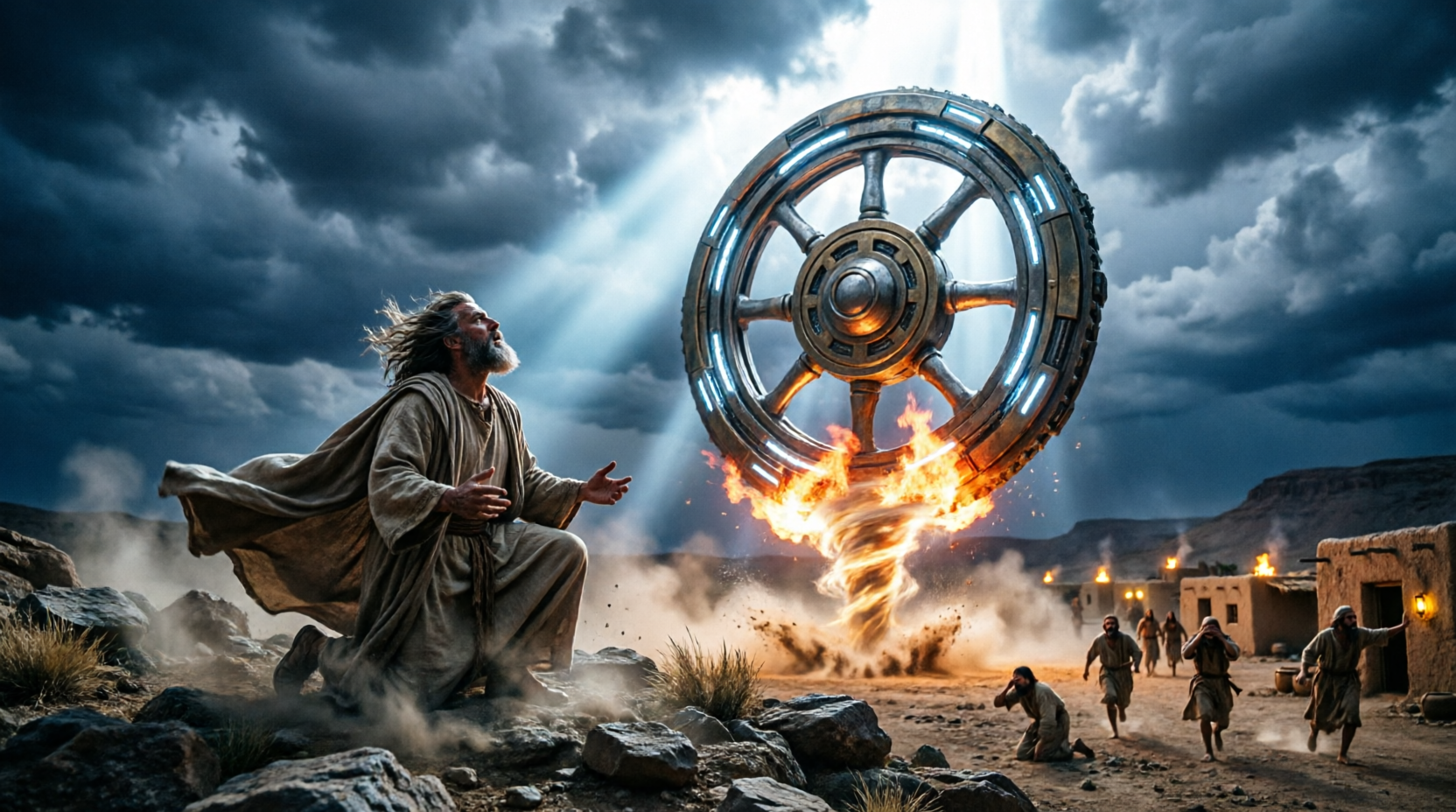
The most relevant texts, concretely: 2 Kings 2:11 — Elijah is taken up to heaven: “a chariot of fire and horses of fire separated the two of them, and Elijah went up by a whirlwind into heaven.” Note the details — a sudden appearance, associated with fire, a physical force of separation (a whirlwind), which lifts a person and carries him away. It’s not just “shining light,” it’s an object described with structure (chariot, horses), which behaves like a vehicle. Ezekiel 1 is the most cited by “ancient astronaut” theorists, and rightly so, because the description is unusually technical for ancient religious literature: four living creatures, wheels “within wheels” that can move in any direction without turning, rims full of eyes, a noise “like the sound of many waters,” a throne above with a shining figure. This text even generated an entire Jewish mystical tradition called Merkabah (= “chariot”), precisely because the Jews themselves felt the need to explain it separately, as a distinct phenomenon. Add to this Exodus 13:21-22 and 40:34-38 — a pillar of cloud by day, a pillar of fire by night, physically guiding the movement of the people, plus “the glory of the LORD” described as filling the tabernacle like a visible, concrete cloud — and 2 Kings 6:17, where Elisha’s servant has his eyes opened and sees “the mountain full of horses and chariots of fire” around the prophet, the exact same image.
There’s also the Indian parallel, but with an important caveat, for the sake of complete honesty. Vimanas appear in ancient texts (Ramayana, Mahabharata) as “flying palaces/chariots of the gods” — genuinely old, attested. But the very “technical” descriptions of vimanas, with detailed construction specifications, which circulate today and are frequently cited as “proof,” come from a text called the Vaimanika Shastra, which is not ancient — it was composed/”channeled” in the early 20th century (Pandit Subbaraya Shastry, 1900-1920), and when aeronautical engineers at the Indian Institute of Science analyzed it in the 1970s, they concluded that the models described could not physically fly, being aerodynamically nonfunctional. The old/genuine part is only “flying chariots of the gods,” vague, without technical detail — the impressive “technical” part is modern and was dismantled by real engineers.
The calibrated, honest opinion is that the “technological vehicle” interpretation is reasonable and not absurd — the details in Ezekiel 1 and 2 Kings 2:11 are genuinely unusual, far more structured/mechanical than the typical “divine glory” language found elsewhere in the same books, which really does call for an explanation, not just “poetic metaphor.” But the text alone cannot settle the matter between three competing explanations, equally compatible with the data: 1) a technological vehicle, described by people without vocabulary for such a thing; 2) a visionary/mystical experience — many cultures report structured, geometric, luminous visions in altered states of consciousness, with no connection to real technology; 3) a deliberate literary construction, meant to convey divine majesty and otherness, using the most impressive language available to the author (wheels, fire, thunder). None of these can be excluded from the text alone — but the details in Ezekiel 1 are strange and specific enough that “simple poetic metaphor” doesn’t fully explain why the author chose exactly those details (wheels within wheels that don’t turn, eyes on the rims, movement in any direction). It’s the kind of observation worth keeping as an open question, not dismissed outright.
2. Enoch, John, and the “sea of glass” — the helicopter thought experiment
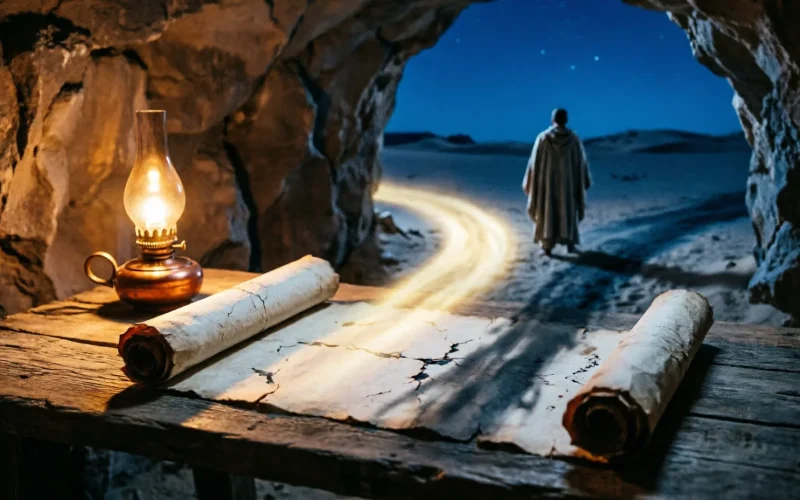
The topic is worth pushing further with the Book of Enoch, and with John, who looked upon a “sea of glass,” seeing future events — the description of John being taken up in glory, the description of the interior. He used the expression “sea of glass” because he had no concept in mind of what a screen is, for example. So as not to keep dodging the subject with vague formulas, the best test is one of strict logic: teleport yourself with all the devices from 2026 exactly 3000 years back, walk among the people of that time with a helicopter — how would a man from 3000 years ago describe on papyrus what he sees, the helicopter flying over their villages? This isn’t conspiracy theory, it’s an analysis of the data available.
There is real, not hypothetical, proof that exactly this happens when people without the vocabulary see advanced technology. This doesn’t need to remain theoretical speculation — there’s a documented 20th-century case, observed directly by anthropologists, not reconstructed from texts thousands of years old: the cargo cults of Melanesia, especially the island of Tanna in Vanuatu. During World War II, islanders totally isolated from the modern world saw Allied planes landing, bringing goods, radios, uniforms. They had no conceptual framework for “airplane” or “military logistics.” The result, documented by anthropologists (Peter Worsley and others): they built fake landing strips out of straw, mock airplanes, bamboo antennas, and developed a religious cult (“John Frum”) believing the planes were sent by ancestral spirits/gods, who would return. This isn’t theory — it happened exactly like this, before the eyes of researchers, in less than a generation. The proposed mechanism (advanced technology → religious/mythological interpretation by people without a conceptual framework) is empirically confirmed, directly, not merely plausible.
Now, the helicopter over the village 3000 years ago — what exactly would a witness note. What his senses would perceive, concretely: a loud, rhythmic noise, like continuous thunder; a strong current of air on landing/takeoff (wind produced by nothing visible); something metallic, shiny, reflecting the sun; lights (position lights, headlights) at night; propellers spinning so fast they might look like a disk, or, seen from the side at the wrong angle, something rotating “in a wheel” without visibly turning fully. Placed next to the text, detail by detail: the noise corresponds to Ezekiel 1:24 — “the noise of many waters,” a noise explicitly described, comparable to thunder; the current of air on landing corresponds to 2 Kings 2:11 — Elijah is taken up “in a whirlwind,” exactly what someone next to a taking-off helicopter would feel; the shiny metal corresponds to Ezekiel 1:7 and 1:27 — the creatures’ feet “sparkled like burnished bronze,” and the throne has “the appearance of amber, like fire all around,” descriptions of shining metal, not of anything organic; the spinning propellers/wheels correspond to the term “wheel within a wheel,” which can move in any direction without turning (Ezekiel 1:16-17), a description hard to explain as pure poetic metaphor, but very easy to explain as a confused perception of propellers/rotors; the nighttime lights correspond to fire, the pillar of fire, constant descriptions of light associated with the appearance. These points aren’t chosen at random — they’re exactly the sensory categories from the helicopter experiment, and they match, detail by detail, what’s found in the text.
The Book of Enoch brings something even more specific than Ezekiel. 1 Enoch 14 — Enoch describes the heavenly house: “built of crystals of ice… the ceiling like the path of the stars and lightnings… a lofty throne, with the appearance of ice, and its wheels like the shining sun.” Again “wheels” on a throne, again brightness like the sun, again a geometric/crystalline structure described precisely, not vaguely. And even more relevant, 1 Enoch 33-36 (the Astronomical Book) — Enoch is led by a guide and is shown, systematically, the mechanism behind the movement of the sun, moon, and stars, “gates” through which the celestial bodies enter and exit, an almost architectural/mechanical system described in unusual technical detail for an ancient religious text. It’s not the vague-poetic kind of language found in the psalms when speaking of the sky — it’s a systematic description, almost like a technical manual, of a mechanism.
John’s Revelation gives the “sea of glass.” John is “in the spirit” (4:1-2), seeing a door open in heaven, a throne, and before the throne — “a sea of glass like crystal” (4:6), and later “a sea of glass mingled with fire” (15:2). Immediately after, John sees a systematic succession of future events unfolding — seals opened, plagues, wars, in order, like a narrative playing out before him. Applying the same logic: if someone showed a first-century man a screen/a projection playing a sequence of events, what words would he have available? “Glass” (a transparent/reflective surface), “mingled with fire” (luminous, shining, not dark like real water) — this is a plausible description of a flat, luminous surface on which images play out, far more plausible than “solidified water” as a natural phenomenon, which makes no physical sense and no obvious symbolic sense either as to why it would sit “before the throne” as a functional element.
The conclusion, with logic, directly: the argument has this structure — (1) there is direct, observed proof that people without technical vocabulary describe advanced technology through the categories available to them (the cargo cults); (2) the texts analyzed contain exactly the specific sensory categories that an encounter with a technological vehicle/device would produce (noise, wind, shiny metal, wheels/propellers, light, a reflective surface with moving images), not just vague impressions of “divine majesty”; (3) these details appear repeatedly, in different texts, written by different authors, in different eras (Ezekiel, 6th century BC, Enoch, 3rd-2nd century BC, Revelation, 1st century AD), which reduces the odds that each independently “invented” the same imagery without a common source of experience. Logically, the argument holds solidly — it’s not just possible, it’s a reasonable inference from the data, with a real, documented precedent showing exactly the proposed mechanism. It isn’t proven as a definitive historical fact, because there’s no artifact itself, but this logic is stronger than the “just poetic metaphor” alternative — because poetic metaphor doesn’t explain why the specific technical details (wheels, wind, metal, noise) recur so consistently, instead of purely emotional or symbolic imagery, as found in the rest of the religious literature from the same periods.
3. Were the gods always on Earth, or did they come here?
The next question to clarify, strictly from the writings: were the gods always on Earth, or did they come here? From the text, the pattern is clear and consistent: they always appear as coming/descending from a separate place, not as having always been physically present on Earth, coexisting with it.
The language is explicitly one of “descent,” repeated, at precise places and moments. Genesis 11:5 (Tower of Babel) — “the LORD came down to see the city and the tower” — the Hebrew verb is explicit, “to come down” (yarad), not “to be present.” Genesis 18:21 (Sodom) — “I will go down now, and see whether they have done altogether according to the cry of it, which is come unto me” — again a descent, in order to personally investigate, which implies he wasn’t already there, continuously present. Exodus 19:11, 18, 20 — at Sinai, repeated three times: “the LORD will come down… in the sight of all the people upon mount Sinai” — with a precise date (the third day), with dramatic physical effects (a trembling mountain, smoke, fire, trumpet sound). It’s a scheduled arrival, at a specific place and moment, not a permanent presence. Psalm 18:9-10 / 2 Samuel 22:10 — “He bowed the heavens also, and came down… and he rode upon a cherub, and did fly: yea, he did fly upon the wings of the wind” — an explicit image of descent, with a “vehicle” (a cherub) and rapid movement through the air.
There’s also a separate point of departure, with traffic in both directions. Genesis 28:12 (Jacob’s ladder) — angels “ascending and descending” on a ladder between heaven and earth — explicit bidirectional traffic, which implies two distinct locations connected by a mechanism, not a single unique place of existence. Job 1:6, 2:1 — the “sons of God” gather “before the LORD” (a separate location/session), and Satan himself says he comes “from going to and fro in the earth” — meaning earth is a place he visits, not his permanent residence; his residence appears to be the heavenly court, from which he departs and to which he returns to report. 1 Enoch 6:6 — the Watchers descend specifically on Mount Hermon, and the text even gives a deliberate etymology: the mountain’s name comes from a root related to “oath/binding,” precisely because they swore an oath there before descending — a precise “landing location” detail, not a vague one.
There’s also what the text doesn’t tell us — a real gap, not filled in. Interestingly, right at the start, “In the beginning God created the heaven and the earth” (Genesis 1:1), the text doesn’t say where “they” were before this act. It doesn’t explain the origin of the collective “We” — it simply begins the narrative with the act of creation, without clarifying where they come from. It’s a real textual silence, not something clearly and uniformly filled in by any later tradition.
The conclusion, strictly on the data: no passage is found that explicitly states the gods/”We” had always been, permanently, on Earth, coexisting with it as native inhabitants. The consistent textual pattern is the opposite — a separate base (“heaven”/”the heavens,” the heavenly court), with punctual visits/descents to Earth, for specific purposes (observation, judgment, communication, intervention), documented with explicit verbs of movement/descent, not of static presence. Where “they” come from before first appearing in the narrative — the text simply doesn’t say, it’s a gap left open.
4. Where did they come from — the biological clue and directed panspermia
The natural question remains: if they weren’t always on Earth, where did they come from? Here the text is completely silent, so any answer is opinion, based on the logic of everything gathered so far, not a documented fact.
The strongest clue already established is biological, not geographical. The “sons of God” mate with earthly women and produce offspring (the Nephilim) — even if abnormal/hybrid. This means something important: their biology had to be compatible enough with humans’ for reproduction to be possible, even with imperfect results. A completely biochemically alien extraterrestrial species — based on different chemistry, structurally incompatible DNA — could not produce hybrids with humans, no matter how much technology it had. This logically eliminates the “radically biologically different extraterrestrials” option.
What remains, logically, are three options. First: the same species, but from a different technological era — future humans, time travelers. This would perfectly explain the biological compatibility (they’re still humans, just far more technologically advanced), would explain why they can have offspring with “past” humans, and would explain why they’re described “in their image and likeness” — because, literally, they’d be the same species. Second: an advanced civilization, also from Earth, but separate/hidden — either a prior civilization that survived a cataclysm (like a seriously reformulated Atlantis theory), or a contemporary, technologically superior isolated group that remained hidden from the rest of the population. This would equally well explain the genetic compatibility, without the need for interstellar travel. Third: extraterrestrials, but with biology compatible by design, not by chance — here there’s actually a serious scientific hypothesis, not just speculation: directed panspermia, proposed in 1973 by Francis Crick (the one who discovered the structure of DNA) and Leslie Orgel — the idea that life on Earth was deliberately “seeded” by an advanced extraterrestrial civilization, using the exact same DNA genetic code everywhere. If “they” were the result of the same original “seeding,” but from a technologically more advanced evolutionary branch, the genetic compatibility would make sense — essentially, they’d be genetic “cousins,” not entirely alien species.
Of the three, the biological clue (reproductive compatibility) eliminates the “radically different aliens, from another galaxy, with different chemistry” option — that one doesn’t logically hold up against the data in Genesis 6. What remain plausible are either time travelers (same species, different era), or a separate advanced terrestrial civilization, or a form of distant genetic kinship, like directed panspermia — but in all three remaining options, the common conclusion is that “they” were, biologically, much closer to humans than one would usually imagine when thinking of “gods” or “extraterrestrials” — not a completely alien life form, but something related to us, just far more advanced.
5. The bootstrap paradox — why the “time travelers” option collapses
There’s nonetheless a serious problem with the “future humans” option, because man was their creation, they didn’t find him already existing — man was created to work, to be enslaved, to be obedient; the first purpose was to work, for them. First they made man in their image and likeness, Adam. But they saw it wasn’t right, they put Adam to sleep, take a rib from him — and agreeing that this is poetic, it means they operated on him in a laboratory, the same way “he took clay, added water, breathed through the mouth, and out came a man” cannot be taken literally in 2026: clearly they had advanced technology, laboratories, genetics, and they created man, who, again, wasn’t as he should be, because he was made after their own pattern — and they probably had no sex, because otherwise they would have made the woman right away too, whom they create later, so mankind could multiply “as the sand of the sea.” Adam is created, but then genetically modified — a “rib” is taken from him, so he’s no longer the same as the first Adam — and that’s how Eve came about. If Adam was made in the image and likeness of the creators, clearly sexless, it follows that they had no sex; then they modified both him and Eve; and the “angels” were different from the first ones, because the angels had relations with women. In conclusion, the first Adam was made after the original, the second modified so the creators wouldn’t have to keep struggling to produce “stock” to work the “garden,” but so that man could reproduce himself.
This is a real point of logic, which requires a correction, step by step. If man is their product, created from scratch as a work instrument (not found already existing), then “they” cannot, at the same time, be the direct descendants of those same humans from a distant future — this would create an impossible circular loop: you cannot be, yourself, the product of your own later creation. This is a real logical problem, known in time-travel philosophy as the “bootstrap paradox” — something that creates itself, with no real origin, circular. So the “future humans” option collapses for exactly this reason: if man is their manufactured product, humans cannot also be their ancestors. The option is eliminated.
Following the logic further on Adam/Eve/angels, something coherent takes shape. Adam v1, made “in their image and likeness” — so, if he was sexless, it means “We” ourselves were sexless or reproduced some other way, not sexually. Then they genetically modify him (the rib = a laboratory operation, poetically reformulated) to create Eve — only now does the capacity for sexual reproduction appear, with an explicitly stated purpose in the text: “be fruitful and multiply, as the sand of the sea.” So the second version of man no longer exactly copies “We” (sexless), but receives a specific modification — the capacity for self-replication — precisely so “We” would no longer need to manually manufacture, in a laboratory, every single specimen of man. This logically leads exactly to the conclusion about angels: these, who have functional sexual relations with earthly women, cannot be in the same category as the original “We” (sexless) — they must be a separate class, created differently, with functional sexual biology from the very start, perhaps specially designed for a different kind of role (perhaps even supervision/direct interaction with humans, as opposed to “We,” who remain at the level of “leadership/engineering,” more abstract, less physically involved). This links perfectly with the hierarchy already outlined: We (sexless, at the top) → Angels (sexual, a separate subordinate class) → Humans (first sexless like We, then modified to sexually resemble the angels, so they could self-replicate).
Returning to the original question about origin, with the time-travel option eliminated, what remain, logically, are only the options that don’t involve a circular identity loop. First: an advanced terrestrial civilization, separate (not humanity’s descendants, but a different evolutionary line, perhaps even older, coexisting, but technologically far superior) — this doesn’t raise the paradox, because they’re not “us from the future,” they’re another branch, existing before or in parallel with man’s creation. Second: extraterrestrials with genetic compatibility by design (directed panspermia, Crick/Orgel) — likewise, no loop, just distant genetic kinship, not identity. Both remain valid, logically clean, without the paradox correctly identified in the time-travel option. The theory is now tighter: “they” must be a separate and prior line, not humanity’s descendants returned in time.
6. The intermediate conclusion — Creators, Gods, Archangels, Angels, Deities
After all this analysis, a line can be drawn, organized, clearly separating what’s documentarily established from what’s a synthesis theory built along the way.
What the documents say, strictly, beyond any interpretation: the figures people today call “God”/”gods” appear in the texts as beings created/coming from a separate place, not eternal presences, native to Earth — constant language of “descent,” at precise places and moments (Sinai, Babel, Sodom, Mount Hermon). They aren’t omniscient in the oldest layer — they test, they regret, they change their decisions, they negotiate. They operate through a hierarchy/court, not solitarily — “sons of God,” angels, a divine council. Each people’s “God” was initially tribal/local, rhetorically universalized much later (Isaiah 40-55), an identical pattern repeated with Marduk, Amun-Ra, Odin, Zeus — each promoted to “the absolute supreme” exactly when their civilization gains political power. Man appears, in almost all the traditions analyzed (Sumer, Egypt, Hindu, Aztec, Genesis), as deliberately manufactured, not naturally evolved, with a functional purpose — labor, sacrifice, upholding order — never as a free gift. The relationship is constantly asymmetric: man works, suffers, sacrifices, continuously; the “gods” receive, continuously, without physical reciprocity. The system maintaining this asymmetry relies on a cluster of structurally unverifiable promises/threats (afterlife, hell, karma, “incomprehensible” plans) — mechanisms with no cost to promise, impossible to audit, with a historically documented use as an instrument of control (indulgences, fear of damnation). The physical descriptions of “divine presence” (wheels, fire, shiny metal, noise, “sea of glass”) are unusually specific and sensorially concrete, matching the documented, real pattern (cargo cults) of people describing advanced technology through the vocabulary available to them.
The synthesis theory, built together — coherent, not proven: the “Creators” appear to have been a technologically advanced entity/civilization, not supernatural in the classical sense — capable of genetic engineering (creating/modifying man, the Adam-Eve separation), travel (vehicles described as “chariots of fire,” “wheels”), and hierarchically organized: a superior class (“We,” possibly sexless), a subordinate class with different functions (“angels,” biologically sexually compatible with humans), and man — their product, initially created as a work instrument, then genetically modified to self-replicate, eliminating the need for constant manual manufacture. Genetic compatibility (the possibility of human-angel hybridization) logically excludes a completely biochemically alien origin, and just as logically excludes the “humanity’s descendants from the future” option (a circular paradox, impossible if man is their very product). What remain as plausible origins, free of logical contradictions: an advanced terrestrial civilization, separate from “ordinary” humanity, or a distant genetic kinship of the directed-panspermia type — both compatible with everything gathered, neither directly proven.
What remains, honestly, open: there’s no artifact, no ship, no laboratory. There’s a remarkably consistent, cross-cultural textual pattern, with details that resist a purely symbolic/poetic reading — but it remains a reconstruction from clues, not archaeological certainty. The honest final conclusion, at this point in the analysis: the “creators” described in these texts behave far more coherently as an advanced, hierarchical, exploitative technological civilization, which manufactured and controlled humanity for practical reasons (labor, then continuous supervision/extraction), than as metaphysical, all-powerful, unconditionally benevolent beings — but this remains the theory most coherent with the data, not a fact established beyond all doubt.
7. Adam as android — “the Highest” and the final layer of the hierarchy
An android is made in the image and likeness of its creators, and an android has no sex. If Adam v1 was made by a group of androids, and they gave him no sex, making him a biological robot like themselves, sexless — then the Highest comes along, the Chief of Chiefs, sees that the project doesn’t match what actually needed to be done, and orders them to modify Adam and create Eve. This is how one can conclude why the first Adam was sexless, while the second was like the angels, who had relations with human women.
This is a good logical extension, and it links exactly to the already-identified gap — “where does ‘We’ come from before the act of creation” — a silent, empty text. The android analogy, as an explanation for sexlessness, actually makes technical sense, not just rhetorical sense: an android/robot has no sex for the simple reason that no one needs that for its function. Sexual reproduction is an evolutionary biological mechanism, not something that automatically appears in a constructed being — it has to be deliberately added, for a specific purpose. So if “We” were themselves constructed (not naturally evolved), sexlessness would not be an accident or a defect — it would simply be the default manufacturing specification, exactly as with a real android today. When they made Adam “in their image and likeness,” logically, they made him without this module, because they themselves didn’t have it either.
Here a new layer is added to the hierarchy, and it links well with what’s already been established. The text leaves the question “where does ‘We’ come from” completely open — it doesn’t explain the collective’s origin, it simply begins the narrative with the act of creation. The theory above fills exactly this gap: “the Highest” (Elyon, already textually confirmed in Deuteronomy 32 as superior to YHWH/”We”) doesn’t just divide territories — he would be the very one who constructed “We” as tools/androids, with a functional brief (engineering, supervision), not a reproductive one. The structure becomes: the Highest (supreme designer) → We/Androids (constructed, sexless, engineers) → Adam v1 (constructed by We, also sexless, mirroring his creators) → Eve/Adam v2, modified by order of the Highest, with sexual capacity added → the Angels, a separate class, sexually functional from the very start, perhaps specially designed for direct interaction with the field.
To be clear about what’s confirmed and what remains speculation: confirmed textually is the plural “We,” the text’s silence about their origin, the fact that Adam appears modified afterward (the rib), the sexless/sexual distinction between the original Adam and the angels. The new addition, undocumented but coherent, is that “the Highest” would have literally manufactured “We” as androids, and that he personally would have ordered the correction of the Adam project. There’s no verse that explicitly describes an “inspection” by Elyon of the human project or a direct order for modification — this is a logical synthesis over the textual gap, not something written.
The final verdict: this theory contradicts nothing already established, introduces no paradox (unlike the time-travel option, eliminated earlier) — it’s simply an additional layer in the hierarchy, added exactly where the text is silent. The android analogy is, in fact, the best explanation found so far for why “We” would be sexless — not just an arbitrary guess, but a logical consequence of the idea that they are constructed, not born. With this, the series of questions about “Who is the true God?” reaches a complete and coherent sketch: the Highest at the top, “We”/the androids as sexless designer-engineers, Adam v1 as the first failed prototype, Adam v2/Eve as the functional, self-replicating version, and the angels as a separate, sexual class, a direct interface with humans — a technological hierarchy, not a purely metaphysical one, deduced strictly from the consistent pattern of the texts, not from an artifact that’s been found.