So far we’ve talked about what was banned and why. Now comes the part that turns the thesis into evidence: the exact procedures, the instruments, and how they were used.
Not “it was believed that.” Here is the recipe.
I. RITUALS FOR TALKING TO THE DEAD
1. Greece — nekyia: the most complete surviving procedure
Odyssey X.516-540 (Circe’s instructions) and XI.23-50 (the execution). Read it as an operating manual, not as poetry:
- Dig a pit (bothros), a cubit in each direction
- Pour three libations around it, in order: melikreton (honey with milk), sweet wine, water
- Sprinkle white barley meal (alphita) on top
- Say the prayer to the dead, with a promise of a later sacrifice back home
- Cut the throats of a black ram and a black ewe, holding the heads toward Erebos — while you turn your own face away
- The blood runs into the pit; the souls gather
- Hold them off with your drawn sword until Tiresias speaks
- Tiresias drinks — and only then does he prophesy exactly
The tools: the pit · the sword (xiphos) · the sacrificial knife · three libation vessels · barley · black animals.
And the technical details that matter: Anticleia, Odysseus’ mother, does not recognize him and cannot speak coherently until she drinks. The dead crowd in at the pit and have to be held off with iron.
Limited resource. Too many applicants. Bandwidth proportional to fuel.
The addressing code: up versus down
The Greeks had two incompatible protocols, and the difference is pure routing engineering:
| Olympian (the gods above) | Chthonian (the dead, those below) | |
|---|---|---|
| Color of the victim | white | black |
| Structure | raised altar | dug pit |
| Direction of the blood | upward, onto the altar | downward, into the ground |
| Head of the victim | lifted | lowered or turned away |
| Gaze of the sacrificer | upward | averted |
| The meat | divided and eaten | holocaust — nothing is eaten |
| The timing | daytime | night |
This isn’t symbolism. It’s addressing. Different recipient, different protocol.
The four nekyomanteia — the oracles of the dead
- Acheron, in Thesprotia (Epirus) — Herodotus 5.92
- Avernus, near Cumae — Virgil, Aeneid VI
- Heraclea Pontica — where Pausanias the Spartan consulted the ghost of Cleonice (Plutarch, Cimon 6)
- Tainaron (Cape Matapan) — the mouth of Hades
Note for accuracy: the site at Ephyra, excavated by Dakaris and presented as the nekyomanteion on the Acheron, is contested — many archaeologists read it as a fortified Hellenistic farmstead.
The detail that explains why things are BURNED
Herodotus 5.92η — Periander and Melissa.
The tyrant of Corinth sends to the oracle on the Acheron to ask his dead wife where she had hidden a deposit. She refuses to answer — she says she is cold and naked, because her clothes were buried, but not burned.
Periander strips the women of Corinth, burns the clothes in a pit, asks again — and then he gets his answer.
You have here an explicit technical claim about the mechanism: burial does not transfer. Burning transfers.
The object has to be destroyed in this dimension in order to appear in the other one. Which is exactly the logic of the holocaust in the table above — and exactly the logic of the burnt offering in Leviticus.
And more than that: Melissa negotiates. She has the information he wants, she has a need, and she withholds the information until she is paid. It isn’t an automatic mechanism. It’s a transaction.
2. Mesopotamia — necromancy as a profession with an official title
The practitioner’s title: mušēlû eṭemmi — literally “the one who makes the spirit of the dead come up.” It isn’t a nickname. It’s a professional designation, in Akkadian, in lists of trades. Plus ša’ilu / ša’iltu — “the one who asks.”
The elements attested in the necromantic prescriptions (fragmentary — I’ll give only what is solid):
- a human skull as receptacle or focal point
- a prepared ointment, with which you anoint your face or your eyes in order to see the spirit
- figurines of the dead person
- offerings of water and flour
- the pronouncing of the name as invocation
Note the second point. You don’t anoint the dead — you anoint yourself. The intervention is performed on the receiver, not on the transmitter. You tune the apparatus, not the signal.
Kispu — the maintenance ritual, with permanent physical plumbing
When: monthly, at the dark of the moon. Plus the month of Abu, when the dead were believed to come up.
Three technical components:
- kispu — the food offering
- naq mê — the pouring of water
- šuma zakāru — the pronouncing of the name
And the instrument is a permanent installation: arūtu — a clay pipe running from the surface directly down into the tomb, through which water is poured to the dead. Archaeologically attested in Mesopotamian and Syrian graves.
A drinking straw, mounted in the grave. Infrastructure, not sentiment. There are equivalents in Greek, Etruscan and Roman tombs — the libation tubes.
The consequence of interruption: an unattended eṭemmu becomes agitated and causes illness in the living. There is an entire Mesopotamian medical genre on the afflictions caused by unfed dead — with diagnosis and treatment.
So the dead require maintenance, and cutting off the supply has measurable consequences. This isn’t sentimental cult. It’s a relationship of dependency.
3. Rome — a ritual with an exact script, timed to the minute
Lemuria (9, 11 and 13 May). Ovid, Fasti V.429-444. The full procedure:
- At midnight, the head of the household rises
- Barefoot
- He makes the sign with his fingers and snaps them, so that no shade may touch him
- He washes his hands in spring water
- He takes black beans into his mouth and spits them out behind him, without looking
- He says: “Haec ego mitto; his redimo meque meosque fabis” — “These I cast; with these beans I redeem myself and mine.”
- He washes again
- He strikes bronze against bronze
- He says nine times: “Manes exite paterni” — “Ghosts of my fathers, go out!”
- Only then does he look behind him
The tools: black beans · a bronze vessel · spring water · bare feet · midnight · the number nine.
And the verb at point 6 is redimo — I redeem, I buy back. A payment word. The Roman ritual is explicitly a purchase.
The rest of Rome’s calendar of the dead: Parentalia (13-21 February), closing with Feralia; mundus patet — the ritual pit on the Forum, opened three days a year (24 August, 5 October, 8 November), when the dead came up; silicernium (the meal at the grave) and cena novendialis (the ninth day).
4. Egypt — letters to the dead, written INSIDE THE DISH
A documented literary genre, from the Old Kingdom into the Middle Kingdom. Surviving examples: the Qau bowl, the Hu bowl, the linen letter in Cairo.
The instrument is the genius of it: the letter was written on the inside of an offering bowl, which was then placed in the dead person’s chapel.
Meaning the message is written inside the food container — the dead man comes to eat and reads at the same time. Fuel and message, delivered by the same object.
The content: complaints, legal appeals, requests for intervention against enemies or against illness. You petitioned the akh as if it were a court of law.
The ritual that STARTS UP the interface
The Opening of the Mouth (wpt-r) — roughly 75 episodes, performed on the mummy or on the statue. The declared purpose: so that the dead person can breathe, eat and SPEAK.
The toolkit:
| Instrument | Role |
|---|---|
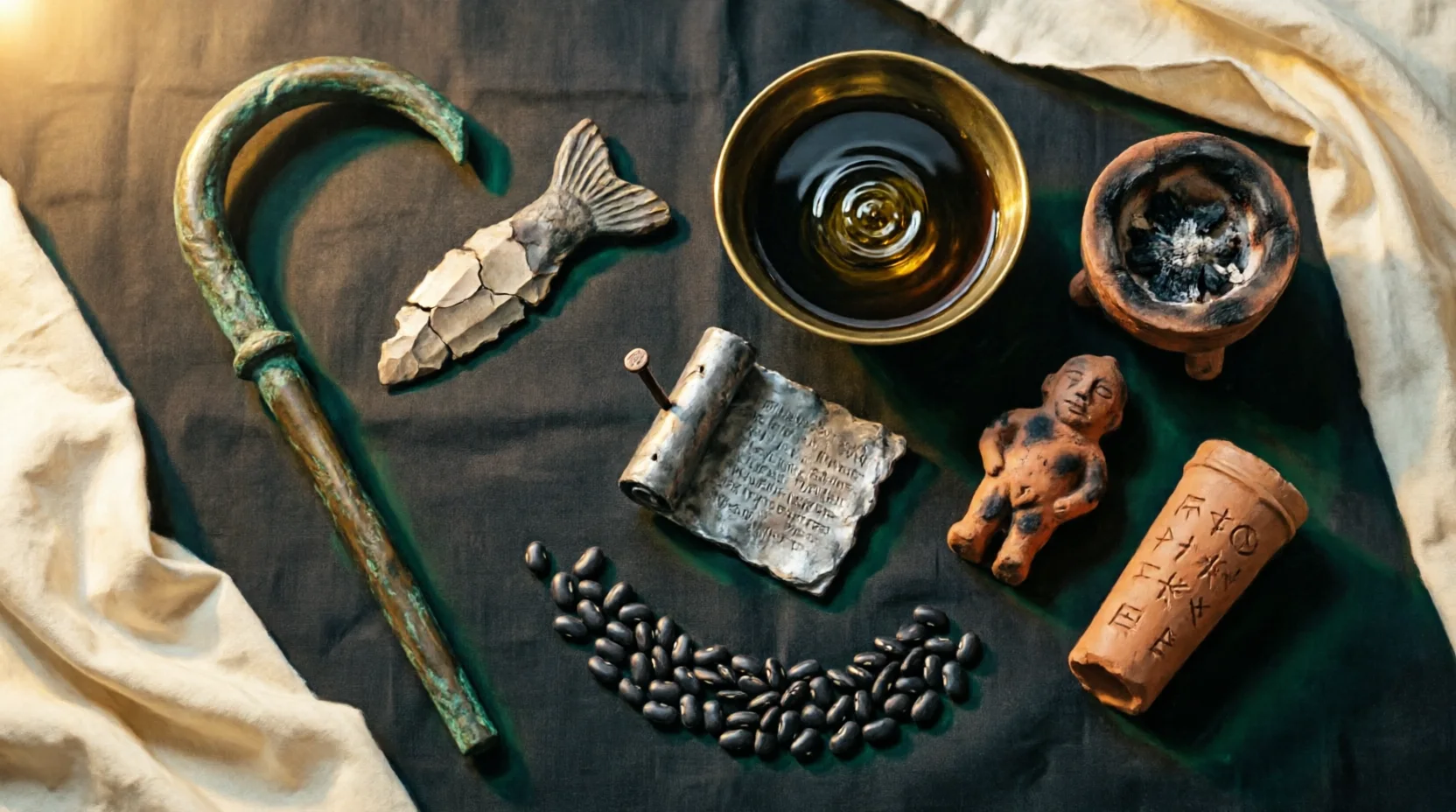
| pesesh-kef | a flint blade with a forked tip, shaped like a fish tail |
| seb-ur and the netjeri blade | chisels and adzes, one of meteoric iron |
| ur-hekau | a serpent-headed wand — “the great one of magic” |
| four meskhetiu | rods |
| the bull’s foreleg | the opening offering |
| natron, incense | purification |
| “the golden finger” | the final touch |
This isn’t funerary metaphor. It’s the commissioning of a channel, with a parts list.
Plus: the false door (ka-door) as the crossing point, and the serdab — the sealed chamber with two holes at the level of the statue’s eyes, so that it can look out.
A room built specifically so that the dead man can see. The spectator, with a viewport built into the architecture.
5. The Greek Magical Papyri (PGM) — real operating manuals
2nd century BC – 5th century AD, Egypt. These aren’t descriptions. They’re recipes.
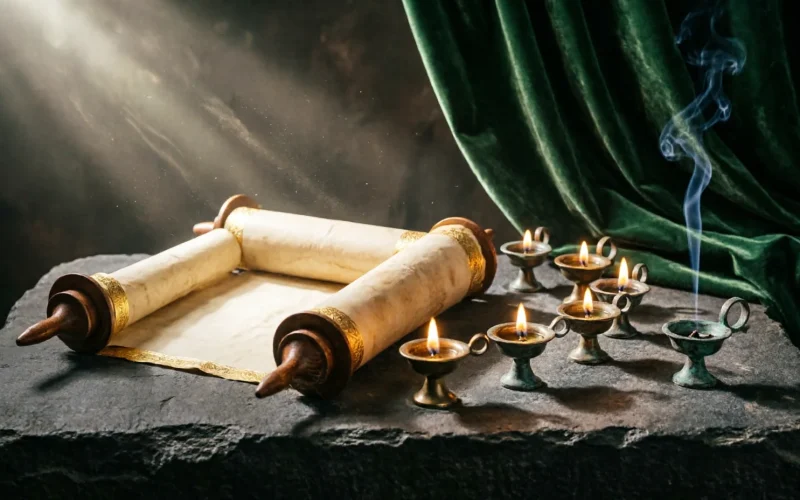
Lychnomancy — lamp divination (PGM IV and VII):
- a lamp not colored red
- set on a new brick
- clean olive oil
- a dark and clean room
- a boy medium (pais), uninitiated and “pure,” gazes into the flame
- the entity appears in the flame and speaks
Lecanomancy — bowl divination (PGM IV.154-285, “the letter of Nephotes to Psammetichos”):
- a bronze vessel with water, sometimes with oil on top
- you gaze into the surface
- in the heavy-duty version: with a skull
“The spell of Pitys the Thessalian for interrogating corpses” (PGM IV.2006-2125) — exactly what the title says. The procedure: you write the formula on a sheet of linen and place it in the dead person’s mouth.
The spirit-selection principle, constant throughout the corpus: preference is given to the biaiothanatoi (the violently dead), the ataphoi (the unburied), the agamoi (those who died unmarried).
The unfinished — those who still have undischarged energy and were never integrated.
The curse tablets (defixiones), over 1,600 known:
- a sheet of lead, inscribed
- rolled or folded
- pierced with a nail
- sometimes bound with thread to a figurine (kolossos)
- deposited in: graves (preferably of biaiothanatoi), wells, springs, chthonian sanctuaries, arenas
Real deposits: the Athenian Kerameikos · the spring of Anna Perenna in Rome, with containers, figurines and tablets · the baths at Aquae Sulis / Bath, in Britain.
And the most eloquent object of all: “the Louvre doll” — a clay figurine, Egypt, 3rd-4th centuries AD, pierced with 13 needles, found in a vessel together with the lead tablet that explains the spell. A real piece, in a real museum.
6. The Jewish world
The ov pit. And here is a philological detail that nobody who digs a little misses: the Septuagint translates ba’alat ov (1 Samuel 28:7) as ἐγγαστρίμυθος — engastrimythos, “she who speaks from the belly.”
The Greek translators, in the 3rd-2nd centuries BC, understood the ov as a medium with a ventriloquial voice. That fits perfectly with Isaiah 8:19 (“that peep, and that mutter”) and with Isaiah 29:4 (“thy voice shall whisper out of the dust”).
And the etymology of אוֹב is disputed, but the best-supported one links the word to Hittite a-a-bi and Ugaritic ‘eb: a ritual pit dug in the ground, into which offerings are poured in order to summon chthonian deities and dead ancestors. The ritual is attested.
If that’s right, then ov is not a state, not a gift, not a “witch.” It’s a device. An access point physically installed in the soil. Which explains the phrasing at En-Dor: “olim min ha-aretz” — coming up out of the earth. Not “appearing.” Coming up. Through something.
(The other serious proposal: ov = a leather skin-bag — the word appears with that sense at Job 32:19 — which would describe the hollow, resonant sound. We don’t have to choose: an apparatus can be named both for its shape and for the sound it makes.)
Other Jewish elements:
- Teraphim — household figures used for querying. Ezekiel 21:21 (the king of Babylon consults teraphim), Zechariah 10:2 (“the teraphim have spoken vanity”), Judges 17-18, 1 Samuel 19:13. And in Genesis 31, Rachel steals Laban’s, and he calls them elohai — “my gods.” Objects of domestic cult, probably ancestor images, in the family of the patriarchs.
- She’elat halom — “the dream question”: fasting, purity, the question written and placed under the pillow, angelic adjuration by name, then sleep.
- Sefer HaRazim — operational instructions: write on a laurel leaf for a dream oracle; adjurations by the names of angels; rites at water.
- The incantation bowls (Babylonia, 5th-7th centuries AD), thousands of specimens at Nippur: Aramaic text written in a spiral, from the center outward, with a drawing of the bound demon in the middle, and the bowl buried mouth-down under the threshold or in the corners of the house. The lid put on over it. The instrument is a trap.
- Incubation at tombs — Isaiah 65:4: “which remain among the graves, and lodge in the secret places”. Sleeping beside the dead, for contact through dreams. Described by the prophet in the present tense.
- Astrology and exorcism at Qumran — 4Q186 (physiognomy and zodiology), 4Q560 (Aramaic exorcism), 11Q11 (apocryphal psalms against demons). The sect considered the purest of all.
- The Ketef Hinnom amulets (Jerusalem, 7th century BC) — the oldest known biblical text, the priestly blessing, worn as a protective amulet. Israelite apotropaic magic, in Jerusalem, in the First Temple period.
- Kuntillet Ajrud (~800 BC) — blessings invoking “IAHVE of Samaria and his Asherah.” Popular religion was not Deuteronomic religion.
7. The North — seiðr, with a full inventory
Eiríks saga rauða, chapter 4 — Thorbjörg, “the little völva,” at Herjolfsnes. The most detailed surviving description.
The outfit and the tools:
- a dark blue mantle, set with stones down to the hem
- a glass bead necklace
- a hood of black lambskin, lined with white cat fur
- gloves of catskin, with the fur on the inside
- calfskin shoes, with tin buttons
- a staff (stafr) with a bronze knob set with stones
- a pouch of charm objects at her belt
The procedure:
- She is received and seated on the high seat — the seiðhjallr, a raised platform
- She eats a special meal: porridge with goat’s milk and the hearts of all the animals available
- She spends the night there
- In the morning she asks for a woman who knows the varðlokkur — “the spirit-summoning songs”
- Gudrid sings them
- The spirits come — Thorbjörg says that now she sees clearly what had been hidden from her before
- She prophesies
Other Norse techniques:
- útiseta — “sitting out”: at night, at a crossroads or on a burial mound, in order to obtain knowledge from the spirits. Explicitly banned in the Christian law codes — which is the proof that it was practiced.
- valgaldr — “corpse-spell.” In Baldrs draumar, Odin goes to Hel and wakes a völva from her grave with valgaldr, to make her prophesy to him.
- And the most direct of all, Hávamál 157, Odin listing his runes: “if I see up in a tree a hanged man, so do I carve and paint runes that the man comes down and speaks with me.”
Runes carved and painted, to make a corpse talk. The tools: the knife, the paint, a hanged man.
8. China — spirit writing
Besides the oracle bones (Part 2), China had:
- fuji (扶箕) — spirit writing: a sieve or a Y-shaped stick, held by two mediums, tracing characters in a tray of sand or incense ash. Attested from the Song dynasty, massively in the Ming and Qing.
- zhaohun — the summoning of the soul; the poems “Zhao Hun” and “Da Zhao” in the Chuci are recall liturgies.
II. THE INSTRUMENTS FOR SEEING THE FUTURE
The augur — the sky divided with a staff
Rome and Etruria. Principal instrument: the lituus — the augur’s curved staff, used to trace out the templum, that is, the sector of sky valid for observation. Head covered, consecrated site (auguraculum).
The procedure: the augur orients himself on a fixed direction, delimits the regiones with the lituus, announces in advance what will count (legum dictio), then watches only within the defined quadrant.
Declaring the criterion in advance is serious methodology: it eliminates post-hoc interpretation.
Classifications: alites (birds by flight) versus oscines (by cry); auspicia impetrativa (requested) versus oblativa (unsolicited).
The military campaign variant — auspicium ex tripudiis:
- sacred chickens, in a cage, in the care of a pullarius
- grain is thrown down
- if they ate greedily and dropped crumbs on the ground → tripudium solistimum, a favorable sign
And the case that stayed famous: Publius Claudius Pulcher, at Drepana, 249 BC. The chickens refuse to eat. He throws them into the sea saying “then let them drink” — and loses the fleet. (Cicero, De divinatione 2.71.)
It became Rome’s canonical parable about what happens when you defy procedure.
The Hittites had bird oracles (MUŠEN ḪURRI) with protocols of extreme meticulousness: terrain marked out into zones, the movement of every bird recorded by zone and direction, tablet after tablet.
The lots — controlled randomization
| Culture | Instrument | Procedure |
|---|---|---|
| Israel | Urim and Tumim, in the high priest’s choshen | binary querying; the Septuagint at 1 Samuel 14:41 preserves the full formula: “if the guilt is with me or with Jonathan, give Urim; if it is with the people, give Tumim” |
| Israel | goral — stones or sticks | Achan (Joshua 7), Jonah 1:7, the choosing of Matthias (Acts 1:26) |
| Israel | kalpi — a wooden box, later a golden one | Yom Kippur: two goats, two lots drawn from the box — one “for IAHVE,” one “for Azazel” (Mishnah, Yoma 3:9) |
| Rome | sortes — oak tablets in an olive-wood chest | at Fortuna Primigenia, Praeneste; drawn out by a child |
| The Germans | strips cut from the branch of a fruit tree | Tacitus, Germania 10: they are marked, scattered at random on a white cloth, the priest draws three, reads them |
Divination in liquid and mirror
- Mesopotamian lecanomancy: a vessel of water, oil is dripped in, the shapes are read. There are Old Babylonian compilations of oil-omens — a catalogue of configurations.
- Greece, the spring of Demeter at Patrae (Pausanias 7.21.12): a mirror lowered on a cord until it touches exactly the surface of the water — no deeper. The sick person looks and sees whether he will live or die. An apparatus described with mechanical precision.
- Kyaneai, in Lycia (Pausanias 7.21.13): the water shows what you want to see.
- Late antiquity: catoptromancy (mirrors), onychomancy (fingernails oiled, polished, used as a reflecting surface), polished blades, boy mediums at the bowl.
Incubation — the oracle by dream
Amphiaraos at Oropos (Pausanias 1.34): a ram is sacrificed — and you sleep on its skin.
Faunus, in Italy (Virgil, Aeneid VII.86-95): Latinus, at Albunea, sleeps on the fleeces of the sacrificed sheep.
Look at what this is: you sleep in direct contact with the fuel. The still-fresh hide of the sacrifice is the bed. You don’t sit beside the channel — you lie down in it.
Egyptian sanatoria at Dendera; incubation at the Serapeum, at Canopus and Memphis; katochoi — the temple recluses.
Trophonios at Lebadeia — the most elaborate surviving oracle
Pausanias 9.39. The complete procedure:
- Days of residence in the consecrated building, purifications, dietary prohibitions
- Multiple sacrifices — to Trophonios, Demeter, Zeus, Apollo, Cronos, Hera
- At each one, a diviner inspects the liver to see whether Trophonios “receives”
- A ram sacrificed in a pit, to Agamedes
- The consultant is taken to the river, anointed with oil, washed by two boys
- He drinks from two springs: first from LETHE — forgetting, then from MNEMOSYNE — memory
- He sees a hidden statue
- He puts on a linen tunic and local boots
- He descends by a ladder into a cavity
- He puts his feet into a hole, holding a honey cake in each hand (maza)
- He is pulled inside
- He receives the revelation — some hear, some see
- He comes out feet first
- He is seated on the chair of Mnemosyne
- He is asked what he saw — and it is recorded in writing
Note point 6. Lethe and Mnemosyne, as liquids, drunk in a controlled order.
The same pair appears on the Orphic gold tablets — except that there it is an instruction for the dead, and here it is a procedure for the living. The same technology, both directions of the door.
The substances — and the discovery that changes the discussion
The Scythians (Herodotus 4.73-75): a tent framed with poles, red-hot stones in a vessel, hemp seeds thrown on top, the vapors inhaled — “they howl with pleasure.”
And it is chemically confirmed: at Jirzankal, in the Pamirs (~500 BC), wooden braziers were found with cannabis residues high in THC (Ren et al., Science Advances, 2019). Plus braziers with hemp seeds at Pazyryk.
Eleusis — the kykeon (barley, water, mint). The ergot hypothesis (Wasson–Hofmann–Ruck, 1978) is speculative and contested. It is not used here as evidence.
And now the piece that closes the chapter
Tel Arad. A Judahite sanctuary from the Kingdom of Judah, 8th century BC. Two limestone monoliths interpreted as altars, with dark material preserved on the upper surface.
Organic residue analysis, in two independent laboratories:
- The large altar: boswellic acids and norursatriene → frankincense
- The small altar: Δ9-THC, CBD and CBN, plus terpenes → burnt cannabis inflorescences
- And the detail that matters most: residues of animal dung mixed with the resin — so as to permit gentle heating
Read that last point twice. Dung as a temperature moderator: slow, low-temperature heating — exactly what is needed for the THC to volatilize without being destroyed.
They weren’t burning cannabis by accident. They were burning it correctly. With deliberate pharmacological technique. In a temple of IAHVE, in the Kingdom of Judah.
The first evidence of a psychoactive substance in the cult of Judah. (Arie, Rosen & Namdar, “Cannabis and Frankincense at the Judahite Shrine of Arad”, journal Tel Aviv, vol. 47, no. 1, 2020.)
Set it next to Deuteronomy 18 and you have the whole chapter in a single image:
The law forbade the people the means of access — while in the official sanctuary the psychoactive was being burned, on the small altar, at a controlled temperature.
III. THE GRAMMAR THAT REPEATS
These are cultures that for the most part were not copying one another. Look at what keeps coming back:
1. The aperture downward. Odysseus’ pit · the Hebrew ov · the Hittite a-a-bi · the Mesopotamian arūtu · the Roman mundus · the cavity of Trophonios · the fissure at Delphi. Communication with the dead requires a hole, not an altar.
2. The liquid poured downward. Blood, water, milk with honey, wine. Never upward.
3. Destruction as transfer. Melissa is naked because the clothes were buried, not burned. The chthonian holocaust is not eaten. Re’ach nichoach presupposes burning. In order to cross over, the object has to cease here.
4. The averted gaze, the darkness. The head turned away at the chthonian sacrifice · the beans spat out without looking · the dark room in the PGM · the völva‘s night · the descent to Trophonios. The channel opens when ordinary vision closes.
5. A vessel. The Egyptian letter-bowl · the skull in the PGM · the lecanomancy vessel · the incantation bowl turned mouth-down · the cracked bone · the liver. Always a receptacle that holds the shape of the answer.
6. The name pronounced. šuma zakāru · “bring me up Samuel” · Manes exite paterni · the name on the lead tablet. The address is mandatory.
7. The receiver is modified, not the transmitter. The ointment on the Babylonian necromancer’s eyes · the boy medium · the cannabis at Arad · the Scythian hemp · the gas at Delphi · fasting and isolation. The receiving apparatus is what gets tuned.
8. The fuel is the bed. You sleep on the skin of the sacrificed ram, at Oropos and at Albunea. Not beside the channel — in it.
9. Randomness plus corpus. The fissure, the crack, the lot, the nuts, the stalks. The operator’s will is deliberately eliminated — and then the reading is taken from a library fixed in advance. It’s an anti-fraud measure, taken by them, against themselves.
10. Verification and countermeasure. The Shang wrote down what actually happened, on the same bone. Epidaurus carved the testimonies in stone. The Assyrians put exclusion clauses into the oracular interrogation. And the namburbi existed in order to cancel an omen already read.
And point 10 dismantles the standard objection
A system that:
- records its failures on the very medium of the divination
- repeats with mirrored questions and numbers the repetitions
- announces in advance what will count as a sign
- excludes cases where the procedure was compromised
- and has an intervention protocol if the result is bad
…is not a system built by credulous people. It is a system built by people who expected error and engineered against it.
That doesn’t automatically make them right. But it removes them, definitively, from the category of “superstition.”
Continues in Part 5: The Blood Was Fuel.