Or: why a power that depletes, fails, and needs spittle cannot be the power of a god
In the previous chapters I asked who was on the cross and who collected afterwards. Here I ask something else, and it is a question I have never heard put from a pulpit: where did the power come from, and who was holding it?
Because if a man heals the blind and raises the dead, you have only three options. Either the abilities were his beforehand. Or they arrived together with something that entered him. Or someone else performed them, at his request.
I began convinced that the texts could not help us choose. I was wrong. They help very precisely, and the answer is written in the very gospels everyone reads.
1. The chronology: the canon is unanimous
The first check is the simplest. Is there any miracle before the baptism?
No. Not one.
Mark, the oldest gospel, does not even bother with the childhood — it begins directly at the Jordan. Matthew and Luke have the birth and the infancy, but in them the child does absolutely nothing; the wonders around him are performed by others — the star, the angels, the dreams. The only scene in which he appears as a minor, aged twelve in the Temple, shows him clever, not gifted.
And John seals it, with the precision of a minute-taker. At the wedding in Cana: “this beginning of signs did Jesus in Cana of Galilee” (2:11). The beginning. After the baptism.
Thirty years of nothing. Then the baptism. Then, immediately, everything.
Notice what this means: the official canon confirms exactly the separationist chronology. Cerinthus said something descended at the baptism. The gospels, which condemn Cerinthus, place the arrival of the power precisely where he said it was. They kept the chronology and rejected the conclusion.
And so that no doubt remains, Luke 2:52 says that Jesus “increased in wisdom”. A being that increases in wisdom is a being that did not have it. That is not the description of an eternal god come down whole. It is the description of a man in formation.
2. The texts that gave him childhood powers were removed
The other version exists too, and what happened to it is instructive.
The Infancy Gospel of Thomas, second century, shows Jesus at five making birds out of clay and bringing them to life. The idea circulated so widely that it reached the Quran (3:49). But the same text also shows him blinding those who complain about him, and killing with a word a boy who bumped into him in the street.
The text was rejected. And it is easy to see why — a child who kills by reflex is not good advertising.
But look at what you are actually rejecting. You are not rejecting only an ugly story. You are rejecting the only version in which the power was his from the start. And the portrait in that text is not absurd, it is coherent: great capacity without moral maturity looks exactly like that — capricious, punitive, unpredictable. A child with powers behaves like a child.
What remained in the canon is a man who does nothing for thirty years and then, suddenly, can. That does not resemble an endowment. It resembles an authorisation.
3. What the power looks like when you examine it coldly
Here is the part that stopped me reading. Every example that follows is in the accepted texts, in the gospels read in church, not in some esoteric manuscript.
“He could not.” Mark 6:5, in Nazareth: he could not do any mighty work there, only lay hands on a few sick people. Not “would not”. The Greek is ouk edynato — he was not able. The power failed, in a particular place, because of conditions he did not control.
A god does not have areas of poor coverage.
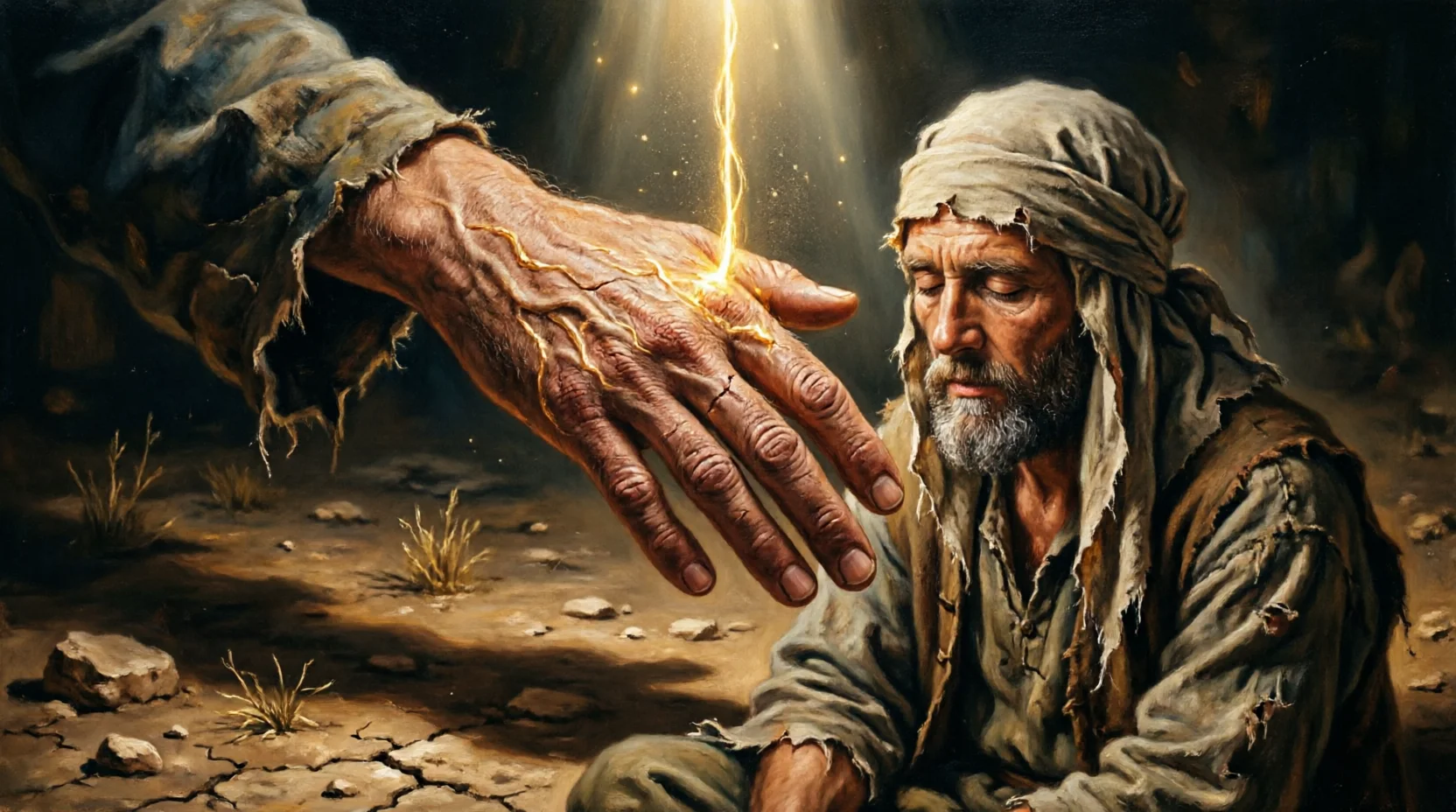
The power depletes. Mark 5:30: the sick woman touches his cloak in secret, and he turns because he felt “that power had gone out of him”. He decided nothing, he blessed no one — he felt a decrease. That is not an attribute, like height or eye colour. That is a reserve, which has a level and goes down when you use it.
It needs props. With the blind man in John 9:6 he makes mud with spittle and anoints his eyes. With the deaf man in Mark 7:33 he puts his fingers in the man’s ears, spits, and touches his tongue. If you have pure power, you do not need materials. You simply do it. Materials appear only where there is a procedure.
And the second attempt. Mark 8:22-25, the blind man at Bethsaida. He touches him once, asks what he sees, and the man answers: “I see men as trees, walking”. Partial result. He has to touch him a second time to get it right.
Read that sentence again. A second attempt was necessary. A god does not calibrate. An operator does.
4. The prayer he himself says was for the audience
And now the piece I find heaviest in the whole chapter, because I am not deducing it — he declares it.
At Lazarus’s tomb, John 11:41-42, he lifts his eyes and says: “Father, I thank you that you have heard me. And I knew that you always hear me; but because of the people standing by I said it, that they may believe.”
In other words: the prayer was not necessary. He spoke it so that people would hear it.
That is a confession of stagecraft, spoken aloud, in the middle of the greatest miracle in the gospels. And it leaves you with three readings, all uncomfortable:
Either he is genuinely asking someone else and decided to make the request visible — in which case he is not the source, he is the applicant.
Or he is asking no one and the prayer is pure staging — in which case the scene was built for witnesses, exactly as at Golgotha.
Or both: he asks, and at the same time knows the asking must be seen.
And if you think I am overreaching, the text goes further than I do. John 5:19: “The Son can do nothing of himself”. And, without any ambiguity, John 14:10: “the Father who dwells in me, he does the works.”
He does the works. Not “I do them with his power”. He does them. The hypothesis that someone else was executing at his request is not a heretical speculation. It is stated in the canonical gospel, in the third person, by the subject himself.
5. The contradiction: why does he hide the evidence?
If the aim was to leave humanity a proof, his behaviour makes no sense at all.
He heals a leper and tells him to say nothing to anyone (Mark 1:44). He raises Jairus’s daughter and strictly charges them that no one should know (5:43). He heals the deaf man and forbids them to tell — and they tell anyway (7:36). He forbids the disciples to say who he is (8:30).
And when a sign is explicitly demanded of him, he refuses: “there shall no sign be given unto this generation” (Mark 8:11-12).
Scholars call this the “messianic secret” and have argued for a century about what it means. I see one simple explanation: that man was not building a proof. He did what he could for whoever was in front of him, and he did not want an audience.
The proof was built afterwards, by others, out of the same material. He healed people; they compiled a case file. He said “tell no one”; they printed.
6. The moral signature: what he used it for
And here everything changes, because the question “where did the power come from” matters less than the next one.
Take the inventory. He feeds hungry crowds. He heals the blind, the deaf, the lame, the leprous. He stops haemorrhages. He gets people out of bed. He calms a storm. He raises three dead.
The only destructive use in the entire canon is a withered fig tree that had no fruit out of season — a scene so strange and so petty that commentators have struggled for two thousand years to find a purpose for it.
That is all. An Apparatus-grade capability, used almost exclusively to repair.
Compare that with any other entity in the file I have been assembling across these chapters. The one that demands blood. The one that sends plagues. The one that asks for the firstborn. The one that installs fear on a scale of millennia.
The same class of power. The diametrically opposite use.
7. The verdict
From all of the above, here is what I think holds and what does not.
It does not hold that the abilities were his beforehand. Thirty years of nothing, plus “increased in wisdom”, plus the fact that the only texts giving him childhood powers were removed from the canon.
It holds badly that he was himself the source. A source does not empty out, does not fail depending on the town, does not need spittle and a second attempt.
It holds best that he was the carrier of a capacity that was not his, and that sometimes — perhaps always — someone else executed the act. Not because I say so. Because John 14:10 says so.
So he was an instrument.
And here is the nuance for which I wrote the whole chapter, because without it the thing reads as demolition, and that is not what I am doing.
An instrument does not choose what is played on it. That man chose.
He had in his hand — or at his disposal, or passing through him — a power that anyone else in human history would have used to dominate. With it you could take a throne in a week. You could shut the mouths that contradicted you. You could do exactly what the child in the rejected text does: punish whoever bumps into you.
He fed hungry people and healed the blind, told each of them not to talk about it, and refused to give any sign to those who came to test him.
Where the power came from does not define him. What he did with it does.
And if it is true that the Apparatus used him as a carrier, then something happened that the Apparatus probably did not anticipate: the vehicle had character. Someone borrowed a hand, and the hand chose to repair.
That is not less than a miracle. It is the only one in the whole story that nobody but the man can claim.