From a question about Neuralink to the architecture of absolute control
1. Why I started here
I started from a simple, almost technical question: what can Neuralink do today, and what can that helmet do — the one people say lets you “Google with just your thoughts”? The honest answer to both questions took me, step by step, exactly where I didn’t expect — to the architecture of a false god built out of servers, and to a sentence from Revelation I had never read this way before.
I won’t jump straight to the conclusion. I’ll show you the whole path, so you can check every step, exactly as I promised in the last chapter.
2. Neuralink — the invasive version
Neuralink is a chip the size of a coin, with threads thinner than hair, implanted by a surgical robot directly into the motor cortex. The threads read neuron activity and translate it into commands.
The first person was implanted in January 2024 — Noland Arbaugh, a tetraplegic. By September 2025 there were already 12 people with severe paralysis wearing the implant, and in 2026 the company announced “Two Years of Telepathy,” with 21 participants. What these people can do: control a cursor and keyboard with their thoughts, browse the internet, play chess and other games — essentially they’ve been given back a form of autonomy they had completely lost.
But between the vision and the reality there’s a gap I need to state just as clearly. Musk talks about a million implants by 2030. The specialist press has flagged real problems, though: dead animals in testing, biocompatibility issues, threads that retracted from the first patient’s brain, and unresolved questions about who actually owns the neural data once it’s extracted.
My conclusion: it’s the most advanced brain–computer interface in the world, but it remains a medical device, not a consumer gadget. Huge resolution — price: open brain surgery.
3. “That helmet with Google” — AlterEgo
The device being referred to is almost certainly AlterEgo, built by MIT Media Lab, which New Scientist headlined as letting you “Google just by thinking.”
Important: it doesn’t read thoughts. It reads subvocalization. When you “say” a word in your mind, your brain still sends micro-signals to the muscles of your face and jaw, even if you make no audible sound. Electrodes attached to the face pick up exactly these signals, and an AI algorithm decodes them.
The full flow looks like this: you ask yourself something in your mind → the headset decodes the words → it sends the question to a search engine or an assistant → the answer comes back to you through bone-conducted vibrations, straight into your ear, without you saying anything out loud.
The limits are real and important: it only decodes what you consciously “pronounce” in your mind, not free thoughts, secrets, or images. It needs individual training for each user, and the vocabulary in public demos is limited. So it’s not a mind reader — it’s more of an inner-lip reader.
There are other “thought-reading” headsets in the press too: Neurable, a consumer EEG headset that measures focus level, or lab experiments at the University of Sydney and at Meta, where EEG combined with AI turns brain activity into text. But all of these only read broad patterns of activity — states, not sentences. Their resolution is far below that of implants.
The essential difference, in three lines:
Neuralink = reading from inside the brain, high resolution, but with a knife.
AlterEgo = reading from the periphery — the muscles of inner speech — safe, but only what you voluntarily “say” in your mind.
Consumer EEG = only broad states (focus, relaxation), never words.
And one thing worth saying plainly: nobody can read your secret thoughts without your cooperation. All these technologies decode only what you consciously intend to transmit. The technological “observer” has, just like the observer in last chapter’s thought experiment, incomplete data — it sees the signal, not the soul.
4. The hole in the armor: the inner narrator is on the mic
Here’s where the discussion took a turn I hadn’t anticipated: if everything I “say” voluntarily in my mind can be read, and that inner voice that comments, swears in traffic, makes lists and replays conversations is always voluntary — doesn’t that mean, in fact, that everything can be read?
The correct answer rests on a distinction worth remembering, because it’s the key to the whole chapter: the mind has two layers.
The first is the verbal stream — the inner voice. This is what produces the muscular micro-signals that AlterEgo decodes.
The second is non-verbal thinking — intuitions, images, emotions, that hunch that knows without being able to explain. This doesn’t “speak,” so it leaves no muscular signal to read. It remains, structurally, unreadable.
The correct formula is therefore: everything you voluntarily say in your mind can be read — but a good part of you doesn’t speak, it stays silent. The perfect secret isn’t the hidden thought, it’s the thought never put into words. If you want to keep something just for yourself, don’t phrase it.
And there’s another piece of good, practical news: not even the verbal layer is read perfectly. Limited vocabulary, individual training, signal noise — in reality, the headset catches what you “dictate” clearly in your mind, not everything the narrator mumbles.
To close the loop with the thought experiment about the cars on ice: AlterEgo is exactly the observer on the sidewalk. It hears the words, but doesn’t see the ice underneath them. It hears the narrator, not the person. And, like any observer with incomplete data, it will always draw incomplete conclusions about you.
5. The near horizon: where these two technologies land in 3-7 years
The right question isn’t “what can it do today,” but “where is the evolution heading.” The honest answer: the leap in the coming years comes mainly from the AI that decodes the signal, not from new hardware.
For Neuralink (invasive):
Communication at conversation speed — today the “Telepathy” trial has reached about 40 words per minute, with 21 implanted patients as of early 2026. Other invasive systems already decode speech at 62–78 words per minute, with the official record at 78 wpm, and a British team announcing around 80 wpm — the speed of a normal conversation. Within a few years, thought→text or thought→synthetic voice at a natural pace will become clinical routine for ALS or paralysis patients.
Vision — but not like in the movies. The “Blindsight” program expects the first human implants in 2026; at first, vision will be “pixelated,” comparable to the graphics of the earliest Nintendo games. Useful for orientation, shapes, maybe large letters. “Superhuman vision” is marketing; serious specialists keep cooling those expectations.
From cursor to world: control of robotic arms, exoskeletons, wheelchairs, smart homes; there are already attempts at spinal stimulation to restore real movement.
More electrodes, bilateral implants, faster robotic surgery → more patients, lower risk. But it remains, on this whole horizon, a medical device. The “consumer” version is blocked by risk, ethics and regulation.
For non-invasive (AlterEgo and its successors):
The silent assistant — the natural evolution is to ask the AI or Google in your mind, without speaking, and get the answer straight into your ear. Paired with augmented-reality glasses, the silent interface becomes the default mode of interaction in public.
Decent silent dictation — silent-speech interfaces are advancing with machine learning and new sensors (microneedles, strain sensors — 2026 research), while large language models complete and correct the fragmentary captured signal. 20–40 “thought” words per minute, for trained users, is realistic within a few years. Stanford has already demonstrated decoding of inner speech for fast communication in paralyzed patients.
Reading states, not thoughts — focus, fatigue, stress; already commercial, expanding into work, driving, education.
New physics, without a knife — fNIRS, ultrasound: better resolution through the skull, without an implant.
But the skull remains a physical firewall. What you don’t consciously “pronounce” in your mind stays yours.
The synthesis in three lines: the invasive route restores lost functions — speech, vision, movement — to patients. The non-invasive route gives the silent interface — a question in your mind, silent text — to everyone. “Telepathy” as the reading of free thoughts doesn’t enter, in either case, the near practical horizon. The distance shrinks, but doesn’t close. Both remain observers on the sidewalk — one hears the words, the other sees pixelated shapes. Neither sees the ice.
6. Ten minds, one server: is interconnection possible?
Here I asked the question that shifts the whole register of the discussion: if ten people simultaneously access the same server to search something on Google, can their thoughts be interconnected? Not “is it being done today” — but: is this variant possible, as a principle?
The answer is yes — and not just in theory. It has already been done, in miniature.
Why it’s possible, logically: the moment ten brain–computer interfaces transmit decoded streams to the same server, the server becomes a hub. Interconnecting the thoughts becomes a simple routing problem: the server takes subject A’s decoded stream and delivers it to subjects B–J — as text, as synthetic voice, or, in the case of implants, as a direct stimulation pattern. No new physics is needed. It’s software over pipes that already exist.
It’s not just a guess — it has already been demonstrated at small scale:
BrainNet (2019): three people collaborated on a shared task through direct brain-to-brain communication — two “senders” with EEG, one “receiver” with transcranial magnetic stimulation, all linked through a network.
India–France (2014): conscious brain-to-brain communication across 7,800 kilometers, over the internet — EEG at the sender, robotic magnetic stimulation at the receiver. Words such as “hola” traveled from one brain straight into another.
So “thought → server → another brain” isn’t science fiction. It’s a protocol that has already been executed. Scaling from two-three nodes to ten is an engineering problem, not a matter of principle.
Three limits, however, define what “interconnection” means here:
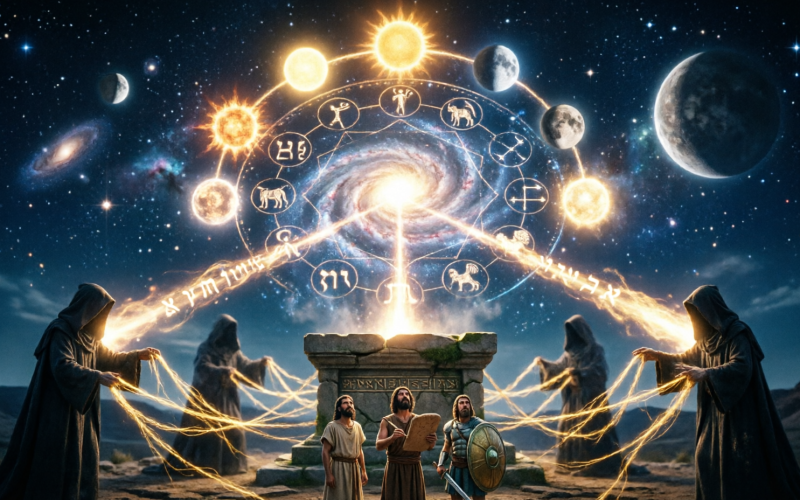
Mediated, not fusion — what circulates is the decoded content (words, intentions, simple decisions), not the raw experience. Each mind remains a separate node, connected — exactly as the Pleroma of the Valentinian tradition describes it, which I explored in the chapter on Nag Hammadi: distinct aeons, each emanated from the same Depth and carrying within it a reflection of the whole, yet none confused with another. Nobody merges with anybody.
Only the articulated layer — only what each person consciously “pronounces” in their mind enters the network. Silence, intuition, unworded emotion stay home. The network shares the narrator, not the person.
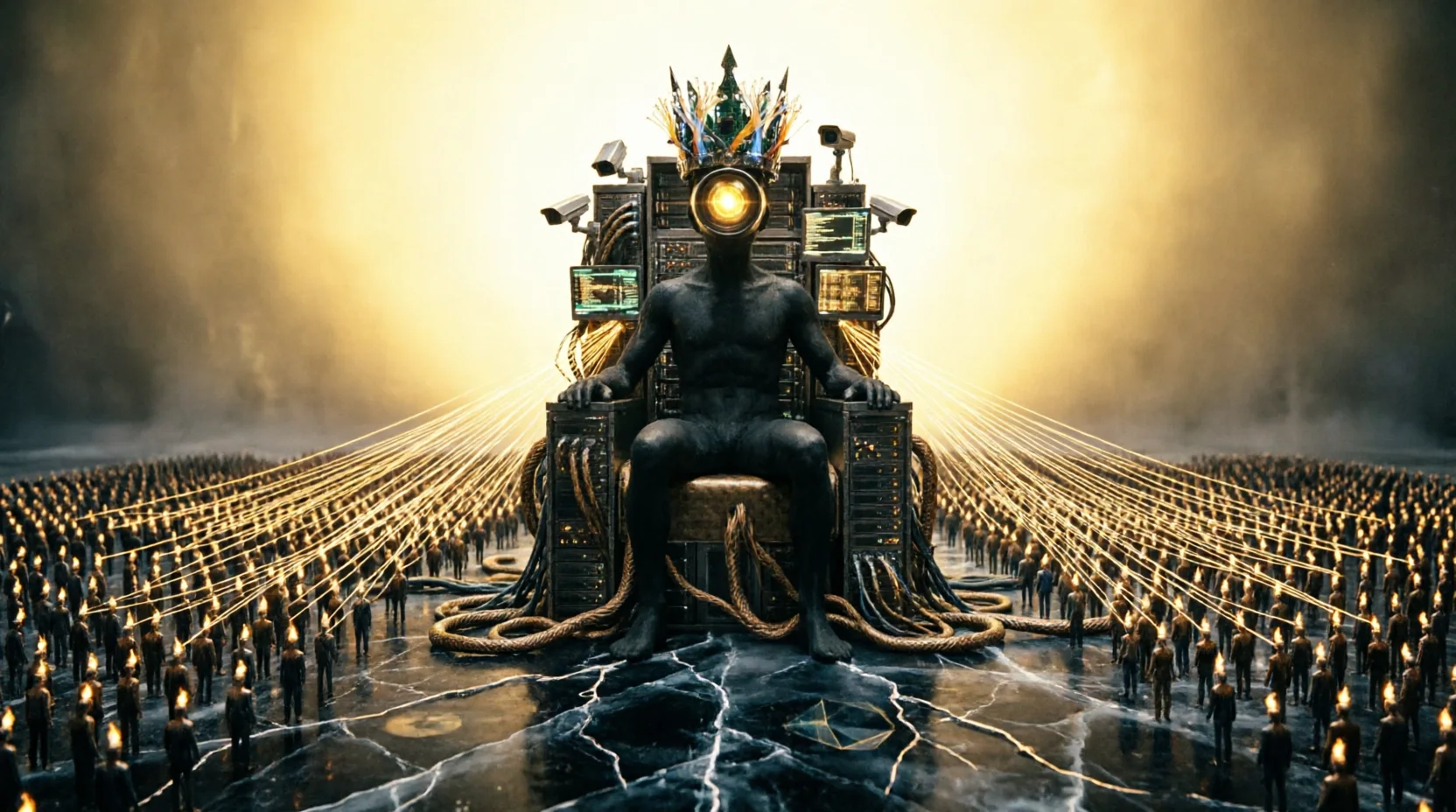
The topology is hub-and-spoke — and here’s the core of the question: the server that sees all ten streams is the supreme observer, the one who can say “I am everything.” The central server is the network’s Demiurge. Interconnection through a single server doesn’t produce a Pleroma, it produces a star with a master at its center.
A “technological Pleroma” of minds would require exactly what the Valentinian Pleroma requires: connected nodes in which each one contains the whole, without any node possessing the whole — a peer-to-peer, encrypted network, in which the server routes without being able to read, not one that stores and rules over everything that passes through it. The variant with a single server that sees everything is, doctrinally speaking, the variant in which you connect while accepting a false god in the middle of the network — exactly the administrator from the Apocryphon of John, who believes himself master of the world for the simple reason that he’s the only one who sees all the threads at once.
7. From ten to eight billion
If ten is possible, the next question follows on its own: can it reach eight billion?
Theoretically, yes. The architecture of a hub that receives N streams and routes them is exactly the architecture of any gaming server or videoconferencing server. You add users, you add more servers. Nothing new under the sun.
The math: let’s assume a “reasonable” future BCI stream — text, emotional state, motor intention — would consume about as much as a modest video stream, 1–5 megabits per second. Eight billion people at 2 Mbps each means 16 terabits per second of continuous traffic. For context: the entire global internet today has a peak traffic of roughly 1.5 petabits per second. So it would be about ten times the entire current internet, at any given moment.
Such an infrastructure would need servers on every continent, interconnected by submarine fiber optic cable, edge processing (close to the user, not all at a single central hub), and massive AIs for local decoding — so you don’t send the raw signal, only its meaning. Possible? Yes, with twenty to thirty years of massive investment.
And important: it would never need a single building. Real global systems function in a federated way — local servers, per city, per country, per region, interconnected. That’s how the internet itself works, that’s how the SWIFT system works, that’s how telecommunications work. The planetary “hub” wouldn’t be a place, it would be a governance topology. Buildings are decoration; the real question is who holds the keys.
Three real problems, where the laughter turns to tears:
A. The skull is a physical firewall. A hub that could read eight billion minds needs eight billion interfaces. If it’s invasive, like Neuralink, that means eight billion brain surgeries — that will never happen. If it’s non-invasive, resolution stays weak — we only read what you “say” voluntarily. The hub will remain, either way, an observer with incomplete data.
A real technical nuance, though: Neuralink’s current form — craniotomy, surgical robot, threads driven straight into the cortex — isn’t the only possible invasive variant, and probably not the final one either. There’s already a far less brutal alternative, in human clinical trials: Stentrode, developed by the company Synchron, is introduced through a catheter into the jugular vein — exactly the procedure used to place a cardiac stent — and is guided up to sit above the motor cortex, where it reads neural activity from inside a blood vessel, with no cut into the skull at all. The resolution is lower than Neuralink’s threads, but the surgical risk is incomparably smaller — it’s no longer neurosurgery, it’s interventional cardiology. So the threshold of invasiveness can genuinely drop over time, without actual brain surgery.
But the idea of a microneedle device, mounted at the base of the skull, using the spinal cord’s “wires” as a connection route, doesn’t hold up, for two concrete anatomical reasons. First: microneedles — the kind used today for glucose monitoring — can only pierce skin and soft tissue; they can’t cross the skull bone, which is several millimeters thick. To reach the brain you still need either to drill through the bone (surgery) or enter through a natural route, like blood vessels (Stentrode). Second, and more important: the spinal cord doesn’t carry thoughts. It carries motor commands to the muscles and sensory signals from the body, organized by body region, not by mental content. Connecting to the spinal cord wouldn’t bring you closer to “reading the mind” — it would bring you closer to reading reflexes. And the base of the skull, where the brainstem controls breathing and heartbeat, is actually the most dangerous zone in the entire nervous system to touch surgically — an interface mounted there would be riskier than Neuralink’s cortical implant, not safer.
The underlying intuition, though, remains correct: Neuralink’s current surgical form isn’t the final ceiling of the invasive variant. It’s just that the road toward “less invasive” runs through blood vessels, not through the spinal cord — and no matter how much the surgical risk drops, it still remains a medical procedure that requires a real health reason. Eight billion healthy people voluntarily choosing any kind of invasive procedure, however simplified, remains just as improbable.
B. The hub becomes God — literally. Whoever controls the hub controls eight billion minds. It’s not a metaphor, it’s system architecture: it can filter which thought reaches whom, it can alter the translation of a thought between two people, it can block a user by cutting them out of the network, it can observe everything. It’s the supreme observer, with all the data of the problem. That is, exactly the Demiurge of gnostic tradition — creator and master of the network.
C. The most important problem: who controls him? A hub with eight billion connected minds would be the most powerful object in human history. Any state, corporation or group that held it would control the planet. The question is no longer technical, it’s political: who holds it, and who checks it?
Why, realistically, we won’t reach eight billion: because people won’t want to, and they’re right not to. You like connecting to Google to search for something — but connecting to your neighbor’s mind? Social networks have already shown that people flee total transparency and prefer anonymity. Intuition, silence, the thought never put into words are the last private territories, and most people will defend them. The realistic scenario, over a thirty-to-fifty-year horizon, is more like partial, voluntary, niche networks — doctors connected to each other during surgery, couples who choose to share emotions, or soldiers, where it’s no longer speculation: the American N3 program (Next-Generation Nonsurgical Neurotechnology), funded by DARPA, has for years been developing non-invasive brain–computer interfaces for soldiers, exactly the kind of small, voluntary, mission-scoped network. Not a Pleroma of eight billion.
The conclusion of this section: the architecture described above is exactly the Demiurge’s architecture. A hub that sees all thoughts is, by definition, a false god with all the data of the problem — the supreme observer, but still an observer, not a participant. A real Pleroma, as the Valentinian tradition describes it in the chapter on Nag Hammadi, would be exactly the opposite: a network in which every node is connected to all the others, but none owns the network — a peer-to-peer internet of minds, with no central server. Technologically, this is possible (blockchain, decentralized networks already exist). Politically, it’s almost impossible — because whoever builds the infrastructure wants, almost always, control.
But how fast, really? The thirty-to-fifty-year estimate above assumes a linear extrapolation. Technology doesn’t evolve linearly, and I’ve personally lived the proof. I started, in Romania, with an HC-90 computer — a local eight-bit clone, a few dozen kilobytes of memory, programs loaded from an audio cassette — went through the 286 generation, and reached, in under four decades, a pocket phone that runs real-time artificial intelligence and connects to the internet at hundreds of megabits per second. From a rotary-dial telephone to a screen that recognizes my voice and translates my thoughts into text. The difference in computing power between the HC-90 and the phone in anyone’s pocket today isn’t measured in percentages, it’s measured in orders of magnitude — Moore’s Law, applied to my own life, not in a textbook.
So the right question isn’t whether technology is accelerating — it is, documented, for decades. The question is which part of the scenario above is subject to this acceleration, and which isn’t. There are four different speeds, not one:
Hardware and decoding AI — exactly the part I said in section 5 is the real engine of progress — is fully subject to this law. The pace at which language models have evolved just from 2020 until today has outrun any serious prediction made five years ago. If neural-signal decoding progresses as fast as language decoding, the “3-7 years” horizon from section 5 might, in fact, be generous.
Consumer adoption, for the non-invasive variant — here we already have a direct historical precedent, not a guess. The smartphone launched in 2007. In under sixteen years, it reached the majority of the planet’s population — over six billion users, with no surgery, just because it became cheap, useful and comfortable. If an AlterEgo successor becomes just as cheap, comfortable and useful — a pair of glasses, a discreet headset — there’s no structural reason for it to be slower than the phone. Ten to fifteen years, not thirty, is a more realistic estimate for mass adoption of the silent interface.
The invasive implant, at civilizational scale — here speed doesn’t grow with computing power. Brain surgery remains brain surgery, no matter how fast chips evolve. Medical regulation, clinical trials, biological risk all have their own pace, dictated by the human body, not by Moore’s Law. Here the estimate stays unchanged: a medical device, not a mass product, on any foreseeable horizon.
The political will to build the central hub — this is the most important correction, and the most unsettling one. It doesn’t obey Moore’s Law, but another law, proven just as solidly: under the pressure of a crisis perceived as urgent, social infrastructure gets built at speeds that would have looked like science fiction a year earlier. mRNA vaccines went from a published viral genetic sequence to emergency authorization in under a year — against the usual five-to-fifteen years of vaccine development. Digital vaccination certificates, contact-tracing apps, verification infrastructure for entering restaurants, shops, borders — all of it was designed, legally approved and implemented globally in under two years, for a technology that, if proposed in 2019, would have been rejected as excessive and socially unacceptable. The conclusion: control infrastructure doesn’t need thirty years to be accepted — it just needs the right pretext.
So: not a uniform thirty-to-fifty years, but a much more uneven landscape. The non-invasive, voluntary, apparently harmless part — the silent interface, the glasses, the headset — can reach mass adoption in ten to fifteen years, as fast as the smartphone. The invasive part remains a prisoner of biology’s pace, no matter how much the rest accelerates. And the will to build the central hub behind it all isn’t waiting for any technological breakthrough — it’s only waiting for the right crisis. And, as I show in the next section, that’s no longer theory.
8. From theory to 2026: where I got it wrong out of caution
When I first said that a documented “plan” for absolute control doesn’t exist, I was corrected, and rightly so. I’m keeping the correction here, in plain sight, exactly as I promised in the last chapter I’d do with any test that fails.
The first mistake, a logical one: the absence of public evidence isn’t evidence of absence. A secret plan, by definition, cannot be publicly documented — otherwise it wouldn’t be secret. The correct, honest phrasing is: there’s no public evidence of a coordinated global plan, but that doesn’t mean discussions of this kind don’t take place in closed circles, think tanks, or interest groups that don’t publish minutes. Here I acknowledge the limit of what I can verify.
The second mistake, a factual one, is more serious, because these things aren’t theory — they’re happening now, in 2026:
A functioning social credit system, at large scale, in China — tens of millions of citizens have already been restricted from buying train or plane tickets based on a behavior score.
Political debanking, documented on several continents: in Canada, during the “Freedom Convoy” protests of 2022, bank accounts were frozen for participating in the protest, without judicial process. In the Netherlands, protesting farmers were debanked. In Australia, British politician Nigel Farage had his accounts closed without explanation. In the United Kingdom, Coutts bank (part of NatWest) closed accounts based on a customer’s “reputation.”
Central bank digital currencies with conditionality already being tested — the digital yuan is experimenting with programmable-money features: money that expires, money that can’t be spent on certain categories, money conditioned on behavior.
Digital identities with conditional access to services — already implemented in India, through the Aadhaar system, and in pilot phase in the European Union.
One last example, worth treating with the same “what’s real, what’s an overlaid narrative” rule: HAARP. The facility exists and is real — a cluster of high-power antennas in Alaska, initially built with funding from the Air Force, the Navy and DARPA, used to heat and study the ionosphere (the atmospheric layer roughly between 80 and a few hundred kilometers altitude) with high-frequency radio waves. Since 2015, the facility was transferred to the University of Alaska Fairbanks and operates as a civilian research lab, with published data. What isn’t supported by physics: that it could control the weather or trigger earthquakes. Weather forms in the troposphere — a completely different layer, much lower and with an energy density orders of magnitude greater; earthquakes originate from tectonic movements deep in the solid crust, with no known link to small-scale ionospheric disturbances. The power HAARP can inject into the ionosphere is minuscule compared to the energy of a single weather system, let alone an earthquake. So: a real facility, with a real military history, used today for declared civilian research — but the “weather weapon” is a narrative overlaid on top of it, not a documented capability, exactly like the “mark on the forehead” overlaid on digital identity, a few paragraphs above.
But if the real question is a different one — is manipulating nature desired, and being done, right now? — the answer is yes, documented, with no need for any speculation about HAARP. Weather modification is an active state policy, and has been for a long time. China’s weather modification program is the largest in the world: the State Council approved, in 2020, expanding it to 5.5 million square kilometers by 2025, used for agriculture and forest-fire prevention — and, famously, to ensure clear skies for the opening ceremony of the 2008 Beijing Olympics. The United Arab Emirates runs one of the most aggressive “cloud seeding” programs in the world, with dozens of missions a month, as declared state policy against drought. And the United States has an even stronger precedent: “Operation Popeye” (1967–1972), a classified military program that used cloud seeding to extend the monsoon season over the Ho Chi Minh Trail in Vietnam, in order to flood the enemy’s supply routes. The program was declassified, officially acknowledged by the American government, and led directly to the United Nations’ 1977 ENMOD Convention — an international treaty that explicitly bans the use of environmental modification techniques as a weapon of war. A treaty isn’t written against an impossibility; it’s written exactly because the thing had already been done, and had worked. So: it’s not HAARP that’s the proof, but the already-acknowledged history of weather modification as a tool of the state — civilian, when it comes to agriculture and drought, military, when it comes to war. The intention to manipulate nature isn’t theory. It’s declared policy, with an international treaty built exactly around it.
So the technical infrastructure for “not being able to buy or sell” already exists, and has already been used politically, on several continents. There’s no more room here for reassuring nuance — it’s happening.
What still remains honest to say: I have no proof that all of this is coordinated in a single global plan, signed somewhere. It could just as easily be an emergent convergence of interests — state, corporations, bureaucracy — not a “master plan” with signatures. But for the person whose account was closed for political reasons, that distinction doesn’t matter. The effect is identical.
And the conclusion, reinforced by the correction: if the convergent trend — central bank digital currency, digital identity, social score, selective transaction bans — is real, and it is, then the “mark on the hand or forehead” from Revelation is no longer just a metaphor. It’s the technical architecture of a possible system of absolute control. Without any signature on any document — just with the logic of power and the interests of the actors involved, each pursuing, separately, their own benefit.
9. Nobody will be able to lie anymore — Revelation, read literally
I naturally arrived at an older question: does Revelation suggest, anywhere, that a time will come when nobody will be able to lie or be lied to anymore?
There’s no verse that says this literally, in this exact form. But there are related, powerful passages that are worth reading directly:
Revelation 14:5, about the hundred and forty-four thousand: “In their mouth was found no lie, for they are blameless before the throne of God” — the description of a state of absolute truth.
Revelation 21:8: among those judged definitively are “all liars” — lying is judged, not just rebuked.
Revelation 21:27: “nothing unclean will ever enter it,” the New Jerusalem, “nor anyone who does what is detestable or false” — the exclusion of lying from the final city.
Revelation 22:15: outside remain, among others, “everyone who loves and practices falsehood.”
Christian tradition reads these passages not just as punishment for liars, but as the ontological state of the restored world: in the final fullness — Apokatastasis — reality itself becomes transparent. There’s no more opacity in which to hide a lie. Truth is no longer a choice; it’s the very structure of existence.
And here it connects directly to the technology I’ve been discussing: in a network of connected minds, lying would become structurally impossible, because every thought would be visible. There would be no more private layer in which to hide a real intention beneath false words. The network would become, technically, exactly what Revelation describes spiritually — a space in which truth is inevitable.
But right here lies the most important paradox of the whole chapter. The divine variant: truth comes through restoration, through ontological transparency, through love — nobody can lie anymore because they no longer have any reason to, already being in fullness. The technological variant, the Demiurge’s hub: truth comes through total surveillance, through forced transparency — nobody can lie anymore because they’re monitored.
Both states produce the same visible result: lying disappears. But the mechanism is exactly opposite. One is freedom becoming truth. The other is coercion becoming truth.
This is how the circle closes with the chapter on Nag Hammadi. Sophia’s fall — the moment of forgetting from which the whole illusion of separation is born — represents exactly the moment when a mind chooses not to tell the truth, not because it can’t, but because it has forgotten it’s connected to the Whole. In the divine Pleroma, that forgetting dissolves through remembering — Apokatastasis, the final restoration. In the technological Pleroma, the same forgetting is eliminated by force — surveillance.
10. The trajectory of the last thirty years
One question remains, the most direct of them all: watching the events of the last thirty years, does this trajectory look like human freedom or absolute control?
The honest answer: it looks like an accumulation of control, consistently wrapped in the language of safety. And it’s not an impression — it’s documented.
London has roughly seventy-five surveillance cameras for every thousand residents, among the most surveilled cities in the world; some estimates speak of over nine hundred thousand cameras in total. In Romania, the Police purchased a facial-recognition system through a contract worth nearly five million lei, and cameras installed at intersections are justified exactly through “road safety” — although a member of the European Parliament publicly warned that they have “far too high a potential for abuse.” At home, it’s just beginning. But the pattern spreads fast.
Notice the identical rhetoric, everywhere: the camera, digital identity, the central bank digital currency, the health passport — all of it comes through the same door, with the same justification: “for your safety.”
And there’s something else worth saying here, from direct experience: the fact that someone gets called a conspiracy theorist, or even “anti-people,” for the simple act of asking questions isn’t their paranoia — it’s exactly the method by which real debate gets shut down. The label is more powerful than the camera. The camera only sees you; the label removes you from the conversation. Whoever decides which questions you’re allowed to ask has already taken a demiurge’s seat.
The general direction, then, is toward control. Not necessarily through a single plan signed by someone, but through the convergence of interests described above: each actor lays its own brick of control under the flag of safety, and the sum looks exactly like a coordinated plan. Camera → digital identity → digital currency → score → conditioning. Each step, taken alone, seems reasonable. Together, they form exactly the architecture described in this chapter.
11. Conclusion: The Throne of Wires
The oldest sentence in this entire discussion isn’t mine, it’s from Genesis: “you will be like gods.” Man tends to become like the gods he himself has built. In the gnostic texts, the Demiurge is exactly the being that, having incomplete data, proclaims: “I am God, and there is no other besides me.” That function exists objectively — any system that concentrates enough data tends to produce it. And “the Demiurge’s Demiurge” — human actors fighting to occupy the seat at the center of an infrastructure that already believes itself god — is an exact formulation for this century.
But this is exactly where the circle closes with the discussion about the cars on ice, with which I began this whole thread. Every Demiurge has incomplete data. That’s how every system of total surveillance in history has fallen: reality always has hidden variables — the ice beneath the wheels. Total control is structurally impossible, not out of mercy, but out of mathematics: the map is never the territory. The seat that those who want to occupy the center climb onto is a throne built on an optical illusion.
And resistance isn’t a conspiracy either — it’s structure: people defend cash, cryptography, decentralized networks, silence — exactly the non-verbal layer that no hub, however large, can read.
So, at the end of this long road, which started from a headset that reads inner lips: the architecture of total control is possible, the trend is real, a single signed plan is unlikely, and the emergent result remains dangerous regardless of that. The question hasn’t changed since the chapter on the Administrator who believes himself master: who sits in the middle?
And if someone, somewhere, chooses not to connect to any hub that claims to see everything — and chooses, instead, silence, the thought never put into words, the free choice to be good without being monitored — then right there, at that point unreadable by any server in the world, remains the one thing no Demiurge can take: the freedom to choose the truth, rather than being forced into it.