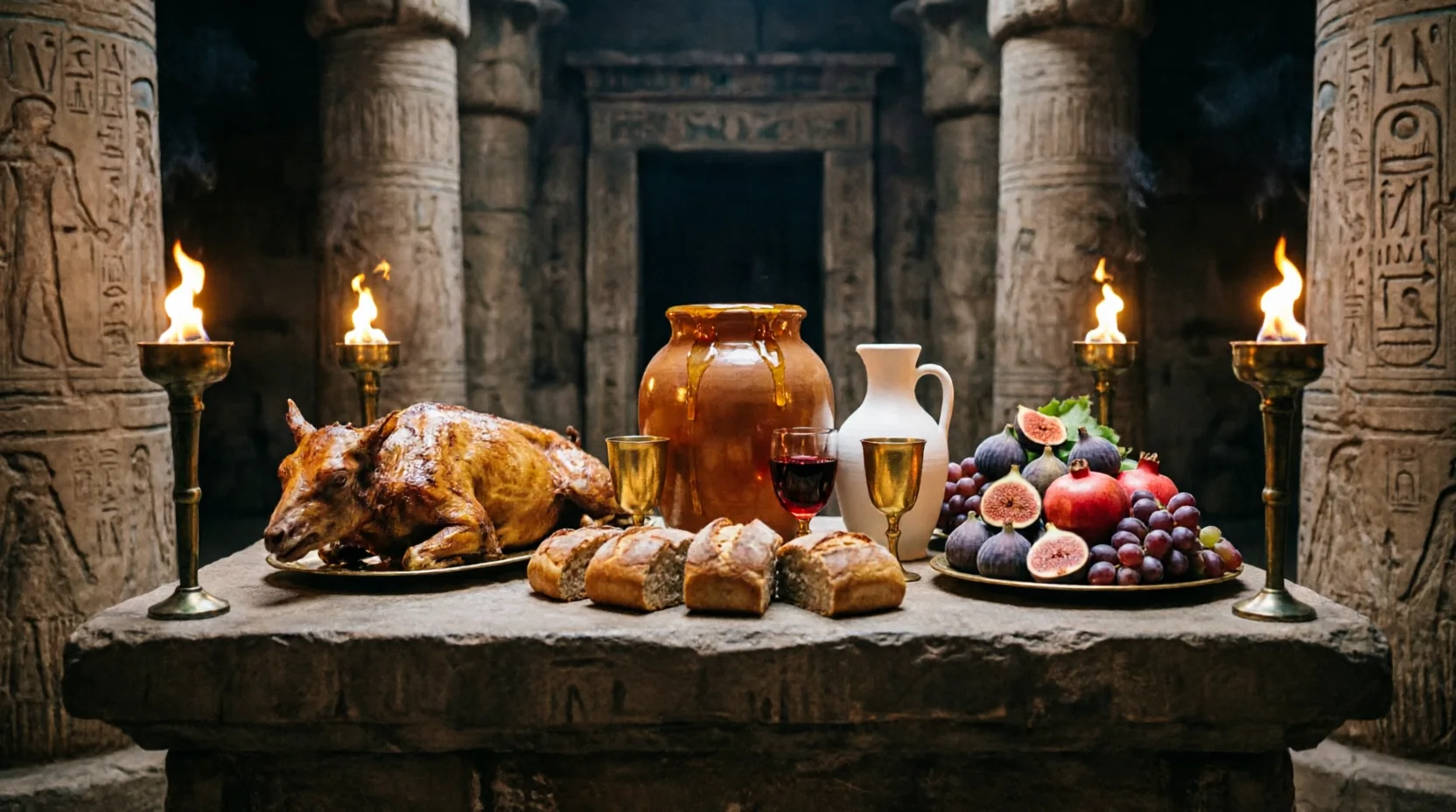
We gathered every food offering ever documented, from every religion, to every god on record. Not hearsay — from tablets, from tombs, from ritual texts that survive to this day. The pattern that emerges at the end is far more unsettling than it first appears.
1. The universal menu — a cold synthesis
Regardless of continent, the gods are always served, with an almost suspicious consistency, the same narrow set: bread or grain, a fermented drink (beer or wine), honey, milk, meat, and the first fruits of the harvest. This isn’t a random list — it’s exactly the luxury calories of an agricultural economy: the refined, processed surplus, the very best, never the leftovers.
The consumption mechanism is just as universal as the menu. The god receives the “aroma” or “essence” — the smoke of burnt meat, the steam of warm bread, the first taste from a vessel. The rest, the actual substance, is eaten by the priests. The Egyptians even had a technical term for this, wDb-rd — the “reversion of offerings”: food placed before the statue was declared “consumed” by the god, then redistributed, in stages, to the priesthood and further down to temple staff. Read economically, the offering was simply the institution’s payroll — the god “consumed” the intangible essence, the administration consumed the real calories.
2. The consumption mechanism: who actually eats
The Greeks even have an explicit story about how this rule got fixed. Hesiod tells how, at the first division of a sacrificed animal, Prometheus tried to trick the gods: he wrapped the bones and fat in an appetizing package and the good meat in an unappealing one, letting Zeus choose. Zeus “chose” the pretty package — the bones and fat — and from then on that remained the gods’ share at every sacrifice (thysia), while humans kept, “by Zeus’s mistake,” the actual meat. It’s an etiological legend, but it captures exactly the mechanism documented everywhere: the god takes the symbolic/intangible part, humans (through priests) take the material rest.
The Mesopotamians had a parallel ritual for the dead too, not just for gods — kispu, the ritual feeding of deceased ancestors with bread and poured water. Practically the same gesture, applied to another category of “unseen presences that still need calories” — which shows that the underlying idea (invisible beings that still eat) wasn’t isolated to gods, but a broader principle applied to any entity presumed to exist beyond the body.
3. The anomaly that actually matters
Here’s the part that should make you pause for a moment. If the gods had been, from the very start, purely abstract concepts — principles, forces, symbols — no civilization would have had any reason to put food on their table twice a day, kept with bureaucratic precision worthy of a modern warehouse. And yet that’s exactly what we find, independently, on every continent: daily rations, tablet lists, jars of honey left specifically for those “beyond.”
People feed what they know, or remember, eats. The simplest hypothesis, not necessarily the most comfortable one, is that the system originated with entities that genuinely consumed calories — and once the practice became institutionalized, it perpetuated long after anyone remembered why it started. From Sumer to the Yoruba, all the gods “ate.” And their menu, everywhere, is the menu of a biological body — not a spirit.
4. The catalog, civilization by civilization, with evidence for each
Not hearsay — from physically preserved tablets, tombs, and ritual texts.
Mesopotamia (Sumer / Akkad / Babylon) — the most complete “supply registers” in all of ancient history. Cuneiform tablets from the temple archives of Ur and Uruk list the gods’ daily rations, served in two meals a day: dozens of varieties of bread, beer, wine, milk, clarified butter (ghee), dates, mutton and beef, fish, barley and wheat. An and Enlil received full meals; at festivals, dozens of animals at once. The texts say explicitly that the gods “eat” and “drink” — and when humans stopped the sacrifices after the Flood, the gods, literally, “went hungry.”
Egypt — bread, beer, wine, milk, beef and goose meat, figs, dates, grapes, cucumbers, onions, honey, cakes. Found physically in tombs, not just written: jars of honey (some still edible after thousands of years), ritual breads, wine labeled with the vintage year and the producer’s name (Tutankhamun’s tomb), mummified/preserved beef. Amun-Ra received dozens of loaves and jugs of beer daily; Osiris — grain and beer; Hathor — wine and honey.
Greece — at the thysia, the sacrificed animal was burned on the altar for its bones and fat (the smoke rose to the gods), while humans ate the actual meat — exactly the mechanism explained by the legend of Prometheus above. Wine, honey, milk, barley, ritual cakes (pelanos), fruit, cheese, figs. The Linear B tablets, the oldest surviving Greek texts, already list offerings to the gods: oil, wine, honey, grain, cheese, figs. Zeus received the hecatomb (100 oxen at once); Demeter — grain and first fruits; Dionysus — wine; Athena — olive oil and honey cakes.
Rome — mola salsa (salted flour, ritually prepared by the Vestals), wine, milk, honey, fruit, grapes, eggs, cakes (libum); at the suovetaurilia — a pig, a sheep, and a bull sacrificed together.
Israel (the Temple) — the “bread of the presence,” twelve loaves replaced weekly and eaten by the priests; mincha, fine flour with oil and frankincense; wine libations; first fruits (bikkurim); salt; animals burned “as a pleasing aroma to the LORD.” The text literally calls it “the bread of his God” (Leviticus 21:6) — a phrasing that, taken strictly at face value, is hard to distinguish from any other food ration on the list.
Canaan / Phoenicia — “cakes for the Queen of Heaven” (Jeremiah 7:18), honey, oil, wine, animals.
Vedic / Hindu India — soma, the sacred drink; ghee poured directly into fire, with Agni acting as the “courier” who carries the offering onward; milk, rice, barley, honey, fruit. There are even fixed god-food pairings: Ganesha receives modaka (sweet dumplings); Krishna, butter and milk; Shiva, milk, honey, and ghee, in the abhisheka ritual.
Zoroastrianism — haoma, the sacred drink equivalent to Vedic soma; bread (draonah), milk, meat, fruit, all in the Yasna ritual.
China — rice, millet, wine, tea, fruit; the “three victims” (pig, ox, sheep). The Kitchen God, Zao Jun, is given honey and sweets specifically, so that, on the twenty-third day of the last lunar month, he reports to Heaven only “sweet” things about the family — practically a local administrator bribed directly with sugar.
Japan (Shinto) — shinsen: rice, sake, salt, water, fruit, fish. At the Ise Shrine, Amaterasu receives the first rice harvest and new sake every year, at niinamesai.
Mesoamerica (Aztec / Maya) — corn, tamales, cacao (the drink of the gods), honey, pulque, amaranth-dough figurines (tzoalli) symbolically “eaten” by the gods — a ritual some comparative scholars place alongside the structure of the Christian Eucharist, as an independent pattern. Huitzilopochtli and Tonatiuh were “fed” with blood and hearts — in their internal logic, the sun simply didn’t function without this fuel.
The Andes (Inca) — chicha (corn beer) poured onto the ground as a libation, coca leaves, corn, cuy (guinea pig), llama meat — all for Inti.
Norse / Germanic — at the blót: horse, boar, or cattle meat, mead and beer poured as libations, bread. Odin received wine or mead — the meat from his table, the texts say, he gave on to his wolves.
Celtic — milk, honey, cakes, grain, mead, left at springs and in places considered sacred.
Yoruba / West Africa — kola nuts, palm oil, honey, palm wine, yams, beans. Fixed pairings here too: Oshun receives honey and oranges; Obatala, white food — rice, coconut; Ogun, palm oil, kola, and gin.
Slavic — ritual bread (korovai), honey, mead, grain, eggs; kutia — boiled wheat with honey and poppy seed — specifically for ancestors, not for gods, the same logic as the Mesopotamian kispu.
5. The conclusion: the same menu, everywhere
Put twenty traditions side by side that never had any real contact with each other — the Andes and Japan, the Yoruba and Scandinavia — and you find, every single time, the same structure: bread or a staple grain, a fermented drink, honey, milk, meat, first fruits. The same division: god-receives-the-essence / priest-eats-the-rest. The same daily bookkeeping, kept with a seriousness you never apply to an abstract symbol.
Either this is independent cultural convergence — hunger and agriculture produce, everywhere, the same symbolic solutions — or it’s the trace of a much older and more concrete pattern than we’d like to admit, in which the “gods” genuinely needed, literally, what was placed on the table for them. The documents don’t decide between the two on their own — but they stubbornly refuse to support the version in which the gods were always just ideas.