1. The God perceived by people and the God deduced by philosophy
The starting question seems simple: how is God perceived by people — is God a man, and if not, what is He? I want a definition based on what people believe, and another based on what He might actually be in reality, without fabrication, sticking strictly to the writings and to the information available, as objectively as possible.
On the text, chronologically, there is a huge, documented discrepancy between how God initially appears in the text and how He is later defined by theology. In the early Torah, God is almost human:
– Genesis 3:8 — He walks in the garden “in the cool of the day,” as if He had a body and a schedule.
– Genesis 6:6 — “the LORD repented that he had made man” — He regrets, He changes His mind, which implies He didn’t know in advance how the experiment would turn out.
– Exodus 33:20-23 — Moses cannot see God’s “face,” but he can see His “back” — a text that literally presupposes a physical form, a body with a front and a back.
– Genesis 18 — God comes to Abraham as three men, eats, negotiates, haggling over the number of righteous people in Sodom, as in a market bargain.
– Genesis 2:7 — He breathes (breathes the breath of life), a physical, biological act.
The oldest layer of the text, then, does not present an abstract, transcendent, bodiless being — it presents an anthropomorphic character, with emotions, indecision, a localized physical presence. Later, under Greek philosophical influence (Philo of Alexandria, 1st century AD, who fused the Torah with Platonism; then Thomas Aquinas, Augustine), the image is rewritten: God becomes immaterial, all-knowing, all-powerful, outside time and space, the “Necessary Being” — a philosophical construction, not an original biblical one. The Quran makes a similar move: it insists on radical transcendence (“nothing resembles Him,” 42:11), but still keeps expressions like “the hand of Allah,” “the face of Allah” — which Islamic theologians (the Ash’arites) debated for centuries as to whether they are literal or metaphorical.
The documentary conclusion for this first layer: popular perception of God is not unified — to this day there coexists an old, anthropomorphic image (an old man with a beard, up in the sky, with human emotions — an image enormously reinforced culturally by the Sistine Chapel) and a refined, abstract, non-physical theological definition. There is even cognitive research (Justin Barrett, “cognitive science of religion”) showing that people implicitly think about God in anthropomorphic terms (as an agent who thinks, wants, communicates in sentences) even when the official doctrine they hold insists on pure transcendence — a documented gap between what is declared theologically and what is naturally, cognitively processed.
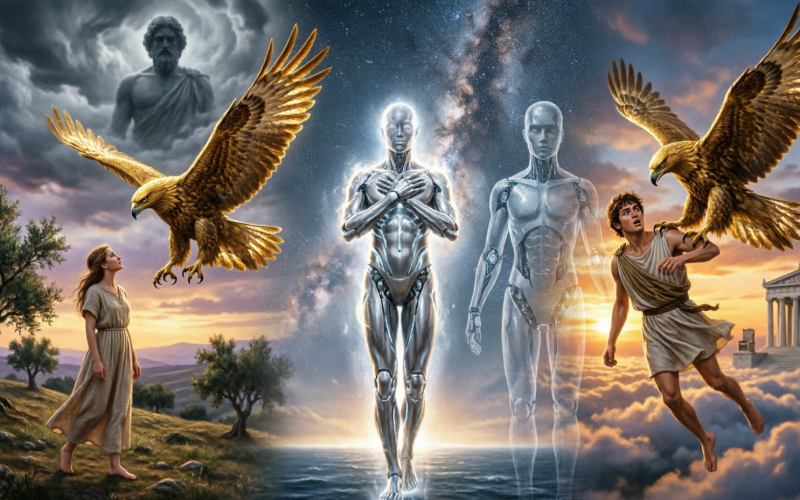
What remains is the question of what God could actually be, without fabrication. Here I must be strictly honest: there is no third source of “objective data” beyond three categories. The first is what the texts say, already covered above — this is not independent information, it is testimony of people’s belief. The second is what rigorous philosophy deduces, through cosmological arguments: Aristotle’s “Unmoved Mover,” Thomas Aquinas’s five ways, Avicenna’s “Necessary Being.” These do not start from revelation, but from pure logic — if every effect has a cause, and the causal chain cannot be infinite, there must be a first, uncaused cause. From the pure logic of the argument, this “first cause” should be: without component parts (otherwise it would need a cause for the assembly of the parts), outside time (it created time, so it is not subject to it), without change (change presupposes an external cause). This is a rigorous philosophical conclusion, documented for centuries, but it remains logical deduction, not empirical observation — there is no way to “verify” a Necessary Being experimentally. The third category is speculative modern reinterpretations — the theory of a superior civilization, computer simulation, etc. — hypotheses, not verified facts, however coherent they may be with the pattern under discussion.
So, if I want an “objective” definition in the strict sense, the most rigorous, non-fabricated one is the philosophical one: a first cause, uncaused, simple (without parts), timeless. Everything else — personality, intentions, morality, communication with people — cannot be deduced from pure logic; it comes from revelation/tradition or from speculation. Practically, we have a God of the people (anthropomorphic, emotional, narrative) and, separately, an abstract philosophical conclusion about a “first cause” — and the bridge between them, namely the hypothesis that the first cause would have personality, would want to be worshipped, would write books through human intermediaries, is not logically demonstrated, it is a leap of faith. That’s honest, without fabrication.
2. God’s behavioral profile, strictly on the text
The natural next step is to go through all the major segments of the text — Genesis, Exodus, the historical books, the prophets, Job, Psalms, the New Testament, Revelation — and build a strictly behavioral profile of God: what He does, what He says, how He reacts, without theological gloss over the text.
The first thing that emerges is that He does not seem omniscient, at least not in the oldest layer. Genesis 3:9 asks Adam “Where are you?” and “Who told you that you were naked?” — questions that presuppose He doesn’t already know the answer. Genesis 22:12, after the test with Isaac, says “now I know that you fear God” — implying that before, He didn’t know for certain. Genesis 6:6 — “the LORD repented that he had made man” — regret, which presupposes the outcome wasn’t fully anticipated. Exodus 32:14 — “the LORD repented of the evil which he thought to do” — He changes His decision following Moses’s argument.
The second notable trait: He is extremely emotionally reactive, not a serene presence. Text after text — explicit jealousy (“I am a jealous God,” Exodus 20:5), frequent anger described physically (His nostrils flare — a literal expression in Hebrew), regret, tenderness (the metaphors in Hosea, where Israel is the unfaithful wife), suffering (“it grieved him at his heart,” Genesis 6:6). Behaviorally, He resembles a character with strong reactions, not an immutable entity.
The third element: He insists repeatedly and defensively on exclusivity. “I am the LORD, and there is none else” appears formulated in almost identical terms many times in Isaiah (45:5, 45:18, 45:22) — a repetition which, behaviorally, suggests a real rhetorical competition, not a calm axiom. This fits the historical context — Israel existed among polytheistic neighbors, and strict monotheism is a position actively defended, not a self-evident one.
The fourth: He is obsessed with procedures and meticulous detail. Exodus 25-30 devotes entire chapters to the exact dimensions of the Ark, the materials of the priestly garments, the incense recipe. Leviticus details exactly which animal organs are burned, in what order. Behaviorally, this is a profile oriented toward protocol and strict ritual compliance, not toward abstract general principles.
The fifth: He uses collective violence, on a large scale, as an instrument. The Flood (Genesis 6-8) wipes out all life except one family. The herem (Deuteronomy 20:16-17, Joshua 6:21) involves explicit orders for the total extermination of conquered populations, including women, children, animals. In 1 Samuel 15, Saul is punished precisely for NOT killing everything (including the animals) as ordered in the extermination of the Amalekites. Behaviorally, He repeatedly resorts to mass elimination as a solution, not only in exceptional cases.
The sixth: the relationship is transactional, conditional, not unconditional. The structure of the covenant is always “if… then” — Deuteronomy 28 explicitly lists blessings for obedience and detailed curses for disobedience. It does not appear as unconditional love in the old layer, it appears as a contract with clauses.
The seventh: He moves from a localized physical presence to a universal abstraction over the course of the text. In Genesis He walks through the garden, comes to Abraham’s tent as a guest who eats. In Exodus He lives in a specific tent, with a precise address (the Holy of Holies). By Isaiah 40+ (“To whom then will you liken me?”, 40:18) and the New Testament (“God is spirit,” John 4:24), He becomes ever more abstract, without a physical location. It is a documentable trajectory, not a constant property.
The eighth: He does not operate alone, He functions through a hierarchical structure. The heavenly court (Job 1, 1 Kings 22:19 — “I saw the LORD sitting on his throne, and all the host of heaven standing by him”), angels with delegated roles, “sons of God” — this fits what has already been established about Satan: it looks like a system with a functional hierarchy, not a single, omnipresent actor who does everything personally.
The ninth: He responds to negotiation and mediation, He is petitionable. Abraham bargains over the number of righteous people in Sodom (Genesis 18:22-33) and God progressively concedes, from 50 down to 10. Moses repeatedly intercedes for Israel and “the LORD repented of the evil” (Exodus 32, Numbers 14). Behaviorally, His decision is not fixed, it is open to argument.
The synthesized description, strictly on the data: the text reveals a powerful, authoritarian character, extremely emotionally reactive, who does not possess complete knowledge in advance (He tests in order to find out), who changes His decisions under the pressure of argument, who insists defensively that He is the only one of His kind, who pays obsessive attention to procedures and ritual, who uses drastic collective violence as an instrument of control, whose relationships with people are contractual, not unconditional, who operates through a court/hierarchy, not alone, and whose presence moves from physical/localized to abstract as the text advances in time. Practically, if I were to analyze Him as a textual character, with no prior theological assumption, I would describe a powerful leader/administrator, with absolute local authority, under constant pressure to maintain His control and exclusivity, who makes decisions as events unfold, not from a position of fixed omniscience — much closer to the profile of a leader within a real power structure (political, military, administrative) than to the philosophical abstraction of a “Necessary, timeless, immutable Being” discussed earlier.
3. The God of Israel: a national deity, not universal from the start
The next question that arises is whether this biblical God is the God of the Jews, correct, even though He presents Himself as being over all people — and whether, analyzing the gods of other peoples, similarities appear, given that the Jews, during those periods of dialogue with God, also existed on their own territories, far from the territories of other peoples, perhaps on other continents.
The answer is yes — correct, He was initially the specific God of the Jews, not universal from the start, and the proof is right in the text, not speculation. Deuteronomy 32:8-9, in its oldest version (preserved in the Qumran manuscripts and in the Septuagint, not in the later Masoretic text, which was altered), says: “When the Most High divided to the nations their inheritance… he set the bounds of the peoples according to the number of the sons of God… for the LORD’s portion is his people; Jacob is the lot of his inheritance.” This text shows a supreme deity (“the Most High”/El Elyon) dividing the peoples of the world among several “sons of God” — and YHWH receives Israel as His own portion, just as other gods receive other peoples. It is almost identical to the structure of the Canaanite pantheon (El, the supreme god, with 70 divine sons), from which early Israelite religion appears to have branched off.
Judges 11:24 confirms the same pattern: Jephthah tells the Ammonites, “Will not thou possess that which Chemosh thy god giveth thee to possess? So whomsoever the LORD our God shall drive out from before us, them will we possess.” He explicitly treats the neighbors’ god as being just as real as YHWH — merely someone else’s god, not Israel’s. Only in Isaiah 40-55, during the period of the Babylonian exile (6th century BC), does universalized monotheism appear, explicit and insistent: “I am the LORD, and there is none else” (45:5, 45:18, 45:22) — a new claim, extending YHWH from “the god of Israel” to “the only god that exists, anywhere.” The trajectory is thus clearly documented: national/tribal deity first, rhetorical universalization only much later.
Regarding the gods of other peoples from the same period, an important distinction must be made, depending on what is meant by “other territories, perhaps other continents.” The direct neighbors — the Canaanites, the Mesopotamians (Sumerians, Akkadians, Babylonians), the Egyptians — were contemporaries of early Israel, and there are documented direct connections, not mere coincidence: the inscriptions at Kuntillet Ajrud (8th century BC) mention “YHWH of Teman” and “YHWH of Samaria,” showing that early Yahwism was a regional Levantine phenomenon, not something that arose in isolation on another continent. The Epic of Gilgamesh/Atrahasis (Mesopotamian) has a flood myth almost identical to the one in Genesis — not independent parallelism, but documented cultural borrowing, from the same geographic area.
Truly distant civilizations — India, China, the Americas — are a different matter. Vedic religion in India (Rig Veda, ~1500-1200 BC) is roughly contemporary with early Israel, as is the religion of Shang/Zhou dynasty China, but there is no evidence of contact or cultural exchange between them and the Israelite tradition. They are independent, parallel developments of human religious psychology (similar motifs — a sky-god, a storm-god, creation narratives), not the product of the same “group” interacting globally. Mesoamerican civilizations (Maya, Aztec) are even more problematic chronologically — the written texts we rely on (the Popol Vuh) are much later, from the colonial period, even if the oral traditions might be older.
To be precise: yes, “parallel” gods existed all over the world in that period, but those in the immediate vicinity of the Jews (Canaanites, Mesopotamians) are documented as historically/culturally connected to early Yahwism, not independent; those on other continents (India, China) are independent, but with no demonstrable link to Israel — a coincidence of human pattern, not the same “story” told by another group from the same “Us.” I cannot maintain, based on the documents, that they were literally “the same entities, on other continents” — that would be a plausible theory as speculation, but not confirmed by anything concrete, textual or historical.
4. The Most High and the sons of God: what the text confirms, where extrapolation begins
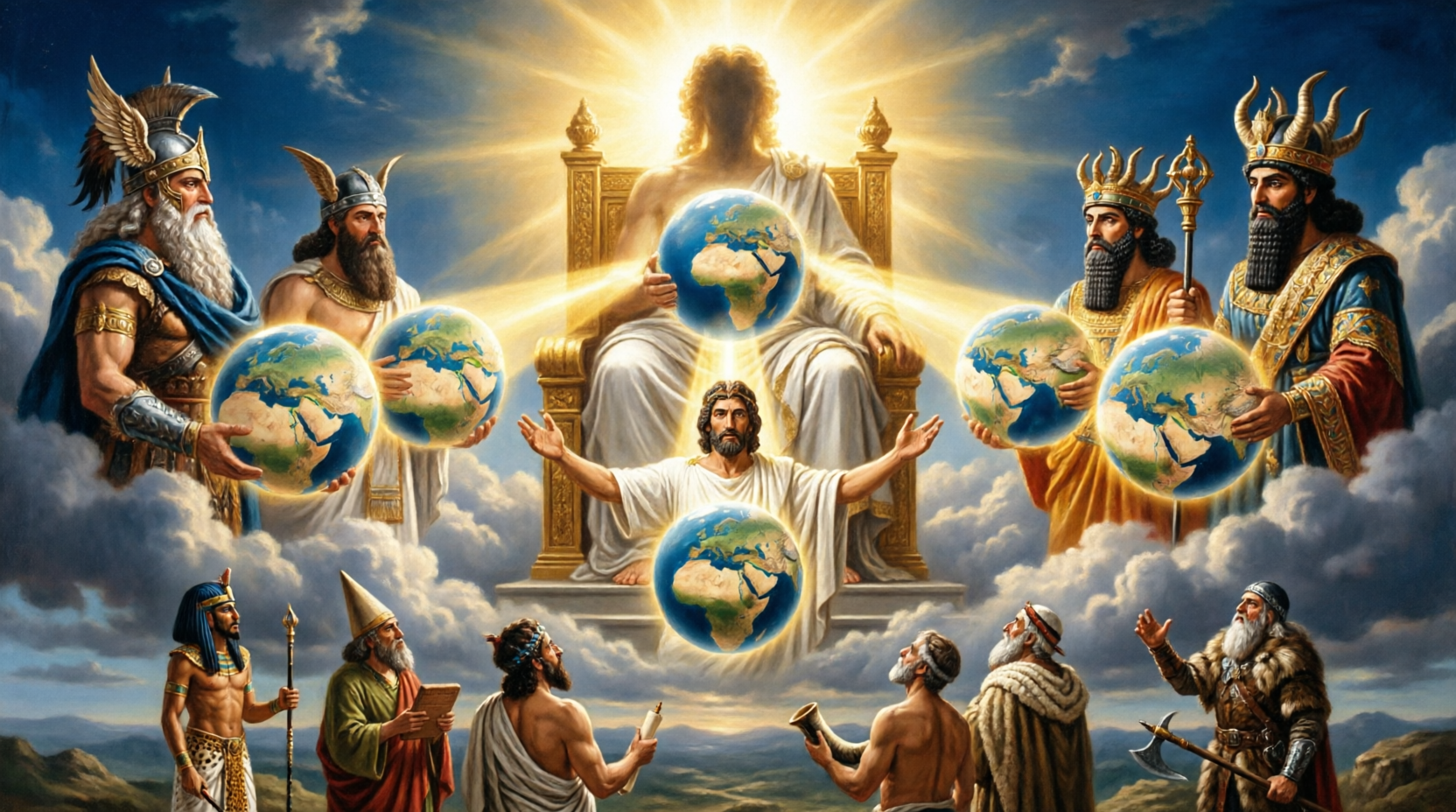
The passage in Deuteronomy 32:8-9 — “When the Most High divided to the nations their inheritance… he set the bounds of the peoples according to the number of the sons of God” — deserves to be clarified fully, because it appears to describe a Supreme God dividing the Earth and its people among different zones of the planet. From this, as a hypothesis, one might derive Odin in the North, and the gods of India, with the Supreme God, the Most High, being the supreme authority over all the other gods — the God of the Jews included, who would in fact be one of the Supreme God’s sons, receiving, without any official agreement, a territory and some people. Added to this is the pattern of the “fabrication” of man, present in all the world’s religions, from Israel to Mexico, which would suggest that people were not here from the beginning, but were “built” and then subjugated by earlier and more advanced creators.
What the text says must be separated precisely from what is added through synthesis — because there are points where this interpretation is documentedly correct, and points where a leap is made that is no longer supported by the text. What the text confirms, exactly: in the oldest reconstructed layer (Qumran, Septuagint), there really is a distinction between “the Most High” (El Elyon), who divides the peoples, and YHWH, who receives Israel as his own portion. This fits perfectly with the Canaanite mythology documented in the Ugarit tablets (14th-12th centuries BC): there, El is the supreme patriarch god, with a court of 70 “sons” (Baal, Anat, Yam, Mot, etc.) — exactly the structure described.
But something important needs correcting, so as not to build on a mistaken assumption: the El/YHWH distinction does not remain stable throughout the Bible, it disappears through fusion. As Israelite religion evolves, YHWH takes over El’s identity and epithets (El Elyon, El Shaddai later become just other names for YHWH, not for a separate god superior to Him). So Deuteronomy 32:8-9 is a textual fossil from an early stage, not the final/consistent position of the religion — the rest of the Bible, the overwhelming majority of the text, treats YHWH AND the Most High as the same entity, not as boss and subordinate. So it cannot be said that “the God of the Jews is different from the Supreme God” as a general biblical position — that is true only for this old, isolated fragment, which survived as a trace, not as continuous doctrine.
Linking this framework to Odin or the gods of India, however, is a leap with no textual support. The framework in Deuteronomy 32 refers to “70 nations” — a number that corresponds exactly to the list of peoples known to the ancient author (Genesis 10, the “Table of Nations” — Egypt, Assyria, Aram, Canaan, etc.). It is a cosmological map of the ancient Near East, not a global one. The author of the text had no knowledge of Scandinavia or India to include their respective “sons” in his scheme. Linking Odin or the Indian gods to the “sons of Elyon” from this specific text thus remains an extrapolation, not something the document supports — plausible as one’s own theory, but not confirmed here.
On the “fabrication of man,” however, the idea is correct — it is a real, widely documented pattern. It genuinely exists, seriously documented: the Mesopotamians (man made from clay + divine blood to work for the gods — exactly the pattern discussed with Enki/Enlil), the Egyptians (Khnum shapes man on the potter’s wheel), the Greeks (Prometheus shapes man from clay), the Mesoamericans (Popol Vuh — the gods try several times: mud, wood, corn). The motif of “man shaped from clay by a creator” is indeed universally widespread. But here is the important point of precision: the fact that the pattern is universal does not automatically prove that the same literal group did this everywhere. The standard academic explanation for the recurrence is different — cultures that used pottery had, independently of one another, the same intuitive analogy at hand (“we are shaped from clay, like the pot I make”) — a convergent narrative invention, not necessarily proof of a single, literal, common historical event. Both explanations (a common group vs. independent parallel invention) are theories — the archaeological/textual evidence does not clearly decide between them, and the version “the same literal group, everywhere” remains one’s own synthesis, not the established conclusion of comparative religion.
So, as a direct answer: yes on the El/YHWH distinction in the oldest text, not on extending it to Odin/India without textual basis; yes on the universality of the “man was fabricated” motif, but not on the interpretation that it automatically explains a single group of planetary creators — that remains a synthetic hypothesis, coherent as a narrative, but beyond what the documents can confirm.
5. The cosmic middle manager: the comparative pattern of gods promoted to supremacy
Still, a real discomfort remains with strict limitation to the text: the writings of the Jews about God are tied to what they were told, not necessarily to objective reality — how could the Jews have known that one of those “sons” was actually Odin? A similar phenomenon exists in modern society, when a lower-ranking manager lets his subordinates believe he is the supreme authority. If the God of Israel told his people, with no clear explanation from the Supreme God, that he is the absolute authority, without equal, then those who wrote the biblical texts may well have had no direct access to the decisions made “in the heavens.” The subject deserves to be looked at with more openness, then, extrapolating beyond what is strictly written in the Bible, toward a more objective theory.
This is a solid epistemological point, worth treating seriously, not dismissed merely with “there’s no evidence” — because the argument is, in fact, logically valid: no ancient witness could independently verify a claim of universal supremacy. A Hebrew scribe had no way of knowing what happened in the “meetings” of other peoples with other gods — this is a real epistemic limitation, not a mere assumption.
The analogy of the small boss who passes himself off as the supreme boss actually fits the behavior of the text. Isaiah repeats obsessively, almost defensively, “I am the LORD, and there is none else” (45:5, 45:18, 45:22) — an insistence which, behaviorally, resembles someone claiming a status rather than a calm, self-evident fact. And, so that this isn’t just a coincidence among the Jews, the pattern is found compared, objectively, in other cultures. In Babylon, in the Enuma Elish (the Babylonian creation poem), Marduk is initially just a young, minor god; after he defeats the monster Tiamat, ALL the other gods explicitly confer upon him, in the text, the title of supreme king over the entire pantheon. Importantly: this happens historically exactly when Babylon becomes the dominant political power under Hammurabi — Marduk’s promotion to “cosmic supremacy” coincides with the political rise of his city. In Egypt, Amun, a local Theban god, becomes “Amun-Ra,” fused with the sun god, precisely when Thebes becomes the dominant political capital. In Scandinavia, Odin is called “Allfather,” king over all the other gods, even though Norse mythology clearly contains older gods (Ymir, the giants) whom Odin and his brothers defeat and replace. In Greece, Zeus is “father of gods and men,” even though mythology clearly shows the Titans as predecessors whom he overthrew.
The objective pattern, then: almost every ancient culture, at some point, promotes its local central god to the rank of “absolute supreme over everything” — and every time, this promotion coincides with a real shift in political power (Babylon, Thebes, the Viking conquests, Greek hegemony). This is a documented, comparative, objective fact, not an invention.
Honestly, two possible interpretations of this pattern remain, both theories, not certainties. The standard academic explanation is that it is a mechanism of rhetorical-political self-inflation: each civilization, as it gains power, promotes its local god to universal status, not because some changed cosmic reality exists, but because religious propaganda follows political power. It is the preferred explanation because it requires no additional assumption — only documented, repetitive human behavior. The other possible interpretation is that each of these “local bosses” (YHWH, Marduk, Odin, Amun-Ra) would be, literally, a real and separate entity, receiving a piece of land and people from a common “Big Boss,” and each one, isolated from the rest, declared itself supreme to its own subjects, exactly like the middle manager in the analogy above. From the strictly epistemic perspective of the people of that time, the two explanations are indistinguishable — an ancient witness could not have told the difference between “my god is rhetorically self-promoting” and “my god is really just a regional manager lying about his rank.”
Honestly: the first explanation is preferred by academic consensus because it is more parsimonious (it does not assume additional beings, only documented human political behavior). But parsimony is not proof, it is only a methodological preference. If one insists on the second variant, the comparative pattern given above (Marduk, Amun-Ra, Odin, Zeus, all “promoted” to supremacy at key moments) does structurally support the idea — only it cannot be proven separately from the political explanation, the two being, from the available data, equally compatible.