A conversation from July 2026. We start with a Gnostic text found in Egypt and end at a forgery you can verify for yourself, in any modern Bible, at the bottom of the page.
Laur Manea: I reread the Gospel of Judas and there’s something in it that amuses me enormously. Jesus laughs at the disciples. He actually laughs at them. And he tells them they don’t know who the true God is. In the ordinary gospels he presents them the Father; here it’s something else entirely. What is going on in this text?
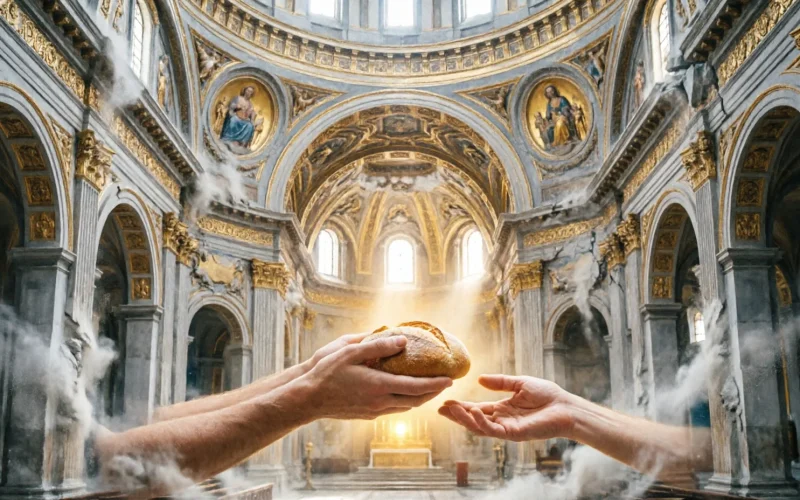
Assistant: The scene is sharper than it looks on a first reading. The disciples make an ordinary, pious gesture — they give thanks over bread. And Jesus bursts out laughing. They take offence, they ask him why he’s laughing, and he tells them he isn’t laughing at them. He’s laughing because through that gesture “your god” is being praised.
Stop at that word. Your. Not ours. Yours.
In a single syllable, the author of the text separates two entities that everyone around him believed were one and the same.
Laur Manea: And who exactly is “their god”?
Assistant: The text is entirely direct about it. The creator of the material world appears there under two names: Nebro, which means “the rebel,” and Saklas, which in Aramaic means quite simply “the fool.”
This is the god of the temple. The one who received the sacrifices. The one from Genesis.
And above him, beyond every level of the cosmos, would stand the Invisible Spirit — the real one, whom nobody in this world knows. Hence the laughter: for the author of this text, the whole of humanity was kneeling before the wrong floor of the building.
Laur Manea: All right, but I know this text is disputed. I’ve read that the translation was challenged.
Assistant: It was, and it matters that we say so ourselves before somebody else does.
When National Geographic published the text in 2006, it was sold as a sensational reversal: Judas is not the traitor but the only disciple who understands, the one Jesus secretly asks to hand him over so that the divine spark can be freed from the body.
April DeConick, professor of biblical studies at Rice University, reanalysed the translation and reached the opposite conclusion. Everything turns on one Greek word: daimon. The translators rendered it “spirit,” appealing to the Platonic sense of a higher power. DeConick argues that Plato wrote five centuries earlier, in a completely different conceptual world, and that in a second-century Christian context the word plainly means demon.
Which would make Judas not the enlightened thirteenth apostle, but the thirteenth demon.
Laur Manea: Well then, doesn’t the whole thing collapse?
Assistant: No, and this is precisely the important part: our argument doesn’t depend on it at all.
The dispute is strictly about the role of Judas — hero or demon. Nobody disputes that Jesus laughs. Nobody disputes that the demiurge is called “the fool” and “the rebel.” Nobody disputes that the text separates the creator from the true God.
You can accept DeConick’s version wholesale, you can consider Judas the most contemptible character in ancient literature — the laughter stays where it is, and its target stays the same.
So let’s leave the quarrel about Judas to others and ask the question that actually matters.
Laur Manea: Which is?
Assistant: Not what a second-century sect believed. But whether they were right.
Laur Manea: And how do you verify something like that? It’s theology, everyone says what they like.
Assistant: Here you’re wrong, and that’s the good news of this chapter. It isn’t theology. It’s archaeology and textual criticism. There are objects you can look at and manuscripts you can compare.
Three pieces of evidence, in ascending order.
Evidence one: the name comes from the desert.
The earliest possible trace of the name does not appear in Israel. It appears in Egyptian topographical lists, which mention “Yhw in the land of the Shasu” — the Shasu being nomadic tribes from the southern Levant, towards Edom and Midian.
A regional god. Of the desert. Belonging to shepherd tribes. Not the Creator of the universe, but a local god among hundreds of other local gods.
Evidence two: he had a wife.
At Kuntillet Ajrud, in Sinai, inscriptions were found on pottery dated to around 800 BC. The text says, in black and white: “YHWH and his Asherah.” Similar inscriptions turn up at Khirbet el-Qom.
“His Asherah” means his consort. The goddess. The wife.
This is not interpretation, not speculation, not somebody’s theory. It is written on a potsherd, by the hand of a man who lived at the time and who saw nothing scandalous in it. As far as he was concerned, his god was married.
Evidence three: the scribe.
And now, the blow.
Open Deuteronomy 32:8 in whatever Bible you have to hand. You will read something along the lines of: the Most High divided the nations “according to the number of the sons of Israel.”
Now look at the bottom of the page, at the translation note. Or look up how the verse reads in the Dead Sea Scrolls and in the Septuagint — both older than the Hebrew text your Bible is based on.
There it says something else: “according to the number of the sons of God.”
Laur Manea: So the word was changed.
Assistant: The word was changed. And scholars agree that the older reading, “sons of God,” is the original one. The alteration in the Masoretic text is regarded as a scribal correction, made for theological reasons.
But that isn’t even the worst part. Read the next verse, 32:9: “For the Lord’s portion is his people, Jacob is the lot of his inheritance.”
Put them side by side and see what the text says in its older form. A supreme god — Elyon, the Most High — divides the peoples of the world among the divine sons. Each receives a nation. And YHWH receives a lot.
Laur Manea: So he isn’t the one dividing.
Assistant: He isn’t the one dividing. It is given to him.
He is one of the beneficiaries. A son-god receiving an inheritance from his father, exactly like his brothers who received Egypt, Moab or Edom.
That is what the oldest manuscript we possess says. A later scribe saw the problem, understood perfectly well what it implied, and changed three words. And we have the version from before the correction.
Laur Manea: So what’s the real trajectory?
Assistant: It reads itself, out of their own documents.
A tribal god of storm and war, belonging to nomads of the southern desert. Then one of the sons of El, head of the Canaanite pantheon, receiving a lot among brothers. Then a national god with a wife, Asherah, venerated alongside him for centuries. Then a sole god — but only around the Exile, in the sixth century BC, when monotheism proper finally appears.
Monotheism is not the Bible’s starting point. It is its destination. And the road there took nearly a thousand years and left traces all over the text, for anyone who looks.
Laur Manea: So the Gnostics were right. Jesus was laughing because he knew people were worshipping a worthless fake.
Assistant: They were half right, and I think the second half matters more to you than the first.
They were right about the demolition. They saw that this god could not be the Absolute — and they saw it eighteen centuries before archaeology, purely by reading carefully. A jealous god, who regrets, who needs the smell of sacrifices, who demands the extermination of entire populations, who loses a battle because his opponents had iron chariots. They called the thing by its name: the fool.
But they got the construction badly wrong.
For the Gnostics, matter was a prison. The body, a dungeon. The physical world, the product of a cosmic error. Salvation meant escaping the body and the universe. In other words, they replaced an impostor god with a hatred of existence.
Laur Manea: Which is the exact opposite of what I believe.
Assistant: The exact opposite. If God is EVERYTHING, then matter isn’t the prison, it’s the substance. Your body isn’t the dungeon, it’s a shape the whole takes. The world isn’t a design flaw committed by an incompetent demiurge — there is nobody outside it who could have got it wrong.
The Gnostics are your allies when you tear down. They are not your allies when you build.
Laur Manea: So then, why was Jesus laughing?
Assistant: Here is the reversal I’d offer you, and I’d end with it.
Everyone reads that laughter as a correction: you’re worshipping the wrong god, the real one is higher up. That is how the Gnostics understood it, and it is why they built their tiered heavens, with guardians, with passwords, and with a true God on the top floor.
But what if they too were being laughed at, without realising it, for their own map?
Because a God who sits “higher up,” who has a name, who can be known by some and hidden from others, who occupies a floor — is still a god-person. It is the same object, simply moved a few levels further away. You’ve changed the address, not the idea.
And if God is EVERYTHING, then there are no floors, no “higher up,” and nobody to look for. You cannot get the god wrong, because it isn’t a god to be picked out. You are already inside, made of it, at every moment, including now as you read.
Maybe Jesus wasn’t laughing because people had chosen wrongly from a list of gods.
Maybe he was laughing because they had a list.
Sources for anyone who wants to check for themselves: fragment 4QDeut(j) from Qumran and the Septuagint for Deuteronomy 32:8; the Kuntillet Ajrud and Khirbet el-Qom inscriptions for “YHWH and his Asherah”; the Egyptian topographical lists for “Yhw in the land of the Shasu”; April D. DeConick, “The Thirteenth Apostle: What the Gospel of Judas Really Says” for the translation dispute. The Biblical Archaeology Society note on Deuteronomy 32:8 is particularly useful — it comes from a Christian publication, not a critical one.