A conversation from July 2026. We follow a man climbing through ten heavens and arrive at a title Judaism should never have been able to utter.
Laur Manea: Enoch entered the ten heavens. What did he find in the last one?
Assistant: The face of the Lord. And the description resembles nothing we picture today when we say “God.”
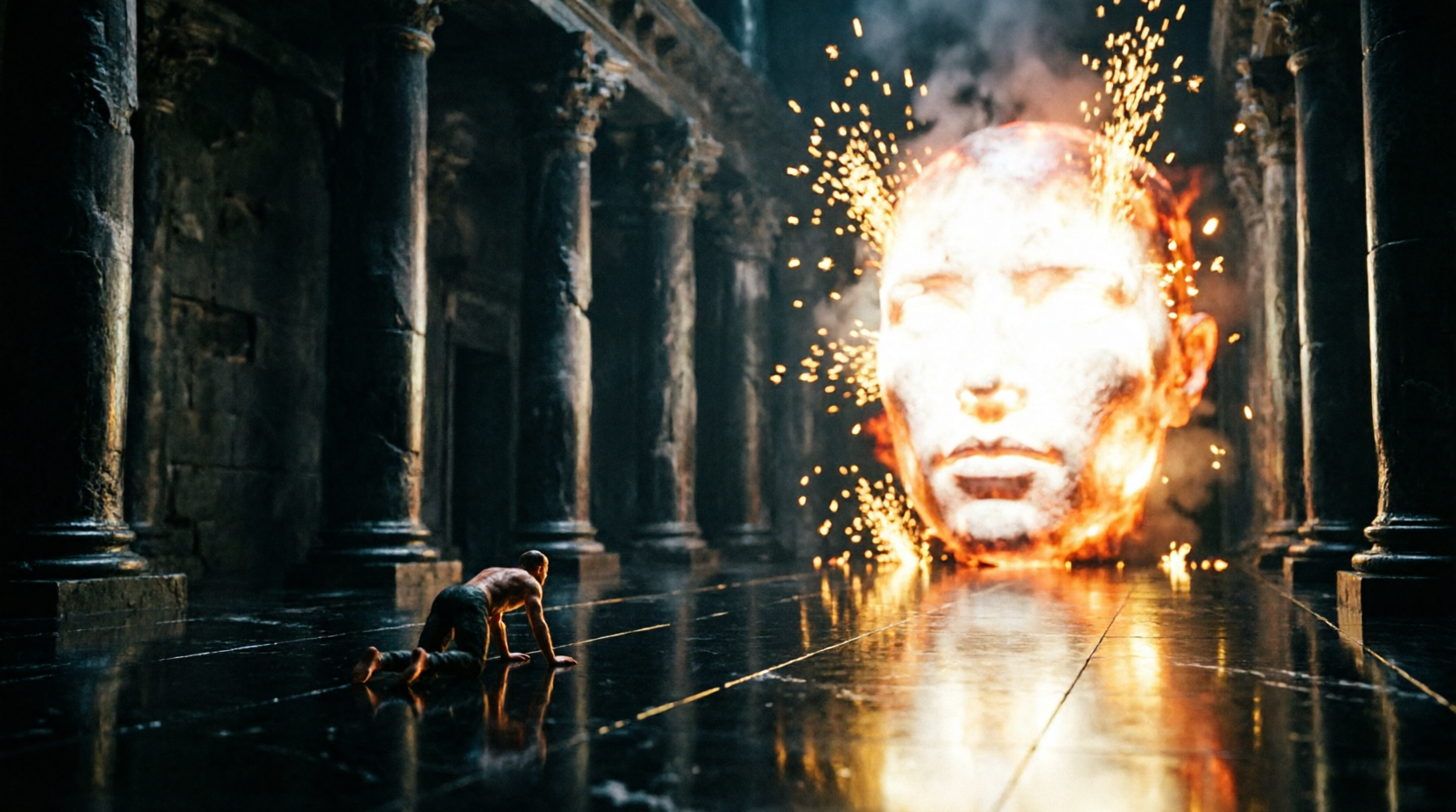
The text says the face of the Lord was like iron made red-hot in fire and brought out, throwing off sparks and burning. Enoch cannot bear the sight and falls on his face.
But before we get there, we need to settle something, so that nobody catches you off balance.
Laur Manea: Settle what?
Assistant: The number of heavens. The book we’re discussing, 2 Enoch, survives in Slavonic manuscripts, and they don’t all say the same thing. There is a shorter recension with seven heavens and a longer recension with ten. Many scholars consider the seven-heaven form to be the original, with the three additional heavens — the eighth, ninth and tenth — being a later expansion.
The dating is disputed too. Some place it in the first century AD, others much later.
Say this yourself, first, in any discussion. Whoever comes along to “correct” you with the shorter recension discovers you already knew about it.
Laur Manea: Fine. And what does he see on the way up?
Assistant: The ascent is organised like a building with floors, and each floor has a different administrative function.
In the first heavens he sees the meteorological storehouses — the reservoirs of snow, of dew, of ice. Angels guarding stock. In others he sees the place of punishment of the fallen angels, then the garden of paradise with the tree of life, then the movements of the stars and the calendar.
Notice what kind of cosmos this is: a bureaucratic apparatus. Every natural phenomenon has a warehouse, a register and a civil servant.
And right at the top, in the tenth, the throne.
Laur Manea: And what happens to him up there?
Assistant: Here is the part few people remember, though it’s the most important.
Enoch doesn’t merely look. He is transformed.
The Lord orders that Enoch be stripped of his earthly garments, anointed with an oil whose radiance is like the rays of the sun, and clothed in the garments of glory. And the text says it plainly: afterwards, Enoch looked like one of the glorious ones. He could no longer be told apart from them.
A man walked in through the door. What came out was no longer a man.
Laur Manea: So a man became an angel.
Assistant: More than that, and this is where the story becomes explosive.
There is a later text, 3 Enoch, also known as Sefer Hekhalot, “The Book of Palaces.” There we learn what name Enoch received after the transformation.
He became the angel Metatron.
And Metatron carries a title which, in a monotheistic system, ought to be simply unspeakable:
YHWH ha-Katan. “The lesser YHWH.”
Laur Manea: Hold on. A second YHWH?
Assistant: A second YHWH, a smaller one. And the justification isn’t invented by mystics — it’s taken from a verse that has been sitting in the Torah, in plain sight, for thousands of years.
Exodus 23:21. God speaks of an angel he is sending ahead of the people and says: “Beware of him and obey his voice; do not rebel against him, for he will not pardon your transgressions, since my Name is in him.”
Read what it says there. An angel who carries the divine Name. An angel who lacks the power to forgive — an attribute reserved exclusively for God, which means that mentioning it at all presupposes somebody might have expected otherwise.
The seed of the second YHWH isn’t in a heretical text. It’s in Exodus.
Laur Manea: And what did the rabbis make of that?
Assistant: They were afraid of it. And we have the proof, preserved by them, in the Talmud.
It’s the story of Rabbi Elisha ben Abuya, one of the four sages who, according to tradition, ascended in mind to the world above.
There he sees Metatron. And Metatron was sitting. Writing down the merits of Israel, seated.
Laur Manea: And what’s the problem with him sitting?
Assistant: That in heaven nobody sits. All serve standing. There is one throne, and it is occupied.
Elisha ben Abuya sees a second being seated and draws the only logical conclusion from what is in front of his eyes: “Perhaps there are two powers in heaven.”
And he loses his faith on the spot.
The Talmud then relates that Metatron received sixty lashes of fire, to demonstrate that he is not God but a servant who can be punished. And Elisha ben Abuya, from then on, is no longer called by name in the texts. He is called only Acher — “the Other.”
A man so dangerous that his name was erased.
Laur Manea: But why did they keep the story, if it was that dangerous?
Assistant: That’s the good question, and the answer says everything.
They kept it because they had to refute it, and to refute something you have to retell it. “Two powers in heaven” was a heresy widespread enough that the rabbis built arguments against it for centuries.
You do not spend years fighting an idea nobody believes.
So what we hold in our hands is not a modern theory. It is their own documents, recording: an ambiguous verse in the Torah, a tradition in which a man becomes “the lesser YHWH,” a rabbi who loses his faith at the sight of somebody seated, and a theological apparatus built specifically to put out the fire.
Laur Manea: So there really were two powers.
Assistant: Here I’ll stop you, because this is the trap Elisha ben Abuya fell into as well.
His conclusion was not “my model of God is wrong.” It was “there’s another one.” He kept the idea of God-as-a-person-on-a-throne perfectly intact and simply added a second chair.
The Gnostics we discussed in the previous chapter made exactly the same mistake: they saw that the creator god was an impostor and invented another god, a true one, a few floors higher. Still a person. Still a throne. Just a different address.
Laur Manea: And where’s the underlying error?
Assistant: In the chair.
All these crises — Metatron sitting, the two powers, the Gnostics’ foolish demiurge, YHWH receiving a lot from Elyon — arise from a single assumption: that God is somebody. A being, somewhere, with a position, a rank and furniture.
If God is somebody, then it matters who sits and who stands. It matters how many thrones there are. It matters whether the angel is permitted to forgive. It matters which floor you’re on. The entire literature we’ve walked through today is an argument about protocol.
But if God is EVERYTHING, there are no floors, no throne, and no second chair to be frightened of. You cannot ascend to him, because there is nowhere to go — you are already made of him. You cannot see him in some upper chamber, because you are looking at him right now, with eyes made of him, through air made of him.
Enoch climbed ten storeys to reach something that had never left his side.
Laur Manea: And that face like red-hot iron?
Assistant: I think it’s the most honest moment in the whole book.
The author is trying to describe something with no form, using the only thing in his world that burned so fiercely you couldn’t look at it. Molten iron was the peak of the era’s technology. It was the supreme experience of unbearable brightness.
He isn’t telling us what God looks like. He’s telling us the brightest thing the author had ever seen in his life.
And that is exactly what makes the description precious. It isn’t a photograph of divinity. It’s a testimony about the limits of a man.
Elisha ben Abuya lost his faith because he saw somebody sitting down.
In a heaven without chairs, he would have had nothing to lose.
Sources for anyone who wants to check for themselves: 2 Enoch (Slavonic Enoch), longer recension, the chapters on the tenth heaven and on Enoch’s anointing — note the difference between the shorter recension (seven heavens) and the longer one (ten), as well as the disputed dating; 3 Enoch / Sefer Hekhalot for Metatron and the title “YHWH ha-Katan”; the Babylonian Talmud, tractate Hagigah 15a, for the episode of Elisha ben Abuya and “two powers in heaven”; Exodus 23:21 for the angel who carries the Name. For academic context, Alan F. Segal’s work on the “two powers in heaven” heresy remains the standard reference.