A conversation from August 2026. We start with an animal that purrs and arrive at the mechanism by which a religion is actually born: out of a granary, through a myth, and into an industry.
Laur Manea: Cats in Ancient Egypt. Why were they so venerated, where do they come from, and what is their story?
Assistant: Let me start with the part that ruins the cliché straight away: Egypt did not domesticate the cat.
The earliest documented association between humans and cats is not Egyptian. It is in Cyprus, at Shillourokambos, around 7500 BC — a cat deliberately buried beside a human, some four thousand years before Egypt had anything to say on the matter. And Cyprus has no native cats. Someone put one on a boat and took it there.
Laur Manea: So where does it actually come from?
Assistant: The ancestor is the African wildcat, Felis silvestris lybica. The relationship begins in the Neolithic Levant, alongside agriculture — not on the banks of the Nile.
The study that settled this is a 2017 genetic analysis led by Claudio Ottoni: 225 archaeological specimens, nearly 100 sites, a span of ten thousand years. The result shows two waves, not one.
The first is the Near Eastern lineage, spreading slowly along with Neolithic farming. The second is the Egyptian lineage — which explodes much later, in the Classical and then the Medieval period, along maritime and trade routes.
Laur Manea: Then what credit does Egypt get?
Assistant: A greater one than origin, in fact. Egypt turned the cat into a cultural export product.
The cat currently in your house is, genetically speaking, more likely descended from an Egyptian cat that boarded a Phoenician or Roman ship than from a Neolithic one out of Anatolia. Egypt did not win at the start. It won at distribution.
And here is a detail worth keeping in your pocket, because it is the kind of thing that shows you know what you are talking about: ancient Egyptian cats were all mackerel tabby, with vertical stripes. The blotched pattern, with the swirls on the flanks, is a mutation that appears only in the Middle Ages, in Southwest Asia.
If you see an artistic reconstruction of pharaonic Egypt featuring a blotched tabby, you are looking at an anachronism two and a half thousand years wide.
Laur Manea: Fine. But why the cat, and not some other animal?
Assistant: Here the root is strictly economic, and it is best said plainly, without poetry.
Egypt is a civilisation of stored grain. The agricultural surplus held in granaries is not a detail — it is literally the state. Out of it are paid the workers, the priests, the army. Without a full granary there is no Egypt.
And a granary attracts rodents. Rodents attract snakes, including the Egyptian cobra and the horned viper.
The cat solves both problems at once. For free. No training, no feeding, nothing asked of you. It is not an animal you brought into the house — it is an animal that came on its own, because that is where the food was, and you noticed that its presence protected, simultaneously, your wealth and your life.
That is the raw premise. Everything else is theology built on top of it.
Laur Manea: And how do you get from mice to a goddess?
Assistant: Through something most accounts miss entirely. The Egyptians did not begin by venerating the house cat. They began by venerating the dangerous feline — and they tamed it symbolically in parallel with taming it in reality.
Mafdet is the oldest feline deity, attested from the First Dynasty and present in the Pyramid Texts. She is a feline killer of snakes and scorpions, protector of the royal chamber, directly associated with execution. There is nothing cute about her. She is the claw that tears.
Sekhmet is the lioness. The fury of Ra embodied — plague, destruction, but also healing. The incandescent pole of the same idea.
And Bastet, note this, was originally a lioness too. Goddess of the city of Bubastis — Per-Bast, today Tell Basta — in the Delta. Only gradually, and decisively in the Third Intermediate Period, when Bubastis becomes a capital under the Twenty-Second Dynasty, does her form shift to a domestic cat.
From warrior lioness she becomes protector of the home, of the mother, of birth, of joy, of music and perfume.
Laur Manea: Why did the lioness turn into a house cat? Who decides something like that?
Assistant: Nobody decides. It gets written into the myth. And the myth is explicit, not accidental.
It is called the myth of the Distant Goddess. The Eye of Ra departs in anger to Nubia and becomes a wild lioness. She refuses to return. She is lured back with beer dyed red, which she drinks believing it is blood, becomes drunk, is pacified — and returns as a cat. As Hathor. As Bastet.
The Egyptians wrote into myth exactly the process they were living in the courtyard: the beast that becomes a companion without ceasing to be a beast.
And this is the point I would press, because it is both beautiful and true: Bastet never loses her claws. She is gentle to her own. That is the definition of protection, not of docility. A goddess who can no longer kill can no longer defend anyone.
Laur Manea: And what is the central image? If I remember one thing, what is it?
Assistant: The Tomcat who kills the Serpent.
In the Book of the Dead, spell 17, and painted superbly in the tombs at Deir el-Medina — Inherkhau’s is the best known — Ra takes the form of the Great Cat of Heliopolis and, beneath the ished tree, cuts off the head of Apophis, the serpent of chaos who tries every night to stop the solar barque.
Here the cat is no longer a useful animal. It is the agent of cosmic order.
Every night, underground, the order of the world is restored by a tomcat killing a snake. And the Egyptian who watched his cat catch a viper in the yard was watching, at domestic scale, precisely the ritual that kept the sun moving.
That is the real mechanism of veneration, and it is a solid one. Not “what a charming animal.” Rather, the correspondence between the small gesture and the structure of the universe. Your household becomes a temple in miniature, and your cat is the priest.
Laur Manea: What did this look like in daily life?
Assistant: We have eyewitnesses, and they are Greek — that is, people who did not understand what they were seeing and therefore wrote all of it down.
Herodotus, in the fifth century BC, in the Histories, Book II, chapters 66–67, reports that at a fire the Egyptians would form a line to guard the cats from the flames, more concerned with them than with the burning house. That on the death of the household cat the family shaved their eyebrows in mourning — and on the death of a dog they shaved their whole bodies. That killing a cat, even accidentally, was punishable by death. And that dead cats were taken to Bubastis for embalming.
Diodorus Siculus says he saw with his own eyes, around 60–50 BC, a Roman lynched by a crowd in Alexandria for accidentally killing a cat. And this at a time when Egypt was afraid of Rome, and the authorities tried, unsuccessfully, to save him.
Laur Manea: Were there pets in the proper sense? With names?
Assistant: Yes. And we have a case that ends the argument.
Ta-Miu — simply, “The She-Cat” — belonged to Crown Prince Thutmose, son of Amenhotep III. She has her own limestone sarcophagus, carved with funerary texts, exactly like a person’s.
And the Egyptian word for cat was miw. Onomatopoeic. They called it, quite simply, “meow.”
Laur Manea: And yet there are millions of cat mummies. Were they all loved like that?
Assistant: No. And here we reach the part you will not find in the charming articles.
The vast majority of cat mummies from Egypt are not pets buried with affection. They are votive offerings — religious objects produced industrially.
It worked as an economy. The pilgrim came to the temple of Bastet, bought a mummified cat, and deposited it as a prayer made material. And the temples bred cats specifically for this.
Modern CT scans and X-rays show the same pattern consistently: young animals, a few months old, with broken necks or suffocated. Killed deliberately, at the optimal age for wrapping. Some “mummies” do not even contain a whole cat — just rags, mixed bones, sometimes nothing at all.
Laur Manea: So it was hypocrisy.
Assistant: No. And this is the genuinely interesting part, if you look at it without the modern reflex.
Both things were true at once. The same man could shave his eyebrows in grief for his own cat and buy from the temple a cat killed to order, to offer to the goddess.
This is not hypocrisy, it is a distinction we have lost: between the animal-as-person and the animal-as-offering. The category mattered, not the species. Ta-Miu was someone. The cat on the temple shelf was something.
You will find exactly the same separation, under other names, in any religious system with sacrifice. Including the ones far more familiar to us.
Laur Manea: And what happened to those mummies in the end?
Assistant: The ending is grotesque, and it is documented.
In 1888, a farmer ploughing near Beni Hasan struck a cemetery containing tens — by some accounts hundreds — of thousands of cat mummies.
In February 1890, roughly 180,000 mummies, weighing around 19.5 tons, were shipped from Alexandria to Liverpool and sold at auction as agricultural fertiliser. Bidding opened at three pounds a ton. They were ground up and scattered across the fields of England.
A few better-preserved specimens were sold separately and are today at the World Museum in Liverpool.
Three thousand years of theology, turned into fertiliser for sugar beet.
Laur Manea: What are the false things in circulation? I do not want to repeat them.
Assistant: Two, and you will find them everywhere.
The first is the Battle of Pelusium, 525 BC. The story that the Persian king Cambyses II had his soldiers carry cats in their arms or painted on their shields, and the Egyptians refused to shoot and lost the battle.
The source is Polyaenus, Stratagems 7.9 — written in the second century AD. That is roughly seven hundred years after the event, in a collection of military anecdotes, not of history. No contemporary source confirms it. It is an excellent story. It is not evidence.
The second is the export ban. It is often repeated that removing cats from Egypt was punishable by death and that priests were sent abroad to buy them back. The documentary basis is thin to non-existent.
And here we have something better than an objection: the genetics contradicts it directly. Egyptian cats spread massively along Mediterranean trade routes precisely in the period when they were supposedly banned. The data says something other than the legend.
Laur Manea: And how does it end?
Assistant: The cult dies with paganism. The decrees of Theodosius I, in AD 391–392, close the temples, and animal cults are explicitly prohibited. Bubastis fades out.
But the cat does not.
Precisely in the period when the goddess disappears from the temples, the Egyptian genetic lineage conquers the world. It reaches Roman ports, northern Europe, even a Viking site in northern Germany.
The goddess lost the temples and kept the houses. I do not think that is a bad outcome.
Laur Manea: If you had to reduce all of it to a single image?
Assistant: Two mummies.
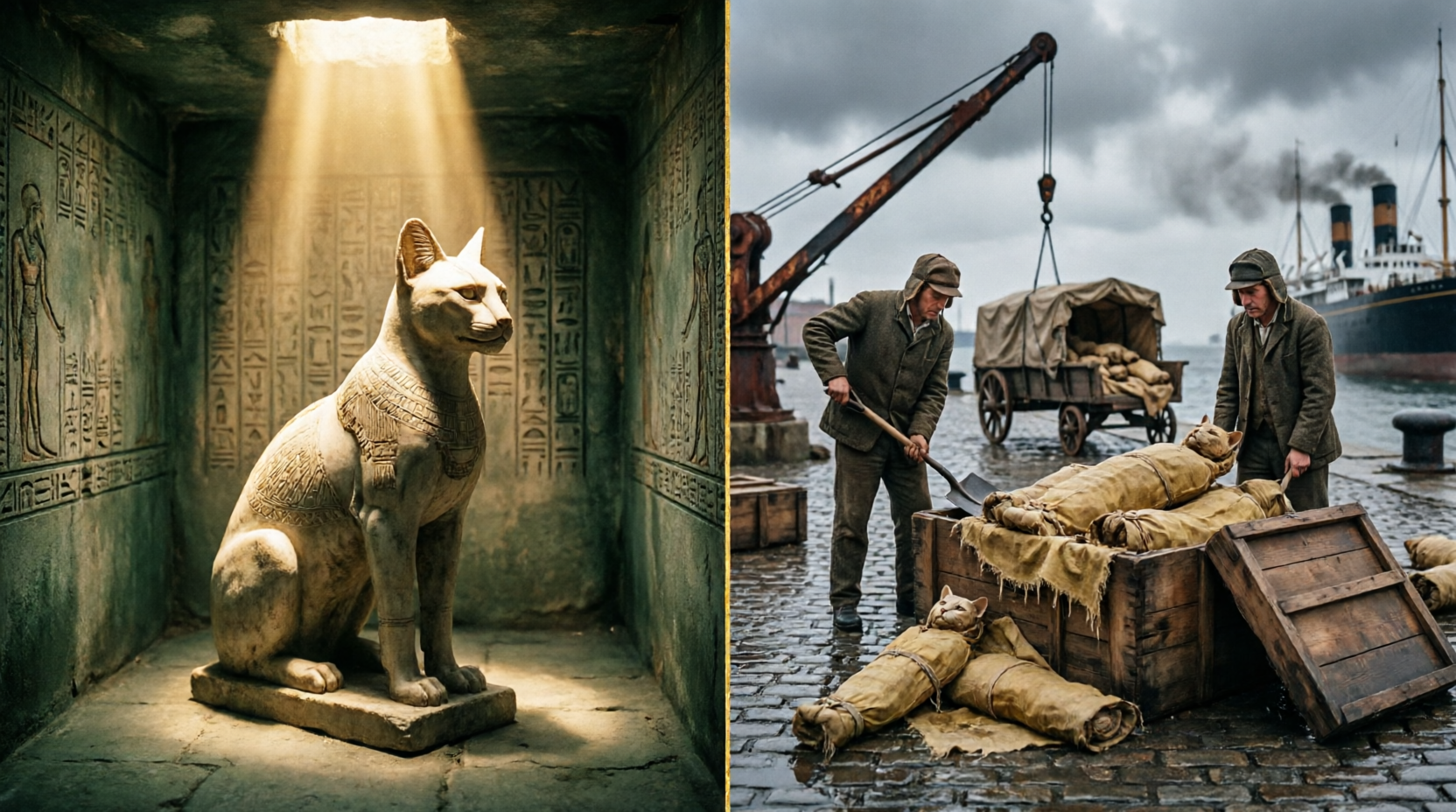
One is Ta-Miu’s limestone sarcophagus, carved with funerary texts for a cat loved by an Egyptian prince.
The other is the nineteen tons unloaded at the port of Liverpool and sold at three pounds a ton.
The same civilisation. The same animal. Two completely different theological categories — and both of them entirely sincere in religious terms.
That says more about how a religion actually works than any list of deities. A religion is not born of a revelation. It is born in a granary full of grain, rises as far as cosmic order, and comes back down into a market where something living is sold by the piece.
The Egyptians did not venerate the cat because it was divine. They made it divine because it guarded their food — then killed it by the tens of thousands to thank it for that.
Sources for anyone who wants to check for themselves: Ottoni, C. et al., “The palaeogenetics of cat dispersal in the ancient world,” Nature Ecology & Evolution 1, 0139 (2017) — for domestication, the two genetic lineages and the tabby pattern; the site of Shillourokambos, Cyprus, for the oldest human-cat burial; Herodotus, Histories II.66–67, and Diodorus Siculus I.83, for the practices observed by Greek witnesses — note, these are foreign sources expressing astonishment, not internal Egyptian documents; the Book of the Dead, spell 17, and the tomb of Inherkhau at Deir el-Medina, for the Great Cat of Heliopolis and the killing of Apophis; Chris Elliott, “Cats, Commerce, and Cemeteries: The Mummified Felines of Beni Hasan” (2023), and the archives of National Museums Liverpool, for the February 1890 shipment; Polyaenus, Stratagems 7.9, for Pelusium — to be read as a late anecdote, not as history.