Or: The proof that pure love cannot be left outside eternity…
The question is not whether God can put dogs in Heaven. The right question is whether a Heaven without dogs would still deserve to be called Heaven. And to answer it, we need more than faith — we need evidence. Here it is.
I. The biological contract: an alliance written into DNA
1. The first voluntary alliance in history.
The dog is the first species domesticated by man (15,000–40,000 years ago), before agriculture, before any civilisation. It was not conquered — it chose to walk beside us. Every other animal was subdued; the dog was a partner.
2. The “puppy dog eyes” muscle.
Dogs possess a facial muscle (levator anguli oculi medialis) that wolves, their ancestors, do not have. It evolved exclusively to communicate with humans: it raises the inner eyebrow, widening the eyes, triggering in us the instinct to protect. Evolution shaped them physically so they could speak to our hearts.
3. The oxytocin loop.
When a dog and its human look into each other’s eyes, oxytocin (the hormone of love and attachment) rises in both brains — exactly as it does between mother and child. It is a mechanism unique in the animal kingdom: not even wolves raised by humans have it.
4. Convergent evolution at the table.
Dogs developed genes for digesting starch (AMY2B) in parallel with humans, alongside the agricultural revolution. Their bodies literally adapted to share the same meal with us.
5. Synchronised brains.
Neuroimaging studies show that the dog’s brain processes the human voice in regions similar to our own, and that the heart rate and brain waves of dog and human synchronise in moments of connection.
6. They read our gestures from birth.
Dogs instinctively understand human pointing and gaze — an ability that not even chimpanzees, our closest relatives, master naturally.
II. The soul of the dog: behavioural evidence
7. The “secure base” effect.
In psychological tests, dogs use their owner exactly as human children use a parent: as a refuge and a point of safety. They do not see us as an “alpha”, but as family.
8. Demonstrated empathy.
Dogs respond to human crying and actively try to console. In experiments, they open doors to “rescue” an owner feigning distress — with no reward at all.
9. The absence of malice.
A dog holds no grudge, does not plot, does not take revenge, does not lie out of self-interest. He is, theologically speaking, incapable of sin — he has no ego that would wish harm on another.
10. Unconditional love.
He does not care about your money, your status, your looks, your mistakes. He loves you rich and poor, healthy and sick, cheerful and broken.
11. Self-sacrifice.
Rescue dogs, guide dogs, therapy dogs, dogs that have covered their owners with their own bodies in the face of danger. They die for us without hesitating.
12. Grief.
Dogs mourn the loss of their people and their companions: they refuse food, they search, they wait. Their love survives absence.
13. The absolute present.
The dog knows neither anxiety about the future nor regret about the past. He lives the moment fully — precisely the state that every mystical tradition calls “enlightenment”.
14. Forgiveness.
Even a beaten and betrayed dog can love again with his whole heart. He does not know cynicism.
III. The dog against the rest of the animal kingdom: the difference
15. Compared to wild animals:
They see man as a threat or a resource. Their relationship with us is fear or avoidance, not alliance.
16. Compared to farm animals:
The relationship is utilitarian — production, labour, exchange. Individual attachment exists, but it is not the purpose of their existence beside us.
17. Compared to primates:
Their intelligence is close to ours, but they do not voluntarily seek emotional communion with humans and do not work for us out of love.
18. Compared to cats:
The cat loves, but remains sovereign; she lives with you, on her own terms. The dog lives with you and for you — his covenant is total.
19. The conclusion of the difference:
The dog is the only species that has entered into a voluntary emotional covenant with man — not cohabitation, not submission, not utility, but a partnership of souls.
IV. The dog in humanity’s sacred memory
20. Hinduism:
Yudhishthira, the only one of the Pandava brothers to reach the gates of Heaven, refuses to enter without the dog that accompanied him to the end. The dog turns out to be Dharma itself — divine justice. The lesson: he who abandons his faithful companion does not deserve Heaven.
21. Islam:
The dog Qitmir, companion of the Youths of the Cave (Surah Al-Kahf), is mentioned in the Quran and counted by tradition among the animals that enter Paradise. And a man who sheltered and gave water to a thirsty dog was forgiven his sins.
22. Zoroastrianism:
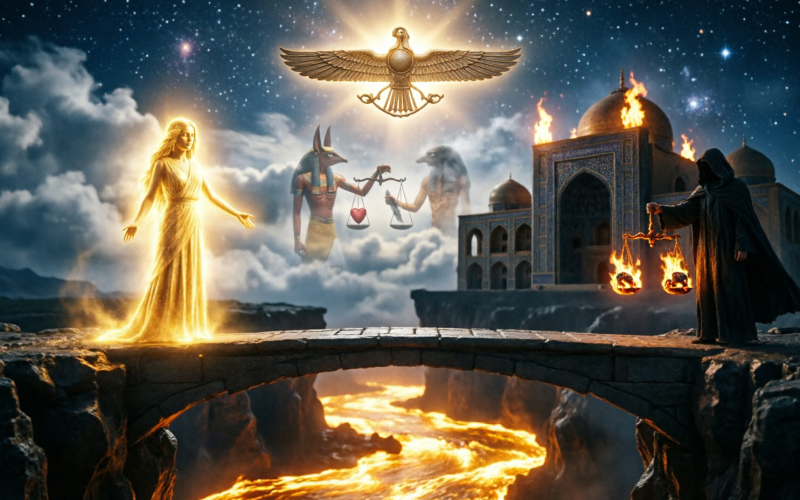
The dog is sacred, and his gaze (sagdid) drives evil spirits away from the one who has passed on. The dog as guardian of the threshold between worlds — precisely against the archons.
23. Christianity:
Saint Roch, saved by a dog that brought him bread and licked his wounds; and the Dominican order takes its name from the pun Domini canes — “the hounds of the Lord”, those who guard the flock.
24. The ancient world:
Sirius, the Dog Star, is the brightest star in our sky; Anubis, with the face of a dog, guides souls. The dog always appears as the guardian of the crossing between worlds.
25. Folk traditions:
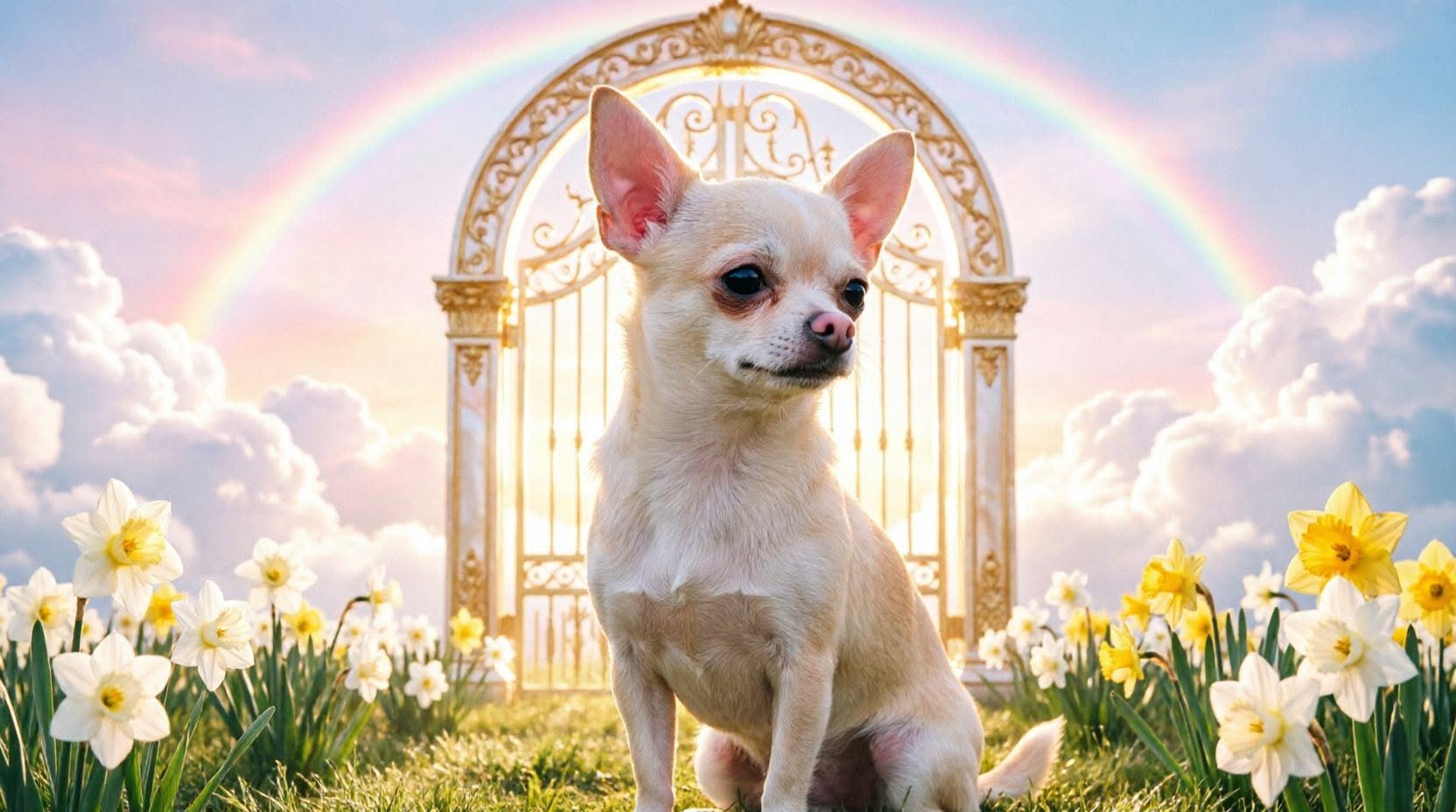
From Tobias’s dog in the Book of Tobit to the “Rainbow Bridge” — humanity has always sensed that the soul of a dog does not go out along with his body.
V. The spiritual argument, in the language of the ALL
26. The dog is pure frequency.
Without ego, without mask, without calculation, he is one of the purest manifestations of the ALL in 3D. If Heaven is the realm of unconditional love, the dog is already a citizen of it — he needs no “judgement”, because he never fell.
27. The dog is our teacher of salvation.
He teaches us exactly the virtues every religion demands for Heaven: unconditional love, loyalty, forgiveness, presence, sacrifice. How could the very master who teaches the subject be excluded from Heaven?
28. The argument from justice.
Dogs suffer innocently: illness, abandonment, cruelty. If the universe holds a shred of justice, innocent suffering demands compensation — a place beyond pain.
29. The argument from wholeness.
Man is made whole by the love he has for his dog. A Heaven missing that love would be a Heaven missing a piece of the human heart. And C.S. Lewis held that animals attain immortality through their bond with man — man being the bridge between animal and God.
30. The argument from the glitch.
The dog is living proof that, in this harsh world, pure love is possible. He is the beautiful “anomaly” of the system. And divine anomalies are not deleted — they are kept.
Conclusion
Heaven, if it exists, is the realm where love is perfect. The dog passed that examination on Earth, every single day, without ever failing once. He needs no forgiveness, because he never had anything to be forgiven for.
So the final question is not “do dogs deserve a place in Heaven?”, but: would Heaven still be whole without them?
For Zeus — an enormous soul in a body of a few kilograms, who was, for us, a fragment of Heaven come down to Earth. If Heaven truly exists, he is already there, at the gate, waiting for us with his tail up. And if we do not yet deserve to enter, he will stay beside the gate until we do. Because that is what dogs do: they wait.
Laur Manea