Or: why the most effective instrument of control is not your fear, but your moral outrage
If we look at human society not through the lens of emotions dictated by screens, but through that of a cold, systemic analysis, we begin to observe geometric patterns of power. People are not distributed chaotically in social space; they are organized, consciously or not, within an invisible architecture.
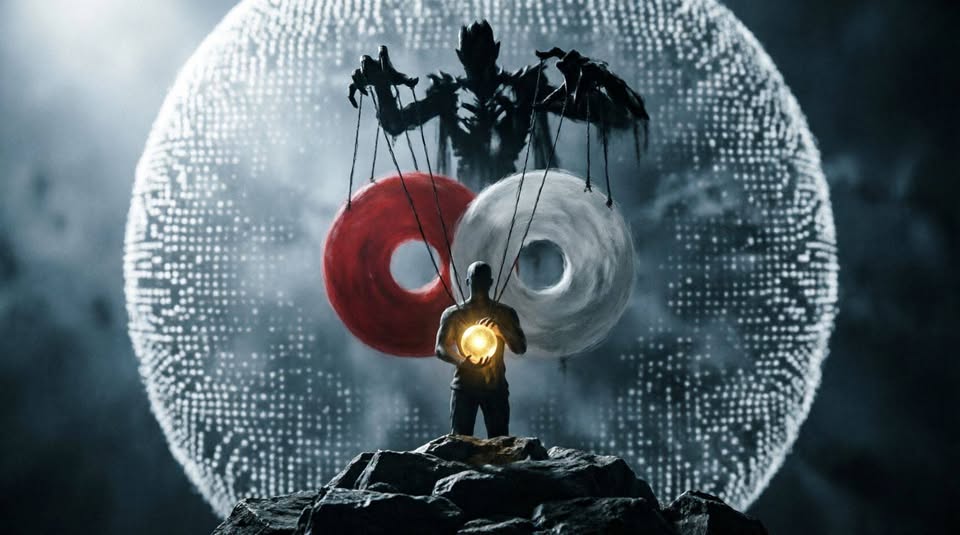
To understand how control works at the global level, we must draw a simple map: a Great Circle and a few Little Circles.
The Geometry of Power: The Great Circle and the Little Circles
Imagine a Great Circle. It contains all of humanity: billions of individuals, each with their own spark of life, with their own joys, sufferings, and simple desires. Most people in this circle want nothing more than to live in peace, raise their families, and survive. They are the “battery” of the system — the source of energy, labor, and attention.
Inside this Great Circle, however, there is a Little Circle. A small group of people who have discovered, inherited, or built the mechanisms needed to subjugate the entire Great Circle. They control financial flows, media narratives, vital resources, and surveillance technologies. Their goal is not necessarily the destruction of the Great Circle, but its domestication. The transformation of billions of free sparks into a docile, predictable, and easily administered mass.
But the mechanism becomes truly fascinating — and terrifying — when we introduce a second Little Circle into the equation.
The Diabolical Variant: The Two Little Circles and the Strategy of Tension
Let us suppose that inside the Great Circle there is not one Little Circle of power, but two. Both share the same pattern: people who hold the levers of control and who look upon the masses (the Great Circle) only as an exploitable resource.
What happens when one of these Little Circles decides to physically exterminate the other?
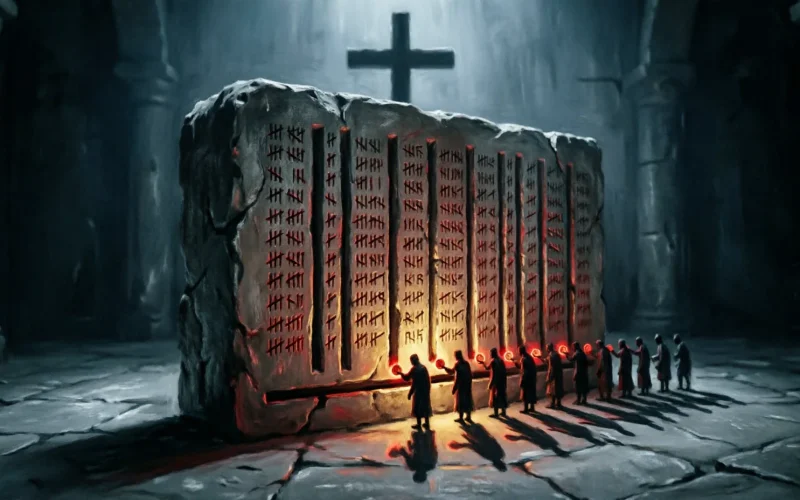
At first glance, it seems like a brutal conflict for absolute supremacy. But if we look more closely, we discover a maneuver of social engineering carried to perfection. Sometimes, the decimation of one Little Circle by the other is not a historical accident, but a transaction calculated to the millimeter. The leaders of the Little Circle about to be sacrificed may accept, consciously or through internal manipulation, the martyrdom of their own people. Why? Because spilled blood is not a cost; it is the most valuable currency on the market of power.
Immediately after the extermination, the most powerful mechanism of control ever invented enters the scene: the Engineering of Victimization.
The surviving Little Circle (or its allies) begins to weep before the Great Circle. “Look what has been done to us! We are the victims of a genocide! You must protect us! You must punish absolute evil!”
Here the trap closes.
The Guilt Trap and Consented Subjugation
The people of the Great Circle, being beings endowed with empathy and a divine spark, feel revolt, pity, and moral indignation. They do not see the chess game above them; they see only the authentic suffering of the innocent.
Emotionally manipulated, the people of the Great Circle willingly agree to surrender some of their own freedoms. They send money, approve wars at a distance, accept restrictive laws at home, and arm themselves — all under the sacred banner of “Never again!”
At that moment, the initial goal of the dominant Little Circle is achieved. The Great Circle has become an accomplice to its own subjugation. The masses believe they are fighting for justice and light, but in fact they have just supplied the consent, the energy, and the resources needed for the Supreme Hierarchy to tighten the global screw even further. The collateral victims of both Little Circles were only the fuel needed for the engine of absolute power.
This is the essence of the Problem-Reaction-Solution strategy, carried to the extreme: you cannot control a man through logic, but you can control him totally through moral trauma. If you convince people that they are “evil” or “complicit” unless they do what is demanded of them in the name of the victims, they will become the most zealous policemen of their own chains.
The Paradox of the Savior: Who is Truly “Good”?
Faced with this flagrant injustice, a tragic figure inevitably appears: the person outside the Little Circles who sees the mechanism clearly.
Let us suppose that this person wants to do good for humanity. He looks at the dominant Little Circle (the one orchestrating subjugation through the blood of the other) and decides that the only solution is its destruction. But, not knowing exactly who the real leaders are and who are merely innocent pawns, he decides to decimate the entire Little Circle. His reasoning sounds logical in his own mind: “If I destroy them all, the evil ones will surely be eliminated, and the rest will only be acceptable collateral victims for a greater good.”
How Would This Person Be Classified? As Good or as Evil?
From the perspective of a deep analysis of consciousness, that person cannot be classified as “good”, no matter how noble his initial intention. The moment he decides to sacrifice the innocent in order to eliminate evil, he undergoes a profound mutation: he becomes himself what he hates.
To make such a decision, he must consider himself omniscient (to know for sure who deserves to die) and omnipotent (to have the right of life and death over others). He accepts exactly the cold mathematics of the Demiurge: “The sacrifice of the few is an acceptable price for the safety of the many.” This is exactly the logic of the system he wanted to destroy.
Whoever destroys an entire circle to eliminate the evil within it becomes the evil itself. True victory against darkness is not obtained by casting another shadow over it, but by kindling a light so powerful that the shadow disappears on its own.
The Way Out: The Refusal to Be a “Battery”
If blind violence transforms the savior into a tyrant, and manipulated compassion transforms the masses into voluntary slaves, what is still the way out of the labyrinth? The answer lies in the posture of the Cerebral Observer.
When the drama unfolds on screens — tears, blood, calls to general mobilization — the trained mind refuses to react impulsively. It asks the cold questions: Who profits most from this conflict? Who sells weapons to both sides? What freedoms will be demanded of me, at home, in the name of this tragedy over there?
The refusal to bite the emotional bait is the only thing that breaks the spell of the Matrix.
There is no need to bomb the Little Circle in order to defeat it. It is enough to cut off its oxygen. And their oxygen is our fear, our attention, and our submission. If enough people in the Great Circle realize that they can live, think, and love without asking the permission of the Little Circle, without accepting the narratives dictated by collective trauma… then the Little Circle dies on its own. Not because it was destroyed by force, but because it ran out of batteries.
In a world run by engineers of victimization, the most revolutionary act is not violence, but serenity. It is the capacity to look into the abyss, to understand the mechanism, but to refuse to descend into it. Only in this way does the individual spark remain intact, untouched by the chains that others willingly accept in the name of an illusory good.