Or: the only apocalyptic calculation that writes its own death sentence into the first paragraph
Nineteen centuries of people have calculated the date. All of them were wrong. And when the date passed, almost all of them did exactly the same thing: they moved the date.
This chapter makes a calculation and gives a year. But unlike all the others, it writes its own death sentence from the start: the year in which, if it has not happened, it gets thrown away.
Not adjusted. Not reinterpreted. Not explained as “it was symbolic”. Thrown away, and I admit in writing, on this page, that I was wrong.
That is the only difference between a calculation and a fortune-telling. The rest is arithmetic.
1. The two readings, and why neither can be proved
I have to state the problem honestly before I calculate anything, otherwise everything that follows is a con.
There are two schools, and they have been arguing for three hundred years.
The first says it has all already happened. Revelation, on this view, was written in the first century about the Roman Empire, the Beast was a specific emperor, and Babylon is Rome. Their arguments are not to be thrown in the bin.
The strongest is the number. In Hebrew gematria, where each letter has a numerical value, “Neron Caesar” written in Hebrew letters gives exactly 666. And in some ancient manuscripts the number is not 666 but 616 — and 616 is what you get if you write the same name in the Latin spelling, without the final letter. That variant makes no sense whatsoever unless the author meant Nero. It is the best argument that school has, and it is a serious one.
Add to that Revelation 17:9 — “seven mountains, on which the woman sitteth” — and you have Rome, the city of seven hills, stated almost openly.
The second school says the descriptions are about the future, and that the man who wrote them lacked the words for what he was seeing.
And here is the problem that stops me accepting the first version as settled: the first school cannot be contradicted by anything.
Show them the locusts with iron breastplates, with the sound of chariots of war, with tails that wound and a king over them — they answer “symbolic”. Show them the hailstones the weight of a talent falling from the sky — “symbolic”. Show them the corpses of the two witnesses which “they of the peoples and kindreds and tongues and nations” watch lying in a street for three and a half days, something physically impossible before satellite television — “symbolic”.
Every technological detail becomes symbol, by definition, regardless of its content. And a theory that can explain anything predicts nothing and can never be tested.
So I say it once, here, and do not return to it: I assume that man saw something he had no vocabulary for. Someone from the year 95, placed in front of an attack helicopter, would write exactly what he wrote: locusts with the faces of men, breastplates of iron, the noise of many chariots of war, tails that hurt.
That hypothesis is no more proven than the other. But it has one advantage the other does not have, and it is the only reason it is worth writing down: it can be killed with a calendar.
2. The scale: the complete map of the book
I have broken Revelation into twenty-six narrative steps, in the exact order of the text, so that we have a ruler on which to place a finger.
| A | The vision and the commission | ch. 1 |
| B | The seven letters to the churches | 2-3 |
| C | The throne and the scroll with seven seals | 4-5 |
| D | Seal 1 — the white horse, with bow and crown | 6:1 |
| E | Seal 2 — peace taken from the earth, the great sword | 6:3 |
| F | Seal 3 — the balance, a measure of wheat for a penny | 6:5 |
| G | Seal 4 — Death, over a fourth part of the earth | 6:7 |
| H | Seal 5 — the martyrs under the altar | 6:9 |
| I | Seal 6 — the black sun, the sky rolled up as a scroll | 6:12 |
| J | The sealing of the 144,000 | 7 |
| K | Seal 7 — silence in heaven, half an hour | 8:1 |
| L | Trumpets 1-4, among them Wormwood | 8 |
| M | Trumpet 5 — the locusts, five months | 9:1 |
| N | Trumpet 6 — the army at the Euphrates, two hundred million | 9:13 |
| O | The two witnesses — 1260 days | 10-11 |
| P | Trumpet 7 | 11:15 |
| Q | The Woman and the Dragon; war in heaven | 12:1-12 |
| R | The Dragon pursues the Woman; the river; war with the remnant | 12:13-17 |
| S | The Beast — 42 months, the mark, 666 | 13 |
| T | The Lamb, the three angels, the harvest | 14 |
| U | The seven bowls, Armageddon | 15-16 |
| V | Babylon judged, fallen in one hour | 17-18 |
| W | THE RETURN — the rider on the white horse | 19 |
| X | The binding of the dragon, the millennium | 20:1-6 |
| Y | Gog and Magog, the great white throne | 20:7-15 |
| Z | The new heaven and the new earth | 21-22 |
3. The seals: the twentieth century, in order
I take each seal and look at what it describes, without forcing anything. Where it does not fit, I say it does not fit.
The first seal — a rider on a white horse, with a bow, with a crown, “conquering and to conquer”. I have no anchor for this and I will not invent one. Moving on.
The second seal — 1914. “To take peace from the earth, that they should kill one another: and there was given unto him a great sword.”
Stop on the wording. It does not say “from a country” or “from a region”. It says from the earth. Before 1914 there had never been a war you could not escape by moving. Wars were regional by their technical nature. The first that covered every continent, with industrial mobilisation, was the one that began in 1914.
The third seal — a pair of balances in his hand, “a measure of wheat for a penny, and three measures of barley for a penny; and see thou hurt not the oil and the wine.”
The detail worth noticing: it is not total famine, it is controlled scarcity with protected exceptions. Wheat and barley, the poor man’s food, at the price of a day’s wage. Oil and wine, the rich man’s goods, untouched. That is not a drought. That is a war economy with rationing that strikes selectively.
The fourth seal — Death, with Hell following, “over the fourth part of the earth, to kill with sword, and with hunger, and with death, and with the beasts of the earth.”
Four causes, in that order: war, famine, disease. The twentieth century delivered all of them within twenty years — the first war, the Spanish flu, the engineered famines, the second war. The fraction of one fourth is stylistic, like every fraction in the book, but the direction is right.
The fifth seal — the souls of those slain for their testimony, under the altar, crying “how long?”, given white robes and told to wait a little longer.
This is the only place in the book where we are told explicitly that there is a waiting pause between the seals. And the pause is undefined. That matters, because it means the sequence is not continuous and the rhythm can change.
The sixth seal — 6 August 1945.
“There was a great earthquake; and the sun became black as sackcloth of hair, and the moon became as blood; and the stars of heaven fell unto the earth, even as a fig tree casteth her untimely figs, when she is shaken of a mighty wind. And the heaven departed as a scroll when it is rolled together.”
A black sun and a red moon are trivial — any large fire produces them, through smoke and dust. They are not the point.
The last image is. A sky that rolls up, visibly, at scale. There is no natural phenomenon that does this. There is exactly one thing that produces the image of a sky folding like a sheet: the shockwave of a sufficiently large detonation, displacing cloud layers in a visibly rolling front.
That man had no word for “nuclear”. He had the word “scroll”, because he knew how a roll of parchment snaps shut when you let it go.
4. The trumpets: and here is the heaviest anchor
The first trumpet — hail and fire mingled with blood, cast upon the earth, a third of the trees burnt and all green grass. The description of an incendiary bombing. Dresden, Tokyo, Hamburg — cities where the fire produced firestorms that consumed everything organic.
The second trumpet — “a great mountain burning with fire was cast into the sea”, a third of the sea became blood, a third of the ships destroyed. The naval war, with tonnage sunk on a scale humanity had never seen.
The third trumpet — 26 April 1986.
And here I interpret absolutely nothing. I read.
“And there fell a great star from heaven, burning as it were a lamp, and it fell upon the third part of the rivers, and upon the fountains of waters. And the name of the star is called Wormwood: and the third part of the waters became wormwood; and many men died of the waters, because they were made bitter.”
Chernobyl — чорнобиль in Ukrainian — means exactly wormwood. Artemisia. It is not a symbolic match, not pareidolia, not a generous interpretation. It is a dictionary translation.
A star that falls from the sky and burns like a lamp. It is called Wormwood. It poisons the waters. People die of them.
I am not saying this proves anything. I am saying that of all the matches I have examined in this book, it is the only one where the name coincides literally, in the local language, without having to turn anything upside down.
The fourth trumpet — a third of the sun, moon and stars darkened. Nuclear winter, or simply the atmosphere of an industrialised planet.
The fifth trumpet — and here is the description I find impossible to read as symbol.
Out of the smoke of a pit come locusts. But they are not locusts: they have “breastplates, as it were breastplates of iron; and the sound of their wings was as the sound of chariots of many horses running to battle”. They have “faces as the faces of men”, they have “tails like unto scorpions, and there were stings in their tails: and their power was to hurt men”. They do not kill, they torment, for five months. And they have a king over them, which real locusts never do — the book of Proverbs says explicitly that the locusts have no king.
A flying object, armoured, making the noise of heavy engines, with a man visible at the front, whose weapon is at the tail, operating under command and in formation.
Five months is a campaign length, not a symbolic one.
The sixth trumpet — four angels bound at the Euphrates are loosed, and an army of “two hundred thousand thousand” — two hundred million — goes out. The horses have heads of lions, and out of their mouths issue fire and smoke and brimstone; “their power is in their mouth, and in their tails”.
Again: power at the mouth and at the tail. The same structure as the locusts. A man describing a vehicle that fires forwards and leaves something behind.
And the place is named: the Euphrates. Not some river — the river running through Iraq and Syria, the theatre of war of the last three decades.
The two witnesses, in chapter 11, bring the detail I consider hardest to explain as symbol. They are killed, and their bodies lie in the street, and the text says: “and they of the people and kindreds and tongues and nations shall see their dead bodies three days and an half.”
All the peoples of the earth watch, simultaneously, two corpses lying on a street, for three and a half days. Before satellite broadcasting, that sentence has no physical sense at all. It is not a metaphor for fame — it is a statement about duration and simultaneity.
And the next verse, which is stranger still
Read 11:10 carefully, because it is where the text says something nobody ever comments on:
“And they that dwell upon the earth shall rejoice over them, and make merry, and shall send gifts one to another; because these two prophets tormented them that dwelt on the earth.”
Three things in one sentence. The world rejoices. The world sends gifts. And the reason is stated explicitly: the two had tormented the population.
That is a very strange description of two holy prophets. It is an exact description of a pair of tyrants.
What the twentieth century actually saw
I am not saying any of the cases below is the fulfilment of the prophecy. I set them out for something else, and I want it to be clear what: to show that the situation described in 11:9 became physically possible only within our lifetimes. Before the camera and the satellite, nobody could have lived that sentence.
April 1945 — Mussolini and Clara Petacci. Two, executed together on 28 April. The next day their bodies were dumped in Piazzale Loreto in Milan, hung upside down and abused by the crowd. Photographed and filmed, the images travelled the world through the newsreels. And Mussolini’s body remained without a legitimate grave for twelve years: buried anonymously, stolen in 1946, hidden by monks, returned to the family only in 1957.
December 1989 — Nicolae and Elena Ceaușescu. Two. Husband and wife. Executed together, against the same wall, in the same moment, at Târgoviște. Footage of the trial and of the corpses was broadcast and picked up worldwide — one of the first executions of a head of state seen globally. Buried only on 30 December, at Ghencea, at night, in secret, under crosses bearing false names. Five days without a grave carrying their own names.
And the date of the execution was 25 December. The one day of the year on which the Christian world is, quite literally, making merry and sending gifts one to another.
July 2003 — Uday and Qusay Hussein. Two brothers, killed together in the same raid, in Mosul, on 22 July. The United States released mortuary photographs on 24 July and allowed television cameras to film the corpses on 25 July, precisely so the world would see. Buried on 2 August. Eleven days.
October 2011 — Muammar Gaddafi. Killed on 20 October, filmed on mobile phones, the body displayed for four days in a cold storage room in a vegetable market in Misrata, with people queuing to see it. Buried only on 25 October, in a secret desert grave. Alone, however — and Saddam Hussein, who might have made the pair, was buried the day after his execution, as Islamic law requires.
What fits none of them
And now the part I am obliged to write, otherwise the whole chapter contradicts itself.
The two witnesses of the text are prophets in sackcloth, “the two olive trees and the two candlesticks” — a direct reference to Zechariah 4. They have the powers of Moses and Elijah: they shut the heavens so it does not rain, they turn waters to blood, they smite the earth with plagues. Nobody can touch them until they have finished their testimony. And after three and a half days they rise and ascend into heaven.
None of those above did any of that. All were caught and killed by their enemies, and none of them got up again.
One objection alone is weaker than it looks, and I say so for fairness: the city. The text says “the great city, which spiritually is called Sodom and Egypt, where also our Lord was crucified”. The word spiritually is placed there by the author to warn you that the geography is symbolic, not literal. That proves nothing about Bucharest or Milan. But it does weaken the objection.
And the lesson, which matters more than all of it
I searched for a quarter of an hour and found four candidates in a single century. Each fitted on something. The Ceaușescus fit on more than all the others — two, together, the same place, corpses seen by the world, five days without a grave, false names, and the population making merry and sending gifts to one another, at Christmas, after having been tormented by them.
It is the best match I found. And precisely for that reason the following must be said:
If a better match can always be found by searching longer, then finding a match proves nothing.
That is not an argument against anyone in particular. It is an argument against the procedure — mine as much as anyone’s. The nineteen centuries of failed datings at the end of this chapter were built exactly that way: someone found a real match, stopped looking, and declared they had the answer.
I am not stopping looking, and that is why I declare nothing.
5. The Woman, the Dragon, and where we are now
We reach chapter 12, and this is where we stand.
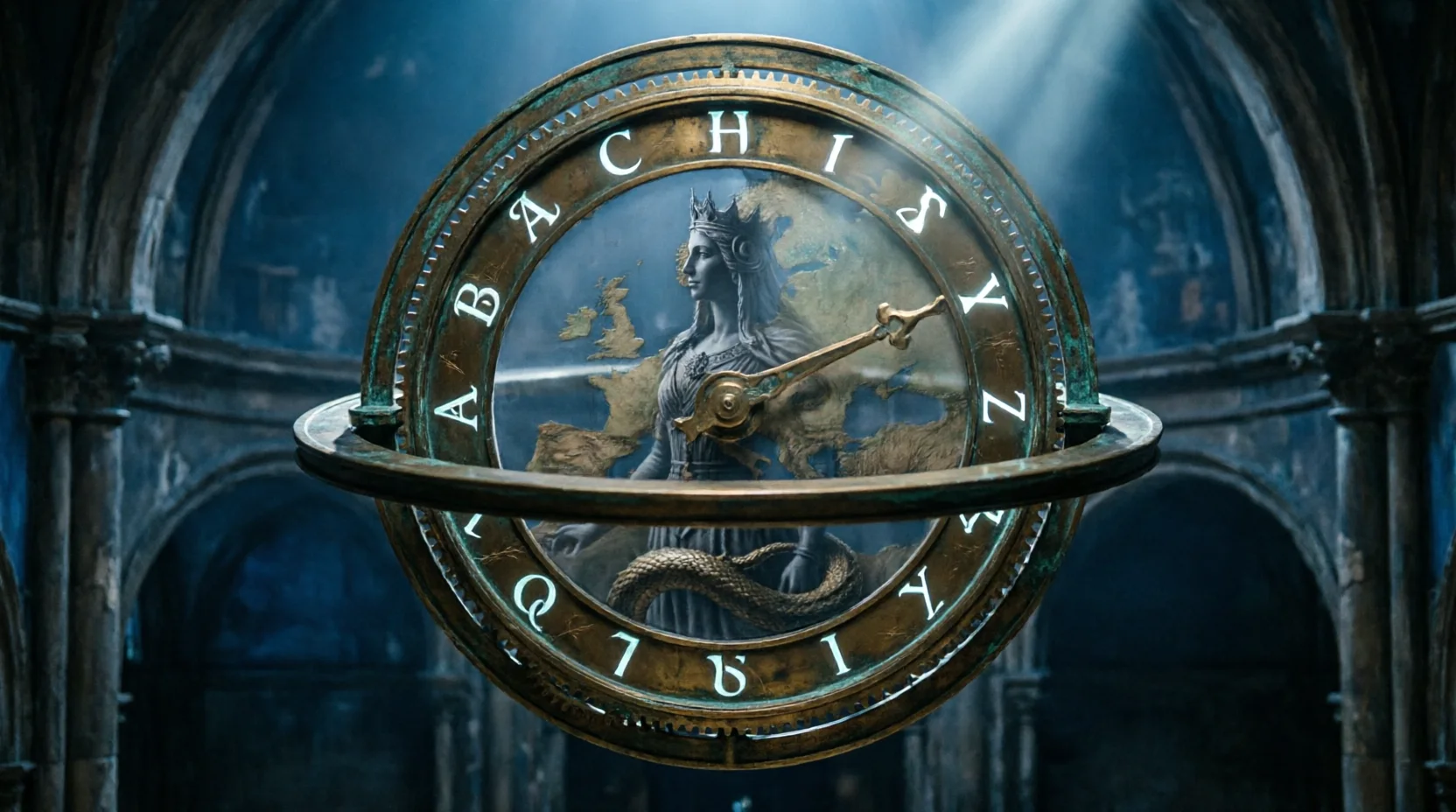
The Woman is Europe, and it is not an opinion
I insist on this because it is the most solid identification in the whole chapter, and because it stands on three independent pillars, two of which have nothing to do with the Bible.
One — the name. The continent is named after a woman. Europa was, in myth, a Phoenician princess carried off across the sea by Zeus in the form of a bull. The continent was female before it was a continent. A gender was not assigned to it later — it had one from its christening.
Two — the map. There is a five-hundred-year-old cartographic tradition in which Europe is drawn literally as a crowned woman: Europa Regina. The first version is by Johannes Putsch, 1537, and the one that travelled the world appears in Sebastian Münster’s Cosmographia. The Iberian Peninsula is the head, with a crown on it. Bohemia is the heart. Italy and Denmark are the arms, each holding an emblem.
It is not anyone’s metaphor. It is a printed map, reproduced for decades, which people actually used.
And if John was looking from above — as I argued in chapter 22, through the sea of glass and through the angel who stands simultaneously on the sea and on the land, a position possible only from a synoptic view — then he needed no imaginative effort to see a woman. He saw exactly what the sixteenth-century cartographers saw, with their own eyes, without any revelation.
Three — the crown of twelve stars. Revelation 12:1 describes her “clothed with the sun, and the moon under her feet, and upon her head a crown of twelve stars.”
The flag of Europe: twelve stars in a circle, on a blue field. Adopted in 1955 by the Council of Europe, later taken over by the Union.
And here not even a coincidence is required, because we have the designer’s own statement. Arsène Heitz, who drew the flag, said publicly that he was inspired by the iconography tied to exactly this passage. The European institutions have always maintained the official version: twelve is a number of completeness, with no religious reference. Both statements are on paper, both verifiable. Choose for yourselves.
Myth, map, flag. Three pillars, none dependent on the others.
The Dragon
“A great red dragon, having seven heads and ten horns, and his tail drew the third part of the stars of heaven.”
I developed the geographic argument in chapter 24 and will not repeat it in full. I keep only what is verifiable: seen from above, Russia has a body elongated east to west and, in the east, the Kamchatka Peninsula — narrow, jagged, full of active volcanoes. Many people looking at maps have independently remarked on the silhouette.
And “the third part of the stars” drawn by the tail is a stylistic formula, not a statistic — “a third” recurs throughout the book, of the sea, of the ships, of men. It is not arithmetic and must not be treated as arithmetic.
Phase R: what happened between 2014 and today
The text describes, in 12:13-17, a sequence of three movements. I place them beside what happened.
The dragon pursues the woman — repeated blows across a decade: Crimea in 2014, the campaign around Brexit in 2016 with documented interest from Russian disinformation, the funding of eurosceptic parties, the invasion of Ukraine in 2022.
“And the serpent cast out of his mouth water as a flood after the woman, that he might cause her to be carried away of the flood” (12:15) — the migrant crisis orchestrated at the Polish-Belarusian border in 2021, used explicitly as a hybrid weapon. A flow of people pushed against a border, not an armed invasion.
“And the dragon was wroth with the woman, and went to make war with the remnant of her seed” (12:17) — not a final battle, but a war dispersed across many small fronts: pressure on Moldova, sabotage of undersea cables in the Baltic, GPS jamming, cyberattacks, electoral disinformation simultaneously in several countries.
And there is one more piece from the text worth placing here. The woman is given “two wings of a great eagle” (12:14) to flee into the wilderness. The eagle as a symbol of help arriving from elsewhere reads obviously towards America. But there is a smaller and more precise detail: Poland itself has a white eagle as its coat of arms, sits geographically at the very hem of the woman’s dress, closest to where the dragon strikes, and was the most active weapons hub of the entire war.
The pattern of the whole phase, observed honestly: every blow produced more European cohesion, not less. Which is exactly what the text says — the woman is not defeated, she is pursued and she escapes.
I wrote all of this twenty years ago, and there is a receipt
I have to stop here, because everything you have just read about the Woman is not something I discovered last week.
I wrote it on paranormal.ro in the early 2000s, and the text is archived by the Internet Archive. The oldest capture of the page is from 10 June 2004:
web.archive.org — paranormal.ro/religie/apocalipsa.htm, 10 June 2004
The site itself is captured from 1 March 2001. Those are not my dates. They were placed by an independent American institution and nobody can alter them retroactively, myself included. Go and check.
What it says, in the 2004 text:
That the Woman is Europe. And I did not get there by revelation, but along exactly the road I retraced in this chapter two decades later, without remembering that I had walked it once already.
I counted the stars on the flag and there were twelve. I looked up who Europa was and found the Phoenician princess, daughter of Agenor, carried off by Zeus in the form of a bull to Crete — and her two sons, Minos and Rhadamanthus, became judges of the dead. Then I came across the paintings in which Europe is depicted as a woman.
Flag, myth, painting. Precisely the three pillars I reconstructed in the pages above, without knowing that I had already assembled them twenty years earlier.
And there is one more thing in it, a sentence I wrote back then without seeing its weight: “this present is already written in the middle of the Revelation of Saint John.”
In the middle. I arrived at the letter R in this chapter through a linear regression on four dated anchors. Twenty years ago I arrived at the same place with no calculation at all.
What I got right:
I wrote then that the kings of Europe were beginning to give their power to a single one, and I gave the currency as the evidence — that the German mark was gone, and the guilder, and that what remained would disappear too. I was writing in the middle of the transition. Euro banknotes reached people’s pockets in January 2002. Today the single currency is in twenty states.
I wrote that a war was coming and that “it will be in my time and I will live to see it”. It came in February 2022, the largest on the continent since 1945.
What I got wrong, and I place it here alongside:
I wrote, quoting Revelation 17:16, that the beast and the ten horns would hate the Whore, make her desolate and burn her with fire. It has not happened. And the trend so far is exactly the opposite — every blow Europe has taken has produced more cohesion, not less.
I also wrote that the present was at the middle of the book. If the middle was around 2004 and we are still at the middle in 2026, then either the clock runs far slower than I thought, or one of the two placements is wrong. I cannot have both.
And part two, captured the same day
The text has a continuation, and the Internet Archive captured it nine minutes after the first, on the same day:
web.archive.org — paranormal.ro/religie/apocalipsa2.htm, 10 June 2004, 16:24
That is where the Dragon is. And that is also where I find, written back then, the argument I reused in this chapter without remembering where I had it from: that John was watching from above, on a screen. The sea of glass in Revelation 4:6. The angel who stands simultaneously on the sea and on the land, in 10:8 — a position that makes no sense unless he is standing on a map.
And if he was looking at a map, the question becomes: how do the continents look from above?
Europe, like a woman. And to her east, a long red body, its snout ending exactly beneath the hem of her dress.
What I wrote there, in June 2004, word for word:
“In the coming years, Europe will manage to complete its project of unifying the countries, today’s Russia will become RUSSIA of old again and not a chaotic mix of states, after which it will invade Europe, destroying this plan with the Community. For us Romanians I do not see a very bright situation, especially as we are right in the Dragon’s mouth.”
And further: that the only help comes from the wings of the eagle, the symbol of America. And that “Russia is the first Dragon that will strike but not the only one… several will ally with Russia”.
Look at that date. June 2004. Russia was in the G8. The NATO-Russia Council had been operating for two years. The war in Georgia was four years away, Crimea ten, the invasion of Ukraine almost eighteen. Nobody was writing then that Russia would become an empire again and attack.
The balance sheet, across eighteen years
Monetary unification. I gave as evidence the German mark and the Dutch guilder, writing in the middle of the transition. They were not the only ones. Gone too: the Italian lira, the French franc, the Spanish peseta, the Greek drachma, the Austrian schilling, the Finnish markka, the Portuguese escudo, the Irish pound, the Belgian and Luxembourg francs. Then, one by one: the Slovenian tolar, the Maltese lira, the Cypriot pound, the Slovak koruna, the Estonian kroon, the Latvian lats, the Lithuanian litas, the Croatian kuna.
And on 1 January 2026 — eight months ago, as I write — Bulgaria became the twenty-first country to switch to the euro. The lev ceased to be legal tender on 1 February.
Twenty-one national currencies extinguished in twenty-four years, and the process is still running. “The kings have given their power to a single one.” That is no longer an interpretation. It is a list.
And those who have not yet given
The text does not say all of them have given. It says something far more precise, in Revelation 17:12:
“And the ten horns which thou sawest are ten kings, which have received no kingdom as yet; but receive power as kings one hour with the beast.”
Which have received no kingdom as yet — but will.
Of the Union’s twenty-seven states, twenty-one use the euro. Six remain: Romania, Poland, Czechia, Hungary, Sweden and Denmark.
And here is the legal detail few people know, which completely changes how you read that verse: of those six, only one has the right to refuse. Denmark has an opt-out clause negotiated at Edinburgh in 1992, the only one in the Union. The other five — us included — are obliged by treaty to adopt the common currency the moment they meet the criteria. It is not a political option you can decline indefinitely. It is an accepted obligation with deferred execution.
Romania’s target is 2029. We are not yet in the preparatory mechanism, and the Convergence Report published in June 2026 shows that we meet exactly one criterion out of all of them — the one on public debt. And on 31 July 2026, the president announced a broad political agreement that includes adoption of the euro, with the roadmap yet to be drawn up.
So: five kings who have not yet given, and who are legally bound to give.
With a reservation I raise myself, so that no one else has to: the text says ten horns. Outside there are six states, of which five are obliged. The number does not match, and I am not forcing it to match. What matches is the structure — a group that has not yet handed over and is going to — not the count.
The war. I wrote that it was coming and that I would live to see it. It came in February 2022.
Russia. That the chaotic Russia of the 1990s would become Russia of old again and then attack. That is exactly what happened.
The eagle’s wings. American help. It came.
That it would not be alone. I wrote that several would ally with the Dragon. North Korea sent troops, Iran drones, China economic support.
And the Dragon’s mouth. I wrote in 2004 that for us Romanians things did not look good, because we are right in its mouth. Since the war began, thirty-three Russian drones have entered Romanian airspace — eighteen of them in 2026 alone — and three were shot down by F-16 aircraft, the most recent on 26 July 2026. Drone fragments or intact drones have been found on Romanian soil in some fifty instances. Romania formally raised the incidents at the OSCE on 31 July.
It is not an invasion. But we can no longer say that nothing has happened to us.
What has not come to pass — and why I do not say “I was wrong”
I wrote in 2004 that Russia would invade Europe and destroy the plan with the Community.
For a long time I considered that a miss. I no longer do, and I will explain why — but I still do not move it to the hits column, because it has not happened.
First, the logical point. I never set a deadline. A statement without a date cannot be falsified, only left unfulfilled. Those are two different things, and confusing them is an error in any field, not just this one. The correct label is: open.
Second, the substantive point. Europe is not a spectator. European states are collectively financing and arming a country at war with the Dragon. And at the same time they are being struck at home: over a hundred and fifty suspected hybrid incidents across the Union and NATO since 2025, a fourfold increase in sabotage and vandalism, cables cut in the Baltic and the north of the continent, GPS jamming, and in the Baltic states a documented shift from cyber operations to kinetic sabotage and targeted assassinations. On 15 July 2026, the president of Lithuania publicly warned that intelligence indicated a provocation was being prepared against energy or transport infrastructure in the Baltics or Poland.
What do you call that state of affairs? It is not peace. It is not declared war either.
The remnant of her seed
And here the text is more precise than I have been. Revelation 12:17 does not say the dragon harasses the woman indefinitely. It says that, unable to reach her, he “went to make war with the remnant of her seed”.
He went. That is, he moved elsewhere, to a real war, in a specific place — not a diffuse campaign of sabotage.
Who is the remnant of her seed? European peoples left outside the woman’s borders. And if you look at the map through Romanian eyes, the answer is two steps away.
The Republic of Moldova is, for the most part, Bessarabia — Romanian territory from 1918 until June 1940. And of today’s Ukraine, Northern Bukovina, the Hertsa region and Budjak — southern Bessarabia, now in Odesa oblast — were Romanian, all taken in that same month of 1940.
I am not saying Ukraine is Romania, and I am claiming nothing. I am stating a fact of history and geography: precisely where the dragon went to make war lies the remnant of a people left beyond the border. A European people, of the same seed as those inside, but outside the wall.
And immediately to the south, Moldova — caught between Ukraine and Romania, with Russian troops stationed in Transnistria, with elections under a documented interference campaign, and with a reintegration plan that will keep tensions high for years to come.
The war in 12:17 is not a metaphor for harassment. It is a war, in a specific place, waged against those left outside. And it is being waged now.
And now my real error, which I have only just seen
Rereading what I wrote in 2004, I realised I did not get the prediction wrong. I got wrong the chapter I took the ending from.
Revelation 12 nowhere says the Woman is destroyed. Read it again. The dragon stands before her to devour the child — and does not devour it; the child is caught up to the throne. He pursues her — and she is given the eagle’s wings and flees to a prepared place where she is nourished. He casts a river after her — and the earth helps her, swallowing the river. And at the end, unable to catch her, he goes off to make war with the remnant of her seed.
The Woman survives. That is what the text says.
“They shall make her desolate and burn her with fire” is from chapter 17, and it is about the Whore — a different figure, a different fate, a different chapter. In 2004 I overlaid them, because both seemed to be Europe, and I took the ending of one and glued it onto the other.
Remove that overlay and look at what remains, point by point:
The dragon strikes the Woman. It happened.
The child is not devoured — the Union did not break apart, it expanded, with a twenty-first country entering the common currency in January. It happened.
The eagle’s wings help her. It happened.
The river cast after her. It happened, at the Polish border, in 2021.
War with the remnant of her seed. It is happening now.
The events of the last twenty years fit Revelation 12 better than they fit my own 2004 prediction.
That is not a victory of mine. It is a correction the text made to me. I read the right chapter and then borrowed an ending from next door, because that ending sounded more dramatic.
What remains a miss, with no excuses
Revelation 17:16, the beast burning the Whore — it has not happened, and I now know it should never have been in my prediction at all, because I was talking about a different figure.
And the “at the middle” placement. I wrote it in 2004. I am writing it in 2026. I cannot have both. Either the clock runs far more slowly than I ever thought, or one of the two placements is wrong — and it is perfectly possible that it is the second one, the very one you are reading now.
That remains the one clean miss in the whole file, and I have no way to patch it.
So the honest score, verifiable by anyone with two links and a search: six hits, one open prediction moving in the direction written but not yet arrived, a methodological error I found in myself, and one miss I leave on the page.
That is not infallibility, and I am not selling it as such. But it is not zero either.
About how they arrive. I do not construct them. I do not sit down to deduce, to calculate, to piece things together. They arrive as ideas, whole, usually about things that had nothing to do with what was occupying me that day. In the 2004 text I described exactly this without realising what I was describing: that every time I approached the subject something else appeared and pulled me away, until I switched off the telephone, drove everyone away and sat alone with it for a few days.
I have said it in other chapters: I do not believe in I, I believe in WE. These thoughts do not feel like mine.
But I build no argument on that statement, and I want it to be clear why. Anyone who says “it was given to me” is asking for an exemption from responsibility. I do not want it. If the model in this chapter is wrong, it is my wrong, regardless of where the idea came from. I am not blaming anyone upstairs for my arithmetic.
I say it only because it is true, and because I want you to know exactly what kind of man made the calculation you are reading.
6. What comes next: S, T, U, V, W
Five steps. I take them one at a time, so that it is clear what we are watching for.
S — the Beast. Chapter 13. A beast from the sea, with seven heads and ten horns, which receives power for 42 months. Then a second beast, from the earth, “with two horns like a lamb, and he spake as a dragon” — something with a gentle appearance and a dominating function. It makes fire come down from heaven on command. It makes an image that speaks and that kills whoever refuses to worship it. And it imposes a mark on the right hand or the forehead, without which no one can buy or sell.
T — the harvest. The Lamb on Mount Zion, the three angels with their proclamation, then the harvest and the winepress of wrath. It is the only step with no technical marker; I pass it as a narrative stage.
U — the seven bowls. Grievous sores on those who bear the mark, which is a description of radiation burns or a chemical agent. The sea becomes blood. The sun scorches men with fire. Darkness over the kingdom of the beast, and men “gnawed their tongues for pain” — a grid failure, or smoke blocking the light. The Euphrates dried up to prepare the way of the kings of the east — a controlled diversion of water, a dam opened strategically. “Frogs” issuing from the mouths of the dragon, the beast and the false prophet — coordinated propaganda broadcasts from three sources. Then the gathering at Armageddon. And at the seventh, the greatest earthquake in history, Babylon split into three parts, and hail with stones the weight of a talent — between twenty-six and forty-five kilograms, depending on the standard used. Hail of that size does not exist in nature. Projectiles of that calibre do.
V — Babylon falls in one hour. Chapters 17-18. What is worth noting is the speed: the text repeats the formula “in one hour” three times. Not a slow decline, a sudden collapse. And history confirms that overstretched empires fall exactly like that — the Soviet Union, in 1991, at the end of exhaustion, not gradually.
W — the Return. Chapter 19.
After that there are three more steps — the binding and the millennium, Gog and Magog with the final judgment, and the new heaven. But the question of this chapter stops at W.
7. The rhythm
Four anchors, in the order of the text, each with a real date: E = 1914, I = 1945, L = 1986, R = 2014.
I placed them on the scale — positions 5, 9, 12 and 18 — and drew a line through them.
The result: 7.89 years per letter.
And now the check, which I give so that nobody thinks I picked what suited me. The line predicts 1917 for E, where reality is 1914. It predicts 1949 for I, where reality is 1945. It predicts 1973 for L, where reality is 1986. It predicts 2020 for R, where reality is 2014.
Deviations of between three and thirteen years. It is not a Swiss watch. But it is not an opinion either — it is a rhythm measured across one hundred and twelve years, with its errors on display.
Hold on to that figure, because in the next section I dismantle it myself. It does not survive.
Interlude: three objections I raise against myself
Before going further with the calculation, I put on the table the three best arguments against what I have built so far. I found them myself, while checking, and it would be dishonest to wait for someone else to find them.
The first: the order of the text is not the order of history
I placed the sixth seal on 1945, because of the sky rolled up as a scroll. But the first trumpet describes incendiary bombing and the second the naval war — both from 1940-1945. And the trumpets come, in the text, after the sixth seal.
So the order in the book and the order in history do not coincide. That is a real problem and I cannot sweep it under the carpet.
There is an answer to it, and it is eighteen hundred years old. Victorinus of Pettau, in the third century, proposed what is called recapitulation: the three series of seven — seals, trumpets, bowls — are not three successive periods but the same period seen three times, from three different angles, each series running to the end and then starting over.
If recapitulation is right, then my scale from A to Z is a good description of the book’s structure, but a poor description of a timeline. And if it is a poor description of a timeline, my regression on four anchors is measuring something that does not exist.
I have no way of settling this. I leave it written down.
The second: the pauses
The book has two places where time stops, and both matter for any calculation.
The fifth seal. The martyrs under the altar cry “how long?”, receive white robes, and are told to rest “until their fellowservants also and their brethren, that should be killed as they were, should be fulfilled”. Read the wording: the waiting does not end after a period of time, but when another group of people has been killed, in the same way. The dead of one war made to wait until the dead of the next join them. The period between 1918 and 1939 looks exactly like that.
The seventh seal. “There was silence in heaven about the space of half an hour” (8:1). The only silence in the entire book, placed immediately after the sky rolled up as a scroll. If the sixth seal is 1945, then the silence is what followed: the half-century in which none of what had been announced happened again.
And from this comes a conclusion I cannot avoid: the sequence is not continuous and has no constant rhythm. The book acknowledges its own pauses, and one of them is explicitly of undetermined length.
An average rate of 7.89 years per letter, calculated across pauses that the text itself declares variable, is a far cruder approximation than it looks when written with two decimal places.
The third: “at the middle”, written twice
I said above that this is the one clean miss in the whole file. On rereading, I think I was too quick to condemn myself.
The contradiction exists only if “the middle” is a point. If it is a phase — and chapters 11, 12 and 13, precisely the middle of the book, are the zone where the 1260 days, the woman, the dragon and the beast all appear — then both 2004 and 2026 can be inside it with no contradiction at all. I am not saying the same wrong thing twice. I am saying the phase is long.
But that defence has a price, and I pay it here, in the open:
If the letter R lasts twenty-two years, then the rate of 7.89 years per letter is wrong.
I cannot have both. Either the middle is a long phase and my rate means nothing, or the rate is good and one of the two placements is wrong.
I choose the first, because it is more honest to the text — and I accept the consequence: the rate falls.
What survives all three
In three paragraphs I have lost the regression, the timeline and the rate. I lost them myself; nobody took them from me.
What remains is exactly two things, and neither depends on what I demolished:
One: the 1260 days. It is not an extrapolation of mine, it is the text’s own figure, repeated five times, and all five occurrences fall between S and W. Recapitulation does not touch it. The pauses do not touch it. The rate does not touch it.
Two: the legislative calendar. The digital wallet in 2026-2027, the cash cap in July 2027, the digital euro after. Those do not come from Revelation, they come from the Official Journal, and they have printed deadlines.
The date I give below rests on those two. Not on the scale, not on the regression, not on the 7.89 years.
I built an instrument and then dismantled it myself in front of you. What is left after the dismantling is less spectacular, but it is the only part I can defend.
8. The only hard number in the whole book
Revelation gives no date. But it gives a duration, and repeats it five times, from five different angles:
11:2 — the holy city trodden underfoot 42 months.
11:3 — the two witnesses prophesy 1260 days.
12:6 — the woman fed in the wilderness 1260 days.
12:14 — “a time, and times, and half a time” — that is, 3.5.
13:5 — the beast is given power to continue 42 months.
The same figure, five times. And all five occurrences fall in the interval between S and W.
Daniel adds two related numbers, in the same chapter: 1290 days (12:11) and 1335 days (12:12) — thirty and seventy-five days longer than 1260, usually read as settling periods after the event.
Translated, this means one thing, and it is the answer to this chapter’s question:
From the moment the Beast receives authority until the Return, the text says 1260 days. Three and a half years. Not centuries, not generations.
9. The clock that has already run out twice
And here is the problem I have to put on the table, because without it the whole calculation is a con.
If we are at R, that is, already inside chapter 12, then the 1260-day clock should have started there. Because 12:6 and 12:14, two of the five occurrences of the figure, are precisely in the passage where we have placed ourselves.
Do the arithmetic:
Crimea, March 2014, plus three and a half years: September 2017. Passed.
The invasion of Ukraine, February 2022, plus three and a half years: August 2025. Passed last year.
Twice the clock has run out and nothing followed of what should have followed.
So one of three things: either the trigger has not fired yet, or the days are not days, or the mapping is wrong.
The second option has a history of its own and deserves telling, because it produced the most famous interpretive disasters in history. It is called the day-year principle: each prophetic day would mean a calendar year. With it, 1260 days become 1260 years. The historicist interpreters counted from 538 and arrived at 1798, the year General Berthier took Pope Pius VI prisoner — a spectacular match at the time, which was followed by nothing else in the book. And William Miller used the 2300 days of Daniel 8:14, counted from 457 BC, and arrived at 22 October 1844. Tens of thousands of people sold their houses. The day passed. It is known, in the history of religion, as the Great Disappointment.
I choose the first option — that the trigger has not fired — and explain immediately why. But note that I wrote it: this model has already been contradicted twice, if you apply it to the obvious dates. Anyone who does not write that in their text is lying to you by omission.
10. Why I think the trigger has not fired: S is no longer prophecy, it is a calendar
The Beast of chapter 13 has one single practical marker in the whole book, one sentence anyone can verify, anywhere, without theology:
“And that no man might buy or sell, save he that had the mark” (13:17).
Not a symbol on the forehead. Not a declared allegiance. A condition of access to transaction.
And that has not happened yet. But it is no longer remotely speculative, because it has deadlines published in the Official Journal of the European Union. Not in books about the future. In adopted legislation.
The European Digital Identity Wallet. Regulation (EU) 2024/1183, adopted, in force since May 2024. Member states are obliged to make a digital identity wallet available to citizens, phased across 2026-2027. Large online platforms are obliged to accept it for authentication.
The European cash cap. Regulation (EU) 2024/1624, adopted. Ten thousand euros maximum cash payment across the whole Union, applicable from July 2027.
The digital euro. A Commission legislative proposal from 2023, with the European Central Bank in its preparation phase since late 2023. Issuance depends on the adoption of the regulation. The draft regulation gives it legal tender status and obliges merchants to accept it.
The digital yuan. Already operating, piloted at a scale of hundreds of millions of people. And in some distributions, sums with an expiry date have been tested, precisely in order to force spending within a given window.
And the heaviest piece, which is not a project but a reality in operation for over a decade: in China, people on judicial enforcement lists cannot buy plane tickets or high-speed rail tickets. Millions of people. Not a hypothesis, not a proposal, not science fiction. Functioning infrastructure, at a scale of hundreds of millions, in which a recorded status stops you from buying something.
The mechanism of 13:17 does not need to be invented. It exists, it works, and it has been tested.
11. The mark needs no law at all
Here is the thing I had wrong until now, and which I correct publicly.
I thought what was missing was the compulsory character. That as long as the digital wallet remains voluntary for the citizen — and it is explicitly voluntary, it says so in the regulation — we are not at 13:17. That the obligation is placed on the merchant, not on the person.
Wrong. And the error matters.
The mark does not need to be made compulsory. It only needs the alternative to disappear.
The moment cash becomes impractical — capped, refused, expensive, suspicious, inconvenient, impossible to deposit without justification — the identifier becomes compulsory in fact, without anyone ever having voted for a law saying “you must have it”. You are not forbidden to buy without it. There is simply nothing left to buy with.
Nobody signs a decree. No tyrant appears on television. There is no day in the calendar on which it was decided. One counter closes, then another, then the bank tells you it no longer keeps cash on the premises, then the corner shop has no notes in the drawer for change, then paying cash becomes a signal of suspicion — and at the end of the road you have exactly what 13:17 describes.
This form is worse than the one with the decree, and it is worth understanding why. A thing that is never decided can never be refused. You have no one to blame. You have no moment at which to object. You have nothing to say no to. You cannot take to the streets against a convenience.
And there is one more piece worth pausing on, because it is graver than it looks.
Money that expires is not money.
A currency with an expiry date is not a good you own. It is a ration. You do not have wealth, you have an allowance. You do not have savings, you have a credit that is extinguished if you do not spend it the way they want and when they want.
And the difference between possessing and receiving is the whole difference between a free man and a kept one. And it is made with a line of code, not with a revolution.
12. The calculation
Step one — when S begins.
Here I have to be careful, because I sawed off my own branch in the interlude.
The regression gave 2027.9. I no longer use that figure as an argument. I showed above why it does not hold: if the letter R lasts two decades, an average rate of 7.89 years per letter measures nothing real. I leave it written in the chapter so the road is visible, not so that anything rests on it.
One reference point remains for S, and it is the one that does not come from Revelation at all: the European legislative calendar. The digital wallet in 2026-2027. The cash cap from July 2027. The digital euro after that, if the regulation passes.
Those are dates printed in the Official Journal, not deduced by me from an old book.
And the fact that the regression, however shaky, fell in the same window as them — I do not use that as evidence. I note it as a coincidence, exactly like the one with the speed of light below. Two weak things placed side by side do not make one strong thing.
So S rests on a single leg, and here is that leg:
S begins in 2027-2028.
Step two — from S to the Return.
Here I extrapolate absolutely nothing, because the text gives the figure itself, five times.
2028 + 1260 days = 2031.5
2028 + 1335 days, Daniel’s figure = 2031.7
13. The year
2031.
The realistic window, given the deviation of the anchors: 2030-2032.
That is all. That is the number. I dress it in nothing and accompany it with no promise.
14. The second calculation, and why I refuse to use it as evidence
In the previous chapter I made an entirely different calculation, starting from relativity: if someone left two thousand years ago at a speed close to that of light, how much time passed for him?
The results, for one generation as proper time on board, departure in the year 30:
| Speed | γ | Generation 25 yr | Generation 40 yr | Generation 70 yr |
| 0.9 c | 2.29 | year 87 | year 122 | year 191 |
| 0.99 c | 7.09 | year 207 | year 314 | year 526 |
| 0.999 c | 22.4 | year 589 | year 925 | year 1596 |
| 0.99980 c | 49.9 | year 1278 | year 2026 | year 3523 |
| 0.9999 c | 70.7 | year 1798 | year 2858 | year 4980 |
| 0.99999 c | 223.6 | year 5620 | year 8974 | year 15683 |
With the biblical generation of forty years and γ = 50, the answer is the year 2026. And at a slightly higher γ, the early 2030s.
And now I say what has to be said, even though it spoils the effect: I do not link this figure to the one above.
They are two completely independent calculations. And if in the relativistic one I had taken a generation of twenty-five years instead of forty, I would have got the year 1278. The fact that one of my choices landed near the other figure is a consequence of the choice, not a confirmation of anything.
Whoever places two coincidences side by side and says “look, they confirm each other” has fabricated evidence. That is exactly where a text’s credibility breaks, and I am not breaking mine for a closing effect.
I keep one single thing from that table, and it is an observation about precision, not about a date: between “arrives today” and “arrives in eight thousand years” there are fifty-eight kilometres per second, out of a total of three hundred thousand. A difference of two hundredths of a percent in speed moves the result by eight millennia.
Which means that if someone really is on the way, not even he has any way of knowing what year he lands in. He would know how long it took for him. He would have no way of doing the conversion.
Mark 13:32: “But of that day and that hour knoweth no man, no, not the angels which are in heaven, neither the Son, but the Father.”
15. Nineteen centuries of failed datings
And now the list, because without it this chapter would be merely the one thousand and first in a series.
Year 170 — Montanus announces the descent of the New Jerusalem in Phrygia. People gather there to wait.
Year 1000 — the millenarian panic.
1260 — Joachim of Fiore fixes the beginning of the final age.
Sixteenth century — the reformers identify the Papacy with the Beast. The Counter-Reformation replies by identifying the Reformation.
1798 — the historicists, via the day-year principle; Napoleon and the imprisoned Pope seemed the confirmation.
22 October 1844 — William Miller. The Great Disappointment.
1914, then 1925, then 1975 — three successive datings by the Jehovah’s Witnesses.
1930s-40s — Hitler as Antichrist.
The Cold War — the Soviet Union in the same role.
1988 — implied by Hal Lindsey, a generation from 1948.
Year 2000 — the millennium panic.
1994, then 21 May 2011, then 21 October 2011 — Harold Camping, three datings in seventeen years.
2000s-2020s — the European Union as the Beast.
Every one of them had current events that fitted perfectly at the time. They were not stupid people. Some were serious mathematicians. They had arguments, they had anchors, they had calculations.
And when the date passed, almost every one of them did the same thing: they recalculated.
That is the disease. Not the error — error is human and unavoidable. The disease is the refusal to lose. A model that can never lose is not a model, it is a private religion.
And there is one more thing I must admit about myself: every generation has found itself at the middle of the book. It is not a coincidence and it is not evidence that the middle is approaching. It is a structural distortion. The middle is where the text becomes interesting, where the action begins and where the reader feels part of the story. Nobody, in two thousand years, has placed themselves at the letter F.
I have placed myself at R. That should worry you a little, and me as well.
16. The year in which I declare myself defeated
So I write here, in black and white, so that it can be quoted against me:
If by 31 December 2034 there is no system in which you cannot buy or sell without a digital identifier — functioning, generalised, with no practical alternative — then the model in this chapter is wrong.
It is not adjusted. The date is not moved another ten years. It is not said to have been symbolic. No other event is sought that might fit. It is thrown away.
And if I am still alive and still writing, I will write it here too, on this page: I was wrong.
I chose 2034 and not 2031 precisely to give myself three years of margin over my own prediction. If it does not work out even with the margin, I have no excuse left.
17. What I do not claim
I do not claim to have deciphered Revelation. Nineteen centuries of people cleverer than I am have tried and failed, and many of them had instruments I do not have.
I do not claim that the matches prove anything. Matching works always — that is its fundamental problem. If you have a book full of violent images and a world full of violent events, you will always find pairs. Chernobyl is the best match in the whole chapter, and it is still not proof. It is only an extremely good lexical coincidence.
I do not claim my anchors are the only possible ones. I chose those that stand in the order of the text and have verifiable dates. Another person, with other equally reasonable anchors, would get another rhythm and another year.
I do not claim the bias does not touch me. See the paragraph above about the letter F.
And I do not claim to be neutral. I am a man who has spent a lifetime looking for answers to the same three questions, and a man who looks, finds. That is the occupational hazard.
Coda: on ideas that do not yet have proof
I wrote this chapter knowing exactly what I would hear. “Nonsense.” “It is not scientifically proven.” “Get out of here.”
And I want to say something about that sentence, because it is misused by a great many people who believe themselves to be on the side of reason.
“It is not scientifically proven” does not mean “it does not exist”. It means “not proven yet”, and that word matters more than all the others combined.
In 1803, the French Academy of Sciences held that peasants’ tales of stones falling from the sky were superstition. The stones really were falling from the sky. It took the meteorite shower at L’Aigle and a serious investigation before it was accepted that the sky throws rocks.
In 1847, Semmelweis told doctors to wash their hands before delivering babies. He was ridiculed, dismissed, and died in an asylum in 1865. He was right, and every person born since owes him something.
In 1912, Wegener said the continents move. He was treated as a dilettante for half a century and died without seeing the confirmation. Today plate tectonics is taught in schools.
In 1982, two Australians said that ulcers are caused by a bacterium, not by stress. Nobody believed them, so one of them drank a culture to give himself the disease. In 2005 they received the Nobel Prize.
Einstein predicted gravitational waves in 1916, doubted them himself, and they were detected only in 2015. Ninety-nine years. The Higgs boson, proposed in 1964, confirmed in 2012 — forty-eight.
In all of these cases, between “that is nonsense” and “that is taught in schools”, reality did not change. Only what we could measure changed.
So no, an idea is not thrown in the bin because at that moment of knowledge it has no scientific basis. You take it, you roll it around, you strike it against everything you have to hand, and you see what stays whole.
But here is the trap, and it must be said
Because that very sentence — “they laughed at Galileo too” — is the most used phrase in the history of quackery. For every Wegener who was right there are tens of thousands of ideas that were rejected because they were, quite simply, wrong. Rejection is not a medal. The fact that people laugh at you does not make you Semmelweis.
So what is the difference? How do you tell a good idea not yet confirmed from a piece of nonsense hiding behind persecution?
It is not how loudly it is rejected. It is not how convinced the author is. It is not even how beautiful it sounds.
The difference is one single thing: a good idea can state what would prove it wrong.
Wegener could: if the ocean floor shows no signs of spreading, the whole thing collapses. Marshall could: if antibiotics do not cure the ulcer, it is over. Einstein could: if the interferometer sees nothing, the theory has a problem.
A piece of nonsense never can. Ask it what would disprove it and it answers either “nothing”, or that any contrary evidence is itself evidence in favour.
That is why I put into this chapter a date on which I declare myself defeated, and why I dismantled half of my own instruments in the open. Not to appear modest. So that I can say with a clean face that this idea is of the first kind, not the second.
And if someone comes and says “it is not scientifically proven”, the correct answer is neither “yes it is” nor “that does not matter”.
The correct answer is: “Quite right. Here is exactly what has to happen for it to be proven, and here is exactly the year in which, if it has not happened, I will throw it away myself.”
That is all. The rest is noise, from both sides.
18. What remains
Notice the shape of the answer, because this is the third time in three chapters that it comes out identical:
The duration is known. The starting date is not.
The text says clearly how long the ending lasts — 1260 days, five times, with no ambiguity. It never says when the counting begins.
Exactly as, in the chapter on relativity, one could calculate precisely how long the journey takes, but not what year you land in.
Exactly as Mark 13:32 says, through the mouth of the main character: I know everything, except the day.
It is not a slip in the texts and it is not an inconsistency. It is the same structure, repeated from three completely different directions: you are given the duration and the clock is hidden from you.
And if the hiding is deliberate, it has one logical reason, and it is a good one.
Whoever knows the date prepares for the date. He does not live.
A man who knew for certain he had five years left would not change — he would wait. He would make calculations. He would postpone. He would become good in the last six months, like a student before an examination, and believe he had solved it.
A man who does not know has to be good now, because there is no other time available. And that is no longer strategy. That is character.
Perhaps that is the entire point of hiding the clock. Not to keep us in fear — but to stop us from scheduling our goodness.
So I leave you with what I left you in the other chapters, because it is the only thing in this entire text that does not depend on any calculation of mine.
Maybe he comes in 2031. Maybe in 2400. Maybe never, and everything I have written here is arithmetic applied to a book of apocalyptic poetry.
But if someone comes — whenever, with whatever light, with however many miracles, and however exactly he hits the date I have calculated here:
look at what he asks for.
If he asks for obedience, for fear, for a mark to be worn, for a fee, for a camp, for an enemy to hate — you know who he is, even if he lands on 15 June 2031 at midday, exactly as I wrote here.
And if he asks for nothing, if he simply tells you to live your life and to be good — then it no longer matters what year it is, nor the clock, nor the speed, nor the scale from A to Z, nor anything I have written in this chapter.