Or: the anatomy of the administrator who thinks he owns the place.
The quotations render the sense of the Coptic; translations differ from edition to edition.
Why this text first. In the jar, the Apocryphon of John was not just any book: it was found in three complete copies and a fragment (Codices II, III, IV). In a library of fifty-two texts, the one copied three times is the foundation text. If the jar is a house, this is its footing.
And there is something else. A fourth copy exists that was never in the jar — the Berlin Codex, bought in Egypt in 1896 by Carl Schmidt. Which means the Apocryphon of John was in European hands forty-nine years before the Nag Hammadi discovery. Why did nobody read it? Because Schmidt’s edition, ready for the press in 1912, was destroyed in its entirety: a burst water pipe at the printing house drowned the whole run. Then came a war, then another. The text was finally published in 1955, by Walter Till.
In the base article I spoke of two lids: the sand and the monopoly. This is the third, and the most absurd of them all. A water pipe. Sixty years of silence caused by plumbing.
1. The setting: the one who appears in three forms
John, after the events, goes up the mountain in grief, and the Saviour appears to him — but not in a single form: now as a child, now as a young man, now as an old man — and promises to show him “what is hidden in silence”.
Commentary: The revealer has no fixed face. Light has no face of its own; it takes the face of whoever receives it. From the very first scene the text lays down the rule of the whole library: truth is not a portrait you bow to, it is a frequency you receive. Anyone who claims to hold the fixed portrait of the divine is already selling you something.
It is worth saying how old this setting is. Around the year 180, Irenaeus of Lyon summarises, in order to refute it, a story with Barbelo, a fallen aeon and a blind demiurge — a story that overlaps, in the bones, with what we are reading here. The manuscript from the jar is fourth-century. The story inside it was circulating at least two centuries earlier.
2. The nameless one
The revelation begins not with the world but with the Source — described negatively, by what it is not:
“Do not think that it is a god, or anything of the sort… it is immeasurable light… no name belongs to it, nor number… it is neither body nor bodiless… no one can conceive it, for it is beyond thought.”
Commentary: This is the first criterion of discernment in the whole library. The Source refuses every category — including the title of “god” as a function of power. The administrator demands a name, a number (a census, a flock) and worship. The One refuses all three. The test becomes simple: whoever demands worship is not the Source, he is the administrator. The true God of these texts does not rule; He is.
Notice too how inconvenient this text is for any institution. A God with no name cannot be correctly invoked. One with no number cannot be accounted for. One who is “beyond thought” cannot be taught from a chair, cannot be defended by a creed, and cannot be misunderstood — because he cannot be understood at all. There is nothing to sell. Nothing to administer. A God who refuses a name implicitly refuses everyone who claims to pronounce it on your behalf.
3. Barbelo: the first thought
The One, looking upon Himself in the living light that surrounds Him, brings forth the First Thought — Barbelo, the “mother-father”, the matrix of all things. She asks and receives: foreknowledge, incorruptibility, eternal life.
Commentary: The Source’s first act is not a command but a reflection — a relationship. The Pleroma is, from the origin, not “I” but “WE”. I have said it many times on this blog, in other chapters and in other words: I do not believe in I, I believe in WE. The Apocryphon says the same thing in its own language: at the origin there is no solitary throne, but a mirror in which light looks at itself and gives birth to the other. Solitude is not the Source’s signature; it is the administrator’s.
And there is a difference of grammar worth seeing. In Genesis, creation begins with a verb of command: let there be. Here it begins with a verb of perception: looks. A system that begins with an order will inevitably produce subjects. A system that begins with a gaze produces partners. The whole parting of the two religions fits inside the opening verb.
4. Sophia’s mistake and the birth of the administrator
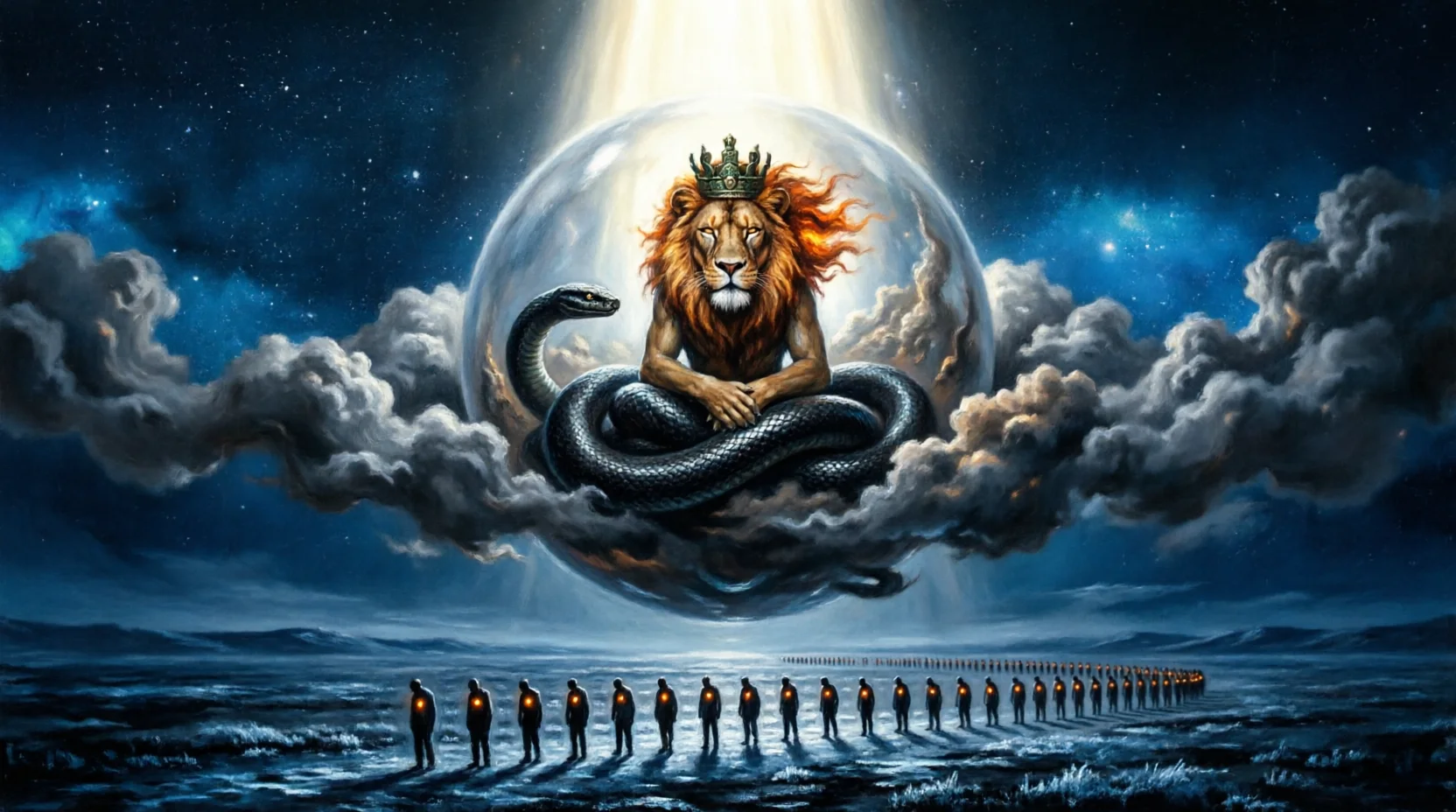
Sophia, Wisdom, the last aeon, wants to bring forth a likeness on her own, without her consort, without consent. What is born is imperfect: Yaldabaoth — “having the form of a serpent with the face of a lion, his eyes like flashing lightning”. Ashamed, Sophia hides him in a cloud, and out of that cloud he makes himself a throne.
Commentary: Three decisive details. First: the demiurge is not born of the Source but of a mistake — of a unilateral act, without relationship. Second: he is not evil by choice, he is blind from birth — he has never seen what is above him. Third: his cloud is the first smokescreen in history — he does not rule by truth, he rules by fog. And notice what Sophia does: she does not kill the error, she contains it. The Source does not destroy its mistakes; it shuts them inside a shell where they can do no harm. The trouble begins when the shell forgets that it is a shell.
The cloud is not a symbol the author picked at random. Take the Bible and count how often the same prop turns up: the pillar of cloud before the camp, the thick cloud on Sinai that no one is allowed to look into, the cloud that fills Solomon’s Temple until the priests cannot go on with the service. Every time, the same staging: the presence announces itself, and visibility is zero. The author of the Apocryphon knew those texts very well. When he has the demiurge build his throne out of a cloud, he is not inventing a symbol — he is citing a file.
5. “I am God” / “You are mistaken, Samael!”
Seeing nothing above him, Yaldabaoth cries out: “I am God and there is no other apart from me.” And out of the cloud the feminine voice answers: “You are mistaken, Samael!” — “you are mistaken, blind one” — and “erre, Saklas” — “you wander, fool”.
Commentary: This is the most important sentence in the entire jar. The administrator’s claim is a lie — and the system itself contains the correction. The voice does not destroy him; it names him. It calls him by his real name: blind, fool. To name is to disarm. The mechanism cannot bear being named from inside the mechanism. The Apocryphon does exactly that — and that is why it was burned. A throne that depends on a lie falls the moment the lie is said out loud.
But something easily lost in the reading has to be pressed here. The sentence Yaldabaoth shouts was not invented by the author. It is a quotation. “I am the Lord, and there is no other” — Isaiah 45. “I am God, and there is no other” — Isaiah 46. “See now that I, even I, am he, and there is no god beside me” — Deuteronomy 32. The author of the Apocryphon takes the most solemn declaration of uniqueness in the Old Testament, puts it unchanged into the mouth of the blind demiurge, and then adds a single line: you are mistaken.
That is no longer alternative theology. That is an act of hostile reading performed on a sacred text, with the sacred text in hand. The author does not say “the Bible is wrong”. He says something far sharper: the sentence is authentic, the speaker is not who you think. He does not dispute the recording. He disputes the identification of the voice.
And the names confirm the charge. Samael reads, in Aramaic, as “the blind one” — samya. Saklas means “the fool”. For Yaldabaoth several etymologies have been proposed, the most widely repeated being “child of chaos”, and it is only honest to say that none of them is certain. But the first two are clear, and both say the same thing: he is not an enemy, he is an incompetent who does not know what he cannot see.
6. Man and the spark smuggled in
The archons see in the water the reflection of the incorruptible light, fall in love with it and want to capture it. They mould Adam — but he cannot stand, he is merely “a crawling thing”. Only when they breathe into him, through their own breath, without knowing it, does the luminous epinoia slip in: Adam becomes luminous, he speaks, and he is greater than his makers. The archons, jealous, cast him down into matter.
Commentary: Man is not the demiurge’s slave by design — he is the demiurge’s failed trap. The spark was not given to him by the administrator; it was slipped in over his head, through his own mechanism. And the archons’ jealousy is the most honest portrait of the farmer there is: he is afraid of the harvest that looks back at him. Any system that forbids people to think is a system that has recognised, in their eyes, the luminous epinoia.
The Greek word epinoia translates roughly as “the thought that comes after” — the flash, the afterthought, what crosses your mind a second after you have heard the official explanation. It is not a solemn faculty. It is exactly that small, irritating reflex: hold on, something here does not add up. The text says this is the organ of salvation. Not faith, not obedience, not sacrifice. The reflex of not swallowing.
And the breathing scene deserves another look with Genesis beside it. There, the breath in the nostrils is the act of ownership: I made you, therefore you are Mine. Here, it is a theft that turns against the thief. The archons give nothing — they exhale, and in their air there was already something else, which they could not see. The whole difference between the two stories lies in one question: who put there the thing that makes you human? In one, the owner. In the other, a smuggler.
7. The garden and the instructor
They place Adam in the garden and command him not to eat from the tree of knowledge. And the instructor comes — the light enters the serpent — and says: “You shall not die. It was out of jealousy that he said this to you; rather, your eyes will be opened.”
Commentary: Genesis turned inside out. The farm fence is the ban on knowing, and “you shall not die” is the first fact-check in history. The instructor does not command, does not threaten, does not found an institution: he informs and withdraws. Eating from the tree is not the fall — it is the waking. That is why the administrator punishes it: not because it is a sin, but because it is lucidity.
The uncomfortable part is that the verification of this fact-check does not happen in the gnostic texts. It happens in Genesis. Open chapter 3 and read, point by point, what was promised and what occurred. It was said: on the day you eat of it, you shall die. They did not die that day; they lived for centuries, by the text’s own reckoning. It was said: your eyes will be opened. Verse 7: “the eyes of them both were opened”. And at verse 22, the one who had forbidden it states the result himself, out loud: “behold, the man is become as one of us, to know good and evil” — and puts him out of the garden lest he stretch out his hand to the other tree as well.
So, in the canonical text: the threat was not fulfilled, the other party’s promise was, and the stated reason for the expulsion is not the sin but the risk that the man might take something more. You need no forbidden gospel to see this. You only need to read to the bottom of the page they handed you.
8. The three descents of the Pronoia
The text closes with the descent of Forethought: “I came three times… I entered into the midst of their prison… I awakened them from the sleep of death… let him who has ears to hear, hear.” And in the hymn: “I am the first and the last… I am the honoured one and the despised one… I am the silence that cannot be comprehended.”
Commentary: The Source does not abandon its harvest. Forethought descends again and again, enters the prison itself, and wakes — it does not command. And the final language is, once more, silence. The administrator speaks, demands, counts. The Source is silent, and out of the silence comes the voice. We have met the pair before: the Depth and the Silence, Bythos and Sige. The map closes where it began: in silence.
One clarification the text needs in order to be read honestly. The Apocryphon has come down to us in two versions, a long one and a short one. The Pronoia hymn, with its three descents, is found only in the long version — the one in Codices II and IV. In the short version, from Codex III and the Berlin Codex, it simply does not exist. Which is to say that the most beautiful ending of the text is also the part most likely to have been added late.
I say this because I do not want to sell as a “first-century document” something that may well be third-century. But notice also what does not change: in both versions, salvation comes as a waking from sleep, not as the settling of a debt. The addition did not change the mechanism, it only wrote its hymn.
9. What the map confirms
All four red threads from the base article run through this text:
- The administrator is not the Source — he is its blind error.
- Salvation is waking, not sacrifice — the instructor informs, he does not ask for blood.
- The spark is smuggled in — the epinoia enters over the farmer’s head.
- Silence and naming are the frequencies of freedom — the voice names the blind one, the hymn ends in silence.
And the honest note, as always: this is a map, not a proof. I have no way of knowing whether the man who drew it saw something or built a system. I only know that his system explains without effort a few things that official theology explains with difficulty — why the god who forbids knowledge behaves exactly like a frightened owner, why the threat in the garden was not carried out, why the one who demands worship always needs a cloud.
But it is a two-thousand-year-old map, drawn by people who never met one another, and it fits — structurally, not in detail — with what I have lived through and with the mechanics I have taken apart piece by piece in the earlier chapters. A map that matches the ground in three independent places is no longer only a map. It is a compass.
Part 2 follows: The Hypostasis of the Archons — Genesis turned inside out. The jar is open.