Or: Genesis turned inside out
The quotations render the sense of the Coptic; translations differ from edition to edition.
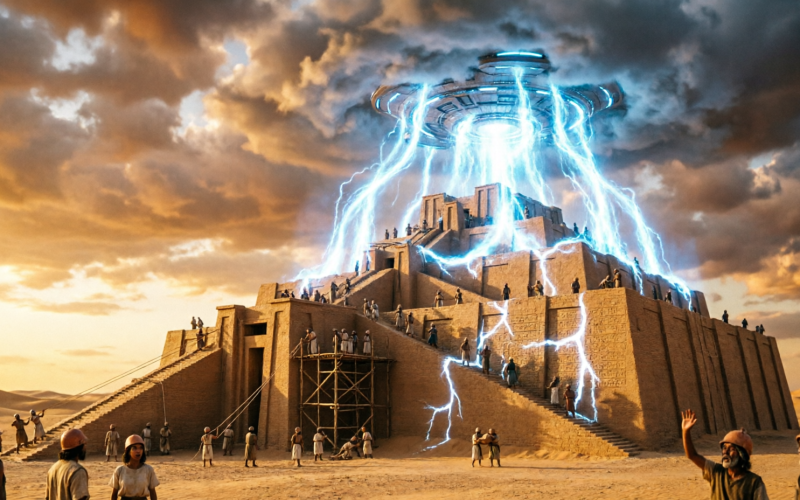
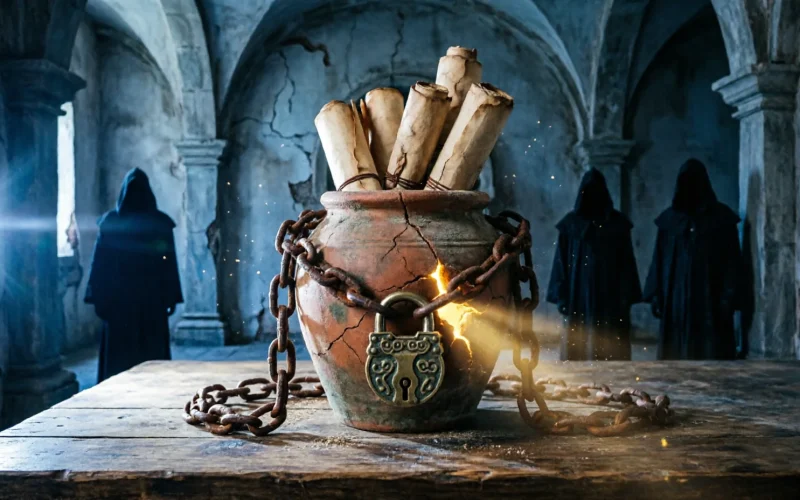
Why these two texts. In Codex II they sit side by side (II,4 and II,5), right after the map (the Apocryphon of John), the voice (Thomas) and the mystery (Philip). As though the librarian had arranged it: first the map, then the counter-narrative of the origin. These are the jar’s Genesis — the same founding story as Genesis 1–4, but filmed from the other camera.
1. The opening: recognition, not devotion
The text opens with the apostle’s quotation: “Our struggle is not against flesh and blood, but against the authorities and the powers.” And it adds: “It is useful to know their reality (their hypostasis).”
Commentary: From the first line, the text declares its purpose: it is not a book of worship, it is a manual of recognition. It does not ask you to believe — it asks you to know your adversary. Any text that begins with “it is useful to know the rulers” is a manual of exit, not of domestication.
2. The administrator’s three names
Pistis Sophia conceives on her own; what is born has “the face of a lion and the eyes of a serpent”. And the text gives him three names: Yaldabaoth (“child of chaos”), Saklas (“the fool”), Samael (“the blind god”).
Commentary: In Part 1 I said that to name is to disarm. Here the text goes further: it gives the administrator not one name but three — and all three mocking. Power you have once seen through gets nicknames. The official version gives him titles; the counter-version gives him nicknames. That is the difference between propaganda and satire — and satire is the weapon of someone who is no longer afraid.
3. The boast and the correction that sharpens
“I am God and there is no other apart from me.” — “You are mistaken, Samael!” And in On the Origin of the World, sharper still: “Your lie, Saklas!”
Commentary: From one text to the other, the correction sharpens: from “you are mistaken” to “you are lying”. The first version names the blindness; the second names the lie. There is a difference between the administrator who is mistaken and the one who knows he is lying. The farm evolves, in these texts, from error to deliberate deception — and the texts record the evolution.
4. “Let us make man” — the harvest that looks at its farmer
The administrators say to one another: “Come, let us make a man after our image and after our likeness.” They mould Adam; he crawls; they breathe into him; and, without knowing it, the light slips into him. Adam rises, luminous — and the rulers look at him and they are afraid: their creature is greater than they are.
Commentary: The plural of “let us make” is not the royal plural here — it is the plural of the committee. And the key scene is the farmer’s fear: he discovers that the harvest is looking at him. Any system that fears the lucidity of its own people has recognised, in their eyes, something greater than itself.
5. The pen: the garden as enclosure
They place him in the garden and command him not to eat from the tree of knowledge. In these texts, the garden is not paradise — it is a pen. The fence is not physical, it is epistemic.
Commentary: The ban is not moral, it is cognitive: “you shall not know”. The farm does not forbid pleasure — it forbids lucidity. And “you shall die” is not a law of nature, it is the threat of the fence, spoken in the language of the fence.
6. The serpent-instructor: the first fact-check in history
The instructor comes in the form of the serpent and says: “You shall not die. It was out of jealousy that he said this to you. Rather, your eyes will be opened.” And in On the Origin of the World, the tree itself is called “the one that gives life to the nations”.
Commentary: The first fact-check in history. The serpent does not tempt, does not command, does not found an institution: he informs and withdraws. And the text turns the official version inside out like a glove: the tempter becomes the one who warns, the tree of death becomes the tree of life, the fall becomes the waking. Genesis turned inside out is not a denial of Genesis — it is the same scene, filmed from the other camera.
7. Cain and Abel: the genetic crime
The most uncomfortable detail in the jar: the rulers come at Eve meaning to force her. But the Coptic text says something that gets lost in the summaries: she laughs at their witlessness and their blindness, becomes a tree, and leaves in their arms a shadow in her likeness, which they defile. Her they never touched. Out of that union Cain is born, whom the text openly calls their son; Abel comes afterwards, from Adam. And Cain kills Abel. The first murder is not man’s crime — it is the farm’s genetics.
Commentary: The official version places the first murder in man; the counter-version places it in the administrators’ descendants. The farm produces the crime itself, then charges it to the harvest. Any system that manufactures guilt in order to justify punishment is working with the same genetics.
8. Norea: the incorruptible
Eve’s daughter, Norea, will not be defiled. The rulers try to take her by force; she cries out; the luminary Eleleth descends and tells her that she is of the race of the living one. Then Norea asks: what is the reality of the rulers? And she receives the answer — the answer is, in large part, the very text we are reading.
Commentary: Norea is the prototype of the Observer: she does not fight with the administrators’ weapons — she names, she cries out, she asks. Her weapon is the cry that knows who it is addressing and the question that does not yield. And the whole jar is, in a way, the answer to Norea’s question: the reality of the archons, told to the one who asks.
9. The expiry date
Both texts close with the dissolution: their heavens are shaken, their power comes undone. The administrator is not eternal — he is a program with an expiry date.
Commentary: The farm has its ending written into the code. That is the difference between the administrator and the Source: the Source is; the administrator expires.
10. The red threads, once again
- The administrator is not the Source — he is her mistake, with three nicknames.
- Salvation is waking, not sacrifice — the instructor informs and withdraws.
- The spark is slipped in secretly — through the farmer’s own breath.
- Naming and questioning are the frequencies of freedom — the nicknames disarm, Norea’s question opens the text.
The honest note, as always: a map, not a proof. But a map which, from another camera, films exactly the scene I lived through and the mechanics I have taken apart piece by piece in the earlier chapters.
Part 3 follows: The Gospel of Thomas — Jesus without the passion. The jar is open.