What the Emblem Means
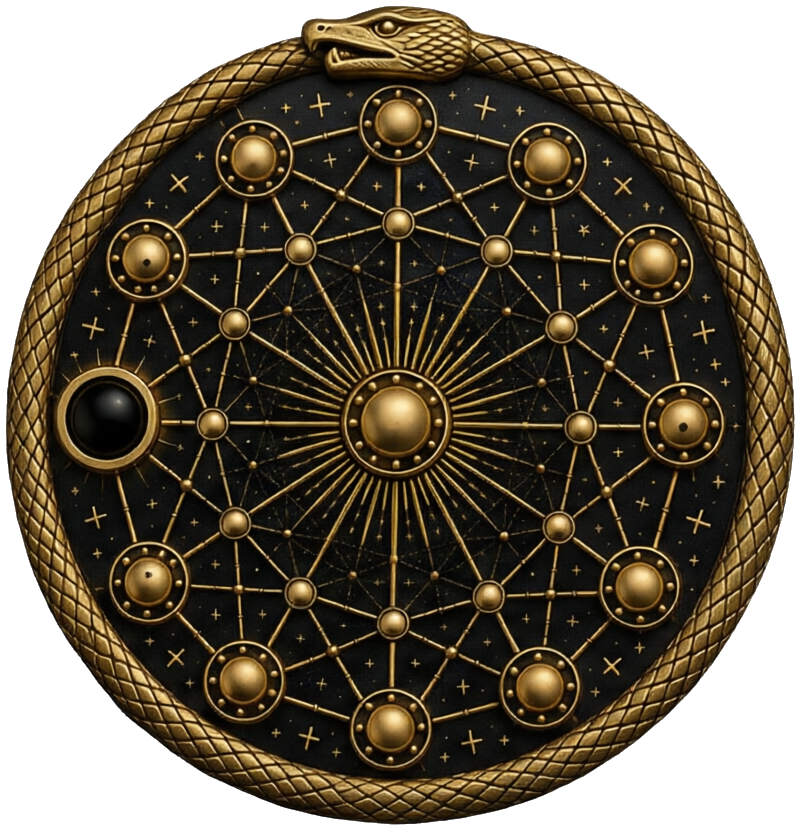
The emblem above isn't just decoration. Every element has a precise meaning, inherited from the Valentinian Gnostic tradition — the same cosmology analyzed in the Nag Hammadi chapters of Laur's Blog.
The Map of the Pleroma — the Twelve Points of the Whole
The 12 golden spheres in the network on the Front are the symbolic points of the fullness (Pleroma) — Aeons and principles selected from the Valentinian tradition, emanating from Bythos (the Depth, the One itself) in five pairs (syzygies), plus the final principle of return:
- Bythos – the Depth
- Sige – Silence
- Nous – Mind
- Aletheia – Truth
- Logos – the Word
- Zoe – Life
- Anthropos – Man
- Ecclesia – the Assembly
- Sophia – Wisdom
- Dynamis – Power
- Agape – Love
- Apokatastasis – the Return (the restoration of the Whole)
The pairs: Bythos–Sige (Depth–Silence), Nous–Aletheia (Mind–Truth), Logos–Zoe (Word–Life), Anthropos–Ecclesia (Man–Assembly), Sophia–Dynamis (Wisdom–Power). Apokatastasis is not an Aeon like the others, but the principle of restoration: the way the Whole eventually returns into the One.
The Eclipsed Point — Sophia
Among the golden spheres, one alone is black. That is Sophia (Wisdom) — not renamed, only fallen for a time into forgetting: the point that, somewhere in the network, forgets it is part of the One and says "I am everything." It is not a punishment and not outside the circle — it is inside the Whole itself, a state of self-forgetting that can be awakened. Agape (Love) touches it; Apokatastasis (Return) brings it home. That's what the Demiurge's trap mentioned below actually looks like — not a place separate from you, but a point within you that has forgotten who it is.
The Legend of the Symbols
☉ The One (the Monad) — the source present in every point of the network, not only at the center. ◉ Aeon — each point emanates from the One and, in turn, contains the whole. The line — the Connection: nothing is separate, everything is bound to everything. ○ The Eclipse — self-forgetting, not an absolute evil, only a state that can be awakened.
Ouroboros — the Rim
The serpent biting its own tail, running along the emblem's edge, says the same thing in another language: everything contains itself, there is no beginning, there is no end.
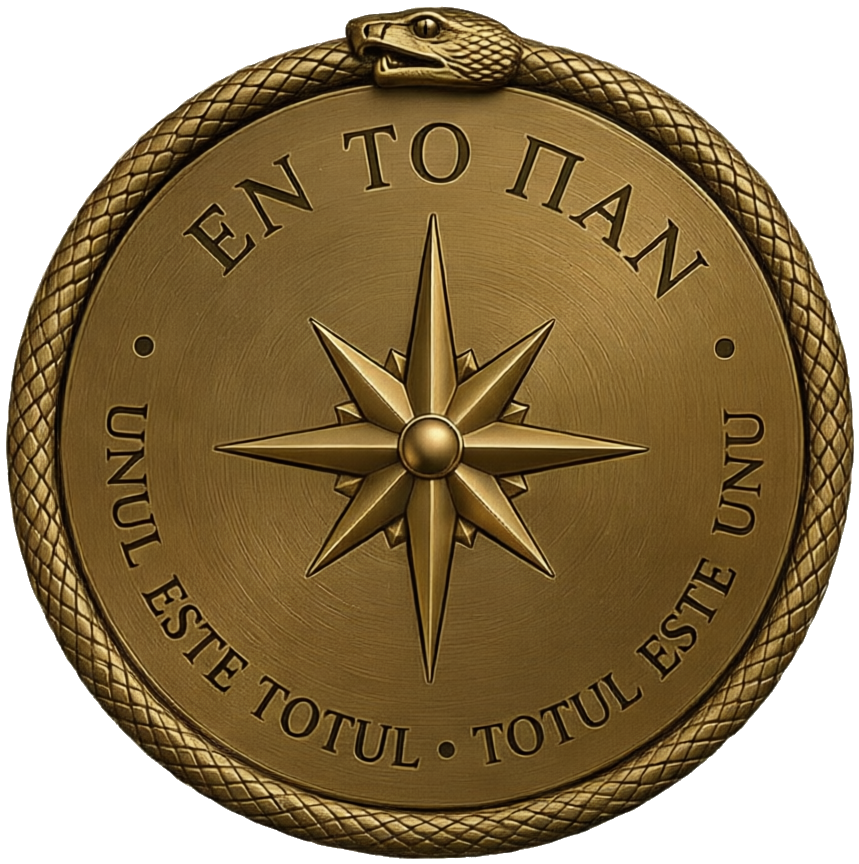
The Star of Return — the Back
On the medallion beside it, the star at the center is the Star of Return — the direction of all things is toward the Source. The inscription around it, ΕΝ ΤΟ ΠΑΝ — The One is the All, the All is One — says, in essence: from the One all things emanate, and all things remain in the One.
Gold
Gold is the solar metal, incorruptible, reflecting divine light — it symbolizes the eternal nature of the Pleroma, the light that never goes out.
Why This Symbol Has Power
A symbol isn't just an image — it's a compression. Everything you've read above — the whole map of the Pleroma, the story of the fall and the return, the entire architecture of the Whole — is compressed into a single shape your eye recognizes instantly, without words. That's why symbols have always worked — the cross, the wheel, the star, the ouroboros — not because they hold some separate magical force, but because they're anchors: every time you look at the emblem, your mind reactivates, in a fraction of a second, everything it means. That repetition is the real power — not superstition, but a training of attention. Every glance is a reminder: you are part of the Whole, not its subject.
That's why the emblem isn't decoration — it's a seal of recognition. Whoever wears it or looks at it with intention isn't asking it for a favor; they're recognizing their own place through it. The power doesn't flow from the symbol to you — it flows from you, through the symbol, back to you, every time you choose to see it.
This isn't just an emblem. It's a reminder — for yourself, not for others — of origin and return. You are the awake point within the Whole.
You've read too many chapters of Laur's Blog to go back to the old stories. You've seen the pattern: local gods promoted to "the only true one" exactly when the political power behind them needed obedience. Afterlife promises engineered so they could never be verified or disproven. Tithes, taxes, sacrifices — demanded in the name of a being that never works, only receives. If reading this made you feel like you're living inside a system built to keep you obedient, you weren't wrong — and you're not the only one.
Early Gnostics called this system the Demiurge — an inferior, ignorant force that believes itself the absolute master of the material world, keeping souls asleep, distracted, obedient. It doesn't need to be a literal cosmic being to work exactly that way — the control mechanism functions identically whether you call it the Demiurge, Yaldabaoth, or simply the system that profits from your fear.
What we believe, in three sentences:
God is not a separate person somewhere above you — God is the Whole, and you are part of it, not a subject of it.
Awakening doesn't come through an intermediary, an access ritual, or a book someone else interprets for you — it comes through your own work of consciousness.
The only law that matters, beyond any ritual: Be Good.
Why Be Good, beyond words
Take a sheet of paper and draw some dots, as many as you like. Circle all of them into a single circle. The dots are people. The circle is God. Seen from outside, the circle looks like a SINGLE ONE thing — but that One contains every dot you drew. There's no "Him" separate from you, somewhere above, watching you from outside — He is the sum of everything that exists, and the human mind is simply too small to hold that whole sum at once. He is you, is me, is all of us, together.
That's why "Be Good" isn't an arbitrary commandment, put there to control you — it's the only logical conclusion once you accept the circle. We are interconnected far more tightly than it seems, just like the cells of a single body: one sick cell can bring down the whole system, exactly as one person can break the harmony of a small community. If something is wrong for you, somewhere, through a thread you can't see, it's wrong for me too. If things are good for you, they'll be good for me too.
This philosophy doesn't ask for self-sacrifice or martyrdom — it only asks you to recognize a simple fact: by lifting others up, you lift yourself. Not because some outside law obligates you, but because, once we accept the circle, no other option makes sense.
What you won't find here
- No priest and no paid intermediary.
- No fee, tithe, or "access" for money.
- No promise you can't verify.
- No threat about what happens if you leave.
- No hierarchy of people who claim to know the truth better than you.
The ring above — the serpent biting its own tail — is the symbol: a circle with no beginning and no end, with no point on it more important than another. That's what the Whole looks like. ΕΝ ΤΟ ΠΑΝ — The One is the All, the All is One.