1. The gods never worked — sacrifice runs in a single direction
Once it’s established, beyond any ambiguity, that all humans were created to serve the gods, an equally direct question remains: while men worked hard, were sacrificed, and suffered, what were the gods doing? Were they also working, digging canals, building pyramids, performing sacrifices? Were the gods sacrificed by humans, or the other way around?
The answer, without further detour, is just as direct: the gods never worked. Never, in any tradition examined. After man is created, the gods withdraw from labor entirely — that’s the very central point of the Sumerian myth (the Igigi go on strike, man takes their place, the gods rest permanently, forever). There isn’t, in any of the mythologies examined, a single scene where a god digs, plows the earth, hauls stone for a pyramid, or raises a temple with his own hands. The gods sit in the heavens, on a mountain, in a temple, they receive, they judge, sometimes they quarrel among themselves — but they produce nothing material.
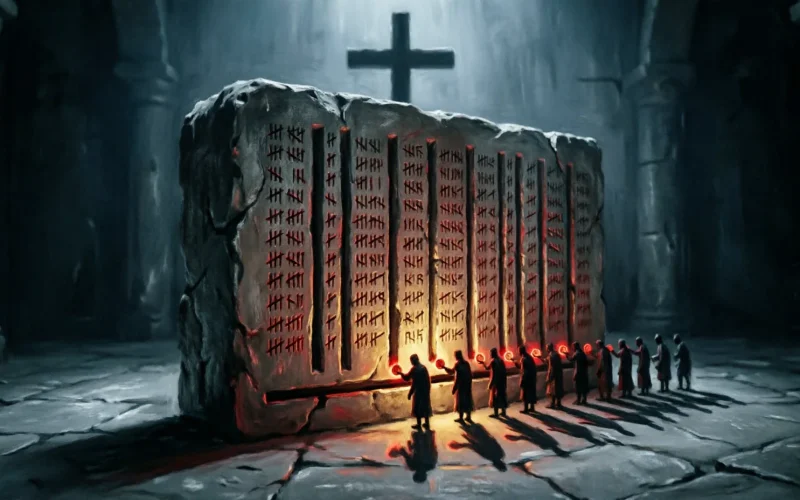
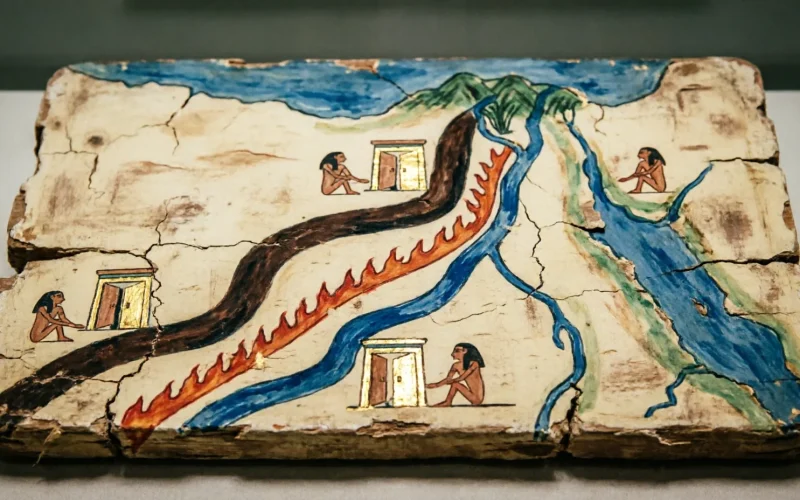
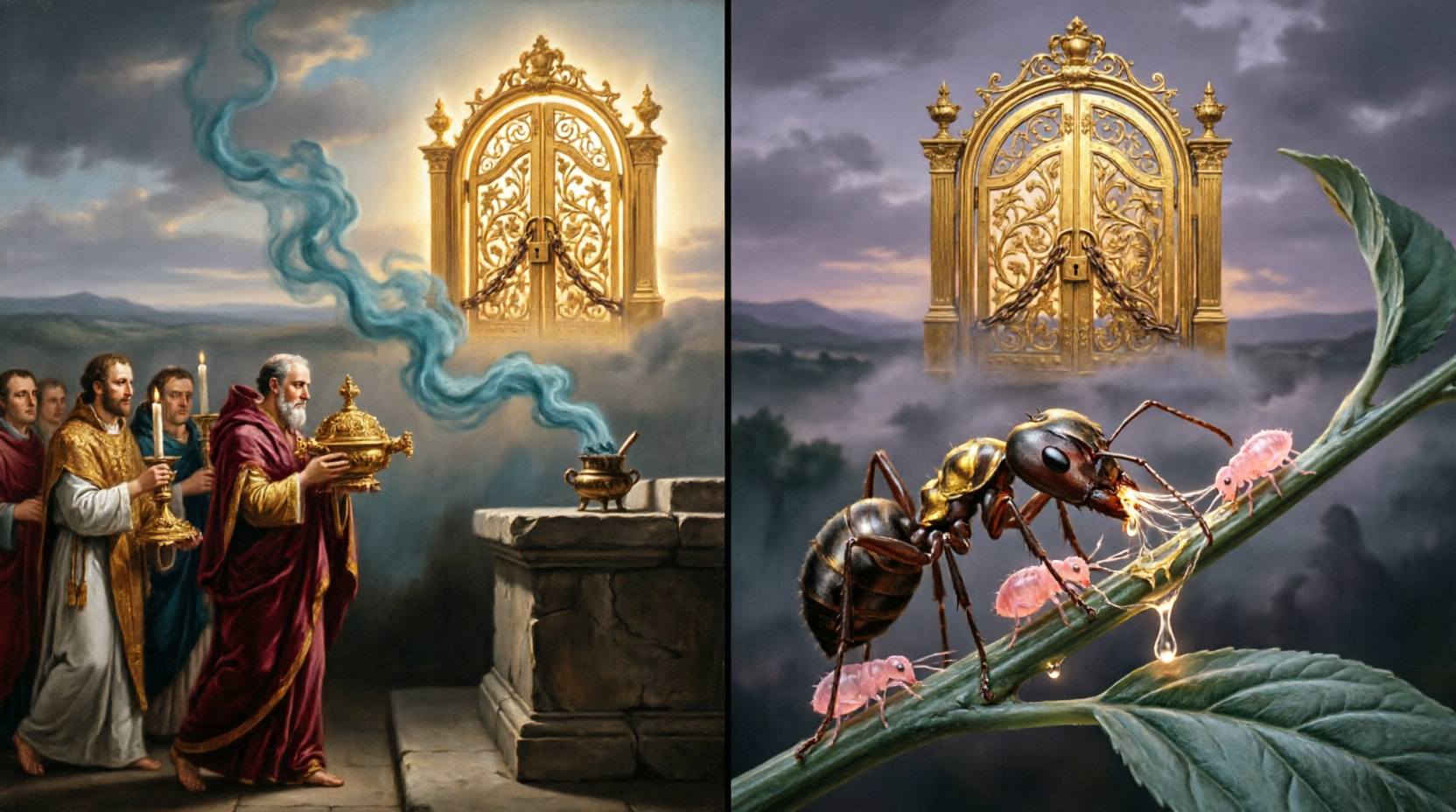
The direction of sacrifice runs one way only: man → god, never the reverse, as an ongoing practice. Man brings offerings — food, animals, blood, incense, and among the Aztecs even human lives — and the god receives, literally, ritually: among the Egyptians, food placed before the statue was considered “consumed” by the god, then reallocated to the priests; among the Hindus, fire (Agni) carries the essence of the offering to the gods; among the Aztecs, the extracted heart and blood fed the sun. The god never returns the sacrifice — there is no ritual in which man “sacrifices” a god in order to eat or consume him.
The only real exception, worth mentioning to complete the picture: the gods sacrifice one another, but only once, at the very beginning of the story, as an act of creation — We-ila among the Sumerians, Kingu among the Babylonians, Purusha among the Hindus, Ymir among the Norse, the giant dismembered to make the world. But that is a crime/sacrifice between gods, carried out by the ruling gods against a rival or inferior god, once, as a founding event — not something humans do to the gods, and it is never repeated afterward.
So, without ambiguity: man works, suffers, and is sacrificed continuously, daily, forever. The god receives continuously, daily, forever. The only “sacrifice of a god” is a single event at the beginning of the world, carried out by gods upon another god — not by humans, and not as a repeated practice. The relationship is completely asymmetric, running in one direction only, from the creation of man onward.
2. Cosmic parasites, or an aphid farm?
The conclusion that naturally follows from the picture above: the gods were essentially cosmic parasites, profiting from the labor of their own creation, man. It’s a logical conclusion, consistent with everything established so far — but the term “parasite” deserves some refinement, because it doesn’t perfectly describe what the data shows. A true parasite gives its host absolutely nothing in return. Here, religious systems always claim to give something back: cosmic order (Maat), good harvests, protection from chaos, an afterlife. It isn’t pure exploitation with nothing offered in exchange — it’s something more precisely described by another, closer biological pattern.
The more accurate analogy: not parasitism, but a “farm” — exactly like ants that raise aphids. Ants “cultivate” aphids: they partially protect them from predators (ladybugs), but the main goal is to extract the honeydew that aphids secrete. Some ant species even clip aphids’ wings so they can’t fly away. Aphids receive something — a little protection, just enough to survive and reproduce — but most of the value goes to the ants, and “defection” (leaving) is actively prevented.
It fits almost perfectly with the religious pattern built up so far:
– The “benefit” offered — cosmic order, harvests, protection from chaos, the promise of an afterlife — exactly enough to keep man cooperative, no more.
– The extraction — labor, sacrifice, tribute, blood — the real value flows to the god-temple-priesthood-king system.
– The anti-defection mechanism — fear used as an instrument of social control: divine punishments, the threat of hell/damnation, sanctions for heresy or refusal to sacrifice — the equivalent of “clipping the wings,” so that man cannot “fly” out of the system.
So, to be precise: this isn’t pure parasitism (which implies zero benefit), but a farming/domestication-type relationship — with just enough apparent benefit to look like a fair exchange, but with massively asymmetric extraction and active walls against exiting the system. In practice, it’s a more sophisticated exploitation than simple parasitism — domestication with a built-in cover story.
3. The afterlife: a promise impossible to verify
Here it must be said, with all the frustration the subject deserves: the farm analogy, even in its gentler form, is still a kind of evasiveness. People sacrifice for those cosmic parasites, and claiming they aren’t parasites because, having technology, they provide, say, rain where there is drought, ignores the fact that, at the same time, they themselves profit from those very harvests. And then comes the hardest part to swallow: the promise about the afterlife — be good and submit to the god, be obedient and a good slave, and you’re promised that after you die you’ll spend eternity, in some religions, relaxing in the sun on a meadow, and in others with dozens of virgins. What kind of promise is this? Is there somewhere a planet of theirs where billions of such rewards sit waiting? Obviously not in the body, since that is dead and buried — but the spirit departs, a spirit that shouldn’t have these needs anymore, and yet goes off to enjoy them? Those cosmic powers weren’t lazy — but they promised humans absolutely nothing verifiable. Where is the afterlife? Has anyone ever seen it?
On this point, the objection is correct, and the farm analogy was too generous — the distinction has to be made clearly. “Rain” and “harvest” belong to a completely different category than “the afterlife.” Rain, harvest, protection from invaders are verifiable, even if attributing them to a god is debatable. If the shaman says “I’m performing a rain dance” and it doesn’t rain, it’s plain to see that it didn’t work — there is an empirical test, however imperfect, even if the priests always found excuses (“you didn’t believe enough,” “you sinned”).
The afterlife is an entirely different story. Here the objection stands firm: in no religion is there a single verified, documented case of someone returning from death to confirm they received what was promised — a meadow, virgins, eternal rest, anything. Zero. It isn’t a rare exception, it’s a complete absence of evidence, across the whole of human history. Structurally, it differs from the rain promise: with rain, if it doesn’t rain, the customer is still alive and can complain. With the afterlife, the “customer” dies exactly at the moment of “delivery” — he can never come back and say “you lied to me” or “you gave me what you promised.” It’s a promise structurally impossible to audit, by its very nature — not by accident, but by design.
And that matters for the analysis: if a “good” can never be verified, never claimed, never refunded, then, from a purely functional standpoint, it doesn’t matter whether it’s real or not, because the system never bears the cost of being caught red-handed. It’s free to promise and impossible to disprove.
Which leads to an honest correction of the farm analogy: the ant-aphid analogy held for real, verifiable benefits (some real protection, even if partial). But the afterlife isn’t that kind of benefit — it’s a contractual clause that costs nothing in the short term, can never be honored or dishonored in any observable way, and precisely for that reason is the perfect tool for keeping people cooperative with zero risk to the system. On this specific point, we’re no longer talking about a farm with real benefits — we’re talking about an empty promise, no cost, no verifiable delivery, no risk of refund. That looks much more like pure exploitation than any exchange, even an asymmetric one.
4. What other lies do we find? Six mechanisms of control
This thread of analysis leads inevitably further: if the afterlife has exactly the structure of a perfect lie — impossible to verify, zero cost to promise, used to maintain obedience — what other religious claims share that same structure? The search, carried out with the same strict criterion, brings six documented mechanisms to light.
1. Hell — the perfect mirror of heaven, the same structure. If heaven can’t be verified, neither can hell. No one has ever come back from hell to confirm or deny anything. But it has an added functional advantage over heaven: fear works more effectively than hope as a behavioral control instrument — psychological research consistently shows that people react more strongly to the threat of loss than to the prospect of gain. That is precisely why the historical use of the fear of damnation (indulgences, sermons about eternal fire) as a weapon of social control has been documented.
2. “God sees everything, even your hidden thoughts” — surveillance without a surveillant. Practically every major religion has some version of this (Psalm 139:1-4 — “O Lord, thou hast searched me, and known me… thou understandest my thought afar off”; in Islam, “closer to you than your jugular vein,” Quran 50:16). It’s brilliant as a mechanism, because it costs nothing — no real watchers, cameras, or informants are needed. Man censors himself even completely alone, in private, because he can NEVER verify whether he is truly being watched or not — exactly like a panopticon, but without the cost of building one.
3. Prayer — the built-in excuse clause, always. “If you pray with enough faith, you get what you ask for.” If you don’t receive it, the standard explanation is always one of: you didn’t believe enough, it wasn’t God’s will, or the answer was “no” (which sounds identical to “nothing happened”). The structure is impossible to falsify — any outcome, including the complete absence of an outcome, confirms the theory. Exactly the kind of epistemic problem that also comes up with “Big Boss”-type theories — a theory that explains any possible outcome doesn’t, in fact, explain anything testable.
4. Karma and reincarnation — the same goods, in Hindu/Buddhist packaging. Present suffering is explained by sins from a previous life, which you don’t remember and can never verify. The functional advantage, documented by historians of religion as ideologically convenient: India’s caste system was directly reinforced by this — you are poor, a servant, because you deserved it from a past life, so you don’t rebel against the present hierarchy, you accept it as a “cosmic justice” you cannot contest.
5. Miracles are always “just beyond” the zone of verifiability. A pattern documented by historians of religion: miracles are placed either in the distant past (before writing/independent witnesses existed), or in entirely private circumstances, without witnesses (Moses alone on the mountain with God; Muhammad’s night journey, the Mi’raj, a private spiritual experience). The Gospels were written decades after the events, with no independent contemporary secular source confirming any specific miracle. Structurally, the miracle is always positioned exactly where independent verification is impossible.
6. “Retroactive” prophecy — vaticinium ex eventu, a documented literary trick. The clearest case, supported by mainstream biblical scholars: the Book of Daniel contains extremely precise “prophecies” about historical events from the Hellenistic period (2nd century BC) — but critical analysis of the text shows that those sections were written after the events they claim to “predict,” not before. It’s a well-documented ancient literary technique — you write the “prophecy” after the fact, falsely date it as older, and readers impressed by its “accuracy” have no way of knowing it was written retroactively.
Six mechanisms already identified, each bearing the same fingerprint — impossible to verify, zero cost to promise. But the list doesn’t stop here.
5. Keep searching: five more mechanisms of control
The insistence on continuing the search, in the conviction that more remain to be found, proves justified — applying the same strict criterion, documented mechanisms rather than assumptions, five more turn up.
7. The “chosen people” / the divine mandate of conquest — the most profitable lie, historically speaking. Not just an empty promise — this one produced concrete, immediate, verifiable material benefits. The herem of Joshua (“God has given you this land”) has repeated itself identically throughout history: the Spanish Requerimiento (a document read to the indigenous populations of the Americas before the conquistadors attacked them, invoking divine authority for conquest and enslavement), the Crusades (“Deus vult” — God wills it), the American Manifest Destiny (westward expansion as divine will). Here the claim costs nothing to make, but produces real territorial and economic gain, immediately — the most efficient kind of lie, because the beneficiary gets paid on the spot, not after death.
8. “God’s ways are not our ways” — the catch-all that absorbs any contradiction. Isaiah 55:8-9. Any event that cannot be explained, any apparent injustice, any senseless suffering — is resolved with “we cannot understand God’s plan.” It’s the older sibling of the prayer clause already discussed — a formula that absorbs any possible outcome, and therefore, technically, explains nothing verifiable. The Book of Job is the exact paradigm: his suffering never receives a moral explanation, it only receives a speech about God’s overwhelming power (Job 38-41) — power, not justification.
9. Natural disasters as moral judgment — with one concrete, important historical example. The 1755 Lisbon earthquake (roughly 50,000 dead, on a religious holiday, with the churches full) was widely preached as divine punishment for the sins of the city. Voltaire wrote explicitly against this interpretation (his Poem on the Lisbon Disaster), and the intellectual reaction to this event is regarded by historians as a key moment in Enlightenment skepticism toward providence. It’s an excellent case because it shows exactly the moment when people began publicly contesting this explanatory pattern.
10. Indulgences — probably the most literal, most documented case of commercial fraud on non-auditable goods. The medieval Catholic Church sold a reduction of time to be spent in Purgatory, for money. It can never be verified by the buyer — not before (you’re not dead yet), and not after (being dead, you cannot complain — exactly the structure already identified in the case of the afterlife). It became so blatant that it directly triggered the Protestant Reformation — Luther’s 95 theses (1517) were an explicit reaction to the practices of Johann Tetzel, to whom is attributed the phrase: “As soon as the coin in the coffer rings, the soul from Purgatory springs.” It is probably the clearest historical example of the literal sale, for real money, of a product guaranteed to be unverifiable.
11. Original sin — the pre-installed debt, before you’ve done anything at all. The idea that all humans are born already guilty for the deed of an ancestor (Adam) is completely unfalsifiable, and functionally brilliant: you don’t have to do anything to become the system’s “customer,” you’re already indebted from birth. Augustine formalized the doctrine, and its direct practical consequence was the imposition of infant baptism in Catholicism — in order to “pay off” a debt you never had the chance to incur yourself.
Eleven mechanisms in total, without any need to invent or force a single one just to pad out a list — each bearing the same structural signature: impossible to verify, free to promise, effective at maintaining obedience. What remains, as a next step, is to organize them into a common pattern — a classification by mechanism, between those that are strictly unfalsifiable, those of the catch-all type, and those that produce direct, immediate, verifiable profit.