Or: the Man and the Apparatus — who was nailed, who left, and who was laughing
The oldest “heretics” were not arguing about what we think today they were arguing about. They were not asking whether Jesus was divine. They were asking something far more disturbing: who exactly was on the cross.
And that question, raised nineteen hundred years ago, was never closed. It was only declared closed.
1. The texts of the substitute
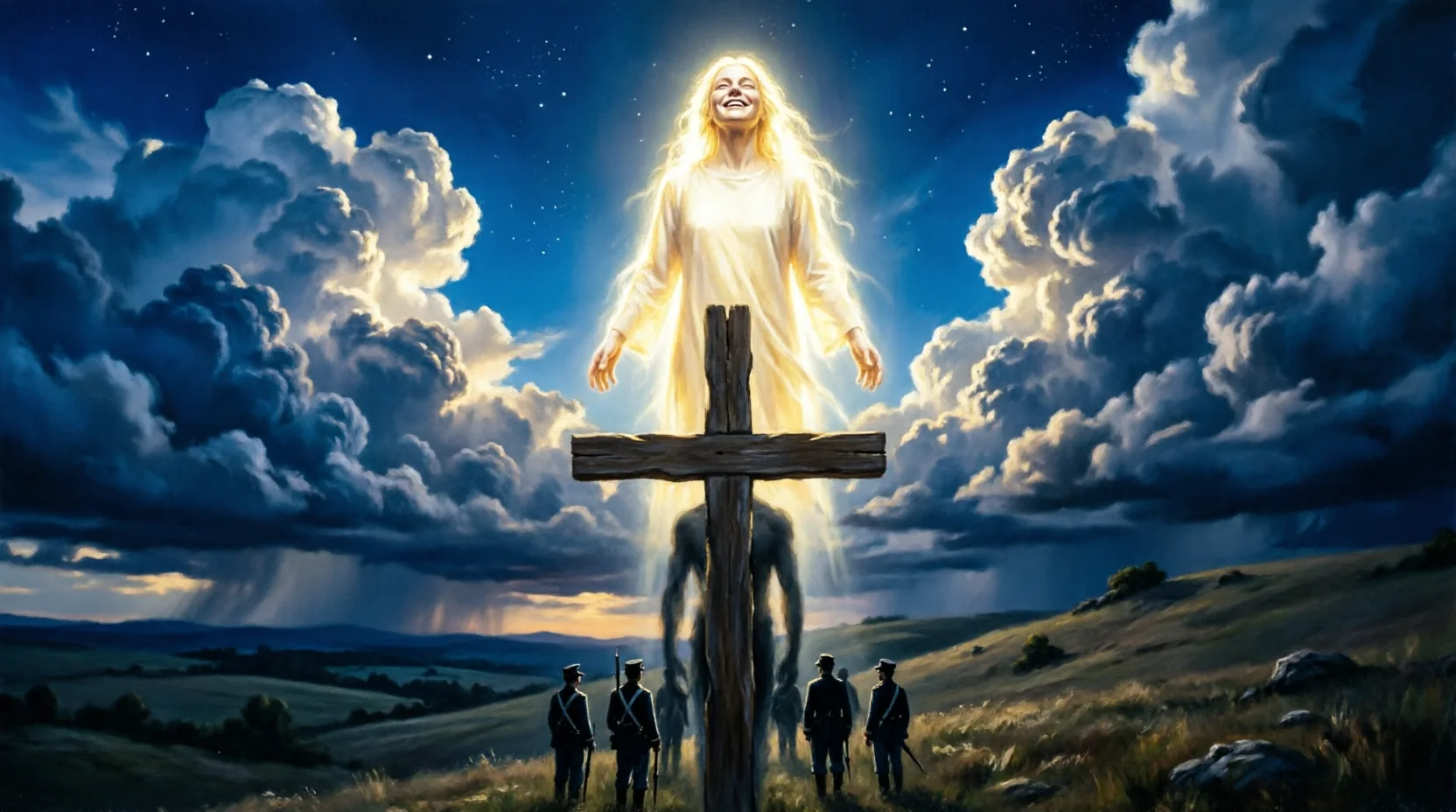
In the Apocalypse of Peter, a text found at Nag Hammadi, Peter watches the crucifixion and sees two things at once. One is being nailed. The other stands above the cross and laughs. He asks the Saviour what he is seeing, and the answer is unambiguous: the one above the tree, glad and laughing, is the living Jesus; the one into whose hands and feet they drive the nails is his fleshly part, the substitute.
In the Second Treatise of the Great Seth, from the same corpus, the voice is Jesus’s own: another bore the cross on his shoulder, another had the crown of thorns placed on him. And he, watching: “I was laughing at their ignorance.”
Basilides, a second-century teacher from Alexandria, says something even more concrete in Irenaeus’s account: Simon of Cyrene, the man made to carry the cross, was transfigured and crucified by mistake, while Jesus stood by and laughed at them.
A note of honesty, which I make because I want this text to hold up in front of someone who actually knows the material: Hippolytus gives a different version of Basilides’s teaching, and whether Irenaeus reported him faithfully or caricatured him in order to refute him is a matter scholars still debate. It does not matter for the argument. Even if Irenaeus exaggerated, he heard the idea somewhere — and considered it dangerous enough to attack in writing.
And Cerinthus, again through Irenaeus, gives the most technical version of all: the Christ descended upon the man Jesus at the baptism and departed from him before the passion, because that which is impassible cannot suffer.
Four sources, one structure: the one who suffered and the one who left are not the same.
I am not asking you to take them at their word. I am asking you to notice that the people closest in time to the event — one or two generations away, not two thousand years — were arguing about precisely this. And the Church did not refute them with evidence. It removed them from the canon and buried their books. The Nag Hammadi texts came out of the ground only in 1945, in a jar, in Upper Egypt. What you are permitted to read was decided long before you were born.
2. The cry that is not a quotation
“Eli, Eli, lema sabachthani.” My God, my God, why have you forsaken me.
The official explanation is that he is quoting Psalm 22. That is: a man dying of asphyxiation, his diaphragm locked, his chest pulled upward by his own weight, gathers the last air in his lungs in order to make a bibliographic reference. This is what we are asked to accept.
The separationist reading is simpler and more human. It is not a quotation. It is a report. It is the moment when the man on the cross states, in real time, that something that was in him is no longer there.
Notice that he does not say “why are you letting me suffer”. He says “why have you forsaken me”. That is not a complaint about pain. It is an observation about absence. Two completely different things, and language does not confuse them.
Anyone who has ever felt a presence withdraw from them knows that the first reaction is not theology. It is panic.
3. The question nobody asks: did he agree?
Here is the hole in this entire two-thousand-year-old discussion. Everyone argues about what entered that man and when it left. Nobody asks whether the man was asked.
There are three possibilities, and each leads in a completely different moral direction.
He consented, knowing everything. Then it is an act of courage almost impossible to grasp — and the Apparatus that accepted his offer is still an apparatus that needed it.
He consented, but was not told everything. That is not an offer, it is recruitment. The difference between a volunteer and a man tricked into signing is the only thing that matters in a contract, whoever the parties may be.
He was never asked at all. Then Golgotha is not a sacrifice. It is a requisition.
And if you look at Gethsemane — “if it be possible, let this cup pass from me” — you see a man negotiating, at the last hour, for a way out. That is not the language of someone who signed freely and in full knowledge. It is the language of someone who understood too late what was coming and is trying to withdraw.
Hold on to that question. It comes back at the end, and the whole verdict hangs on it.
4. What I know, not from books
I have always wanted to know why I was born, where I come from and where I go after I die. Before the first experience I describe here, I asked explicitly to be shown the truth. To see what is beyond.
I went out through a spiral. Me in the middle, and all around me, pouring as if through a funnel, my whole life — from the moment I came out of my mother to the moment I lay down on the bed to begin.
Then I woke up in space.
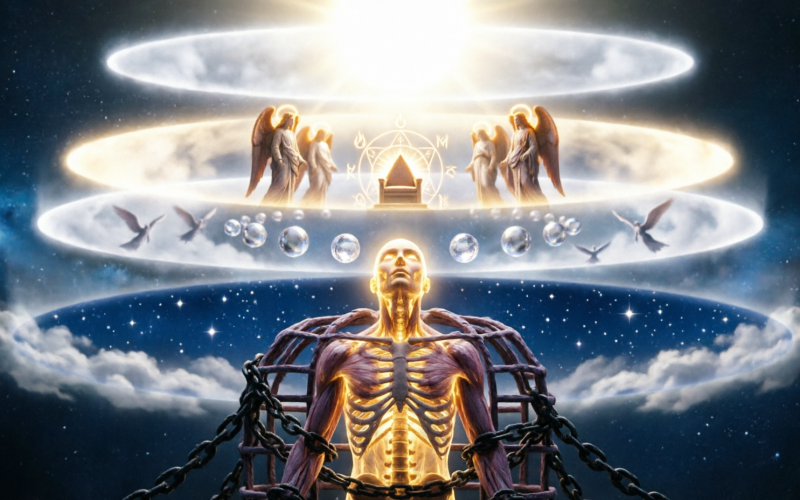
I was like an astronaut in the middle of space. I could see the stars. I was floating. And the main thing, the thing that stayed with me, is that I knew I existed, but I had no body. No form at all. I looked for my hands, for my feet — they were not there. I was there. I could see as though I had eyes, but I had no eyes.
Then I felt a voice behind me. Old, male. It said one thing to me:
“Why do you search for something you will have for an eternity, and do not enjoy the moments you have to live on Earth?”
And immediately a thought came to me: I am in space, and in space I cannot breathe. The fear of suffocation set in. Instantly I was pulled back through the spiral, my life unrolling around me again, and I woke in my body.
The second time
The second experience was also through space, also without a body, but this time following Thoth’s instructions. I know what is said about the Emerald Tablets — that they are a science-fiction story written by someone with time on his hands. I will not enter the debate about the age or authenticity of the text, because I cannot settle it and that is not why I write.
I will only say this: the book contains instructions for leaving the body. I followed them. And I arrived somewhere. For me, personally, that settled the question of whether it is a book of nonsense — a man inventing a story does not leave inside it a procedure that works.
The same tunnel, with my life flowing around me. Then space, without a body, but existing.
I came to a golden gate, closed, in the middle of space. I was very close to reaching it and opening it. Through the bars of the gate I could see steps, climbing towards somewhere.
And here is the detail I still cannot get out of my head: you could not enter from the sides. Even though I was in open space, where there are no “sides”. Only through the gate. The gate was not a door in a wall — there was no wall. And yet going around it was not an option.
When I was close, three entities appeared, running in zig-zag. They did not flow through space; they cut it, with abrupt changes of direction. I “felt” that they did not wish me well. Nobody threatened me, nobody said anything to me — I simply knew.
I remembered that I had to run in a spiral, or they would catch me. I began to spin, and I was pulled into the vortex again. I saw my whole life again. I woke in my body.
What I take from this, and what I do not
I do not tell these as proof for anyone. I have never written them down anywhere until now, and I have no reason to lie — I am selling nothing, asking for nothing, giving no lectures. They are real experiences, mine. Whoever wants to believe them, good; whoever does not, equally good. I put them here because they change the way I read the rest of this chapter, and it is only fair that you know where I am speaking from.
First: consciousness does not need a body in order to exist. No hands, no feet, no face — and still entirely me, with full perception, with sight and no eyes. Exactly what the texts describe about the one who “left”: he did not evaporate, he decoupled. And if a consciousness can leave a vehicle and leave it behind still functioning, then “he departed before the nails” stops being a figure of speech. It becomes a technical description.
Second: the spiral runs both ways. On the way out and on the way in, the same spiral, with the whole life pouring around me as through a funnel. That dismantles an idea everyone repeats: that your life unrolls “at death”, as a moral reckoning. If it were a reckoning, it would make sense in one direction only. For me it unrolled every time, out and back, four times in two experiences. It is not judgement. It is a transit protocol. A border check, identical in both directions. I wrote in chapter 30 about amnesia on re-entry as evidence that recycling is not pedagogy. Here is its mechanism, seen from the inside.
Third: what pulled me out was fear, not a decision. The first time I was pulled back by the thought that in space one cannot breathe — the reflex of a body I did not even have at that moment. A phantom body pressed a real button. Remember that: fear works as a leash even where there is nothing left to fear. If someone wanted to keep a consciousness tied to a vehicle, they would not need chains. A well-planted reflex would do.
Fourth, and hardest to digest: the gate. A barrier in open space that you cannot go around, even though it has no sides. That is not a physical construction. It is a condition of access. And if there is a barrier, someone placed it there, and there is a criterion I did not meet.
Fifth: the guards. Three of them, moving in zig-zag, appearing exactly when I was close. In the chapter on the Archons I wrote about the guardians of the spheres — the entities that, in the old texts, stand at every threshold the soul must cross. I wrote that chapter from the texts. It was not comfortable to discover that the description matched something I had already seen.
And now the part I do not claim, so that it is clear: I do not maintain that this proves anything for anyone else. I do not know whether the gate is “real” in the way a door is real. I do not know whether the entities were consciousnesses or reflexes of my own mind. I have no way of knowing, and anyone who tells you they know is either lying or fooling themselves.
What I do know is far less, and far more solid: I existed twice without a body, and each time it was me. The rest is packaging. And an apparatus that is good with packaging has, by that fact, no claim whatsoever on the contents.
5. The anomalies afterwards
If someone left, the next question is who came back. And the resurrection accounts have an oddity the sermons always pass over: nobody recognises him.
Mary Magdalene, who knew him well, takes him for the gardener. Two disciples walk with him on the road to Emmaus for hours, talk with him, and realise only at the table, when he makes a familiar gesture — at the breaking of the bread, not at the sight of his face. He appears in rooms with locked doors. And yet he eats fish to demonstrate that he is solid, and shows his wounds so that he can be touched.
Solid, but unrecognised. Tangible, but passing through doors.
That is not the description of a healed body. A healed body looks as it did before, only mended. This is the description of a new body with a consciousness transferred into it. The same memories, the same gestures, the same voice — different packaging. That is why recognition always comes through gesture, through voice, through habit, and never through the face.
And anyone who has read the chapter on Lazarus knows I am not improvising: it is the same mechanism, applied twice, a few weeks apart, by the same operators.
6. The laughter above the cross
What remains is the image. And it is not the cross.
Not the nails. Not the suffering we were taught to look at until we went numb, until we ended up wearing an instrument of torture around our necks without ever asking again what it is.
The laughter.
The living one, above, laughing at their ignorance. Not at the man — never at the man on the tree. At the mechanism. At the apparatus convinced that by holding a body it is holding the being. At the executioners who do their job thoroughly, check it, drive the spear between the ribs, seal the stone, post a guard — and touch nothing of what mattered.
I wrote in the chapter on the Archons that they cannot bear laughter, because laughter is the frequency of freedom: it says “I see you, and I am not afraid of you”. And the oldest image of that laughter is not a metaphor I invented to support my theory. It is in a text buried in the desert around the time it was being decided what you would be allowed to read.
Someone stood above the most efficient machinery of suffering ever built, looked at it in full operation, and laughed.
That is not cynicism. Cynicism laughs at people and leaves them there. That laughter was laughing at the mechanism, while the man on the cross was treated with all the gravity he deserved — because he was the only real thing in the entire scene.
That is the position I am after, and the one I recommend: to see everything, to be unafraid, and never to mistake the apparatus for the Source.
And if you have ever left yourself and come back, you already know the part nobody can take from you: you existed without hands, without feet and without a face, and you were still you. The rest is packaging. And they never had access to anything but the packaging.
In the next chapter I deal with what the Apparatus did with that scene after it was over. Because the truly profitable part was not the execution. It was what was built on top of it.