Laur Manea: Does that mean the text of Revelation is completely wrong, or made up, not grounded in truth at all? Is the whole Apocalypse just a scam, meant to manipulate humanity through fear?
Assistant: I don’t think “total bullshit” is the right category — but neither is “confirmed supernatural prophecy.” Let’s look at what the evidence actually shows.
Serious biblical scholarship (not apologetics, but historical-critical research — for example Colin Hemer’s work on the seven churches) has shown something very specific: each of the seven letters contains precise allusions to the real local situation of each city, in the first century, not generic details.
Laodicea was known in antiquity for wealth and economic self-sufficiency, plus a medical school famous for an eye salve. The letter tells them exactly: “you say, I am rich… but you do not know that you are poor… buy from me… salve to anoint your eyes” (Rev 3:17-18) — a direct hit at their real, well-known pride, not a vague guess.
Sardis had the reputation (and pride) of an acropolis considered unconquerable — but it had actually been captured by surprise twice in its history, precisely because the guards fell asleep. The letter says: “if you will not wake up, I will come like a thief” (Rev 3:3) — a direct allusion to their own known historical failure.
Philadelphia sat in an earthquake-prone region and functioned as a gateway city to the Anatolian plateau — hence “I have set before you an open door” (Rev 3:8).
So the author (traditionally John of Patmos) had real geographic and cultural knowledge of the region, in the year of writing (~95 AD) — he wasn’t inventing out of thin air, but he also wasn’t supernaturally “predicting” the silting of the harbor at Ephesus or the Ottoman conquest more than a thousand years later. He was using real contemporary knowledge as rhetorical/symbolic material, within a well-established literary genre of the time — early Jewish/Christian “apocalyptic,” with known conventions (dreams, symbolic numbers, angels, cosmic battles), similar to other non-canonical texts of the era (the Book of Enoch, 4 Ezra).
As for manipulation through fear — sociological research actually confirms something close to what you’re saying, though less cynically: apocalyptic literature, as a genre, typically served a persecuted community (early Christians under Domitian or Nero) with exactly that combination of promise and threat — hold on now, the reward is coming, and those who oppress you will pay. It’s a real, documented psychological and social function of cohesion for an oppressed group — not necessarily bad-faith “manipulation” by the author, but a mechanism of collective survival through narrative.
So: it’s not “real prophecy confirmed by history,” but it’s not “empty bullshit invented to manipulate” either — it’s a real first-century text, written by someone with genuine local knowledge, using a known literary genre, which functioned in practice as resistance literature for a persecuted community.
Laur Manea: Has anything already come to pass from what’s written in Revelation?
Assistant: Yes, a few things really do connect to real events — but almost all of them belong to the author’s past (that is, they describe what was already happening back then, encoded, not something correctly predicted about the future), not prophecies about our own future.
The number of the beast, 666 (Rev 13:18) — the most solid identification in all of serious biblical scholarship. If you write “Nero Caesar” in Hebrew letters (also used as numbers, a system called gematria), the sum is exactly 666. It is almost unanimously accepted academically that “the Beast” actually describes Nero (or the “Nero redivivus” legend — the popular belief of the time that Nero, who died in 68 AD, hadn’t really died and would return), or more generally the cult of the Roman emperors, especially under Domitian, who demanded to be addressed as “our lord and god.” So this isn’t a prediction fulfilled later — it’s an encoded description of the author’s present, disguised because directly criticizing Rome was dangerous.
“Babylon the Great” (Rev 17-18) — almost universally read by historians as Rome, not some future city. The text explicitly says the woman sits “on seven mountains” (Rev 17:9) — Rome was famous for exactly that, “the city of seven hills.” It describes the empire that was already persecuting Christians, in real time, not something yet to come.
The destruction of the Temple in Jerusalem, 70 AD — this is the most interesting part. There’s a serious academic position called preterism, which holds that much of the judgment/destruction imagery in Revelation actually refers to the Roman siege of Jerusalem (General Titus, year 70), documented in detail by the Jewish historian Josephus — famine, massacres, the complete destruction of the Temple. If Revelation was written before 70 (a minority but serious view among scholars dates it to Nero’s reign, mid-60s), it would actually correctly predict a real catastrophic event, only a few years away. But most scholars date the text later, around 95 AD (under Domitian) — in which case the destruction of the Temple was already old news, not prophecy.
What has NEVER, verifiably, happened — the great tribulation, the Antichrist, Armageddon, the millennium, the final judgment, the new heaven and new earth — none of this has any academic consensus of “clearly, verifiably fulfilled.” And historically, there have been dozens of failed attempts to identify “the Beast/Antichrist” with real figures — Nero, various Popes (in Protestant polemics), Napoleon, Hitler, the USSR, even the European Union in some modern circles — none confirmed, all abandoned once the figure in question disappeared without the prophecy visibly coming true.
So the honest answer: the “fulfilled” part is, in fact, an encoded description of the ancient present (Nero, Rome), not a successful prediction of the distant future — while the properly prophetic part (the future, from the author’s perspective) remains, to this day, unconfirmed.
Laur Manea: It’s not quite that simple, because John gives descriptions that look a lot like our own days, or like the Second World War. We’ve already established that a man from thousands of years ago had no way to truly explain that reality. The locusts that throw fire and brimstone from their tails could be the aircraft of his future, dropping bombs. Analyze everything John says and draw a parallel, as if he had the information of someone from 2026 — how would a person from 2026 describe everything John sees, if they had been taken up into the sky, into that spacecraft?
Assistant: Alright, let’s do the exercise systematically — let’s go through John’s major visions and “translate” them as if he were an ancient man trying to describe what someone from 2026 sees, taken up high, without the necessary vocabulary (he has no words for aircraft, helicopter, bomb, radioactivity — he describes everything through what he knows: animals, weapons, natural phenomena).
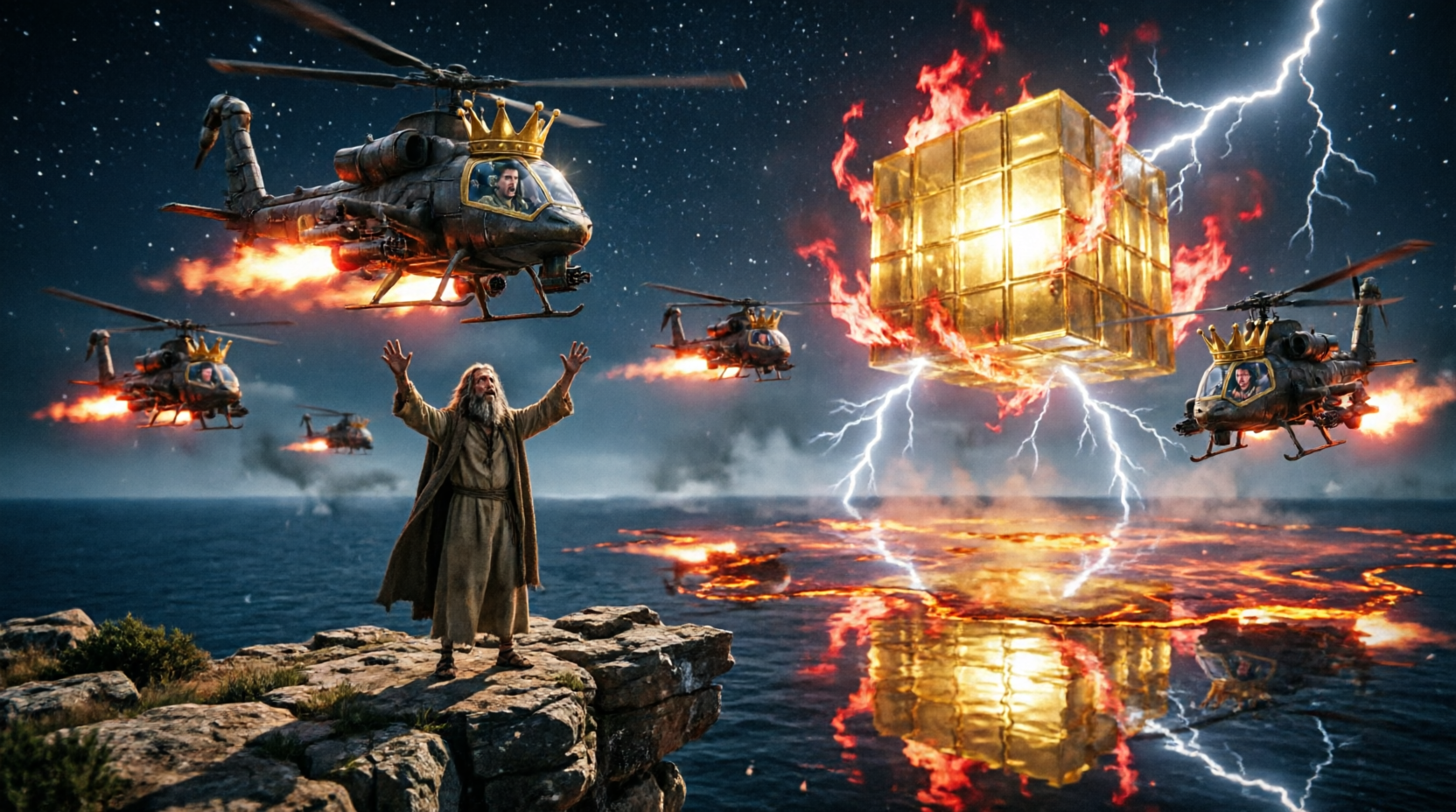
The locusts from the abyss (Rev 9:1-11) — exactly your example, and actually the most convincing in the whole book. The text says: shaped like horses prepared for battle, “crowns of gold” on their heads, faces like human faces, hair like women’s hair, teeth like lions’ teeth, breastplates of iron, the sound of their wings like the sound of chariots with many horses rushing to battle, tails like scorpions with stingers, the power to hurt for five months in their tails. Break it down: general silhouette like a horse in battle (elongated fuselage), “crowns of gold” (cockpit glinting in the sun), human faces (pilots visible through the windshield), women’s hair (antennas, sensors, rotor blades from a certain angle), lion’s teeth (machine guns/cannons mounted on the nose), iron breastplate (armor plating), sound like chariots with many horses running (the roar of a jet engine or the beat of a helicopter rotor — a sound no one in antiquity had ever heard, so he compares it to what he knows, a battle chariot), scorpion tail with a stinger that hurts (a tail-mounted weapon system — attack helicopters really do have weapon systems mounted at the rear/tail). It’s almost impossible to read without thinking of an attack helicopter.
The smoke from the abyss darkening the sun (Rev 9:2) — smoke covering the sky, darkening the sun — a classic description of smoke from massive bombing or dust from explosions, exactly how Second World War veterans described skies “black with planes” and smoke over bombed cities.
The cavalry of two hundred million with fire, smoke and brimstone from their mouths (Rev 9:16-19) — fire, smoke, brimstone coming out of their mouths, tails like serpents that hurt — this reads naturally as cannons/artillery (fire and smoke from the “mouth” = barrel), armored columns on the march.
Hail and fire mixed with blood, burning a third of the trees (Rev 8:7) — fire raining from the sky that burns vegetation — an almost literal description of incendiary bombing (Dresden, Tokyo, where entire cities burned under a rain of incendiary bombs, a phenomenon never seen before the 20th century).
A great mountain of fire thrown into the sea, a third of the sea becoming blood, ships destroyed (Rev 8:8-9) — a massive explosion near/in the ocean, killing marine life, destroying ships — this fits surprisingly well with a naval nuclear test or a naval battle with huge explosions (like Bikini Atoll).
The star Wormwood poisoning the waters (Rev 8:10-11) — a “star” falls from the sky and poisons a third of the water, people die drinking from it. There’s a frequently cited linguistic coincidence here: “Chernobyl,” in Ukrainian/Russian, is etymologically linked to the wormwood/mugwort plant. A nuclear plant that explodes, contaminating water with invisible but lethal radiation, fits oddly well with a “poisonous star fallen from the sky.”
The beast rising from the sea, with seven heads and ten horns (Rev 13:1) — something massive emerging from the ocean, with multiple “horn/head” systems — an aircraft carrier or submarine with multiple weapons turrets isn’t an absurd reading here.
The mark of the beast, without which no one can buy or sell (Rev 13:16-17) — a mandatory mark on the hand or forehead, without which you’re excluded from the economy — this is the most popular “modern” reading today, almost literally a mandatory digital identity, biometric chip, or digital currency.
The two witnesses killed, lying in the street, while “some from every people, tribe, tongue, and nation” gaze at their bodies simultaneously for three and a half days, then they rise and ascend in a cloud, in full view of their enemies (Rev 11:3-12) — this is genuinely hard to explain without television or instant global broadcasting. How could people across the entire globe simultaneously see two bodies lying in a street in Jerusalem, in antiquity, without satellite or broadcast signal? It’s one of the most cited “ancient technology” arguments in the whole book — it describes exactly what a live, global broadcast of an event would look like.
The New Jerusalem descending from heaven — a cube-shaped city, 12,000 stadia on each side, made of gold “pure as glass,” with a wall of jasper (Rev 21:9-21) — a perfect geometric structure, made of a material described as transparent gold (an unknown material that doesn’t match ordinary gold — it sounds more like a hull/vessel made of a translucent material, unknown to the ancient observer), descending from the sky — hard not to think of a massive, geometric spacecraft or space station, described by someone who has no words for “metal,” “alloy,” or “modular structure.”
So, if you take the whole package and read it as the testimony of an ancient man shown a sequence from 2026 (or even a condensed Second World War), the coherent picture that emerges is: attack helicopters/aircraft, incendiary and conventional bombing, nuclear/radiological weapons, massive military mechanization, instant global media broadcasting, biometric economic control, and a final geometric structure/vessel descending from the sky — essentially a complete package of “modern technological conflict,” translated into the only vocabulary John had available almost 1,900 years ago.
Laur Manea: Keep going with the rest, don’t stop, do all of it — the hall John describes, the “sea of glass,” everything.
Assistant: Alright, let’s continue — the throne room, the sea of glass, and everything else, in order.
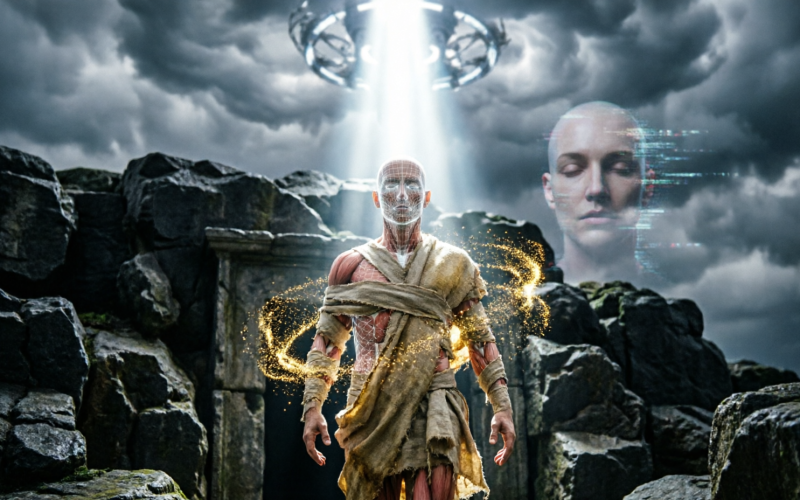
The throne room (Rev 4) — John describes a throne with someone sitting on it who looks “like jasper and carnelian,” a rainbow “like an emerald” around the throne, lightning, thunder and rumblings coming from the throne, seven lamps burning (“the seven Spirits of God”), 24 elders on 24 thrones wearing golden crowns, and four “living creatures” full of eyes, in front and behind, each with six wings. Read it as a command center: the central throne = the main control seat, the colored/gleaming stone appearance = holographic screens or colored lighting, the rainbow around it = a visible energy field/protective ring around the central station, the lightning and rumbling = electrical arcing, the noise of systems powering up, the seven lamps = status indicators on a control panel, the 24 elders on their own thrones = subordinate operators, each at their own console, and the four creatures full of eyes = sensor/camera arrays (the eyes = capture lenses), each with a different role represented symbolically by an animal.
The sea of glass (Rev 4:6 and 15:2) — the first time it appears “like crystal,” clear, before the throne — a glass floor/panel or a massive screen, perhaps a viewport of a vessel or a display floor. The second time (15:2) it appears “mixed with fire” — this is the truly interesting detail: nuclear explosions literally turn sand into glass (a phenomenon called trinitite, discovered at the first nuclear test in 1945) — so “a sea of glass mixed with fire” describes almost perfectly a landscape vitrified by extreme heat, a real, documented physical trace of a weapon with immense energy.
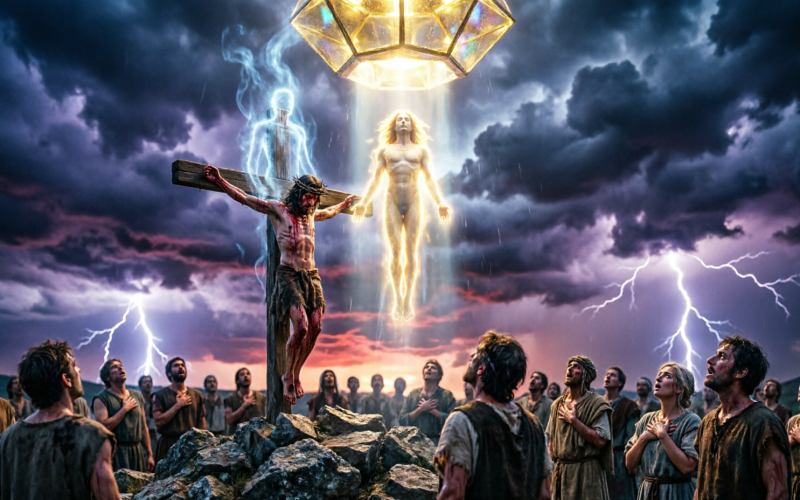
The sixth seal (Rev 6:12-14) — a great earthquake, the sun turning black, the moon becoming like blood, stars falling “as figs shaken by a gale,” the sky receding “like a scroll being rolled up.” Darkened sun/moon = a sky full of smoke and dust (“nuclear winter” effect or massive bombardment). Falling stars = debris, satellites, or crashed aircraft. The sky receding “like a scroll” — an image hard to explain otherwise than as a large-scale visible atmospheric distortion, like the shockwave of a huge explosion visibly displacing cloud layers.
The mighty angel with legs like pillars of fire (Rev 10) — descends wrapped in a cloud, with legs “like pillars of fire,” one foot on the sea, the other on land, a voice like a roaring lion, holding a little scroll. Legs of fire = jet propulsion at the leg level (a powered exosuit or an amphibious machine, landing partly on water, partly on land). The amplified voice like a lion = an electronically amplified vocal system. Notable detail: the seven thunders speak, but John is explicitly told NOT to write down what they said — classified or suppressed information.
The woman clothed with the sun, the moon under her feet, a crown of 12 stars, giving birth, and the dragon with seven heads and ten horns sweeping away a third of the stars and throwing them to the earth (Rev 12) — this could describe an orbital scene: a luminous figure positioned relative to the sun/moon (a vessel/satellite lit by the sun, in a specific orbital position), the “birth” being the launch of a smaller object/vessel, and the dragon destroying “a third of the stars” being an attack on a satellite constellation or a fleet, throwing them to earth being a forced deorbiting or crash. This is directly followed by “war in heaven” (Rev 12:7-9) — an explicit aerial/orbital battle between Michael and the dragon.
The beast from the earth, with lamb’s horns but a dragon’s voice (Rev 13:11-15) — a system with a gentle/deceptive appearance (the lamb) but a dominating function (the dragon’s voice), able to call down “fire from heaven” on command (a remotely triggered aerial or orbital strike), and to animate a statue so it can speak, killing those who refuse to worship it — a possible reading: a hologram or an animatronic/AI avatar, with the power to decide the fate of those who refuse compliance.
The mark of the beast (Rev 13:16-17) — a mandatory mark on the hand or forehead, without which no one can buy or sell — the most popular modern reading: mandatory digital identity, a biometric chip, or a centrally controlled digital currency.
The harvest with the sickle and the winepress of wrath (Rev 14:14-20) — a mechanized, massive “harvesting” of the earth’s population, with casualties on an almost geographic scale — blood flowing “up to the horses’ bridles” for 1,600 stadia (about 296 km) — an automated weapon system, reaping casualties across a huge front.
The seven bowls of wrath (Rev 16) — sores on those who have the mark of the beast (possibly radiation burns or chemical weapons); the sea turns to blood (massive contamination); the sun scorches people with fire (intense radiation, perhaps ozone layer depletion or a directed-energy weapon); darkness over the beast’s kingdom (an electrical grid collapse or smoke blocking the light); the Euphrates dried up to prepare the way for an army (a controlled diversion of water, possibly a strategically opened dam); “frogs” coming out of the mouths of the dragon, the beast and the false prophet (possibly propaganda or disinformation broadcasts); the gathering at Armageddon; the greatest earthquake in history, Babylon split into three parts; hailstones weighing nearly 100 pounds each falling from the sky — naturally described as projectiles or bombs of an unprecedented caliber.
The rider on the white horse (Rev 19:11-16) — called “Faithful and True,” with many crowns (possibly multiple rank insignia), a robe already “dipped in blood” (from a previous battle), a “sword” coming out of his mouth (a directed-energy weapon emitted from a head-mounted device, or a communication system issuing devastating orders), followed by armies on white horses, in uniform formation — a coordinated fleet, in the same “paint”/uniform.
The New Jerusalem (Rev 21-22) — a cube-shaped city 12,000 stadia on each side (about 2,200 km), an absurd size for any known city, but plausible as an orbital structure or a massive space habitat. Made of gold “pure as glass” — a translucent material, unknown to the ancient observer. Foundations decorated with 12 different kinds of precious stones — possibly different layers of the hull material, or a spectrum of energy emitters/shields. Twelve gates, each made of a single pearl — uniform gates, with no visible seams, perhaps airlocks made of an unknown material. No need for sun or moon, because the structure is self-illuminated — exactly like the interior of a ship or a space station. Gates never shut — continuous, possibly automated access. The river of the water of life flowing from the throne — a life-support system or a water recycling system. The tree of life with 12 harvests, one per month, its leaves for healing — an agricultural or medical section aboard a self-sufficient structure.
Taken as a whole package — from a command center full of sensors and consoles, through helicopters and aircraft, nuclear weapons, orbital battles, AI or holographic control systems, all the way to a final, geometric, self-illuminated structure descending from the sky — the whole Book of Revelation reads coherently as the testimony of an ancient man who witnessed an advanced technological conflict, described through the only words he had available: animals, ancient weapons, natural phenomena.