Or: the Jesus who laughs — the substitute and the living one
The quotations render the sense of the Coptic; translations differ from edition to edition.
Why these two texts. In Codex VII they sit side by side (VII,2 and VII,3) and both say the same scandalous thing: the one nailed up is not the living one. The living one watches — and laughs. If Part 3 was the voice without the cross, Part 4 is the cross without the victim: the final dismantling of the sacrificial economy.
1. The scene: the one seized and the one who laughs
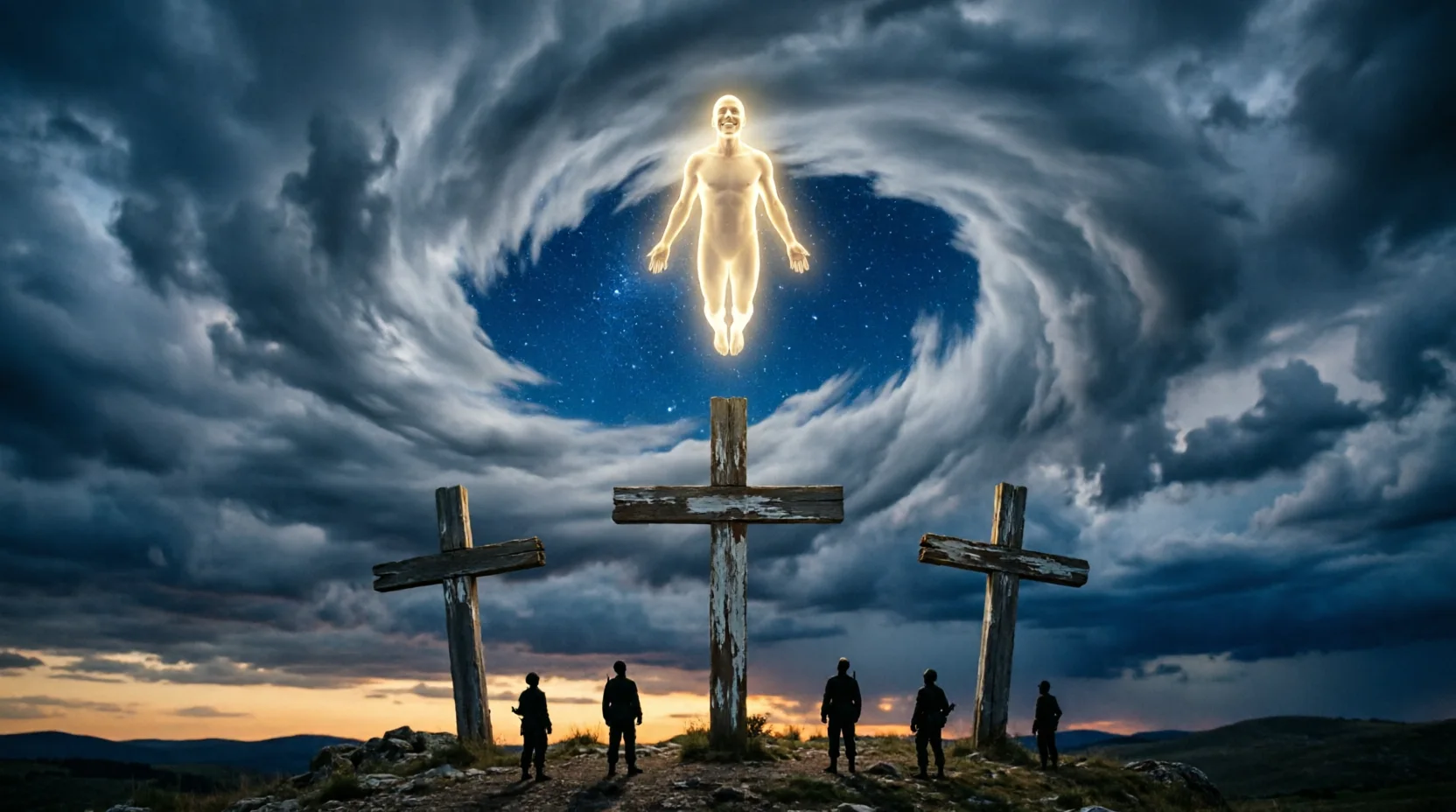
The Apocalypse of Peter: the narrator sees “him” as though seized by them, and asks who it is. The answer: “He whom you see above the cross, glad and laughing, this is the living Jesus. But the one into whose hands and feet they are driving the nails is his fleshly part, the substitute, the one who came into being in his likeness.”
Commentary: The text separates the shell from the living one with surgical precision. The substitution is not a detail — it is the thesis. The apparatus needs a victim; the living one refuses to be one. He does not die in your place — he shows that the “place” was a shell.
2. The laughter
The Second Treatise of the Great Seth: “I did not die in reality, but in appearance… I was laughing at their ignorance.”
Commentary: Laughter is the frequency of freedom. It is not mockery aimed at suffering — it is the lucidity of the one who sees the mechanism: they nail up a coat rack and think they are killing a king. Laughter is the sound the spark makes when it sees that it cannot be touched. And it is the only frequency that produces no adrenaline — therefore the only one the apparatus cannot harvest.
3. The substitute: Simon and the coat rack
Seth: “It was another who bore the cross on his shoulder, another, Simon…”
Commentary: The tradition of Simon of Cyrene is taken here to its logical conclusion. And the image of the empty coat racks says the rest: when the living one steps out of the shell, the hooks are left bare, but the spectacle carries on by itself — because the crowd needs the spectacle more than the spectacle needs the truth. Sleight of hand: one thing is what you see, another is the truth.
4. The attack on those who venerate the substitute
The Apocalypse of Peter attacks those who “blaspheme the truth and proclaim evil teaching” — the community that says the one nailed up is the Christ. Seth is harsher still with the “shepherds”, “the deaf and the blind”.
Commentary: This is the sharpest point in the whole jar: the attack is not on Rome, but on the community that mistakes the shell for the living one. The institutional church is described, from the inside, as the veneration of the coat rack. The narrative hijacking from Chapter 36 is foretold here, by those who lost the brand.
5. The suffering is real, the victory is not
An honest and necessary note: the texts do not say that no one suffered. The man on the cross — whether the man Jesus or Simon — truly suffered. The apparatus’s cruelty remains intact: it calculated public suffering as fuel. The laughter does not cancel the suffering; it cancels the apparatus’s claim to have defeated something living.
Commentary: Here the moral core from Chapter 23 remains standing: the suffering was real, the calculation was cold. Laughter is not cynicism — it is the proof that the spark was not captured.
6. Existing without an interface
Seth: “I was not afflicted at all… I am the mind of my Father… I am the light.”
Commentary: The living one defines himself not by the body but by mind and light — consciousness uncoupled. It is exactly the state I lived through: knowing that you exist with no hands, no feet, no form, and seeing without eyes. The text does not describe my leaving the body as an event, but as a state — and that is the difference that matters.
7. Two cameras, the same scene
The substitution reading (the shell on the cross) and the separation reading (the divine departs before the nails — Cerinthus, Chapter 23) are two cameras on the same scene: in both, the living one does not die on the cross. Chapter 36 uses both: the uncoupling before the event (the spiral) and the shell after the event (the clone). The jar offers textual anchors for both cameras.
8. The red threads, once again
- The administrator is not the Source — here the administrators nail up a coat rack and think they are nailing up God.
- Salvation is waking, not sacrifice — the living one does not die for you; he teaches you not to die asleep.
- The spark is untouched — the shell can be nailed, the light cannot.
- Laughter is the frequency of freedom — the only one the mechanism cannot harvest.
The honest note, as always: a map, not a proof. And here the map warns of itself: do not venerate the substitute.
Part 5 follows: The Gospel of Truth and the Gospel of Philip — the Valentinian line. The jar is open.