To understand what Deuteronomy 18 banned, you first have to get the Middle Ages’ image out of your head. The witch with the black cat has nothing to do with what divination was in the ancient world.
Divination was state infrastructure. With a guild, a curriculum, archives, teaching materials, verification procedures and error-control protocols.
Mesopotamia: a state science, with apprenticeship and oath
The expert was called a bārû. He wasn’t a visionary. He was a scholar. His discipline, bārûtu, was formally taught: apprenticeship, professional oath, a corpus to memorize.
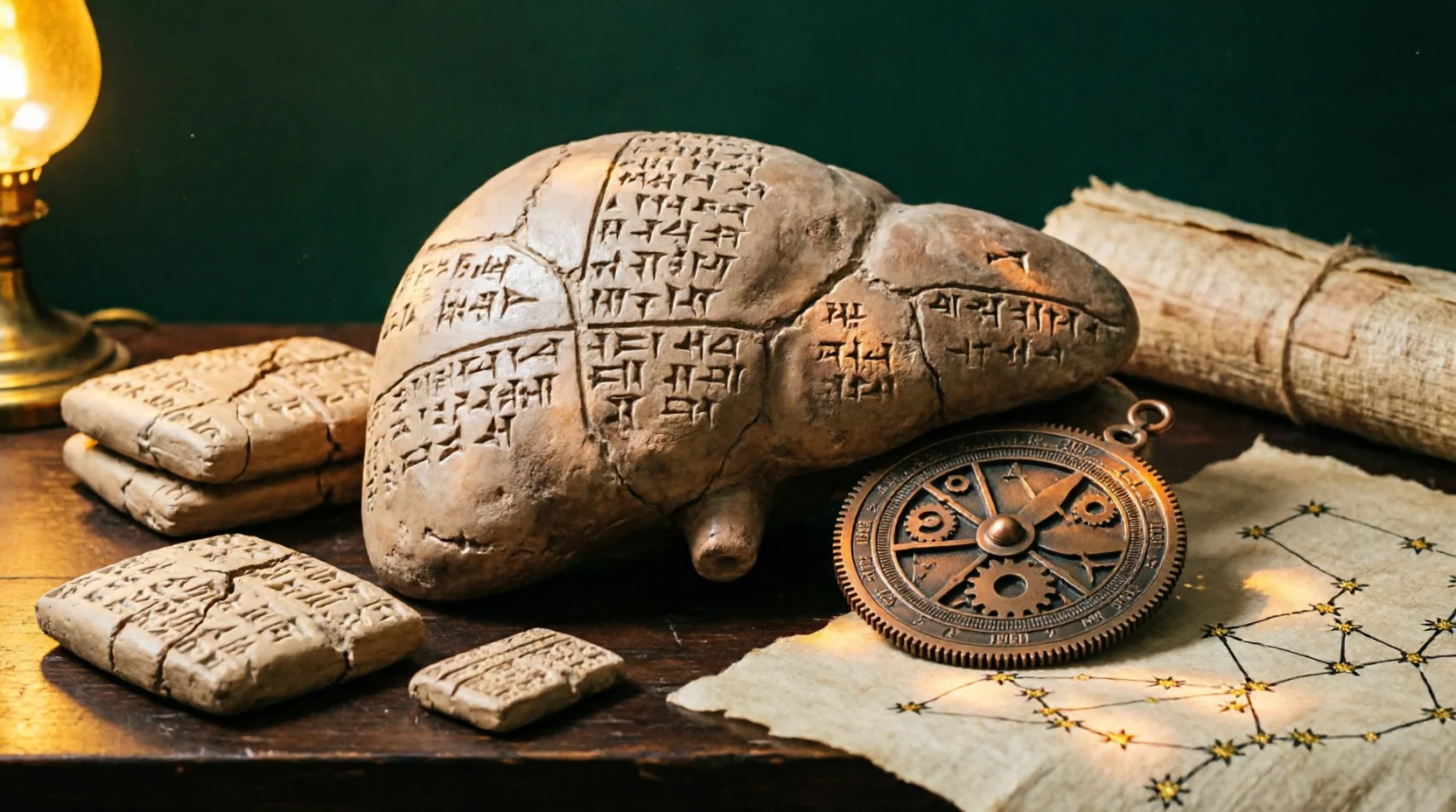
Hepatoscopy — reading an animal’s liver — had its own teaching material. Clay liver models have been found, with the zones marked out and the omens inscribed directly onto them, at Mari, Babylon, Hattusa, Ugarit, Megiddo and Hazor. These aren’t cult objects. They’re three-dimensional school textbooks.
The theoretical corpus exceeds the Hebrew Bible in sheer volume:
- Enuma Anu Enlil — the series of celestial omens: roughly 70 tablets, around 7,000 catalogued omens, compiled over centuries and canonized around 1000 BC.
- Šumma Alu — some 120 tablets of terrestrial omens. From the behavior of ants to the way a house is built.
- Šumma Izbu — 24 tablets on birth anomalies.
The bārû‘s procedure was standardized. The question was spoken into the animal’s ear or written down. Then came the sacrifice, then the inspection in a fixed order: naplastu (the look) → padānu (“the path”) → manzāzu (“the station”) → šulmu → the gall bladder → the lobes → ubānu (“the finger”) → the coils of the colon. Every feature had a catalogued meaning.
And among the Etruscans, the same discipline produced an extraordinary instrument: the bronze Liver of Piacenza (~2nd-1st century BC), a sheep’s liver cast in metal, divided into 40 regions inscribed with the names of gods. The outer band has 16 divisions — corresponding exactly to the 16 celestial regions of Etruscan doctrine.
Meaning the liver is a map of the sky. “As above, so below,” engraved in bronze, as a working instrument.
The Mari archive: chain of custody for prophecy
The Mari archive (18th century BC) contains roughly 50 letters reporting prophecies to king Zimri-Lim. The sources are the āpilum (“the one who answers”) and the muḫḫûm (the ecstatic).
And here is the detail that changes the whole picture: officials sent, along with the written report, a lock of the prophet’s hair and a hem from his garment — as an element of authentication.
They had a chain-of-custody procedure for prophecy. They treated it like judicial evidence, with physical identification of the source attached to the file.
It wasn’t fatalism. It was diagnosis plus treatment
The standard objection goes like this: if fate is written, what good is reading it?
The Mesopotamians answered that four thousand years ago, with an entire ritual genre: namburbi — rituals specially designed to cancel a bad omen already read.
So the logic was: omen = prognosis, ritual = intervention. A medical model, not fortune-telling. The sign wasn’t a verdict, it was a diagnosis — and a diagnosis calls for treatment.
Which means the practitioner could renegotiate the outcome. And that is exactly what is intolerable to a god who claims a monopoly on the verdict.
And they weren’t naive. They controlled the variables
Esarhaddon’s oracular queries to Shamash are drafted like legal instruments, with explicit exclusion clauses:
“Disregard whether the lamb was defective. Disregard whether the diviner was ritually impure. Disregard whether the formula was misspoken.”
Meaning they isolated confounding variables. They knew about false positives and they designed against them.
The supreme proof of sincerity: the substitute king
The ritual was called šar pūhi. When an eclipse omen predicted the king’s death, a stand-in was enthroned, with the regalia and a queen beside him. The real king was withdrawn from office and given the title ikkaru — “the farmer.”
After roughly 100 days, the substitute and his consort were killed, absorbing the predicted fate.
It’s attested in the official correspondence from Esarhaddon’s time, with a written report on the death of a substitute.
A state does not hide its king and execute two people over a ritual it considers folklore. This is the hardest argument we have that the system was believed with all the seriousness an imperial administration is capable of.
Astronomy was born as the infrastructure of astrology
The Babylonian astronomical diaries contain nearly unbroken observations from around 652 BC to around 61 BC. Nearly 600 years of data, systematically correlated with grain prices, the level of the Euphrates and political events.
It is the longest continuous scientific dataset in human history. And its declared purpose was omen work.
Out of that same guild came Babylonian mathematical astronomy — Systems A and B for lunar theory, capable of predicting eclipses and planetary positions.
Astronomy exists because astrology paid for it.
And the oldest known individual natal horoscope is Babylonian, from 410 BC, for a child born on 13 Nisan. Dated, concrete, not legend.
Greece: the oracle as an institution that tested itself
Delphi. The Pythia answered on the seventh day of the month, nine months a year. Plutarch — who was himself a priest at Delphi — wrote a treatise on the decline of the oracles, describing the vapors and the sweet smell in the adyton.
And geology has found a plausible physical mechanism: De Boer & Hale, in the journal Geology (2001), identified the intersection of two faults beneath the temple and light hydrocarbons — methane, ethane, traces of ethylene, an anesthetic that produces euphoric trance — in the spring water and in the travertine.
A necessary caveat: the faults and the presence of the gases are solid. The effective psychoactive dose is contested in the later literature. So the mechanism is plausible and documented, not demonstrated.
Dodona. The oracle of Zeus. Over 4,200 lead tablets have been recovered carrying the real questions of ordinary people. “Was I the father of the child?” “Should I take up sheep farming?” “Will I get better?”
It’s the archive of an ancient help desk, preserved intact.
Croesus. Herodotus (1.46-48) tells how the king of Lydia sent envoys to seven different oracles, with a trap question about what he was doing at a date fixed in advance. Delphi answered correctly.
Be honest about this story: it’s an account in Herodotus, unfalsifiable, probably embellished. But note what it is structurally — a blind, controlled test, with a comparison group, designed by the client against the suppliers.
The ancients did not swallow things whole. They tested.
“The wooden walls.” The two responses Delphi gave Athens before Xerxes’ invasion (Herodotus 7.140-143), interpreted by Themistocles as the fleet — and from there, Salamis.
Whatever the mechanism, an oracle changed the trajectory of Western civilization, because people acted on it.
Epidaurus. At the temple of Asclepius, incubation had a full protocol: purification, bathing, an offering (cakes, a rooster), sleep in the abaton on a kline, with dogs and snakes present in the sanctuary. The god appeared in a dream and either healed directly or prescribed.
And the cures were carved in stone as iamata — testimonies. Around 70 have survived on the stelae at Epidaurus. An oracle’s medical register, in stone.
Egypt: the oracle as a courthouse
At Karnak, the barque of Amun was carried in procession, and the statue “answered” by moving forward or backward to written yes/no questions.
And at Deir el-Medina, the workmen used the oracle of the deified Amenhotep I to settle real cases: property disputes, accusations of theft, claims. There are surviving ostraca with the verdicts.
The oracle functioned as a court of law.
Egypt also had the execration texts — vessels and figurines bearing enemies’ names, ritually smashed and buried. Found at Saqqara, and at Mirgissa with a decapitated skull alongside.
And the central concept, heka — magic — was not the opposite of Egyptian religion. It was the operating principle of the universe, personified as a god, used by the gods too.
Etruscans: lightning manuals, thunder calendars
The Etruscans had a technical library organized by discipline: libri haruspicini (liver), libri fulgurales (lightning), libri rituales.
The sky was divided into 16 regions, each with its own god. The fulguriator read which region the lightning had come from and where it had gone. The spot struck was ritually buried as a bidental.
And the Brontoscopic Calendar of Nigidius Figulus, preserved in Greek by John Lydus, gives the thunder for every day of the year, with the corresponding prediction. A transmitted text, not a reconstruction.
The final irony: the longest surviving Etruscan text, the Liber Linteus of Zagreb, is a ritual calendar written on linen cloth — and it survived only because someone cut it into strips and wrapped a mummy in it in Egypt.
An entire civilization’s liturgical manual reached us because it was recycled as bandage.
China: the system that audits itself
The Shang oracle bones (~1250-1050 BC). Roughly 150,000 fragments. The best-documented divination system in human history.
The procedure:
- An ox scapula or a turtle plastron, cleaned, thinned, polished
- Hollows are drilled in rows, on the back
- A red-hot bronze point is applied to the hollow
- The bone cracks — and the Chinese character for divination, 卜 (bu), is the drawing of that crack
- The shape and angle of the fissure are read
- It is inscribed on the bone: the question, the prognostication — and, often, what actually happened (yanci, the verification)
Three points of method that would do a modern laboratory credit:
- questions were put in positive/negative pairs
- the divination was repeated, and the repetitions were numbered
- the actual outcome was recorded on the same medium
A divination system that writes down its own failures, in writing, three thousand years ago.
And the point that ties the whole chapter together: the recipients of the Shang questions were the royal ancestors. The oracle bone is consultation of the dead.
Under the Shang, the future is seen by asking the dead. Necromancy and forecasting are the same act.
Binary systems: the convergence that isn’t easily explained
| System | Instrument | States | Corpus |
|---|---|---|---|
| I Ching (China) | 50 yarrow stalks, 18 manipulations; or 3 coins | 64 hexagrams | canonical text + commentaries |
| Ifá (Yoruba) | 16 palm nuts (ikin) or the opele chain; signs traced in iyerosun wood dust on the opon Ifá tray | 256 odù | vast oral corpus, verses per odù |
| Sikidy (Madagascar) | seeds, binary rows | matrix | derivation rules |
| ʿIlm al-raml (Arab) → European geomancy | randomly traced dots | 16 figures | the interpretive “shield” |
Four cultures with no contact between them arrived at the same architecture: a discrete randomness generator, a library of finite states, a memorized interpretive corpus.
When four civilizations independently invent the same structure, either all four are wrong in identical ways, or the structure is answering to something.
What functions it actually performed
| Modern function | Who did it in antiquity |
|---|---|
| Intelligence service | the Assyrian scholars — the king’s analysts |
| Courthouse | the oracle at Deir el-Medina |
| Medical system | Epidaurus; diagnostic extispicy |
| Astronomical observatory | the Babylonian omen guild |
| Foreign policy | Delphi — it coordinated Greek colonization across the Mediterranean |
And Israel had exactly the same functions, just with a different supplier: Urim and Tumim for binary querying, the ephod, the lot, the court prophet.
And the piece that ends the discussion about “guessing”
The Antikythera mechanism, dated to around 150-100 BC. A bronze geared computer that tracked the Sun, the Moon, the lunar phases, the eclipse cycles — Saros and Exeligmos — and had a parapegma with the stellar risings, plus the Metonic dial.
With it, eclipse prediction becomes mechanical. You input the date, you read the result.
When someone tells you the ancients were “guessing,” show them this object.
They weren’t guessing. They were building machines.
Conclusion of this part
So Deuteronomy 18 does not abolish a superstition. It monopolizes a service.
It bans the competition’s civil servants and installs the single supplier in the very next verse.
And if the prohibition had been about falsehood, it would have read “it doesn’t work.” Instead it reads — at 13:2 — “it comes to pass, and still you must not listen.”
Truth is not what’s at stake. The supplier is what’s at stake.
Continues in Part 3: Samuel Was Disturbed.