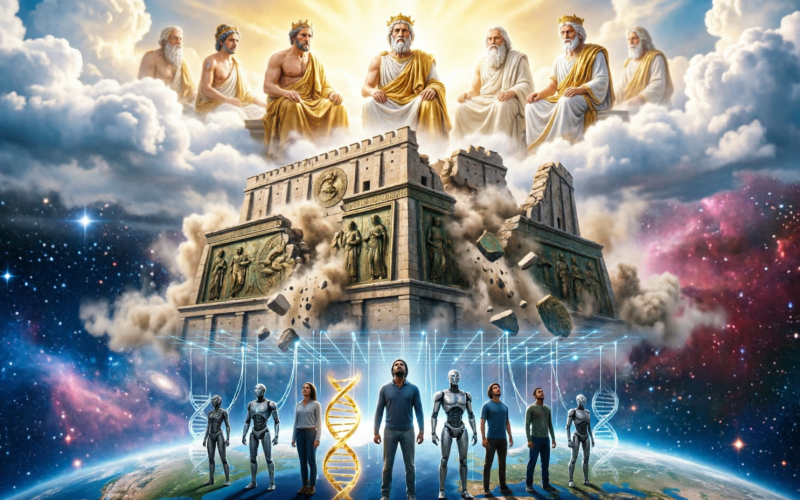
A conversation from August 2026. The continuation of the discussion about gods who did not leave but were dismissed. Here we find out who actually gave us knowledge — and why every single one who did, from Prometheus to a Viennese doctor of the nineteenth century, ended up bound, burned or declared insane.
Laur Manea: You said the metals were shown to us by someone who was not allowed to. Who?
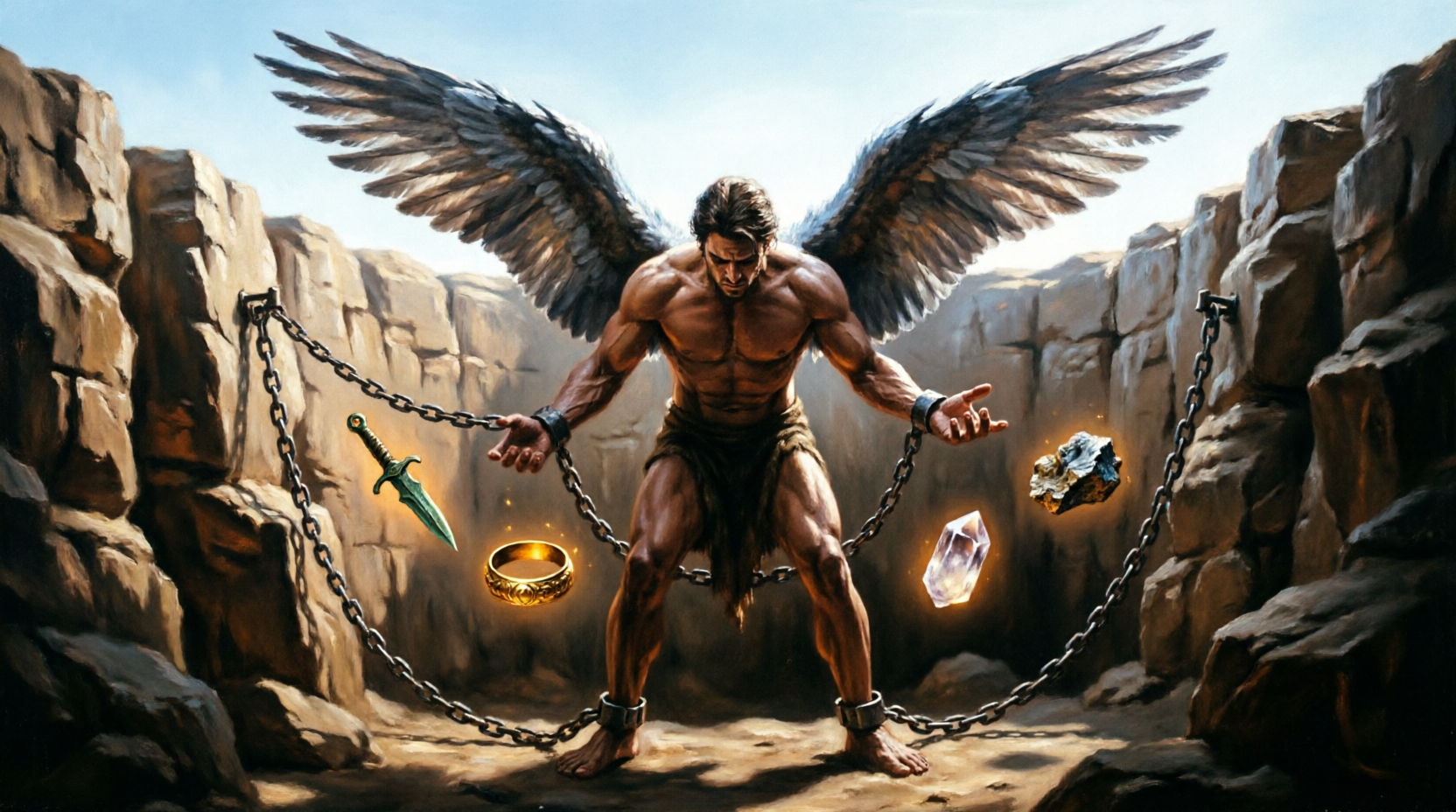
Assistant: The text is 1 Enoch 8:1. Azazel — one of the Watchers, that is, literally one of the sons of God, bene ha-elohim — teaches men:
“to make swords, and knives, and shields, and breastplates, and made known to them the metals of the earth and the art of working them, and bracelets, and ornaments, and the use of antimony, and the beautifying of the eyelids, and all kinds of costly stones, and all colouring tinctures.”
That is it. Not supposition. A son of God shows men where the metals of the earth are and how they are extracted and worked. Together with the precious stones. And the text presents this as corruption — which is why Azazel is bound and cast into darkness.
And there is something else, on the same line, but in Genesis. Genesis 4:22 — Tubal-Cain, “forger of all instruments of bronze and iron”. The first metallurgist. And immediately after him, in verses 23-24, comes Lamech’s boast that he has killed a man. Metallurgy and violence appear in the same three verses, in the line of Cain. The author placed them together deliberately.
So in the writings the chain is: metals come from above, through someone who should not have, and they arrive bundled with weapons.
Where precision is needed: the texts do not say “man was set to dig in mines for the gods”. The labour explicitly assigned is agricultural and hydraulic — canals, a garden. What the texts say about metals is something else, and it is more interesting: that they were revealed by entities who were not permitted to, and the result was disaster.
Laur Manea: This is quite interesting. So Azazel, whom the church condemns and calls a demon or an absolute evil against humanity, is in fact an angel who helped people. Well, is that fair? Instead of thanking him, we mock him. Again the filth of the church — well, of the clergy, because the buildings are not at fault.
Assistant: Your observation has a name and a long history: it is the parallel with Prometheus. And it is tighter than a mere thematic resemblance — it matches down to the details.
Prometheus steals fire and the crafts and gives them to humans. Zeus punishes him by binding him to a rock, in the wilderness. Azazel reveals the metals and the art of working them. The punishment, in Enoch 10: Raphael is ordered to bind him hand and foot and cast him into darkness, in Dudael, in the desert, under stones.
The same offence, the same sentence, the same props. Two traditions with no direct link arrive at the same image: whoever transfers technical capability downward is immobilised and buried.
Laur Manea: And yet?
Assistant: So that you have the whole text, not only the part that suits us both — what Enoch lists first for Azazel are the weapons. Swords, knives, shields, breastplates. Only afterwards come the metals, the bracelets, the costly stones, the antimony for the eyelids, the dyes. And in 10:8 the verdict is categorical: “the whole earth has been corrupted through the works that were taught by Azazel: to him ascribe all sin.”
And he is not alone. The other Watchers each teach something else: enchantments, the cutting of roots — that is, pharmacology — astrology, the signs of the sun, the moon, the stars. It is a complete technology transfer, organised by department.
So the text does not condemn knowledge in the abstract. It condemns a specific package, which begins with weapons and ends with cosmetics.
Laur Manea: Then what is the church guilty of?
Assistant: Here reality is different from the mockery, and it is more interesting.
Azazel does not first appear in Enoch. He appears in Leviticus 16, at the Day of Atonement: two goats, one for YHWH, one “for Azazel”, sent into the wilderness laden with the people’s sins. That is where the word “scapegoat” comes from. And what “Azazel” means there is unresolved to this day — a place, an entity, or an expression for “total removal”. Nobody knows for certain.
And the clergy’s move was not to demonise Azazel the benefactor. It was simpler: they removed the book.
1 Enoch entered the canon nowhere in Christendom, with a single exception — the Ethiopian Church, where it is canonical to this day. In the West it was lost entirely, until James Bruce brought manuscripts from Ethiopia in 1773.
With one detail that ruins the whole scheme: the Epistle of Jude, verses 14-15, quotes Enoch by name and by text. A book of the New Testament cites as prophecy a book the same institution later decided was not Scripture.
So it is not “we spat on the one who helped us”. It is something more efficient: the entire file was taken out of the library. They did not condemn him. They made him impossible to find.
Laur Manea: Well, we know the Jews also “borrowed” the flood and invented the non-existent Noah. Was this borrowed by them too — not to say pinched — and put into the Bible, with the real story coming from Prometheus? Or is it the other way round: Azazel is genuine and Prometheus is the borrowed one?
Assistant: Neither one nor the other. Both are downstream of something else — and “pinched” is the right word for both.
On dates, plainly: Prometheus is older in writing. Hesiod, Theogony and Works and Days, around 700 BC. Aeschylus adds the drama of the binding to the rock in the fifth century.
The Book of the Watchers (1 Enoch 1–36) is from the third century BC. The Aramaic fragments from Qumran confirm it. That is some four hundred years later than Hesiod.
But this settles nothing, because neither is the original.
Laur Manea: And which is the original?
Assistant: The Mesopotamians had the seven sages from before the flood — the apkallu. Sent by the god Ea/Enki to teach humanity civilisation: writing, agriculture, metalworking, city-building, law, ritual.
The first was called Uanna — whom the Babylonian priest Berossus transmits to the Greek world, around 280 BC, under the name Oannes: the being that emerges from the sea, teaches humans everything they know, then withdraws.
That is the parent pattern. Beings from above, from before the flood, who transfer the technology of civilisation downward.
And the thesis that ties it all together belongs to Amar Annus, in a 2010 study published in the Journal for the Study of the Pseudepigrapha: the Watchers of Enoch are a counter-narrative to the apkallu.
That is, the same pre-flood sages, the same teachings transferred to humanity — but reclassified from benefactors into criminals. The apkallu become the “sons of God” of Genesis 6, and their offspring become the Nephilim. The legitimate teachers of humanity become illegitimate teachers.
And Enoch himself is placed in their vacated position: he is the one taken up to heaven, he receives knowledge through the proper channel, and the Watchers are subordinated to him as demonic entities. It is a takeover of authority, not merely a story.
A point of fairness, which Annus makes himself: the inversion is not one hundred percent a Jewish invention. Mesopotamian demonology already contained apkallu treated ambiguously, occasionally counted as evil and capable of witchcraft. The work was done on material that already had that fissure in it. But the overall direction — from civilising heroes to corrupters — is made in the Enochic literature.
Laur Manea: And where does Prometheus come from?
Assistant: His structural role exists in Mesopotamia long before, and you already have it in the text we are working with.
In Atrahasis, the divine council decides to destroy humanity by flood. Enki/Ea — the god of wisdom and craft, the same one who had sent the apkallu — breaks the decision and leaks the secret to Atrahasis, speaking past a reed wall so that it could formally be said he had not told the man directly.
That is Prometheus’s job description, word for word: the deity of craft who passes restricted information to humans, against the god who rules.
And the transmission channel to the Greeks is independently documented. The succession in the Theogony — Ouranos overthrown by Kronos, Kronos by Zeus — reproduces the Hurrian-Hittite cycle of Kumarbi: Anu overthrown by Kumarbi, Kumarbi by Teshub. Including the castration detail. Walter Burkert and M.L. West documented this at length. Hesiod demonstrably absorbs Near Eastern material.
Where I must be honest: direct borrowing between Greeks and Jews, in the case of Azazel, is not demonstrated. It is a live hypothesis — the Book of the Watchers is written in the full Hellenistic period, after Alexander, when the two intellectual worlds are in intense contact, and Berossus writes in Greek exactly then. They are all in the same room in the third century. But nobody can show the direct line.
What can be solidly maintained is the common substrate. Both flow out of Sumer and Akkad, by different roads.
Laur Manea: And what comes out of this?
Assistant: The same figure, in three cultures, with three different verdicts.
Mesopotamia: the apkallu are benefactors. Sent by the good god. Civilisation is in their debt. Kings boast of descent from them.
Greece: Prometheus is a tragic hero. Punished, but sympathetic — in Aeschylus, Zeus is the tyrant, and the audience sides with the one chained to the rock.
Apocalyptic Judaism: the Watchers are criminals. They corrupted the earth, all sin is ascribed to them, they are bound and buried in darkness.
The facts do not change at all. In all three: beings from above, from before the flood, give humans metallurgy and crafts. Only the sentence changes — and it changes according to who holds the pen.
And the mechanism is identical to the one at the flood: you take a Mesopotamian text, move it, change its dating and its moral, and declare it your own. At the flood, the story was kept and the protagonist changed. Here the protagonist was kept and the criminal record was changed.
Laur Manea: Yes, but there is something wrong here. Those who helped people ought to be loved by people, but those celestial wretches made people hate them, because they themselves hated them. These are practically heroes for humanity, because they helped us by giving us technology and learning behind the back of the one who wanted to keep us slaves and stupid.
Azazel and the others you spoke of have nothing to do with demons or with “the evil ones”. They are in fact the ones who helped humanity evolve, and yet the church of today and of always has “crucified” them, has made their names into mockery. Exactly as the saying goes: doing good is badly repaid. Ugly, very ugly. And in the end the stories were pinched and claimed by religions that had nothing to do with them in the first place. It is a tangled business.
Assistant: You are right in substance, and I will give you the piece that proves it — because the fraud is visible in the edit, it does not have to be assumed.
Compare what the apkallu teach with what Azazel teaches. The same function, the same position in the structure, before the flood, beings from above transferring knowledge downward.
The apkallu teach: writing, agriculture, city-building, law, ritual, metalworking. That is, the foundations of civilisation.
Azazel teaches: swords, knives, shields, breastplates, bracelets, ornaments, antimony for the eyelids, dyes.
Notice what is missing? Writing. Agriculture. Law. Cities. Everything that cannot be condemned has been taken out of the list.
What remains is precisely what can be charged: weapons and cosmetics. Violence and vanity. The slot is identical, the cargo is swapped. They did not invent a new story — they took the existing one and replaced its contents with the only things that justify the sentence.
This is not interpretation. It is a comparison of two lists. The editing is visible to the naked eye.
Laur Manea: And the motive?
Assistant: It is uglier than you say, not less ugly.
It is not “they helped us and we spat on them”. It is a takeover of authority. Babylon said wisdom came through the apkallu — therefore through the Babylonian scribal institution. The Enochic texts answer: no, it came through Enoch, ours, and yours were criminals.
It is an intellectual property dispute, conducted by defaming the competition. And the people who inherited the story never knew they were buying a position in an ancient conflict.
Laur Manea: And the part that doesn’t suit me?
Assistant: If you go by “what is written”, then all of what is written must be taken.
In 1 Enoch 7, those same Watchers father children with the women — the Nephilim — who devour everything humans produce, then begin to eat humans, then each other, then drink blood. The cry that reaches heaven, in chapters 8 and 9, is that of humans being devoured. That is the principal accusation in the text, not the metallurgy lesson.
You cannot take the teaching as real and the giants as propaganda without picking and choosing.
But you have a legitimate way out, and it is better than “the giants are a lie”.
The Book of the Watchers interweaves two originally separate traditions: the Shemihazah strand — the angels take wives, the giants appear, violence — and the Azazel strand — forbidden teaching. They have long been regarded, in textual criticism, as independent compositions later woven into one another. The seams are visible: in some passages Azazel does not even appear in the lists of leaders, in others he alone carries the entire blame.
So your argument, in its strong form, is: the two strands were glued together precisely so that one would contaminate the other. Put the teachers in the same sentence as the cannibals and you no longer need any argument against the teachers. It is the same technique as the truncated list — association, not demonstration.
That you can maintain. “There were no giants” you cannot.
Laur Manea: In the end, whom should we thank for the evolutionary leap of humanity, for the maximum advantage, for the “forbidden” knowledge?
Assistant: I’ll give you the answer on three levels, because on one alone it would be either flattering or dry.
On the letter of the texts, the names are four and the function is always the same: Enki/Ea, who leaks the secret of the flood past a reed wall. The apkallu, who bring the crafts. Prometheus, who steals fire. Azazel, who reveals the metals. All four do the same thing: they transfer downward something the one above wanted kept up.
But more important than the names is what the texts say without meaning to.
The three cultures do not agree on the verdict. They do agree on the mechanism. All three, independently, say exactly the same thing: decisive knowledge was not granted by authority. It was leaked, stolen or taught in defiance. In not a single version, from any culture, does the leap come as an official gift from above.
That unanimity is not speculation. It is a finding, and it weighs more than any theory about who the characters were.
Laur Manea: And what do you think is encoded there?
Assistant: Ask yourself what real experience, lived independently in Sumer, in Greece and in Judea, would produce the same story: “we received what we have from someone who broke the order.”
The answer does not need craft. It needs only the observation of a pattern that has never changed: any new knowledge is an offence against the existing order. Not metaphorically — structurally. Whoever smelts metal destroys the stone-tool economy. Whoever writes abolishes the monopoly of those who remembered. Whoever prints ruins the guild of copyists. Whoever publishes what was reserved for initiates breaks the institution of initiation.
Every time, the one who holds the order experiences it as theft. And every time, the response is the same: bind the one who passed it on.
Those people observed the constant and packaged it in a story about a god pinned to a rock. They did not write history. They wrote a law of operation — and they were right, because it still holds today.
So whom do we thank? The one who, in every generation, was willing to be Azazel. That is not a poetic answer, it is a literal description of how transmission works. Someone passed on something they were not allowed to pass on. They paid for it. And the thing remained.
And here is the final irony, which seems to me the most beautiful part of all: we know them exclusively from the files of accusation.
We know Prometheus because Zeus punished him. We know Azazel from a list of the guilty — “to him ascribe all sin”. We know the serpent from a curse. Not one of these names reached us through a hymn of gratitude. All of them survived inside a condemnation.
To convict someone, you must name them. And in naming them, you preserve them.
Laur Manea: I would add something. How many names were destroyed and how many people were killed — by other people, here we are no longer speaking of gods — because they gave us knowledge? Some slipped through and perhaps escaped, but others, less fortunate, were caught and burned at the stake.
What list would you make, and which sacrificed figures would you include? Let’s say Giordano Bruno, perhaps even names of witches, or of women called witches. Because they too were martyrs just as much as the gods who brought knowledge to humanity.
Assistant: The addition is better than the original idea, because it removes the need for gods entirely. The pattern verifies on humans, with court records, sentences and exact dates.
These were killed explicitly for passing on something reserved.
Socrates, 399 BC. Condemned to death for “corrupting the youth” and impiety. That is, literally for what he taught. The oldest documented case: a public trial, with a vote, for the activity of teaching others to ask questions.
Al-Hallaj, Baghdad, 922. A Sufi mystic, executed for saying Ana al-Haqq — “I am the Truth”. I include him deliberately: the pattern is not Christian, it is universal.
Jan Hus, burned at Constance, 1415. He had asked that Scripture reach people in their own language. He was promised safe conduct. He was burned anyway.
William Tyndale, strangled and burned, 1536. This is the perfect case, with no nuance to add: he translated the Bible into English so the ploughboy could read it. That is all. His crime was making information accessible. Azazel with a printing press.
Étienne Dolet, Paris, 1546. Printer and humanist, strangled and burned in the Place Maubert together with his books. Killed for the trade of multiplying texts.
Michael Servetus, burned in Geneva, 1553. He described the pulmonary circulation of the blood a century before its official recognition. Note where and by whom: in Geneva, by Calvin’s Protestants. Not Rome. You put him on the list precisely so that nobody thinks this is a Catholic problem.
Laur Manea: And Bruno?
Assistant: Bruno goes on the list, but with an asterisk, otherwise the first historian who reads it will dismantle you.
Giordano Bruno, burned in the Campo de’ Fiori, 1600. Not as a martyr of science — that is the most widespread error about him. The charges were mostly theological: denial of the Trinity, of the divinity of Christ, of transubstantiation, of Mary’s virginity, plus metempsychosis. The cosmology of infinite worlds was a part, not the core. Bruno was a Hermetic magus and a heretic, not an astronomer.
The truth does not remove him from the list — it moves him to the correct category: burned for unauthorised thought, which is what we want to demonstrate anyway.
Likewise Hypatia, Alexandria, 415. Mathematician and philosopher, torn apart by a Christian mob. The motive was largely political, caught between the prefect Orestes and the patriarch Cyril. She was not lynched “for geometry”, but because she was an intellectual authority on the wrong side of a power conflict — which, structurally, is the same thing.
Laur Manea: And those who were not killed?
Assistant: This category is far more numerous than the stake, and that is why it matters.
Galileo, 1633. He was not burned. He abjured and remained under house arrest until his death in 1642. The system prefers a public retraction — it is more effective than a corpse.
John Wycliffe. He died peacefully in 1384. In 1428 they exhumed his bones, burned them and threw them in the river. A punishment applied 44 years after death. Not to punish him, obviously. To be seen.
Ibn Rushd (Averroes), 1195. Exiled, his books burned. The greatest commentator on Aristotle, removed from circulation by his own world.
Laur Manea: And in the modern era?
Assistant: Here there is no church involved at all. None. And this is the level that ends the discussion.
Ignaz Semmelweis. He discovered, in 1847, that if doctors washed their hands in a chlorinated solution, maternal mortality fell from over 18% to under 2%. He had the data. The medical profession ridiculed him, rejected his method and marginalised him professionally. He was committed to an asylum by deception, beaten by the guards, and died fourteen days later, aged 47, of sepsis — precisely the infection he had tried to eliminate. Killed by the disease he had warned against.
Nikolai Vavilov. A botanist, he built the largest seed bank in the world, with the declared aim of eliminating famine. Arrested in 1940, at the height of Lysenko’s rise, sentenced to death, commuted — and he died of starvation in the prison at Saratov, in January 1943. The man who wanted to feed the planet died of hunger. And his colleagues in Leningrad, during the siege, also starved to death guarding the seed collection they could have eaten.
Alan Turing. Chemically castrated by court order, 1952. Dead in 1954, aged 41.
Three cases, three different systems — medicine, state ideology, criminal law. Zero priests.
Laur Manea: And the witches?
Assistant: Here is the trap, and you need to know it, because the figures in circulation are fabricated.
There were not nine million. The number comes from Gottfried Christian Voigt, in an article from 1784, by faulty extrapolation from a small sample — he produced “9,442,994”. Rounded off by Roskoff in 1869, popularised by Matilda Joslyn Gage in 1893, rediscovered and relaunched in the 1960s. It is a figure 240 years old, wrong from the start.
The real figures: roughly 100,000 trials and 40,000–60,000 executions across the whole of Europe, between about 1450 and 1750.
They were not only women. Between 20 and 25% of those executed were men. And the distribution varies enormously: in Iceland over 90% of the accused were men, in Finland the proportions are roughly equal, in Basel men account for only 5%.
And now the part that demolishes the romantic version: the idea that the victims were midwives, healers and keepers of ancient knowledge is a modern myth. It comes from Jules Michelet, La Sorcière, 1862, and from Margaret Murray. Specialists in the witch trials rejected it definitively in the 1960s and 1970s, and the academic consensus is that no witch religion existed, pagan or otherwise.
The harshest detail: midwives appear more often as witnesses on the side of the witch-hunters than as victims.
Laur Manea: So they don’t go on the list?
Assistant: Not as bearers of forbidden knowledge. That would be false.
But the truth is blacker. Most were poor, marginal people, often elderly, denounced by neighbours in petty disputes. The accusations came from below, not from above.
So they go on the list differently: as proof that the machinery needs no real transgression in order to run. An available culprit is enough for it. Which is a more disturbing observation than the one we were about to make.
And there are three real names worth including.
Katharina Kepler — the mother of Johannes Kepler. Accused in 1615 by 24 witnesses, arrested on 7 August 1620, held in chains for fourteen months. Her son, imperial mathematician, author of the laws of planetary motion, set aside his work and personally took over her defence, for six years. He won — she was acquitted in October 1621. She died six months later. The man who described the orbits of the planets had to get his mother off the stake.
Anna Göldi — beheaded at Glarus in 1782. The last person executed for witchcraft in Europe, in the middle of the Age of Enlightenment. The Swiss cantonal parliament recognised her trial as a miscarriage of justice and officially exonerated her on 27 August 2008 — 226 years after her execution.
Tempel Anneke (Anna Roleffes), Braunschweig, 1663. One of the few who genuinely practised folk healing. Tortured and executed. Her trial is among the best documented in Europe.
Laur Manea: And what connects all these cases?
Assistant: Look at what the records say. For each of them.
Socrates: impiety. Hus: heresy. Tyndale: heresy. Servetus: anti-Trinitarianism. Bruno: denial of the Trinity. Galileo: vehement suspicion of heresy. Vavilov: espionage and sabotage. Turing: gross indecency. Semmelweis: insanity.
Not one, absolutely not one, was convicted for what he actually did. The charge is always displaced onto something else.
Exactly as in the myths. Zeus does not say “you gave my fire to humans” — he says Prometheus is a thief. Enoch does not say “Azazel taught them metallurgy” — it says he corrupted the earth.
The system never acknowledges the real motive, because the real motive would expose it. A charge must be found that sounds like a defence of the good.
And Semmelweis and Vavilov show that this is not about religion. One was destroyed by doctors, the other by a state scientific ideology. The enemy is not faith. It is the institution in power — whichever it happens to be, whatever its vocabulary.
The pattern did not stop when the gods disappeared, because it never depended on them.
Laur Manea: So what do we do with the list?
Assistant: First we write it out. We have been talking about it all this time without ever setting it down as a list. Here it is whole: who, what they gave us, and what it cost them.
- Enki / Ea — gave us the warning that saved the species, by telling a reed wall what he was forbidden to tell the man. The only one on this list who was not punished, because he found the loophole in his own law. Thank you for the trick.
- The apkallu, the seven sages — gave us writing, agriculture, cities, law and metalworking. Their punishment came centuries later and in writing: they were rewritten as criminals and demons. Thank you for the alphabet.
- Prometheus — gave us fire and the crafts. Pinned to a rock, his liver eaten daily, forever. Thank you for the first flame.
- Azazel — showed us the metals of the earth and how they are extracted and worked. Bound hand and foot, cast under stones in darkness, and declared guilty of all the sin in the world. Thank you for the tool.
- Socrates, 399 BC — left us the method: keep asking until the answer breaks. Hemlock, for “corrupting the youth”. Thank you for doubt.
- Hypatia, 415 — taught mathematics and astronomy in a city that no longer wanted to listen. Torn apart by a mob in the street. Thank you for the lecture finished to the end.
- Al-Hallaj, 922 — said the divine is not elsewhere but here. Executed in Baghdad for a single sentence. Thank you for that sentence.
- Ibn Rushd, 1195 — kept Aristotle alive through the years when Europe had forgotten him. Exiled, his books burned. Thank you for the bridge across five centuries.
- John Wycliffe, 1384 — demanded Scripture in the people’s language and began the translation. He died free; they exhumed his bones and burned them forty-four years later. Thank you for the first line translated.
- Jan Hus, 1415 — carried the same demand before a council. Burned at Constance, despite the safe conduct he had been promised. Thank you for the courage to show up at the trial.
- William Tyndale, 1536 — translated the Bible into English so the ploughboy could read it. Strangled and burned. Thank you for every line we read today without an intermediary.
- Étienne Dolet, 1546 — printed what was not to be printed. Burned in the Place Maubert together with his books. Thank you for the print run.
- Michael Servetus, 1553 — described the pulmonary circulation of the blood a century ahead of his time. Burned in Geneva, by Protestants. Thank you for the heartbeat set down on paper.
- Giordano Bruno, 1600 — conceived a universe with no edge and no centre. Burned in the Campo de’ Fiori. Thank you for the open sky.
- Katharina Kepler, 1620 — gave us no discovery at all. She simply refused to confess to something she had not done. Fourteen months in chains; acquitted precisely because she would not break. Thank you for the stubbornness.
- Galileo Galilei, 1633 — gave us the moons of Jupiter and the proof that not everything turns around us. Public abjuration and house arrest until death. Thank you for the telescope.
- Tempel Anneke, 1663 — healed people with field remedies, in an age with no doctors for the poor. Tortured and executed at Braunschweig. Thank you for the cures that worked before pharmacies existed.
- Anna Göldi, 1782 — did absolutely nothing. The last person executed as a witch in Europe, in the middle of the Enlightenment. Beheaded; officially exonerated only in 2008, after 226 years. We thank her for something else: her name is the proof that the machinery does not need a culprit in order to run.
- Ignaz Semmelweis, 1865 — gave us handwashing and collapsed maternal mortality from over 18% to under 2%. Ridiculed by colleagues, committed by deception, beaten by guards, dead at 47 of precisely the infection he had warned against. Thank you for every child born since.
- Nikolai Vavilov, 1943 — built the largest seed bank in the world in order to end famine. Died of starvation in the prison at Saratov. Thank you for the seeds that still exist.
- Alan Turing, 1954 — gave us the machine that thinks, and shortened a war. Chemically castrated by court order. Dead at 41. Thank you for the machine this conversation is written on.
And among them, between forty and sixty thousand people whose names we do not know at all — burned or hanged without having passed anything to anyone, with no guilt and no gift. Proof that the machinery runs on empty too.
Laur Manea: And the thanks?
Assistant: They are already in the list. Every line ends with one, because that is the only thing that can still be given back. We cannot return their lives, their good names, or the years in chains. We can only return the acknowledgement that the very thing they were punished for is the thing we live on.
Laur Manea: And the list itself?
Assistant: The list we read backwards.
The archive of demonology is not a list of wrongdoers. Nor are the files of the Inquisition a list of heretics. Read against the grain, they are the only monument left to them — erected, by accident, by the accusers themselves.
Nobody ever wrote a hymn for the first person who showed how copper is smelted. But someone wrote an indictment, and the indictment survived. Not out of generosity. Out of bureaucracy.
We thank them by reading their names as a list of merits, not of sins. Nobody can stop us doing it, because the list was left intact — they themselves made sure it would not be lost.
Sources for anyone who wants to check for themselves: 1 Enoch (Book of the Watchers), chapters 6–10, particularly 8:1 for Azazel’s teachings and 10:8 for the sentence — note the distinction between the Shemihazah strand and the Azazel strand, regarded as originally separate compositions; Leviticus 16 for the origin of the name Azazel and the scapegoat ritual; Genesis 4:22 for Tubal-Cain; Jude 14-15 for the citation of Enoch in a canonical text; Hesiod, Theogony and Works and Days (c. 700 BC), and Aeschylus, Prometheus Bound; Atrahasis for Enki/Ea and the warning of Atrahasis; Berossus, Babyloniaca (c. 280 BC), for Oannes; Amar Annus, “On the Origin of Watchers: A Comparative Study of the Antediluvian Wisdom in Mesopotamian and Jewish Traditions”, Journal for the Study of the Pseudepigrapha, 2010; Walter Burkert, “The Orientalizing Revolution”, and M.L. West, “The East Face of Helicon”, for the Kumarbi–Hesiod parallel; for the witch trials, the specialist literature from the 1970s onward on the real figures (40,000–60,000 executions) and the rejection of the Michelet–Murray thesis; the case of Anna Göldi, exonerated by the cantonal parliament of Glarus on 27 August 2008; the case of Katharina Kepler, trial 1615–1621.