Or: why the simplest message in history needed two thousand years of complications
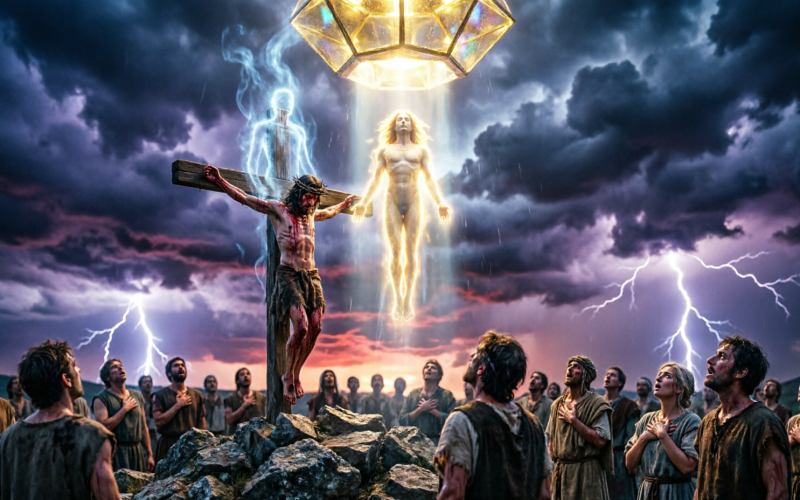
If I had to compress everything that man said into a single sentence, I would keep two words: Be Good.
And that is not a liberty I am taking. It is the compression he made himself.
1. The compression is his, not mine
Asked directly which is the greatest commandment — a test, put by someone trying to trip him up — he does not deliver a discourse. He gives two sentences and stops: love the Source, love your neighbour as yourself. “There is none other commandment greater than these” (Mark 12:28-31).
And in Matthew 7:12 he is even more blunt. After giving the golden rule — treat others as you would want to be treated — he adds: “for this is the law and the prophets”.
This is the law and the prophets. All of the law. All of the prophets. Hundreds of commandments, centuries of commentary, volumes of rules — he says, in his own words, that they reduce to this.
So everything added on top, over two thousand years, was added by someone else. And it is worth asking why.
2. Why it could not stay simple
Look at what you need in order to deliver “Be Good”.
You do not need a building. You do not need a hierarchy. You do not need an intermediary, a sacred language, an office, a vestment, a fee, a calendar, or anyone’s permission. You do not even need to be able to read.
A four-year-old understands it. Anyone can verify it, anywhere, immediately: did you behave as you would have wanted others to behave towards you, or not?
That is the problem. A message that needs nobody cannot support anybody.
To build an institution on top of a truth, the truth must be made heavy. It must acquire subtleties you cannot grasp alone, conditions you cannot verify, a language you do not know, a book you are not permitted to interpret, and a list of transgressions about which you cannot know on your own whether you have committed them.
The moment you need someone else in order to find out whether you are good, that someone has a job. And jobs get defended.
3. Fear in place of choice
And here is the biggest theft in the whole story.
Ask the people around you why they do not do evil. You will hear, in various forms, the same structure: because there is a price. Hell, punishment, karma, “it comes back to you”, “God sees”.
Very rarely will you hear the simple answer: because it is not right.
The difference between the two is not a nuance. It is the whole difference.
A man who is good out of fear is not good. He is managed.
Kant put it most clearly: an act performed out of fear of punishment has no moral worth. It may be socially useful, it may be convenient, but it says absolutely nothing about the person who performed it. It only tells you that the deterrent works.
And fear has a fatal defect, known to anyone who has ever run anything: it regulates only what is seen. A man held in check by the fear of being caught behaves impeccably as long as he feels watched, and exactly the opposite the moment he is certain that nobody is looking.
This explains something that otherwise seems impossible to explain. The institution most saturated with the fear of God in human history produced, inside itself, some of the greatest documented abuses. Not in spite of the fear. Because of its structure. The fear of God does not work in the dark, because the man preaching it is the first to know how hollow the pulpit is on the inside.
A man with his own compass behaves the same when nobody is watching. That is the only test that matters, and it needs no surveillance system, earthly or heavenly.
4. Error as school, not as invoice
I wrote in chapter 37 that the system runs on debt. Here is the reverse, and it is just as important.
A person must err in order to learn. That is not an excuse, it is the mechanics of the only way anything has ever been learned. A child who does not fall does not learn to walk. A man who has never hurt anyone has no way of knowing what it means to stop yourself.
And between the two models there is a chasm.
Error as school: you see what you did, you are sorry, you repair what can be repaired, and you do not repeat it. It ends in a change.
Error as invoice: you see what you did, you get frightened, you pay, it is struck from the register, and next time the same. It ends in a receipt.
The second model does not produce better people. It produces loyal customers. A confession that repeats identically for twenty years is not healing, it is a subscription — exactly the accounting apparatus from chapter 37, moved inside the person.
I am not afraid. When I have done wrong, I ask forgiveness before my God — mine, not some institution’s — and I try not to repeat it. That is all. I do not tremble, I do not tally, I do not calculate my way towards a reserved seat.
And around me I see people who, after an ordinary human stupidity, shake like a leaf, convinced that a booking has been permanently cancelled. They are not thinking about the person they hurt. They are thinking about their file.
That is not conscience. It is accounting anxiety. And it is the exact opposite of what was asked by the man they all claim to follow.
5. What was built in his name
I will not dwell here, because the facts are known and I have no need to exaggerate them.
In the name of a man who said “love your enemies”, wars were waged, people were burned alive, tribunals of faith were organised, pardons were bought and sold, fortunes were amassed on a scale he could not have conceived of, and crimes against children were systematically covered up.
And, to be fair: not all of them. I have known poor and honest priests who do their work in forgotten villages, bury the dead for free, and keep people alive with a word. They exist. But they are too few to function as the exception that proves anything. An exception that recurs this rarely no longer saves the rule; it only makes it more visible.
The gap between what he said and what was done in his name is so large that, if this were a commercial contract, it would have been voided for non-performance long ago.
6. A brand, not a voice
And here I arrive at the formulation that seems to me to describe most exactly what happened.
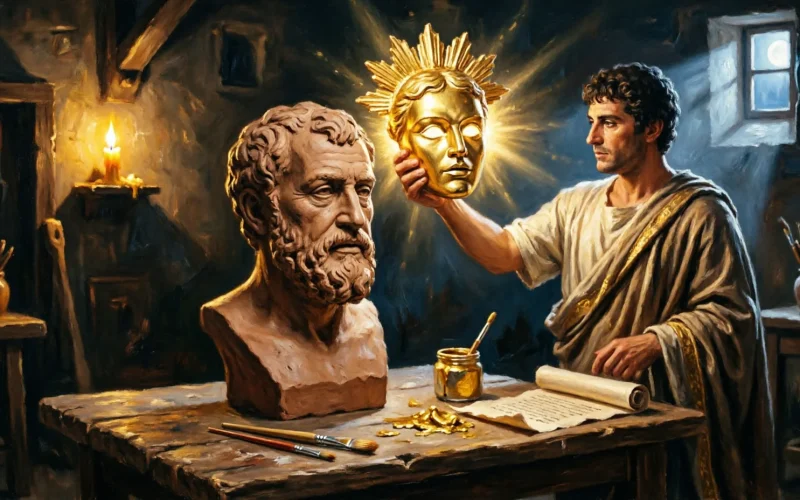
Jesus became a brand, not a voice.
The difference is not poetic, it is structural. Look at what each one needs in order to exist.
A brand needs maintenance, an owner, exclusivity, competitors to define itself against, protected symbols, defenders, revenue. It has to be repeated constantly or it disappears. It asks for loyalty, not understanding. And above all, it needs you to be unable to obtain the product elsewhere.
A voice needs only to be heard once and remembered. It has no owner. It has no competition, because it sells nothing. It does not defend itself, because it cannot be stolen — if someone tells you “be good” for another reason and in another language, they have plagiarised no one, they have said the same true thing.
A brand asks “are you one of us?”. A voice asks “did you do good today?”.
To the first question you can answer yes without having done anything. To the second, you cannot.
7. Who has the right to condemn
One thing remains, and it is the hardest, because it is where I run into my own limit.
I am not a gentle man when it comes to murder, to rape, to any assault on a person who could not defend themselves. I would be cruel. I know that about myself and I do not pretend otherwise.
And I still know that I do not have the right.
The distinction that keeps me on the line is a single one, and I believe it holds for anyone:
You can judge an act. You cannot judge a person.
The act must be judged. Whoever refuses to call evil evil is not spiritually advanced, he is complicit. A society that does not judge acts is not gentle, it is at the mercy of its most violent members. Stop, restrain, punish — all necessary.
But the person is something else. To condemn a person — not his act, but him, finally — you would need to know everything: what he inherited, what was done to him before he could choose, what broke in him and when, what he would have been otherwise. You would need omniscience. And if you claim it, you have taken exactly the step from the Saviour’s Paradox in chapter 34: you have appropriated a divine attribute in order to do something that seems right to you, and you have moved, without feeling it, to the apparatus’s side.
You can stop a man without knowing what he is. That is all that is asked of us, and it is enough.
And who has the right to judge at the end — the Source, or someone above the Demiurge, or nobody — I do not know. What I know is that it is not me, and that this peace costs me nothing. I do not need to be the judge of the universe in order to know what to do tomorrow morning.
8. The test
I will close with a thought experiment, and I invite you to do it honestly.
Imagine that tomorrow morning every building, every hierarchy, every vestment, every calendar, every added rule and every institution built in his name disappears. All of it. Overnight.
What remains?
Be Good remains. Untouched. Functional. Verifiable by anyone, immediately, with no intermediary.
Everything that would have vanished was brand. Everything that remains was voice.
And if the voice survives without any of those things, it means it never needed them. It means they were not built for it.
They were built for someone else.