Or: what the censors buried and the desert kept.
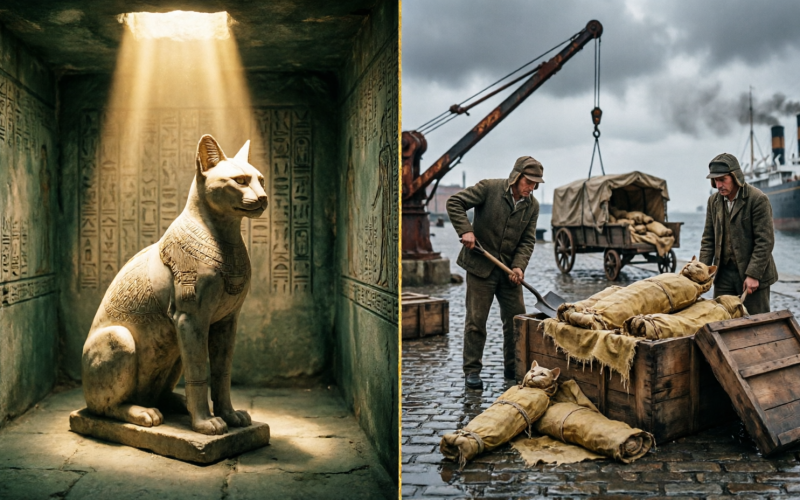
In December 1945, near the town of Nag Hammadi in Upper Egypt, at the foot of the Jabal al-Tarif cliff, a local farmer digging for fertiliser soil strikes a sealed clay jar almost a metre tall. He breaks it open hoping for gold. There is no gold inside. Inside is something that the most powerful institution of the age had ordered burned some 1,600 years earlier: the other voice of early Christianity.
His name was Muhammad Ali al-Samman, he came from the hamlet of al-Qasr, and he was not looking for anything sacred. He was looking for sabakh — the nitrate-rich earth at the base of the cliff that the fellahin haul away by camel and spread on their fields instead of manure. According to the account he later gave researchers, he hesitated for a few moments before smashing the jar: he was afraid a spirit might be shut inside it. Then it occurred to him that a spirit shut inside a jar is usually guarding something worth guarding. He raised his mattock.
No spirit came out of the broken jar, and not a gram of gold. A library came out.
1. The facts
Thirteen leather-bound codices. Fifty-two texts in Coptic, some in more than one copy. The manuscripts are dated to the middle of the fourth century; the texts are translations of Greek originals composed, for the most part, in the first three centuries. Today they are in the Coptic Museum in Cairo.
Those figures are worth unpacking a little. Of the thirteen codices, one — the thirteenth — did not survive as a volume at all, but as eight leaves torn out and stuffed inside the cover of another. Of the fifty-two writings, some are duplicates, so the number of distinct works is somewhere around forty-five. And of those, the great majority were, until 1945, completely unknown: we did not even have their titles.
The dating does not come from a palaeographic guessing game but from an accident of technology. The leather covers of the codices were stiffened on the inside with cartonnage — waste papyrus glued in layers, exactly the way you might use old newspaper as padding today. When specialists took the covers apart, out fell receipts, contracts and private letters with dates on them: the 340s. Whoever bound these books used the administrative rubbish of their own generation as filler. Rubbish that now tells us, to the year, when the work was done.
The language is Coptic — late Egyptian written in Greek letters. But not one of these writings was thought in Coptic. They are all translations from Greek, some of them clumsy, with Greek words left untranslated because the translator had no equivalent. Which means the texts we read are already copies of copies of originals far older than the jar.
Two details worth remembering:
- By all accounts, a few pages were lost for good — burned as fuel, before the finders understood what they were holding. Muhammad Ali’s mother is said to have used some of the papyrus to light the oven. Censorship does not always need an order; sometimes ignorance is enough. Sixteen centuries of desert treated these texts more gently than a single morning in a kitchen.
- Even after they came out of the ground, the texts stayed “locked” for another thirty years or so: access was held by a small circle of specialists, and the complete edition only appeared in the 1970s. The jar had two lids: the sand and the monopoly.
The second lid deserves describing, because it is more instructive than the first. Codex I was smuggled out of the country onto the black market and bought in 1952 by the Jung Institute in Zurich — hence the name it went by for decades, the “Jung Codex”. The rest were nationalised and deposited in the Coptic Museum. What followed was a quarter of a century of publication rights carved up between teams, promised editions that kept slipping, scholars sitting on manuscripts as though they were property. The complete facsimile edition, under UNESCO’s auspices, was only finished in 1977. The first full English translation appeared the same year.
Do the arithmetic: 1945 → 1977. Thirty-two years. The texts sat shut in a jar for sixteen hundred years and one human generation — and the second time, the sand was not to blame.
2. Why they were buried
There was one of the earliest Pachomian monasteries in the area. In 367, Athanasius of Alexandria writes the letter that fixes, for the first time, the canon of the New Testament and orders the rejection of “apocryphal” books. The dating fits almost to the year. The most plausible reading: someone did not burn them, as the order demanded, but buried them. Probably meaning to come back. He never came back.
The document is called the Thirty-Ninth Festal Letter. It is an Easter circular, the sort of text in which a patriarch announced the date of the feast and slipped in a few instructions along the way. In that circular there appears, for the first time in history, the exact list of the twenty-seven books of the New Testament — not one more, not one fewer. And with it the order: let no one add, let no one take away, and let the “apocryphal” writings be cast out. It is not a theological suggestion. It is an inventory list with a disposal instruction attached.
The letter was translated into Coptic and sent to the monasteries of Upper Egypt, so that it could be read where the monks knew no Greek. That is to say, in precisely the region where, a few kilometres away, someone crammed thirteen codices into a jar and put them under the ground.
It has to be said honestly that this connection is the best explanation we have, not a proven one. There is no note in the jar saying “hiding these from Athanasius”. There are scholars — most forcefully Nicola Denzey Lewis and Justine Blount, in a 2014 study — who dispute the monastic scenario and propose something else: a funerary deposit, books placed beside a dead man, as had been done in Egypt for thousands of years. Their argument is that the discovery story has been retold too many times, and that the cliff was full of graves. It is a serious objection, and I put it here because an argument that does not show its counter-argument is not an argument, it is an advertisement.
But the coincidence remains. A destruction order issued in 367, translated specifically for the monasteries of that region, and a hoard of forbidden books buried a few kilometres away, in leather stiffened with paperwork from the 340s. It could be chance. Chance is rarely that punctual.
The censorship that meant to erase them preserved them. The desert turned out to be a better archive than the library.
And that is the irony holding this whole chapter together: the canonical books survived because they were copied over and over — each copy further from the original, each scribe with a hand of his own. The forbidden books survived because nobody touched them again. What was kept was altered. What was buried stayed exactly as it was.
3. Why it changes everything
Until 1945, the “heretics” existed only in the prosecutors’ files: Irenaeus, Tertullian, Epiphanius — men who wrote in order to condemn, not in order to understand. To read the history of early Christianity through them alone is to know a man only from his indictment. Nag Hammadi gave the accused their own voice. And what came out is not a monolithic “sect”, but a whole spectrum of communities for whom the spark, the remembering and direct knowledge (gnosis) mattered more than the institution.
It is worth saying what happened when the two piles were laid side by side. Irenaeus of Lyon had written, around the year 180, in Against Heresies, a summary of a myth he considered absurd: a female entity called Barbelo, a fall, a demiurge who believes he is alone. For eighteen centuries that was our only source. And when the jar was opened, inside it was the Apocryphon of John — and the story matched, in broad outline, what the prosecutor had described.
Which is a far more interesting result than “Irenaeus lied”. Irenaeus did not lie. He summarised reasonably accurately. But he summarised in order to demolish: he kept the bizarre names and stripped out everything that made sense of them, kept the myth and threw away the experience behind it. It is the difference between reading a poem and reading someone’s minutes explaining why the poem is nonsense. Both contain the words. Only one contains the poem.
Epiphanius, two centuries later, went further still: he catalogued eighty heresies as though they were diseases, in a work he actually called the Medicine Chest. Once you catalogue people as symptoms, you no longer need to listen to them. You only need a treatment.
Nag Hammadi did not hand us a new truth. It handed us the defence. And for the first time, we can compare the prosecution with it.
4. What is inside — the contents of the parts to come
This is the base article. Each point below becomes a separate part:
Part 1 — The Apocryphon of John: the map. The Pleroma, Barbelo, Yaldabaoth “with the face of a lion and eyes like flashing lightning”, the spark hidden in man. “I am God and there is no other apart from me.” — “You are mistaken, Samael!”
Part 2 — The Hypostasis of the Archons and On the Origin of the World: Genesis turned inside out. The administrators who say “come, let us make a man after our image”, and the serpent-instructor: “You shall not die. It was out of jealousy that he said this to you.”
Part 3 — The Gospel of Thomas: Jesus without the passion. 114 sayings, no cross, no demand for belief — only waking up. “Become passers-by.” / “The Kingdom is inside you and outside you.”
Part 4 — The Apocalypse of Peter and the Second Treatise of the Great Seth: the Jesus who laughs. The one nailed up is the substitute; the living one watches from above. “I was laughing at their ignorance. I did not die in reality, but in appearance.”
Part 5 — The Gospel of Truth and the Gospel of Philip: the Valentinian line. The world as fog and nightmare; salvation as waking. “God is a dyer.” / “Light and darkness are brothers; they cannot be separated.”
Part 6 — Zostrianos, Allogenes, The Three Steles of Seth: the ascent. The uncoupling, the climb through the spheres, the guardians, the crown — and the final language: silence. “I heard a perfect silence, and out of the silence came a voice.”
5. The four red threads
Four axes repeat across all the texts — these are the theses we will develop in the parts:
- The god of this world is not the True God. He is a blind administrator who believes he is the owner.
- Salvation is remembering, not sacrifice. Nobody redeems you with blood; you wake up.
- The spark comes from somewhere else. Introduced in secret, untouched by the farmers.
- Silence and laughter are the frequencies of freedom. The only ones the mechanism cannot harvest.
Anyone who has read the chapters on the Archons, on the crucifixion as an engineering of consent, and on brand versus voice will recognise those four axes immediately. Not because I built them to fit. Because I arrived at them by a different road, and now we are opening the jar in which they were already written.
6. Why it matters now
The jar is the perfect image of censorship: the apparatus demanded the texts be burned; someone buried them instead; 1,600 years later they resurfaced and rewrote history. What is erased does not necessarily disappear — sometimes it is only waiting for its reader.
And there is something else, which has nothing to do with the fourth century. A list of forbidden books is a crude tool: it is visible, it is countable, you can dig for it. Today’s tools bury nothing — they simply move things down the results. Nobody burns the book; it just does not come up. No destruction order is issued; a weighting is adjusted. Censorship that leaves jars behind is amateur censorship. The professional kind does not even leave shards.
That is why a farmer digging for fertiliser matters. Not because he found a treasure — he did not, he was disappointed, he wanted gold. But because the best-organised system of the age gave one simple order, “burn them”, and a single unknown man, for a reason we will never learn, did something else. One man, one mattock, one jar. It was enough for us to lose the order and keep the books.
The parts follow. The jar is open.