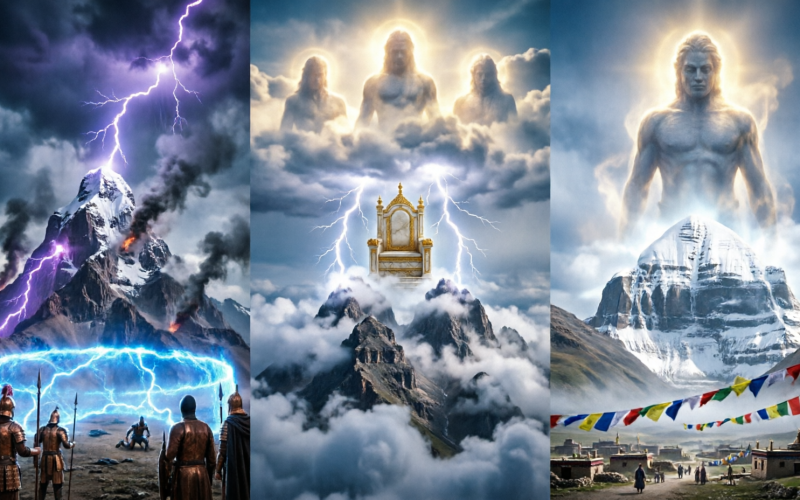
Kali Yuga isn’t a person — it’s a concept from Hindu cosmology. And, to my own surprise, it lands in exactly the same place I reached in the chapter about 2031, coming from a completely different tradition.
1. What Kali Yuga Actually Is
Kali Yuga is the fourth and last of the four ages in a cosmic cycle from Hindu cosmology: Satya Yuga (Gold), Treta Yuga (Silver), Dvapara Yuga (Bronze), Kali Yuga (Iron). “Kali” does not refer to the goddess Kali — it comes from the word for conflict, strife, discord. “Yuga” means age. The Iron Age is described as spiritual and moral decline, ignorance, materialism, corruption, shortened lifespans — not a moment, a climate.
According to the classical tradition (Surya Siddhanta), Kali Yuga began in 3102 BCE and lasts 432,000 years, meaning we are only 5,125 years into it. Over 426,000 years remain until its official end and the arrival of Kalki, the tenth avatar of Vishnu, who would restart the cycle with Satya Yuga.
Mathematically, then, the year 2031 has nothing to do with the end of Kali Yuga. But the insistence on the 2030s comes from somewhere real, and it deserves to be taken apart by source, not buried.
2. Three Sources of the Confusion — Weighed Separately
Sri Yukteswar Giri, a respected guru (the teacher of Paramahansa Yogananda), proposed in The Holy Science (1894) that ancient astronomers miscalculated, and that a full cycle lasts only 24,000 years, tied to the precession of the equinoxes. In his version, Kali Yuga lasted only 1,200 years and ended around 1700 CE — we would now be in an ascending Dvapara Yuga, an age of rediscovering energy and truth, not decline. It’s a serious reinterpretation, but a minority one, not classical doctrine.
The Age of Aquarius is an import from Western astrology and New Age currents: the transition from the “Age of Pisces” (dogma, hierarchy) to the “Age of Aquarius” (direct knowledge, connectivity), placed by many astrologers somewhere between 2030 and 2050. It’s a popular overlay on Kali Yuga, not part of its original content.
Popular prophecies are the weakest layer: predictions attributed to Baba Vanga for 2031 are, for the most part, internet inventions, not verifiable texts. Edgar Cayce did predict “great earth changes” for the 2030-2033 period — but his wording is vague enough to fit almost any decade retroactively.
Three sources, three different strengths. Lumping them together with the classical Hindu calendar is syncretism, not tradition.
3. The Link Isn’t on the Calendar, It’s in the Symptom
If you gather what the texts say about Kali Yuga — truth hidden or distorted, a person’s worth reduced to wealth, confusion elevated to the norm — they don’t describe a year, they describe a state many recognize living through right now. It isn’t a chronological coincidence (the 432,000 years don’t end then), it’s an archetypal one: the sense that an old cycle is nearing a breaking point, whatever you call it — end of an age, Aquarius, or simply the species growing up.
4. The Gordian Knot of 2030 — Three Real, Not Symbolic, Pressures
Here the discussion breaks off from mythology and enters verifiable ground: 2030 isn’t chosen at random in global discourse, it’s where three curves intersect.
Climate and resources. The Paris Agreement calls for a 45% emissions cut by 2030 to keep warming under 1.5°C — the current trajectory isn’t close to the target, so after 2030 the conversation shifts from prevention to forced adaptation. World Bank estimates put internal climate displacement above 200 million people by 2030.
Artificial General Intelligence (AGI). Unlike today’s narrow AI, this is intelligence that matches or exceeds human capability across any reasoning domain. Industry leaders’ estimates (including Sam Altman, Demis Hassabis) place AGI between 2027 and 2035. Double impact: automation reaching cognitive work too, and a technical threshold — by 2030, synthetic video/audio/text generation will make it nearly impossible to tell real from fake without cryptographic verification.
Social restructuring. The UN’s Agenda 2030 (adopted 2015, 17 goals) is real as a document, but its implementation calls for extensive monitoring of individual behavior. The “Great Reset” (Klaus Schwab, WEF, 2020) proposes rebuilding the economic system — the concrete mechanisms already visible are central bank digital currencies (CBDC, which allow programmable control of money — money that can expire or carry spending restrictions), unified digital identity, and a shift from ownership to subscription/service. The phrase “you will own nothing and be happy” is often quoted out of context — it does come from a real 2016 WEF article, but circulates as a slogan, not formal policy.
5. How the Three Pillars Feed Each Other
The climate crisis supplies the moral urgency for extreme measures. AGI supplies the technological tool to monitor and manage those measures at global scale. Social restructuring (CBDC, digital ID) is the mechanism that makes the control “voluntary” — to access basic services, you have to be in the system. Each pressure alone would be manageable. Together, on the same date, they form what strategists call a polycrisis.
6. A Second, Independent Tradition Arriving at the Same Decade
I already wrote about the 2030-2032 window starting from a completely different tradition — the numerology of Revelation, the letter-scale, and the 1260 days repeated five times (see the chapter “2031 — The Apocalypse Ladder, the 1260-Day Clock, and the Year I Declare Myself Defeated”). There, I explicitly argued against merging the relativistic calculation with the apocalyptic one, because that would have been cheating. Here it’s different: it isn’t the same calculation carried further, it’s a separate tradition — Hindu, not biblical — which, through its own reinterpretations (Sri Yukteswar) and through overlap with Western astrology, converges on the same time window independently given by the climate calendar (Paris 2030), AGI estimates (2027-2035), and the declared agenda of economic restructuring (Agenda 2030, WEF targets).
It stops being a coincidence when three sources that never consulted each other — a thousands-year-old Sanskrit text, a book of apocalyptic theology, and administrative UN/WEF reports from the last decade — point to the same interval. That’s ground.
7. What You Do With This
The year 2030 isn’t a magic prophecy, it’s a real, documented administrative and technological deadline. Kali Yuga doesn’t end in 2031 — but its symptoms, yes, are visibly intensifying right now, and whoever has taken off their blinders doesn’t wait for the Sanskrit calendar’s validation to act: they secure independence in resources (water, energy, food), cultivate the skills AGI cannot take (critical thinking, craft, real human connection), and diversify their assets before the financial system fully digitizes.