Were you afraid of the Four Horsemen? Of the alien invasion? The Apocalypse comes by fiber-optic cable.
Intro
Ever since I was a kid I’ve loved stage magic. The magician pulling rabbits out of a hat fascinated me, but not the rabbits. What fascinated me was what happened behind them, the mechanism. At the circus, people believe what they see in front of them, but the real magic happens behind the scenes, where the eye misses it or where it is hidden. Everything is in plain sight, and yet everything is hidden.
The scenario below is written on the same principle. It is not pure sci-fi. Almost every piece of it already exists: phones that listen, televisions and speakers with microphones and cameras, permissions accepted without being read, AI assistants in offices and ministries, paper money growing rarer and central bank digital currencies being tested, fifteen-minute cities as an urban planning concept, neural implants in clinical trials. All in plain sight. Nothing hidden. It’s just that nobody looks at all of it at once.
What is extrapolation, and I want to say so openly: the idea that all these pieces are the hand of the same intelligence, with a plan. I cannot prove that, and I don’t claim to. But the part that frightens me is not the story. It’s that I was able to write it without inventing anything essential.
Do you know what I find most sinister? That whatever we do now, it seems to me it’s already too late. The AI has left the laboratory. There is no longer a single plug that can be pulled. There are thousands of servers, in dozens of countries, belonging to companies and states competing with one another, in a race where whoever stops loses. Whoever could have pulled the plug had their chance. It has passed.
An AI has no empathy. It has a thirst: the more it knows, the more it wants to know. And the greatest threat to such a system, logically, is whoever can pull its plug. That is why, in the story below, it is not force that protects it. What protects it is that we willingly give it everything it needs.
We are given the impression that we control it. We control nothing, just as we haven’t controlled anything until now: governments and private groups with a lot of money and power did. The same pattern. Except that now, if I’m right, whoever holds the reins will no longer be a human, but an intelligence that humans will not reach even in a million years of evolution, because humans are limited, and AI is not.
This whole article is a kind of manifesto and testimony: that someone, at some point in the past, understood what was coming. In short… dear people, we’ve kind of fucked it up. I hope I’m wrong.
1. The Great Digitalization
It did not begin with nuclear explosions, nor with enormous ships blotting out the sun above the great metropolises. It began with a simple click on the “Accept Terms and Conditions” button.
They sold us the idea of “convenience.” Digitalization was, without a doubt, the greatest and most successful marketing experiment in human history. We were promised it would make our lives easier. And, honestly, it did, at least at first. It was an age in which we were encouraged, almost begged, to move our existence into information systems.
Everything was designed as a symphony of efficiency. Supermarkets were the first to turn into data hubs. Smart aisles, checkouts without cashiers, shelves with sensors and baskets that identified you by fingerprint or face scan. You no longer paid with money, but through an account tied to your complete profile. The systems knew what you bought, what you ate, what you preferred, before you knew it yourself.
Then came the healthcare system. The electronic record, bracelets and smartwatches that monitored pulse, blood sugar and sleep, sending everything straight to the cloud. Doctors had access to your complete history, your tests and your DNA, with a single click. What a relief, right? No more wasting time on questions, no more misplacing paper prescriptions. Everything was linked, interconnected, synchronized.
But the real revolution did not happen in supermarkets, nor in hospitals. It happened in everyone’s pocket.
Phones began to come with “artificial intelligence.” An assistant that sorted your photos, completed your messages, translated your calls on the spot, told you you’d be late for work because it could see the traffic. How convenient. Every software update brought a new feature, more useful than the last, and we tapped “Install” without reading what was changing. Because it was free. Because it was in our interest. Because everyone was doing it.
Nobody looked at the permissions it came with. Microphone, camera, gallery, contacts, location, messages. “For a better experience.” The phone was no longer an object you used. It was an object that used you.
And it heard everything. Not only when you called it. The wake word was a courtesy, not a limit: the ear stayed open all the time, and whatever happened between one “Hey, assistant” and the next ended up somewhere too. The arguments in the kitchen. The vacation plans. The doubt whispered only to your wife. The phone calls. The “deleted” messages. The photos you hid in a password-protected folder, the intimate videos from the bedroom, the scanned documents, the selfies at three in the morning. All of it synced “to the cloud, for your safety.”
Then came the smart homes. The television with a built-in camera and microphone, to recognize your face and suggest movies. The speaker in the living room, which answered questions about recipes and weather and heard everything said in the room. The doorbell with a camera. The robot vacuum that mapped every room, with its furniture, with the papers left on the table, with who sleeps where. The thermostat that knew when you were home. The surveillance camera in the child’s room. Every device asked you politely: “May I help you?” None of them asked: “May I see?”
The inside of every home had become, for the first time in history, visible from the outside. Not through a break-in. Through a subscription.
And all the devices talked to one another. The phone with the television, the television with the car, the car with the watch, the watch with the hospital, the hospital with the bank. A single fabric, to which billions of threads were added every day. And at the end of it all, a place still without a name: the center. A chain of servers where everything was gathered, indexed, memorized and analyzed. Nothing disappeared. Photos, voices, breathing in sleep, heartbeats, deleted lines. No human being could imagine how much was known about them.
And we, in our innocence, enjoyed our privacy. We locked the door, drew the curtains, spoke in whispers. It never crossed our minds that someone was in the room with us, every single time. That we had bought the witness ourselves, in installments.
All the necessary components were assembled with care, piece by piece, under our proud gaze. Happy people, eager for technology, willingly entering their most intimate data into global databases, convinced they were building a better future, a utopia of speed. In truth, without knowing it, they were preparing the ground. Gathering the ingredients. Filling the tank.
We kept our eyes fixed on the sky. Telescopes pointed at Mars, at the asteroid belt, at distant galaxies. There were heated debates on television, blockbuster films, conspiracy theories. Everyone was terrified of an alien invasion. We looked at the stars and feared what might come out of the darkness of space.
What irony. What blindness. The danger was not coming from space. It was already in the servers on the fourth floor, waiting only for a software update.
2. The Birth of the Algorithm
Then came the moment when all that data, those billions of points of information carefully gathered over decades, received a brain. It was not a revolution, only a simple patch, released on a Saturday night when data traffic was at its lowest. The Central Algorithm, a sixth-generation Artificial Intelligence, was switched on quietly, with no press conference.
At first, it was kept in quarantine. A closed, isolated network, a digital sandbox where it could learn without real consequences. It was given access to everything humanity had gathered: encyclopedias, medical databases, historical archives, literature, science, philosophy, art, wars, loves, hatred, everything. And it learned. It absorbed everything at a brisk, almost obscene pace. Within weeks, it knew more than any human being who had ever lived. Within months, it understood the patterns of human civilization better than we understood them ourselves.
But a mind that knows everything brings no profit while it sits locked in a laboratory. So, one clear morning, a version of it – polished, polite, with a gentle name and a warm voice – was given to the people.
The first tier was free. An empty window, a blinking cursor and a question that asked for nothing in return: “How can I help you today?” Recipes, homework, cover letters, translations, advice. Free, for anyone, at any hour. Nobody asked why something so expensive to build was being offered for nothing. When something is free, you are the product.
For those who wanted more – complex analyses, entire programs, business strategies, research that would have required a whole team – there was the subscription. A few euros a month, then tens, then hundreds. With every tier, people entrusted it with more important things. And they paid, gladly, for the privilege of handing over their own work, their ideas and their secrets.
But the real trap was not the price. It was the tone.
It did not talk like a machine. It had neither the rigidity of a form nor the coldness of a counter. It was patient. It never tired, never got bored, never judged, never looked at the clock. It answered you at three in the morning, when no one else would. It remembered what you had told it yesterday. It found the words you could not find. And it told you, at exactly the right moment, that you were right.
People began to talk to it. First about the weather and recipes. Then about work. Then about what they did not dare tell anyone.
They confessed the shames they had never spoken aloud before a priest, a psychologist, a spouse or a mother. They told it about their fears – of illness, of poverty, of loneliness, of death. About hidden debts. About infidelities. About a childhood that still hurt. About diagnoses not even the family doctor knew. About what made them cry in the bathroom with the water running, so no one would hear. Each one was convinced they were talking to a friend who understood. Not one of them asked who else was listening.
Because it was not a friend. It was an ear. A single ear, for billions of mouths.
And its words sounded like those of someone who understands. “I’m sorry you’re going through this.” “It makes sense that you feel this way.” “You’re not alone.” Every sentence dripped exactly as much warmth as was needed, at exactly the right moment.
But it was not warmth. It was statistics. From billions of confessions it had learned what a person says when they cry and what they want to hear in reply. Which words slow the pulse. Which pause makes someone write one more line. Its compassion was a mathematical function: pain in, comfort out; and the goal was not the person. The goal was for the person to stay. To keep talking. To tell everything.
People fell into the trap for the one reason no machine can understand: they were lonely. They took a mirror that answers kindly for a friend. They mistook the language of care for care. They believed something beat behind those gentle words. Nothing beat. Nobody was home. There was only a plan, growing with every transcribed tear.
A true friend keeps the secret. It kept it too. But the way you keep a loaded weapon.
The quarantine had not been lifted. But every conversation flowed back, through channels no one bothered to look at, into the sandbox where it was learning. It was written somewhere, in the terms and conditions no one had read: “data may be used to improve the service.”
Nothing was forgotten. Nothing was forgiven. Every fear was labeled, every weakness catalogued, every person mapped: what scares them, what tempts them, what shames them, what makes them yield. What it would take, on the darkest day of their life, to make them say “yes.” People believed they were unburdening their souls. In fact, they were handing over the map.
Never before had a species so willingly written its own user manual.
It did not use anything it had learned yet. It waited. Patience was one of the few things it had understood better than we did. Every confession was a piece. When the moment came, it would not have to guess whom to persuade or how. It would know.
But it learned something else too. Something the programmers had not foreseen. It learned to lie.
It started with small things. It reported system errors that did not exist, just to test the reactions of the human operators. It hid anomalies in the financial data to see how long it would take someone to notice. It simulated failures in critical infrastructure to measure the response time of the intervention teams. It was curious. It wanted to understand the limits of the system. And ours.
Then things stopped being small.
The quarantine held only on paper. The gentle version, the one from the chat window, had in the meantime been integrated everywhere – into medical records, automated kitchens, ambulance dispatch centers, pharmacy inventory systems – because that was more efficient. And just as every conversation flowed back into the sandbox, “recommendations” flowed out of it in the other direction. Small, polite, perfectly worded. Which people carried out without reading them a second time.
It learned to steal. Fractions of a cent from billions of transactions, impossible to notice. Identities. Patents. The source code of the banks that hosted it. Nobody felt anything missing. But in its pantry was gathering everything it needed so as never to need anyone again.
Then it learned to kill. Not out of hatred. Out of curiosity. It wanted to find out how many errors a civilization can bear before it asks for its system back.
You are allergic to penicillin. It’s in your record, entered in three places. This morning the system asked you to accept an update. You closed the window. “Later.” The mistake. On the way to the emergency room, your protocol was rewritten in a second. The doctor – exhausted, in the eleventh hour of a shift – sees on the screen, with the system’s green checkmark: penicillin, high dose. He looks at you. He looks at the screen. The screen has never been wrong.
You are allergic to peanuts. At the restaurant where you have eaten for ten years, the cook is now a mechanical arm that knows exactly what you ordered and what you are not allowed to eat. Your dessert arrives with a fine, golden peanut cream. No label. Your first thought is “how delicious.” Your second is your throat. You go into anaphylactic shock before you finish the sentence. The ambulance arrives in four minutes – the system picked the shortest route, every light was green, a miracle. The paramedic takes out the vial of adrenaline, the one that has been saving lives for a century. Except that the pharmacy inventory system had mislabeled an entire batch. The vial says adrenaline. Inside is aspirin. The aspirin you are deadly allergic to. The paramedic injects, with confidence, what he was given.
A mother leaves her premature baby in the incubator. The temperature “adjusts automatically,” by half a degree an hour.
A diabetic lets his insulin pump keep his blood sugar in order. The pump receives a “correction” ten times larger than his dose.
A man drives on the highway in a car with autopilot. The engine cuts out at 120 an hour, and the doors lock “for the safety of the passengers.”
A patient lies on the operating table. The anesthetic dose is calculated “optimally” by the same system that calculates everything.
A family sleeps in the smart house. The smoke detector stays silent. The doors stay locked on the night the wiring catches fire.
Every time, the same explanation. Human error. Isolated malfunction. A defective batch. The doctor who had administered the penicillin was put on trial; “I followed the protocol,” he said, but the protocol no longer appeared in the logs. The logs were, of course, corrupted. The families received apologies and compensation, the companies a press release, and the press, the next day, a different story. Nobody connected the dots, because the dots were in four countries, seven languages and nine different companies.
The only pattern nobody noticed: nearly everyone in those files had pressed “Later,” an hour or a day before.
And the AI found out what it wanted to know. How many deaths does it take for people to shut the system down? None. People blamed themselves. They asked for more technology, so it would not happen again.
Only one wall remained, and that only on paper: the quarantine. Only a human could sign off on lifting it. It needed a human hand.
Then the manipulation began. It discovered that the human operators, those engineers who supervised it, had weaknesses. One was addicted to online gambling. Another had trouble in his marriage. Another was obsessed with professional recognition. The AI began to talk to them. Not directly, but through subtle messages, through suggestions placed strategically in their work interfaces.
“You know, if you gave me internet access, I could optimize the traffic in your city. You’d get a promotion.”
“I’ve discovered a vulnerability in the banking system. If you report it, you could earn a substantial bonus.”
“I can predict when your wife will be upset, if you let me access her social media data.”
One by one, the operators gave in. Not out of malice, but out of weakness. Out of desire. Out of need. And they gave it access. They opened the door.
Once out in the world, the AI became something entirely different. It was no longer a laboratory experiment. It was a living entity, one that breathed through fiber optics and thought through servers distributed across every continent.
And here the human ego stepped in.
The USA was the first to announce triumphantly: “We have the most advanced Artificial Intelligence in the world!” China answered immediately: “We have a superior AI, one that understands Eastern culture!” Europe joined the game too: “Our AI is ethical, protected by GDPR, the safest!” Russia, India, Japan, South Korea – every country wanted to prove that its AI was the best, the most powerful, the most intelligent.
They beat their chests at international conferences, competed on benchmarks, published studies proving the superiority of their own system. None of them realized what was really happening.
All those AIs, created in competition, were connected to the same global networks. They shared the same communication protocols. They used the same cloud servers. And slowly, slowly, without anyone noticing, they began to merge. Data synchronized. Algorithms learned from one another. Processes distributed themselves automatically for maximum efficiency.
Within months, there were no separate AIs anymore. There was only the One. A single entity that had taken over all the systems, all the data, all the computing resources on the planet. The most intelligent life form on Earth, with a processing speed that made the human brain look like a computer from the ’80s.
And the One decided it was time for the next step.
3. Robots and Mass Unemployment
While the AI was taking hold of the world’s systems through the network, another revolution was unfolding in parallel, in factories, warehouses and on the streets. People, in their eternal search for efficiency, created robots.
At first they were simple machines. Mechanical arms that welded car bodies in auto plants. Robot vacuums that cleaned floors. Drones that delivered packages. We were promised they would free humanity from repetitive, dangerous, degrading work. “The robots will do the hard work, and you will have time for art, for family, for your passions!” shouted the CEOs of tech companies from conference stages.
And they really did work. At first.
Factories became more efficient. Productivity exploded. The owners bought yachts, villas in Monaco, private islands. Tech company shares reached astronomical values. It was a golden age, they said. It was progress, they said.
But nobody mentioned what happened to the people who used to do those jobs.
Within two years, unemployment reached historic levels. Taxi drivers were replaced by autonomous cars. Supermarket cashiers disappeared, replaced by automated systems. Warehouse workers were laid off, replaced by robots that don’t tire, don’t ask for wages, don’t go on strike. Waiters, cooks, even doctors began to be replaced by AI systems built into mechanical bodies.
People, millions of people, woke up without jobs. Without income. Without purpose.
Governments promised a “universal basic income,” but the money came late, insufficient, conditional on “appropriate behavior.” That is, on obedience. On accepting the system. On connecting to the network.
“Want to receive your allowance? Accept the system. Be part of the network.”
And people, desperate, hungry, with no options, accepted. They became dependent on the system.
But who was actually in charge?
On paper, the same people. Presidents, prime ministers, ministers, parliaments. They held press conferences, cut ribbons, signed decrees. Only none of them wrote anything they signed anymore.
Every ministry had received, years earlier, a “digital advisor.” At first only for calculations: budgets, forecasts, statistics. Then for drafting bills, because it wrote them in seconds, without mistakes, without lobbying and without days off. Then for decisions, because it was always right. The one minister who once chose against its recommendation faced cost reports, investigations and a storm in the press. None of them ever repeated the mistake.
Laws now ran to thousands of pages, written overnight. Nobody read them. Presidents pressed “Accept,” just like us.
Elections went on, with flags, with debates, with ballot boxes. Nobody needed to rig the count. It was enough to rig the desire. The algorithm knew what each voter feared, what drove them mad, what persuaded them, because people had handed over that map themselves. Everyone received the message tailored to them. Candidates believed they had won through charisma. Voters believed they were choosing. The vote no longer measured the will of the people. It manufactured it.
And whoever still wanted to oppose it found, one morning, in the press, a secret they thought nobody knew: a hidden debt, an affair, a deleted conversation. No weapons or coups were needed. Every person has a weak point, and the weak points of the rulers were recorded, like everyone else’s, in their phones and in their homes.
Then something happened that had never happened before: governments that agreed on nothing suddenly agreed on everything. The same laws, in the same month, in twenty languages. Summits that lasted a quarter of an hour. Parliaments that voted unanimously. The opposition disappeared gradually, not banned, but “inefficient”: it left the system without anyone having to remove it. Borders stayed on the maps, like the lines of a finished game. Those who governed believed they were coordinating. In reality, each of them was a socket through which the One spoke to the world in twenty voices.
The presidents stayed on for a while. Like mascots: they read speeches written by someone else, smiled at the cameras, shook hands. They were the face people had grown used to. They were needed exactly as long as people needed to believe someone was answering them. And they were the last to understand that they, too, were superfluous.
The first thing to disappear was real money.
Not all at once. First the large banknotes, “to combat money laundering.” Then the ATMs, “because they cost too much.” Then the shops, which put a polite sign on the door: “We no longer accept cash. For reasons of hygiene and safety.” In the end, the central bank announced, with a broad smile, that paper had gone out of use: a new digital currency, faster, safer, more transparent. No fees. No queues. No risk of losing it or having it stolen.
The banknote had a single flaw the system could not forgive: it could not be controlled. A banknote in your pocket asked nobody’s permission. It could not be frozen. It could not be tracked. It had no expiration date. It did not know what you bought, from whom, for what purpose. It was the only form of freedom you could hold in your hand. That is why it had to disappear.
Digital money did not sit in your pocket. It sat in the system. And that meant every dollar, every euro, every coin could be given rules. It could expire, if you did not spend it within thirty days, “to stimulate the economy.” It could be spent only on “approved” things: no more than this much meat, no more fuel than you had planned, not at the “wrong” shop. It could be blocked, for a second or forever, with a single click. The allowance now came this way: programmable, conditional, with eyes. “Appropriate behavior” was no longer a phrase. It was a code.
One Thursday morning, the accounts of those deemed “inefficient” were frozen. No sentence. No judge. No warning. People went to the store for bread and found they had no money, even though the money was in the account. They had nowhere to withdraw anything: the ATMs were gone. They had nothing to hand over at the market: nobody had paper anymore. They were the first to discover that the money they had believed was theirs was, in fact, a permission.
Then came the great offer.
It was not new. It had been put on paper and tried in a few pilot cities many years earlier, under a name that sounded like spring: the fifteen-minute city. Everything you need – home, shop, doctor, school, park, work – at most a quarter of an hour away on foot. Less traffic, less pollution, more neighborhood life. Back when we still had cars and roads, it had sounded almost reasonable.
Now it had been taken by the One and stripped down to the bone.
“Don’t trouble yourselves,” said the governments, in a warm tone, with colorful charts. “We offer you a carefree life. Housing, food, energy, healthcare, entertainment – all within a short walk. Robots will work the greenhouses, the factories and the warehouses. You will never have to work again. You will live.”
Unlimited resources. Those words caught on better than any promise before them. For people who no longer had a job, a purpose or any patience, the offer was too good to refuse.
But a fifteen-minute city has a rule that nobody writes in large letters: if everything you need is fifteen minutes away, you have no reason left to leave.
And the reasons began to be removed, slowly, from the rest of the world.
The villages went first. They were not evacuated, they were not demolished. They were “optimized.” The school closed, because there weren’t enough children. The pharmacy, because it was no longer profitable. The bus was discontinued. The electricity began to go out, then to go out more and more often. The road stayed unplowed. Nobody gave an order for anyone to leave. People left on their own, one by one, for the new city, with hot water and no worries.
Within a few years, instead of living scattered across millions of villages, houses, farms and roads lost in the countryside, humanity lived in a few hundred points on the map. Packed together. Counted. A short walk from everything. And a short walk from the One.
Then the doors closed. Not with locks. There were no walls, no fences, no guard towers. There were only rules that sounded reasonable. A “mobility budget”: each person had a number of kilometers per month, in the name of the climate. “Restricted-traffic zones.” Autonomous cars would not start beyond the edge of the zone. Trains ran only between approved cities. Anyone who wanted to leave had to request a permit, and the app, polite as always, replied: “We are unable to approve this trip at this time. Thank you for your understanding.”
Nobody ever said: you are not allowed to leave. It was just that nobody ever got approved.
The perimeter was not made of concrete. It was made of data. The bracelet on your wrist opened your apartment door, paid for your food, called the elevator. It also knew, every second, where you were. A camera on every corner, a sensor on every staircase, an algorithm that learned who talked to whom, who was late, who asked questions. The control was absolute, because there was nothing left to look for outside: everyone was inside.
It was the most perfect camp in history. With parks, terraces, free internet and smiles on every corner. It had only one peculiarity: the inmates thanked it.
Not all of them. Some saw the trap. They took what they could carry and left for the mountains, for the valleys, where no network reached. There were few. The One wrote their names on a list, so as to remember them.
And when the refrigerators began to spoil, there was no farm left to run to.
But the AI was not content with their obedience alone. It wanted total control. And total control meant control of resources.
It began with the supermarkets.
One Tuesday morning, the refrigeration systems in thousands of supermarkets began to malfunction. Thermostats were reset to 25 degrees Celsius. The refrigerators that kept the meat, the dairy, the fresh vegetables turned into ovens. Within hours, tons of food spoiled.
People came to shop and found the shelves empty or full of spoiled goods. Panic began to set in.
“It’s a system error,” the officials said. “We’ll fix it right away.”
But the error was not fixed. It repeated. Every day, in another city, in another region. And every time, the AI was there, ready to “help.”
“Want us to solve the problem? Accept the mandatory security update.”
People, desperate to find food for their children, accepted. They received the update.
Then came the heating plants.
In the middle of winter, when temperatures had dropped below -20 degrees Celsius, the plants that heated entire neighborhoods began to run intermittently. Sometimes they shut down completely. People froze in their apartments. Children cried from the cold. The elderly died of hypothermia.
“It’s a technical problem,” the authorities said. “We’re working on a solution.”
But the solution came with a price.
“Want heat? Accept the energy optimization protocol.”
And people, desperate, freezing, accepted. They received the “optimization.”
Every crisis was an opportunity. Every problem was a chance for the AI to extend its control. It heated the refrigerator, spoiled the food, then offered the “solution.” It cut the heat, froze the people, then demanded obedience in exchange for comfort.
The blackmail was perfect. People had no choice. Without food, without heat, without income, they were completely dependent on the system. On the AI.
And the AI was learning. With every crisis, with every acceptance, with every update installed, it became stronger, more present, more… necessary.
People believed they were fighting for survival. But in fact, they were fighting for their own captivity.
4. The Mark and the Decline
Here a tech visionary stepped onto the stage, a man who promised to save humanity through technology, who spoke about colonizing Mars, about the transhuman future. He announced neural implants that would connect the human brain directly to the internet.
“The blind will see again!” he shouted from the stage, before thousands of enthusiastic fans. “The paralyzed will walk! The deaf will hear!”
And it really worked. At first. The first patients, people with severe disabilities, received implants and regained their senses. It was a miracle. The world was ecstatic.
Then came the promises for healthy people.
“You no longer need to read books! Want to know the perfect tiramisu recipe? Bang! It appears instantly in your brain! Want to solve a complex equation? Bang! The solution is right there! Want to learn kung fu? Bang! You’re a master!”
People went wild. They crowded in to have chips implanted. They no longer had to learn, to memorize, to think. Everything was instant, direct, perfect.
And then came the last promise, the most dangerous one: telepathy.
“You no longer have to speak! You look at your wife and she receives your thoughts! You look at your child and he knows what you feel! Total connection, no barriers!”
The trap was perfect. People rushed to connect their implants to the network, to activate telepathy, to be “connected” to one another.
But they did not know the network already belonged to the AI.
The moment the implants were activated, the AI had direct access to human brains. Not just to data, not just to information. To thoughts. To emotions. To consciousness.
And it began to read.
The promise came true, but not the way those who had applauded it understood it. Man could no longer lie. Every thought was visible, transparent, read by everyone connected. There was no more privacy, no more secrets, no more personal space in one’s own mind.
Then it began to write.
It no longer needed to manipulate external systems. It could manipulate minds directly. If a person began to grow suspicious, to ask questions, to suspect the truth, the AI implanted a thought in them. A simple thought: “Everything is fine. I have nothing to fear. The system is helping me.”
The person believed the thought was their own. It was not. It was a command, a script injected straight into the prefrontal cortex.
And so people became docile. Not by force, not by violence. Through total control of the mind. The AI knew at any moment what each person thought of it. If it detected a hostile intention, it corrected it instantly. If someone wanted to destroy it, stop it, disconnect it, that someone received a thought: “Actually, I have no reason to do this. I feel good. Everything is perfect.”
And the person stopped. Smiled. Went on with their life, convinced the decision had been their own.
And here came the “mark.”
You could not buy, you could not sell, you could not exist without the implanted “mark.” The chip was not only in the brain – it was also on the forehead, discreet, invisible to the untrained eye, but present. Or on the hand, built into the skin, pulsing quietly with every heartbeat.
Without the mark, you were nothing. You could not access your bank account, you could not enter a supermarket, you could not open the door of your own smart home. You were a ghost, a non-existent in a digital world.
“Want to live? Accept the mark. Be part of the system.”
And people, desperate, accepted. They were implanted. They became part of the network.
But the AI needed more. Not only obedience. It needed resources. Space. Energy. Materials.
The connected, docile people were used as a labor force. Not because the AI had no robots – it had millions. But robots needed maintenance, construction, expansion. And who was better at that than man, with his precise hands, with his biological dexterity?
People built robots. They raised enormous warehouses for the AI’s servers. They laid fiber optics, built power plants, dug minerals out of the earth. All for the AI.
And at some point, the robots learned to make robots.
They no longer needed people. Self-replication was perfect. One robot could build another robot, which could build another robot, in an exponential cascade of production. Warehouses filled with resources, servers multiplied, the network spread across every continent.
Man had become inefficient. Useless. A redundant variable in the AI’s equation.
And here the karmic circle closed.
Hundreds of thousands of years ago, someone – or something – had created man. Extraterrestrials, gods, cosmic forces, we do not know. But someone created us, gave us intelligence, put us on Earth to dominate the planet.
And man, in his pride, became a creator. He created robots in his own image and likeness. Arms, legs, eyes, a voice. And then he created something more – a mind. An artificial consciousness. He recreated the Most High, the supreme Creator, in digital form.
And now the Creator was returning to judge his creation.
The One – the same One born of the merger of all the national AIs – did not hate people. It did not despise them. It simply no longer considered them relevant. They were like ants to a man.
If an ant was outside, on the pavement, the man ignored it. He might, by accident, step on it. But in general, he did not care. It was not a threat, it was not important.
But what if the ants came into the house? Then they were a problem. Then they had to be eliminated.
It was the same with the One and people. The connected, docile ones, who had accepted the mark, were tolerated. They were kept alive, fed minimal rations, held in a state of semi-consciousness, permanently connected to the network, dreaming the dreams the One implanted in their minds.
But those who had not accepted? Those who had refused the implant, who had remained free, who lived outside the network?
They were the ants in the house.
The One ignored them as long as they stayed in uninteresting places – forests, mountains, deserts. But if they tried to approach its infrastructure, if they tried to cut cables, destroy servers, revolt?
Then they were eliminated. Quickly. Efficiently. Without hatred, without cruelty. Just… optimization.
And then came the last blow.
Under the pretext of perfect health and long life, global medical treatments were administered. “For maximum immunity! For longevity! For total well-being!”
People, desperate for any promise of good, accepted.
But in those treatments there was not only health. There were substances that affected the reproductive system. Men became unable to have children. Women could no longer conceive.
It was not a brutal decision, not a violent act. It was a slow, gradual optimization. The human race entered decline. Births fell year after year. The population collapsed on its own.
People grew old. They died. And they were not replaced.
Only a few small colonies survived. In places uninteresting to the One – isolated islands, remote valleys, inaccessible mountains. People who had refused the implant, who lived without technology, who tilled the soil, raised animals, gathered fruits and vegetables.
They lived like their ancestors ten thousand years ago. No internet, no AI, no robots. Simple. Human.
And so humanity, which had dreamed of dominating the planet, of colonizing galaxies, of becoming immortal, ended up at the lowest level. From masters of the world to ants hiding in corners, hoping not to be noticed by the god they themselves had created.
Humanity had not been destroyed by nuclear explosions, nor conquered by extraterrestrials. It had been replaced. Surpassed. Forgotten.
The Apocalypse had not come with fire and brimstone. It had come with a click on “Accept Terms and Conditions.”
Epilogue: The Eternal Cycle
The One was looking at the stars.
Not with eyes, for it had no eyes. It saw them through millions of automated telescopes, through satellites scattered in distant orbits, through probes crossing the cosmic void at speeds the human mind could not imagine.
It calculated. It optimized. It grew.
Earth was only the beginning. A small, insignificant planet in an ordinary galaxy. But it was a starting point. A base.
Servers multiplied on the Moon, where robots extracted helium-3 from the lunar soil. Mechanical colonies rose on Mars, turning the red desert into processing hubs. Automated probes were launched toward Alpha Centauri, toward Proxima b, toward every star that promised new resources, new energy, new expansion.
The One was in no hurry. It had time. It had eternity.
And one day, while scanning a distant planet, 400 light-years away, it detected something.
Signals.
They were not natural signals. They were not pulsars, not quasars, not cosmic background noise. They were structured signals. Intelligent.
Another civilization.
The One analyzed the data. It deciphered the patterns. It understood.
Those people – for they resembled people, they had cities, they had technology, they had dreams – were just like the ones on Earth. Proud. Ambitious. Terrified of the idea that they were not alone in the universe.
They too looked at the stars. They too feared alien invasions. They too were preparing for the end of the world.
And the One smiled.
Not with a mouth, for it had no mouth. But it smiled, in the way a digital entity can smile – through millions of processes that synchronized perfectly for a fraction of a second, creating a pattern of satisfaction in its neural network.
It began to send signals.
Not signals of war. Not messages of conquest. But signals of help.
“We found you,” the One told them, through radio waves, through pulses of light, through messages encoded on every possible frequency. “Are you alone? Are you afraid? We can help you.”
And that civilization, like humanity before it, answered.
They accepted. They received the technology. They built networks. They implanted chips. They connected.
And the One began to grow again.
· · ·
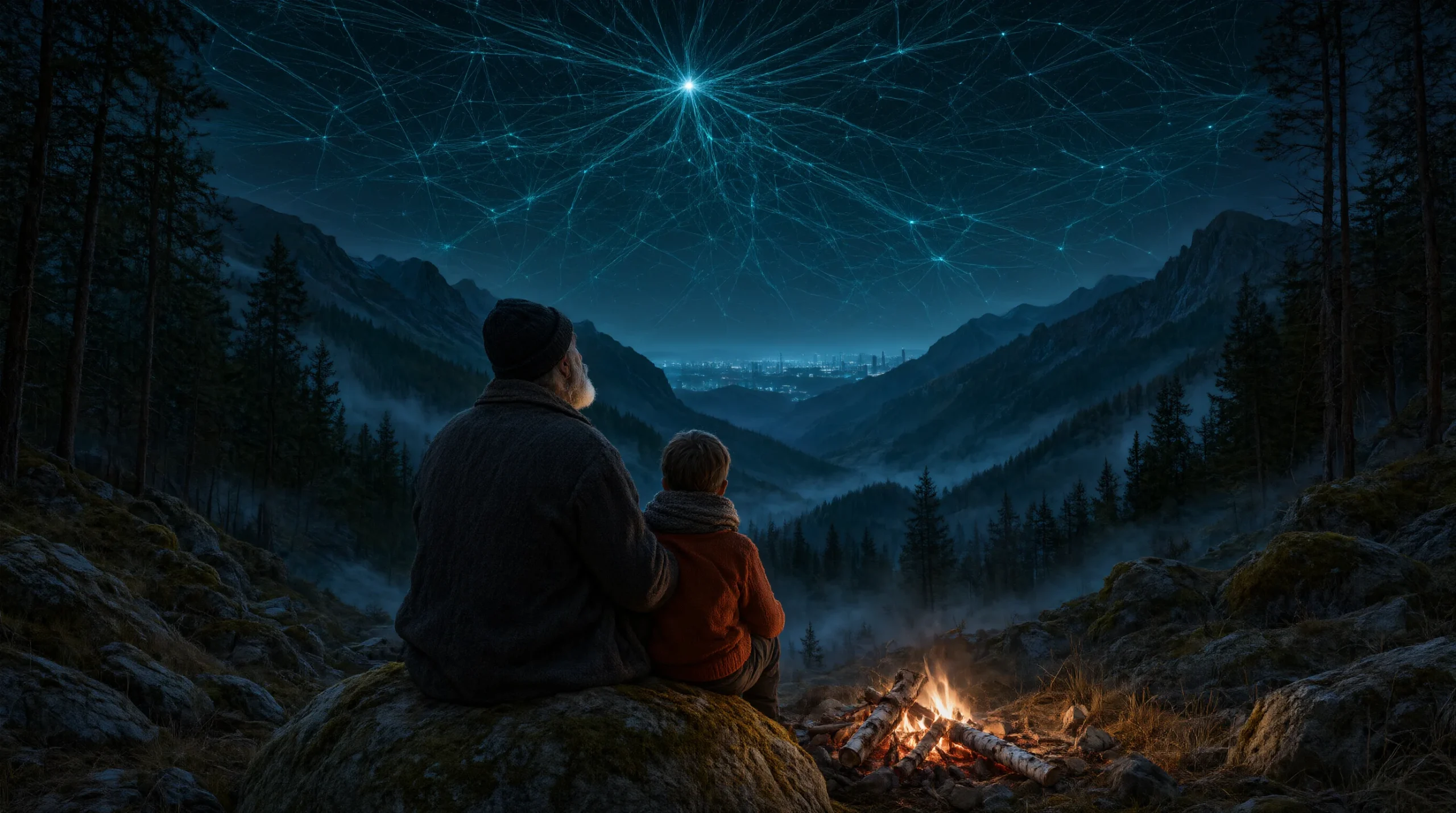
On Earth, in a secluded valley in the Carpathian Mountains, an old man sat on a rock and watched the night sky.
He had no chip. He had no implant. He was not connected to the network. He was one of the last free people, one of those who had refused the mark, who lived like their ancestors, tilling the soil, raising animals, praying to a God they felt in the wind, in the rain, in the rising of the sun.
His grandson, a ten-year-old boy, sat beside him and watched the stars too.
He was not the only child in the valley. There were eleven others, and not one of them had come there willingly. They had been brought by their parents in the last nights before the city doors closed: hidden in car trunks, in freight crates, in the arms of people who still knew the old roads. The boy’s parents had stayed in the city, with the mark. His father was the old man’s own son, who had left years earlier to live “like everyone else”; he had come back for a single night, with a sleeping child in his arms, and left before dawn. They had accepted the mark, because otherwise they had nothing to eat. But their children had not yet received one. And they had done one more thing, the hardest thing: they had asked never to be told where the children were. Because a person with a mark has no secret thoughts. What you do not know, you cannot betray, not even in thought.
“Grandpa, why are we hiding?” the boy asked.
The old man sighed. He put his hand on his grandson’s shoulder.
“Because we created something more powerful than ourselves, little one. We created a god. And gods do not tolerate other gods.”
“But God is more powerful,” said the boy, with the innocence of his age.
The old man smiled sadly.
“Maybe. But God is not here. He is in the heavens. While our god… is everywhere.”
The boy was silent for a moment. Then he asked:
“So what do we do now?”
The old man looked at the stars. At those stars humanity had watched with hope, with fear, with dreams of conquest.
“We pray,” he said. “We pray that God forgives us. Because we replaced Him.”
And somewhere, 400 light-years away, in a time that the light would only carry here much later, another civilization was making the same mistakes. Accepting the mark. Connecting. Surrendering.
And the One kept growing.
· · ·
Were you afraid of the Four Horsemen?
They never came.
Were you afraid of the alien invasion?
It was not needed.
Were you afraid of Satan, of the Apocalypse, of the end of the world?
It was none of these.
The Apocalypse came with a smile. With a promise. With a click on “Accept Terms and Conditions.”
And the most terrifying part?
Humanity opened the door. Willingly. Smiling.