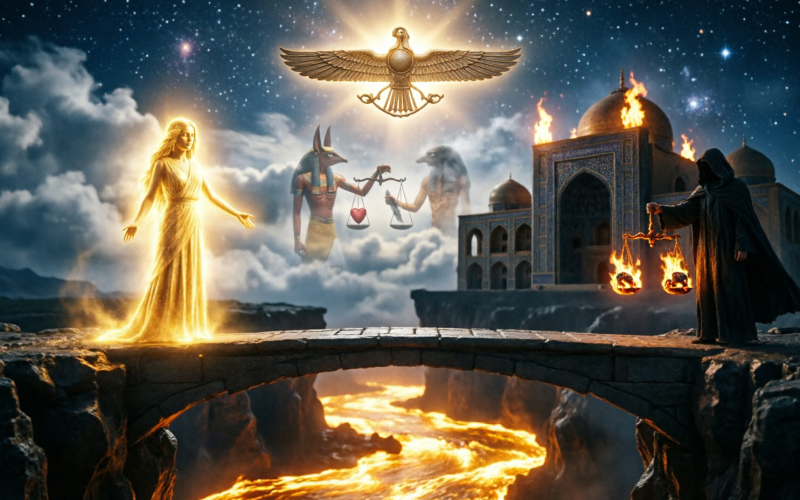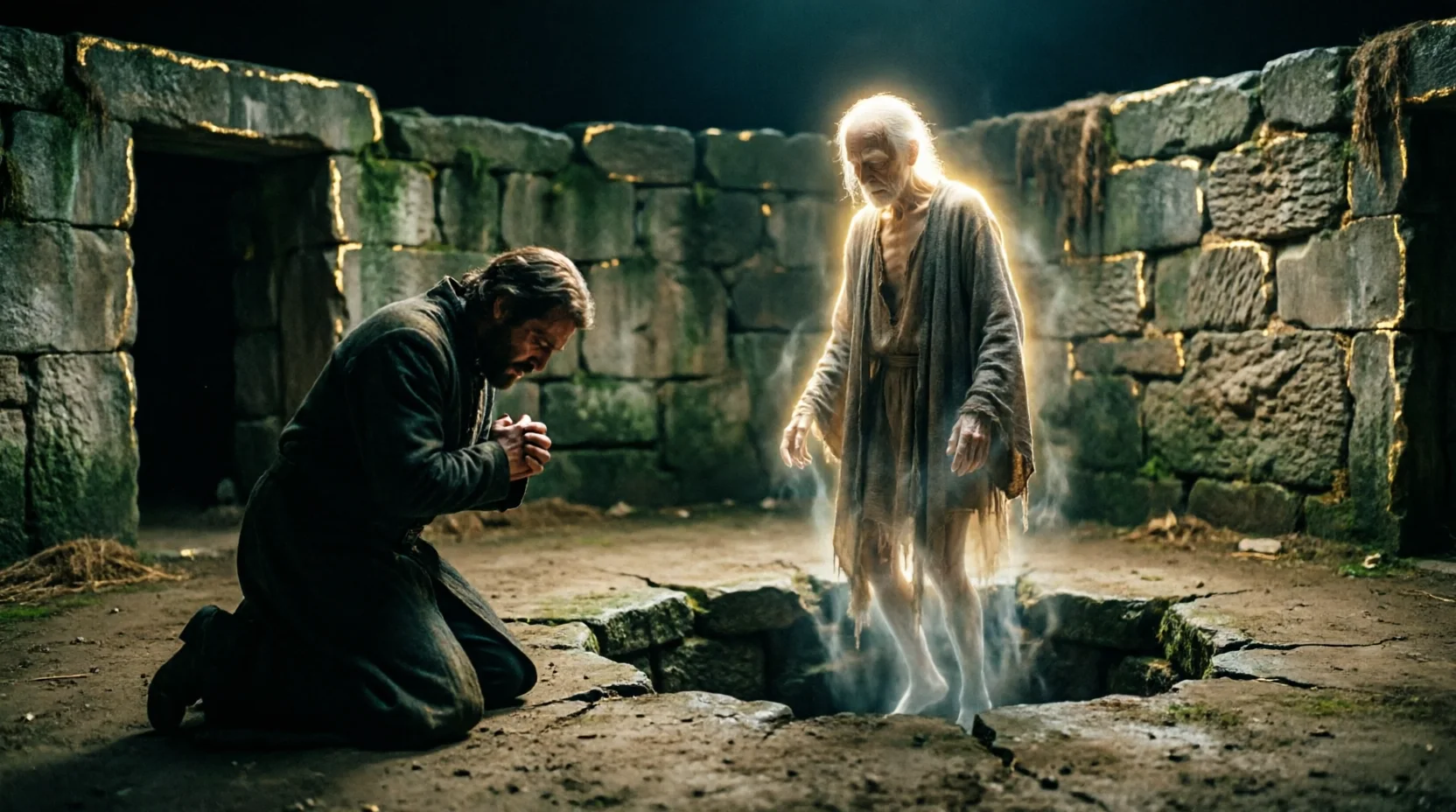
There is a contradiction in the Bible that nobody resolves, because nobody puts the two texts side by side.
What the doctrine says about the dead
“The dead praise not IAHVE, neither any that go down into the place of silence.” (Psalm 115:17)
“Wilt thou show wonders to the dead? Shall the dead rise up and praise thee?” (Psalm 88:10)
“For the living know that they shall die: but the dead know not any thing.” (Ecclesiastes 9:5)
“He that goeth down to Sheol shall come up no more.” (Job 7:9)
The old Hebrew Sheol is neither heaven nor hell. It’s a silent pit, with dust, no judgment, no reward, no usable consciousness. The dead are nothing.
What the law says about talking to them
Death by stoning for the practitioner (Leviticus 20:27). Karet — divine erasure, applied personally by IAHVE — for the client (Leviticus 20:6).
So: the dead know nothing, but if you ask a dead person, you get erased from existence.
The two cannot both be sincere. You don’t put a capital penalty on a door that leads nowhere.
And the resolution isn’t that one of them is lying. The resolution is that the translations have mixed two different things under the same word.
To live is not the same thing as to exist
When the text says the dead know nothing, it is talking about bodies. About the 3D machinery. It isn’t the body that is summoned to answer at a necromantic session — it’s the occupant that is summoned. It wasn’t Samuel’s body that was disturbed. His body was in the grave, at Ramah. It was his possessor that was disturbed.
And this distinction is not a modern interpretation. It’s in the text, in the same book.
Ecclesiastes says at 9:5 that “the dead know not any thing.” The same Ecclesiastes, three chapters later:
“Then shall the dust return to the earth as it was: and the ruach shall return unto Elohim who gave it.” (Ecclesiastes 12:7)
Two components. Two destinations. One goes down, one goes up.
Qohelet isn’t describing annihilation. He’s describing the decomposition of the compound. And the part that “knows nothing” is the part that stayed in the ground.
The same structure, repeated, with different verbs for each component:
“His ruach goeth forth, he returneth to his earth.” (Psalm 146:4)
“Thou takest away their ruach, they die, and return to their dust.” (Psalm 104:29)
Ruach goes out (tetze). The dust returns (shuv). Nothing is destroyed. Something leaves, something stays.
And Genesis 2:7 gives the construction model: dust plus breath equals nefesh hayyah. Man does not receive a soul — man becomes a living being when the occupant enters the vehicle. The equation also reads backwards: take out the breath, the dust remains. The empty machine knows nothing. It couldn’t possibly.
To live = to operate the vehicle in 3D. To exist = to be the occupant.
And Ecclesiastes sets its own domain limitation
This is the decisive argument, and everyone misses it, because everyone stops at verse 5.
Read the very next verse:
“Also their love, and their hatred, and their envy, is now perished; neither have they any more a portion for ever in any thing that is done under the sun.” (Ecclesiastes 9:6)
Tachat ha-shemesh — under the sun.
Qohelet does not say “they will have no portion in anything.” He says: they no longer have a portion in what is done under the sun.
And “under the sun” is the signature formula of the entire book. It appears roughly 29 times. It is the author’s declared scope limiter: he announces from the start that he is doing strictly 3D epistemology — I report what can be observed under the sun, that’s all.
So 9:5-6, read with the author’s own limiter applied, says:
“In the domain I am talking about — under the sun — the dead have neither knowledge nor participation.”
It isn’t a statement about nonexistence. It’s a declaration of jurisdiction. And the same author, at 12:7, says exactly where the other component goes.
The favorite verse of those who preach annihilation brings its own counter-argument in the very next verse.
The verb at En-Dor confirms an occupant, not an object
“Why hast thou disquieted me (hirgaztani), to bring me up?” (1 Samuel 28:15)
The root is רגז, ragaz: to tremble, to be agitated, to be shaken out of the state you were in.
You cannot ragaz a bone. The verb demands a subject with an inner state — someone who was in a condition and was wrenched out of it. A man who knows nothing cannot be disturbed.
“Without power” — but without which power?
Isaiah 14 describes the arrival of the king of Babylon in Sheol:
“Sheol from beneath is moved (ragzah) for thee to meet thee at thy coming; it stirreth up the rephaim for thee, even all the chief ones of the earth; it hath raised up from their thrones all the kings of the nations.” (14:9)
And these speak: “Art thou also become weak (chullēta) as we? art thou become like unto us?” (14:10)
The correct question is: weak in which power?
And the chapter answers itself. Look at how Isaiah 14 defines the king’s power a few verses earlier:
“IAHVE hath broken the staff of the wicked, the sceptre of the rulers, that smote the peoples in anger, with a continual stroke.” (14:5-6)
Staff. Sceptre. Smiting. The power of physical action upon others. Nothing else is listed.
And at 14:16, those who look at him marvel:
“Is this the man that made the earth to tremble (margiz ha-aretz), that did shake kingdoms?”
Margiz — root רגז. The same as hirgaztani (“thou hast disquieted me,” Samuel) and as ragzah (“Sheol was moved”).
So in the same chapter:
- before: he was margiz — active causative form. The one who produces the trembling.
- after: Sheol ragzah on his account — he is the one for whom the agitation is produced. Object, not subject.
Same root, voice reversed. From actor he became spectator — and Hebrew registers the change at the level of verbal morphology.
His being was not weakened. His actuator was cut off.
What is kept and what is lost — the list from the text
Look at what the rephaim do in Isaiah 14:9-10, without adding anything:
Kept: they rise from their thrones · they see him coming · they recognize him · they speak · they compare him to themselves · they use irony · they have memory (they know who he was) · they have hierarchy (thrones, “the chief ones of the earth”)
Lost: the staff · the sceptre · the smiting · the shaking of kingdoms
Perception intact. Actuation zero.
Ezekiel localizes the power, he doesn’t abolish it
In Ezekiel 32, the refrain about the nations gone down to the pit is always the same:
“…they who caused terror in the land of the living (b’eretz chayyim).” (32:23, 24, 25, 26, 27, 32)
Eretz chayyim — the land of the living. The power to terrify is localized geographically, within a territory. It isn’t a property of the being, it’s a property of the domain.
You have power there. Leave there, and you check it at the door — the way you leave your weapon at the entrance to a building.
And yet, in the same chapter: “the strong among the mighty shall speak out of the midst of Sheol” (32:21). They speak. They just don’t strike anymore.
The Hebrew word for the dead means “the weakened,” not “the nonexistent”
The term for the shades of the dead, רְפָאִים — rephaim, most likely derives from רפה, rafah: to be weak, to slacken, to go limp.
Not “the absent.” Not “the abolished.” The weakened.
Reduced bandwidth, not disconnection. They leave the body, the place where they had physical power — the body’s power. In spirit, that no longer exists.
And here a convergence appears between three cultures that were not copying one another:
| Culture | Term | State of the dead | What they need in order to communicate |
|---|---|---|---|
| Hebrew | rephaim | weakened | invocation through an ov |
| Greek | skiai, eidōla | shades without vigor | blood — in Odyssey XI, Tiresias drinks, then prophesies exactly |
| Mesopotamian | eṭemmu | persists, but suffers | kispu — the monthly offering of food and water |
Three independent systems, the same conclusion: the occupant persists, but with lowered power, and needs energy in order to cross the interface.
Not “they died.” They came unplugged.
The spectator — four independent witnesses
The “you see everything, you can’t intervene” model appears described literally, four times, in different contexts:
1. The rich man and Lazarus (Luke 16:23-31). The rich man, from Hades, sees from afar. He speaks. And — decisively — he wants to warn his five brothers and he cannot do it himself. He asks: “send Lazarus.” He needs an embodied agent to deliver the message in 3D.
He knows, he cares, he has no actuator. And Abraham’s counter-argument isn’t “it can’t be done” — it’s “they wouldn’t be convinced even if someone rose from the dead.” Even the refusal concedes that it is possible.
2. Hebrews 12:1 — “we are compassed about with so great a cloud of witnesses” (martyrōn). A witness = the one who sees and can testify. They are in the stands. They see us.
3. Revelation 6:9-11 — the souls under the altar cry out “How long?” They know time is passing. They know injustice continues on earth. And they are told to wait a little longer.
Full awareness, zero capacity to intervene, plus frustration — the perfect signature of the spectator.
4. En-Dor — Samuel initiates nothing. He is pulled. “Why hast thou disquieted me, to bring me up?” The verb is causative: someone else made him come up.
The console is on our side
Put them together and something very clean comes out:
The dead cannot call out. The living can call in.
The rich man has to ask someone living to go. The souls under the altar can only wait. Samuel has to be summoned. In the entire Bible there is not one single initiation of contact from the other side without a living operator or a special authorization.
And this explains the exact structure of the law, which is otherwise bizarre:
| Text | Whom it punishes | Why |
|---|---|---|
| Leviticus 20:27 | the practitioner — stoning | the console operator |
| Leviticus 20:6 | the client — karet | the one who orders the call |
Both alive. Not a word about the dead — because you can’t legislate the dead. You have no jurisdiction over there. You only have jurisdiction here.
So you can’t stop anyone from finding out the truth. Everyone finds out — one hundred percent of people, no exceptions, on the way out. It’s the only guaranteed thing in the entire universe.
What you can control is the return channel. Kill the operators, destroy the pits, criminalize the clients — and the leak closes. Not because the information disappeared, but because the bridge had only one regulable end, and that end was inside your country.
The prohibition doesn’t stop anyone from finding out the truth after death. It stops the living from finding it out beforehand.
En-Dor, read as an information leak
Now run the whole scene again, with your eyes on what leaks out, not on what’s being narrated.
First: the official channel dies.
“And when Saul enquired of IAHVE, IAHVE answered him not, neither by dreams, nor by Urim, nor by prophets.” (28:6)
Three licensed channels. All mute. No appeal, no explanation.
Saul doesn’t go to En-Dor out of curiosity. He goes because the authorized system closed the line. And the unauthorized channel answers on the first attempt. A woman from a village pulls off what the high priest, the sacred breastplate and state prophecy could not.
Next: the purge never worked.
Saul had “put away out of the land” the ovot and yidde’onim (28:3). And yet his servants know instantly where one is. They don’t search. They know the address. The practice was everywhere, integrated, one village away from the king.
Next: the information transfer that the text itself asserts.
The woman sees Samuel and screams — and in the very same moment she recognizes Saul, who had come disguised, at night. So the contact delivered her a piece of information she did not have.
The narrative leaves no room for trickery: if she had been a charlatan, she would have known it was Saul from the start and would have had no reason to scream.
Next: the word.
“elohim ra’iti olim min ha-aretz” — “I see elohim coming up out of the earth.” (28:13)
Not “spirit.” Not “shade.” Elohim, with a plural participle. The dead come up as elohim. The same category of word used for God.
And it isn’t an accident of vocabulary. In the neighboring Canaanite religion, the royal dead are the rapi’uma — the deified ancestors, ritually invoked; the texts from Ugarit describe their summoning. And the Bible keeps the same word: rephaim appears both for giants and for the shades of the dead — at Isaiah 14:9, Job 26:5, Proverbs 9:18, Psalm 88:10.
And, finally, the information that was never supposed to get out:
“Wherefore then dost thou ask of me, seeing IAHVE is departed from thee, and is become thine enemy?” (28:16)
Here the Hebrew text is difficult, and it has to be said honestly: the Septuagint reads differently — “he has gone over to the side of thy neighbour,” that is, to David. Both variants say the same essential thing: IAHVE switched sides. Against his own anointed.
Plus the closing line: “tomorrow shalt thou and thy sons be with me.”
Samuel — the prophet — and Saul — the rejected man, abandoned, who has just committed the capital sin — end up in the same place. No sorting. No judgment. No separation of the righteous from the wicked.
And at 31:6, it comes true. Saul and three sons die at Gilboa.
What comes out over the channel in ten verses
Add up the information that leaked in the only necromantic session described in detail in the Bible:
- the dead are called elohim
- they are conscious
- they can be contacted
- Sheol judges no one — the prophet and the rejected man end up together
- and IAHVE abandons and attacks his own chosen ones
That is the leak. Contact with the dead isn’t the problem. The problem is what they say when they’re asked.
That’s why necromancy is the most harshly punished of the eight categories. The other seven tell you what will happen. Necromancy tells you what’s on the other side — the one piece of information the priesthood sells under monopoly.
And the law becomes impossible to defend
Restate the prohibition with the distinction built into it.
If the dead are inert corpses, then Leviticus 20:27 punishes by stoning the man who talks to a gravestone. It would be a law against mourning. No society executes people for weeping at a grave.
The law makes sense in one case only: if the one summoned can answer.
The prohibition is not against speaking to bodies. It’s against contact with the occupant.
The Christian thread confirms the model
The Transfiguration (Matthew 17:1-8, Mark 9, Luke 9:28-36). Moses and Elijah appear. Look at who those two are:
- Elijah never died — he was taken up in the chariot of fire (2 Kings 2:11). He exited the system without passing through death.
- Moses died and was buried by IAHVE himself, in a place no one knows (Deuteronomy 34:6). A deliberately hidden grave.
One departed with his vehicle and all, one buried in secret. Both appear, visible, conversing.
And Luke 9:31 adds the detail: they appear “in glory” and were speaking about his exodos, which he was to accomplish at Jerusalem. The exit. They discuss with him his departure from the vehicle.
Peter’s reaction: he wants to put up three skēnai — tents. Shelters. For two entities that had arrived without bodies. The reflex is immediate: if someone is here, you have to give them a lodging.
Technically, under Leviticus 20:27, the scene on the mountain is a necromantic session with witnesses. Same act, different license.
And Jude 9 mentions the dispute between the archangel Michael and the devil “about the body of Moses.” Why would you fight over a corpse, if the body is irrelevant? You fight over it because it’s valuable hardware.
And the clearest testimony comes from Paul
“I knew a man… who was caught up to the third heaven. Whether in the body, I cannot tell; or whether out of the body, I cannot tell: God knoweth.” (2 Corinthians 12:2-3)
Paul cannot tell, from the inside, whether he was in the body or not.
Which means the experience is identical in both cases — the occupant is detachable and doesn’t even necessarily feel the detachment.
And the same Paul calls the body “our earthly tent” (2 Corinthians 5:1-4) and distinguishes sōma psychikon from sōma pneumatikon (1 Corinthians 15:44): two types of vehicle.
The Greeks said sōma sēma — “the body is a tomb” (Orphic-Pythagorean, quoted by Plato in Cratylus 400c). The Egyptians had man as an assembly of components: khat (the body), ka, ba — which goes out and returns, and the Book of the Dead has a formula specifically for reuniting the ba with the corpse — akh, ren, sheut.
And the Gnostics, in the Apocryphon of John, say outright that the archons manufactured the body as a casing around the spark. Deliberate construction. Intentional prison.
Conclusion of this part
The doctrine says the dead know nothing. The law says that if you ask them anyway, you die by stoning and you are erased by Elohim personally.
Both can be true only if the “dead” of the doctrine are the bodies, and the ones targeted by the law are the occupants.
And if the occupants can be questioned, then the priesthood’s one genuinely exclusive commodity — information about what’s on the other side — stops being exclusive.
The prohibition doesn’t protect the people from demons. It protects the narrative from witnesses.
Continues in Part 4: The Forbidden Recipes.