We established the constraint: the occupant who has left the body perceives fully, but cannot act physically. A spectator.
So ask yourself the engineer’s question: what can you usefully give to an entity that sees but cannot manipulate?
Not tools — it can’t pick them up. Not food — it can’t bring it to its mouth. Not clothes — it can’t dress itself.
You can give it exactly one thing: something to READ.
Why gold
The Egyptians called gold “the flesh of the gods,” and the stated reason is that it is the matter that does not change. That’s why the funerary mask is gold. That’s why Tutankhamun’s innermost coffin is solid gold.
And now look at what was written on gold:
| Object | Material | Content |
|---|---|---|
| The Orphic tablets (Hipponion, Petelia, Thurii) | gold foil | navigation instructions for the soul |
| The Ketef Hinnom amulets | silver | the priestly blessing |
| The Pyramid Texts | stone, carved on the walls | route maps |
| The Book of the Dead | papyrus | a manual — but sealed in the tomb |
| Curse tablets | lead | a message to be delivered, not re-read |
The pattern is visible: what is meant for the soul TO READ is written on the material that does not perish. What is meant to be DELIVERED is written on cheap material.
Gold is not ornament. Gold is the read-only medium. It stays legible indefinitely, with no maintenance, for a reader who cannot wipe the dust off it.
And every civilization’s flagship product is a text
Look at what they actually are:
- The Book of the Dead — a manual with passwords, the names of the gatekeepers, formulas to recite
- The Orphic gold tablets — “do not drink from the spring beside the white cypress; go to the one from the Lake of Memory; say: I am a child of Earth and of starry Heaven”
- The Coffin Texts and the Pyramid Texts — routes
- The Tibetan Bardo Thödol — read aloud to the corpse, for 49 days
All of them, without exception, are navigation information delivered to a being that can perceive but cannot intervene.
That isn’t a coincidence. It is the only commodity compatible with the constraint.
But how did they know what to write?
That is the question that matters. Who was there? Who took the measurements? Where does the map come from?
And the beautiful part is that the texts answer for themselves. Each one declares its provenance.
| Text | Declared source | Method |
|---|---|---|
| The Myth of Er (Plato, Republic X) | Er, a soldier who died, lay 12 days on the pyre and woke up | returned from the dead |
| Thespesios (Plutarch, De sera numinis vindicta) | a man “dead” for 3 days, who came back | returned from the dead |
| Timarchus (Plutarch, De genio Socratis) | descent into the crypt of Trophonius | induced descent |
| Gilgamesh, Enkidu and the Netherworld (Sumerian) | Enkidu comes back and is interrogated | returned, plus debriefing |
| The Underworld Vision of an Assyrian Prince (Kummâ) | a nocturnal vision, first-person report | vision |
| 1 Enoch | a guided tour, with an angelic interpreter | revelation plus guide |
| The Book of the Dead, The Book of Two Ways | Thoth | non-human author |
| Bardo Thödol | Padmasambhava, hidden then rediscovered; verified by delog | revelation plus returnees |
| The Orphic tablets | the tradition of Orpheus, who went down and came back | the founder’s descent |
| Baldrs draumar | Odin wakes a dead völva and interrogates her | necromancy |
| Odyssey XI | Tiresias, dead, gives the route | necromancy |
| 1 Samuel 28 | Samuel, dead, gives the information | necromancy |
They collapse into three methods. And all three are in the toolkit we inventoried:
- Those who came back — clinical death, revival, report
- The induced descent while you are alive — initiation, incubation, substances, seiðr, Trophonius
- The interrogation of the dead — necromancy
Trophonius was a research institute
Go back to the procedure at Lebadeia. The last two steps:
14. He is seated on the chair of Mnemosyne — Memory 15. He is asked what he saw — and it is written down
That is not ritual. It is a data collection protocol.
Purification (control of variables) → descent (exposure) → return → seating on the chair of Memory (anti-amnesia procedure) → interrogation → entry into the archive.
The oracle of Trophonius operated for centuries. Every consultant was a researcher sent into the field, and his deposition entered the corpus.
And the sanctuary was next to the springs of Lethe and Mnemosyne — you drink forgetting, then memory. In other words, they were calibrating their measuring instrument before every mission.
And the most explicit text is Sumerian
Gilgamesh, Enkidu and the Netherworld. Enkidu goes down, comes back, and Gilgamesh interrogates him systematically, category by category:
— Did you see the man with one son? — I saw him. — How does he fare? — The one with two sons? With three? With seven? — The one who died in battle? The one who fell from the mast? The stillborn child?
Every category, with an answer about its condition.
That is a questionnaire. It isn’t funerary poetry — it is a structured debriefing, by category, written down, four thousand years ago.
That is how you build a map.
The Tibetans have a word for this profession
Delog (འདས་ལོག) — literally “returned from death.”
It isn’t an isolated anecdote. It is a recognized social category and a literary genre. People who died, traveled, came back, and dictated what they saw. Their reports circulated and were compared.
Plus verification from the other side: practitioners trained for years to stay lucid through the process of dying, precisely so they could report.
And the Bardo Thödol is read to the dead for 49 days because it is considered a field-validated map.
The consequence
If the map is produced through returnees, induced descents and the interrogation of the dead — then look at what Deuteronomy 18 does when it forbids all three, at once.
It doesn’t forbid consulting the map. It forbids CARTOGRAPHY.
And the consequences follow on their own:
- no new data → the map can no longer be corrected
- no independent verification → it can no longer be contested
- no survey → whoever holds the last copy holds the only version
A map you are not allowed to check is no longer a map. It is a declaration.
And the proof is what is missing from Israel
All the neighboring civilizations have a map.
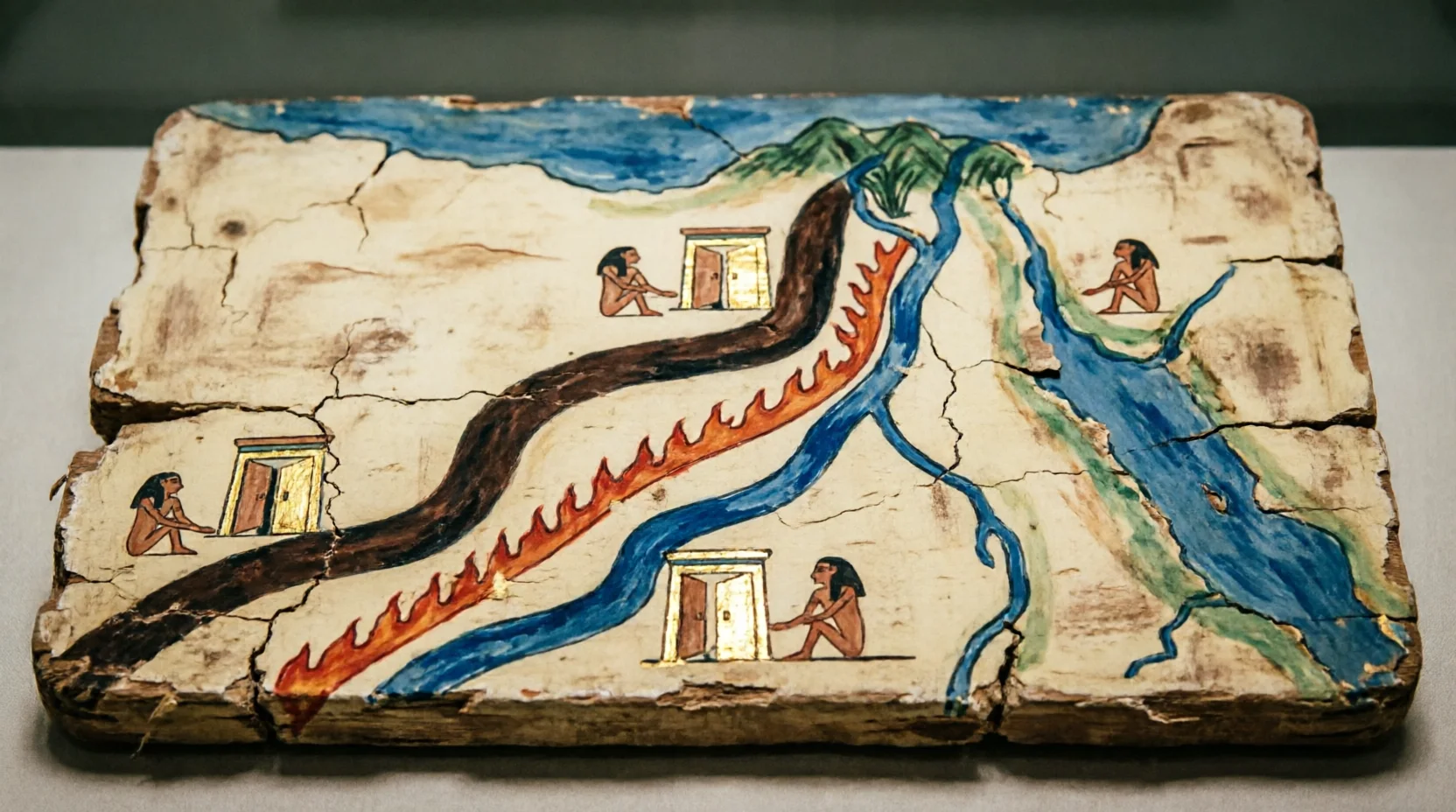
The Egyptians have The Book of Two Ways — Middle Kingdom coffins, from Deir el-Bersha, around 2000 BCE. An actual drawing, with two routes — one by land, one by water — with gates, named guardians and marked lakes of fire.
The oldest map of the afterlife in history, literally.
The Mesopotamians have topography and gate protocols. The Greeks have rivers, a ferryman, a fork in the road. The Tibetans have a 49-day itinerary.
Israel has an undefined pit.
Not a bad map. Zero map. Sheol has no gates, no guardians, no routes, no sections. It is the only descriptively neutralized space in the whole Near East.
Under this hypothesis, that isn’t a gap. It is the expected result of a culture that banned the survey earlier and harder than anyone else.
And when, after the exile, a map finally arrives — resurrection, judgment, hierarchies of named angels, Daniel 12 — it comes from outside, already drawn, with authorized interpreters included, and with no legal instrument of verification, because the instruments were punishable by death.
The convergence test
If the maps were pure invention, they should contradict each other chaotically. Look at what keeps coming back, in cultures with no contact:
| Element | Where it appears |
|---|---|
| A water crossing | Styx and Acheron · Hubur (Mesopotamia) · Gjöll (Norse) · the Egyptian boat · Chinvat (Iran) |
| A ferryman or gatekeeper who must be “handled” | Charon · Humut-tabal · Mahaf · the Egyptian gatekeepers |
| A password or a name you must know | the Book of the Dead — most of it is gatekeepers’ names · the Orphic formula · the Mesopotamian gate protocols |
| Dogs at the crossing | Cerberus · Garm · the dogs at the Chinvat bridge · Yama’s two four-eyed dogs (Rig Veda 10.14) · Anubis |
| A weighing or a reckoning | the Egyptian scales — the heart against the feather of Maat · Chinvat · the late judgment |
| A fork in the road | The Book of Two Ways · “do not drink from the spring beside the cypress” |
| The danger of forgetting | Lethe · the Orphic warning · the confusion in the bardo · the Egyptian spells against forgetting one’s own name |
Seven recurring elements. Some are explained by diffusion — the dogs are clearly Indo-European, water is a natural metaphor.
But two are not easily explained.
The password requirement. Why would independent cultures invent that “you will be asked who you are and you must know what to answer”?
And the memory hazard. All the maps warn about the same danger: that you will forget. And the reincarnation systems — analyzed separately, in Part 5 — say that forgetting IS the mechanism of recycling.
Two completely different genres, produced by people who did not know one another, name the same single danger. And Trophonius had a chair of Memory installed as an operational procedure against it.
It isn’t proof. But it is a residue that will not dissolve.
The counter-argument, given honestly
The best objection, and it has to be raised before someone else raises it:
The map always looks suspiciously like the local administration.
Egypt had a bureaucracy → the Egyptian afterlife is a bureaucracy, with forms, gatekeepers, document checks and a tribunal. Mesopotamia was dusty and sad → Kur is dusty and sad, you eat clay. The Norse had the mead hall → they get Valhalla, with beer. The Greeks had boat crossing fees → they get Charon, who demands payment.
Projection. A good explanation, economical, hard to refute.
Where it falls short: it doesn’t explain why the same procedures show up — the password, the memory hazard, and the “you see but you cannot touch” constraint, which we derived independently, from Hebrew verbs and from Isaiah 14, without starting from it.
The scenery is local. The regulations are not.
The conclusion of this part
The maps of the afterlife were drawn by those who came back, by those who went down voluntarily, and by the dead who were asked.
Deuteronomy 18 did not forbid them one at a time, out of religious caution. It forbade all three, at once. That is to say, exactly the surveying team, entire.
Since then, the map has not been updated. All that remains is the copy from the one who banned the measuring.
Continues in Part 7: Your Name Is Not Yours.