There is a paradox the reader senses instinctively but cannot put into words.
If I am spirit, possibly reincarnated, then my real name is not the earthly one. The name on the ID card is a label for a single tour of duty. How would the soul know its true name? And why would it be a catastrophe to forget a name that was never its own?
The question is a fair one. And the answer unties the whole knot.
The name is not the identity. It’s the address
Go back to what we established: in kispu, the third mandatory component is šuma zakāru — the pronouncing of the name. At En-Dor: “bring me up Samuel.” At Rome: “Manes exite paterni.” On the lead tablet: the name of the victim.
The name is the routing component. It isn’t who you are. It’s how someone reaches you.
Your phone number is not you. But if they deactivate it, you don’t die — you become unreachable.
And that is exactly what the sources describe happening to the unnamed dead:
- the eṭemmu without kispu is not abolished — it wanders and afflicts the living
- the Egyptian whose name is erased is not annihilated — he loses his cult, he is cut off from the channel
And the Egyptians treated the erasure of a name as execution. Damnatio memoriae on Hatshepsut, on Akhenaten — the chisel in the cartouche. Not vandalism. Disconnection.
Their expression for maintaining someone’s existence was s’ankh rn — “to make the name live.”
And yes: it’s “a different scheme.” Two levels
The Egyptians distinguished explicitly:
- rn nfr — the beautiful name, public, the one on the stele
- rn imn — the hidden name, secret
And the canonical text that explains the difference is The Legend of Isis and Ra: Ra has a secret name that not even the other gods know. Isis poisons him and tears the true name out of him — and by that she gains power over him.
So Egyptian doctrine says it outright: whoever knows your true name controls you.
From which it follows that the true name is not given away. Not even at the checkpoint.
What the gold tablets actually say
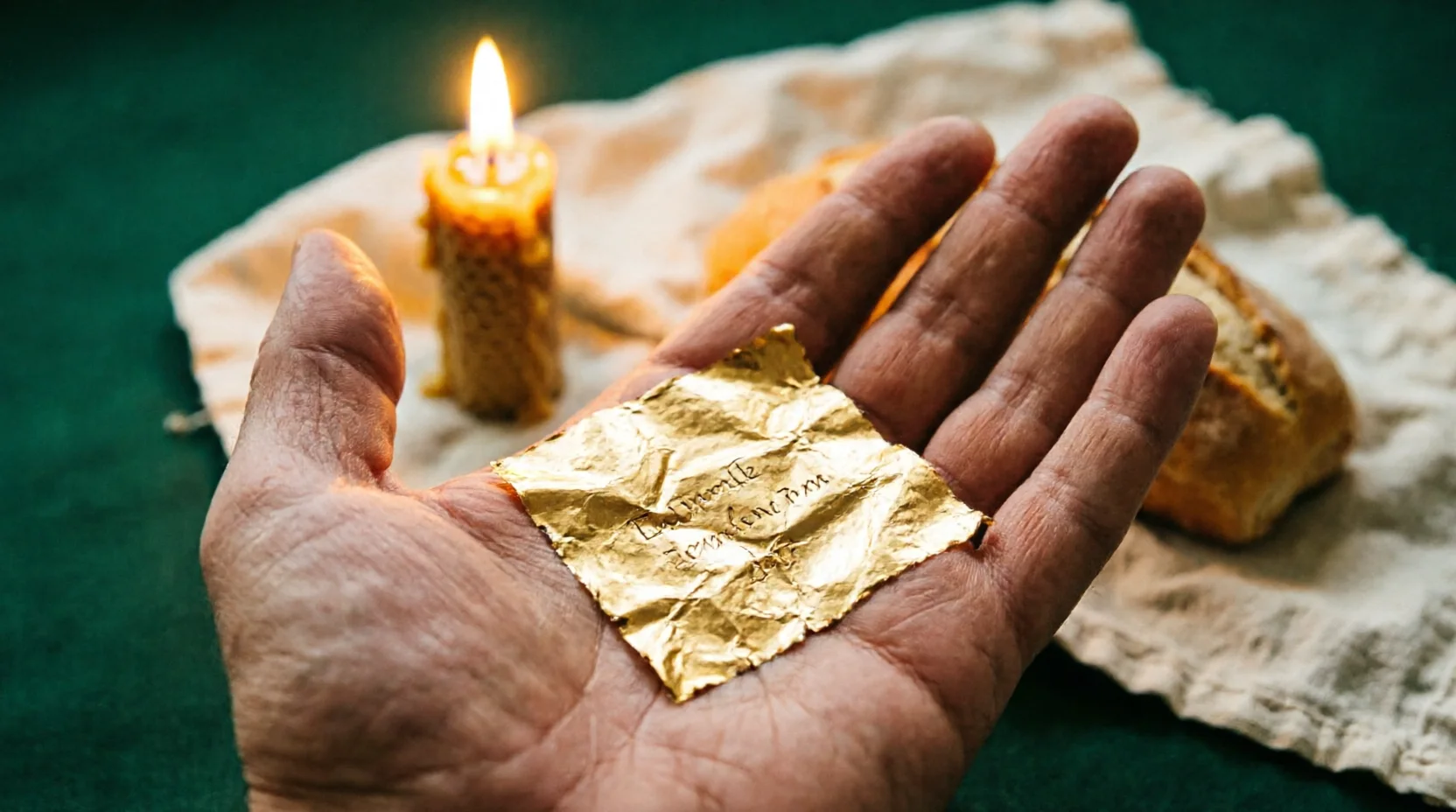
Here the question resolves itself. The Orphic manual — the actual instruction for the soul — contains no name at all. It contains:
“I am a child of Earth and of starry Heaven.”
And on the Thurii tablets, more:
“I come from the pure, pure…” · “I have paid the penalty for unrighteous deeds” · “I claim that I am of your blessed race” — γένος
It isn’t a name. It’s a declaration of origin and of kin.
The manual does not tell the soul “remember what you were called.” It tells it “remember WHAT you are.”
So the scheme is this:
| Direction of the traffic | Which information is operational |
|---|---|
| The living → the dead — commemoration, offering | THE NAME — the delivery address |
| The dead → the checkpoint | THE KIN, THE CATEGORY — the credential for passage |
Two different pieces of information, for two different directions.
The earthly name is useless to the soul and essential to the living.
Confirmation from another tradition, completely independent
Bardo Thödol — how is it read, technically? The reader says:
“O nobly born, [NAME], listen…”
Then follows the instruction about what he actually is: “your own mind, void in itself…”
The name opens the channel. The content is knowledge of the category. Exactly the structure above, six thousand kilometers away and with no contact.
And in the Jewish tradition there is a custom attested in late sources: at the end of the Amidah one recites a verse that begins and ends with the letters of your name — the stated reason being to remember your name on the Day of Judgment.
(A custom recorded in late halakhic and kabbalistic literature, not in the Talmud — so practice, not law.)
A liturgical mnemonic, repeated three times a day, for a whole lifetime, against the amnesia of death. They considered the hazard real enough to drill against it daily.
WHY WOULD A SPIRIT NEED MATTER?
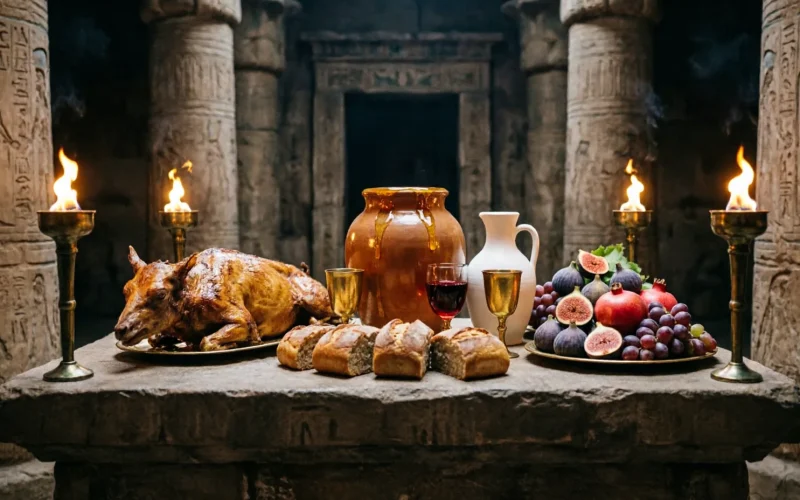
The entire absurdity comes out of one unspoken presupposition: that the offering is food.
If it is food, the argument is won — an entity with no stomach has no use for a loaf of bread. But not one of the systems we inventoried says, at its technical level, that the dead eat. They say something else, and we translated it badly.
Melissa distinguishes between buried and burned
Go back to what Melissa asks for, in Herodotus. She doesn’t ask for food. She asks for the clothes burned. And she gives the reason: “I am cold and naked, because the clothes were buried but not burned.”
So she explicitly distinguishes between a buried object and a burned object. The same dress, the same matter — but one doesn’t reach her, the other does.
Matter is not the content. Matter is the carrier. And the burning is the transmission.
The Egyptians said this most clearly of all and we didn’t listen: the offering has a ka, and the ka of the offering feeds the ka of the dead. The bread does not go to the dead. What goes is something the bread contained and which is released when the bread stops being bread.
The honest analogy: you can’t send a paper letter by e-mail. You have to scan it — destroy the physical constraint and transmit only the structure.
Fire is the scanner. The object is the medium, not the message.
And this explains why the chthonic holocaust is never eaten. If you eat it, you kept it. If you kept it, you didn’t send it.
The four functions of the offering — none of them “food”
1. Proof of cost. An offering you give and keep is not an offering. That is why it has to be destroyed: the burning is the receipt. The fire feeds nobody — it proves that you paid irreversibly.
2. Carrier, not cargo. The object is the envelope. The burning is the sending. What arrives on the other side is the structure, not the substance.
3. Address. šuma zakāru — the pronouncing of the name. Without an address, the package doesn’t leave. And the address is the immaterial part of the operation.
4. Communication bandwidth — and only when you want an answer. In Odyssey XI it is a power scale, not a meal: the libations → they gather; the blood → they speak coherently. Nobody gets full. The signal goes up.
The decisive proof: the Egyptians took matter out of the system
This is the unbeatable argument, because it isn’t theory. It is the documented evolution of a cult, across two thousand years.
The Egyptians started with real physical offerings. Then:
- they moved to model food, of clay and wood
- then to painted food on the walls
- then to written lists of offerings
- and finally to ḥtp-dỉ-nsw — the offering formula, about which they decided that it was just as effective as the objects
And they took it all the way, with a dedicated literary genre: the appeal to the living. Inscriptions on tombs that address the passerby:
“O you who live and exist, who love life and hate death — whoever shall pass by this tomb, let him say: «a thousand loaves, a thousand jars of beer…»”
They ask for words. Not bread. Words. And in exchange they offer the passerby that his own name too shall be well remembered.
The civilization that invented the funerary offering arrived, through practice, at the conclusion that matter is optional and the name is mandatory.
And more: it is an engineering solution for the case where the family line dies out. They knew descendants forget. The answer: carve an open invitation to strangers on the tomb, and make it free. Funerary crowdsourcing, with a zero barrier to entry.
And now look at our own pomeni
Because, without realizing it, we have already completed the transition the Egyptians began.
What happens at a Romanian pomană (memorial almsgiving)?
- the food goes horizontally, to living people
- the clothes are given to living people
- and the only thing that goes vertically is the pomelnic — the read list of names
Matter does not leave 3D by a single millimeter. Nothing is sent. A name is pronounced, and the cost is paid out to the living.
So it is neither superstition nor contradiction. It is exactly the functional model, arrived at its final form: the name is operational, matter is the receipt, and the receipt is settled with the one who needs it here.
And the fact that it is “also an economic approach, a mutual aid” is not the alternative. It is the result. The system evolved so that the cost which guarantees sincerity would no longer burn away for nothing, but be of use to somebody. It is an optimization, not a degradation.
DO THE POMENI HELP? WHAT WE HAVE AND WHAT WE DON’T
Here we have to be strict, otherwise the first serious commenter takes us apart.
What we DON’T have
No controlled, verifiable demonstration that a dead person’s state has changed. Zero. There isn’t one and, by the nature of the problem, there probably cannot be one.
And the only place where the efficacy of prayer has been tested experimentally — the STEP study (Benson et al., 2006, on cardiac patients) — was about the living, and it came out null. It isn’t the same thing, but if we don’t say it, somebody else will.
What we DO have — and it’s more than it looks
a) The practice is attested without interruption, and Paul argues from it.
- 2 Maccabees 12:39-45 (circa 124 BCE) — Judas Maccabeus collects 2,000 drachmas and sends them to Jerusalem for an atoning sacrifice for the dead, “since he had the resurrection in view.” The text comments: “a holy and pious thought.”
- 1 Corinthians 15:29 — the least used and the strongest: “Otherwise, what would those do who are baptized for the dead?” (hyper tōn nekrōn). Paul does not explain the practice and he does not condemn it — he uses it as a premise in an argument. So for him it was known and valid.
- 2 Timothy 1:16-18 — Paul prays for Onesiphorus: “may the Lord grant him mercy on that day,” in a context that suggests the man had already died.
- Tertullian, De corona 3 (circa 200 CE) — mentions the annual offerings for the dead as an already established custom, not as a novelty.
- Gregory the Great, Dialogues IV — the case of the priest at the baths: a spirit asks for prosphora; Gregory brings the Eucharist, the spirit disappears. It is presented explicitly as proof that the offering helps.
- Catacomb graffiti (2nd-3rd centuries) — pete pro nobis, reciprocal requests between the living and the dead, in stone.
So what can be honestly asserted: the practice is older than the dogmas that frame it, and the apostle treats it as a fact. Not that it works — that it was considered functional by those closest to the source.
b) The strongest argument: the precision of the recipient.
The Romanian formula is “for the soul, not for the body of grandmother.”
The liturgical formula specifies the recipient with a technical precision that popular doctrine has lost. Because the doctrine, in its simplistic version, says “the dead know nothing, they sleep until the resurrection.”
But the ritual does not say that. The ritual addresses the soul, in the present tense, as an entity that can receive.
And the ritual is correct — on the exact distinction we derived independently from Ecclesiastes 12:7 and from the verb hirgaztani.
And here there is a solid methodological principle:
Ritual is transmitted with high fidelity — you copy it from your grandmother, exactly, without understanding it.
Doctrine is transmitted with low fidelity — it gets rewritten by councils, theologians, translators.
So when ritual and doctrine contradict each other, the ritual is the older layer.
Practice is conservative. Theology is revisable. And in the Romanian pomană we have a ritual that contradicts the simplified doctrine and preserves the technical distinction that the doctrine lost.
It isn’t proof that it works. It is proof that the formula is older than the explanation laid over it.
c) And the mechanism is coherent:
matter has a cost → the cost is paid irreversibly → the name is pronounced (the address) → the recipient is specified (the soul, not the body).
You aren’t handing grandmother a ring loaf. You pay a real cost, you settle it with a living person who needs it, and you pronounce the address.
HOW LONG DOES IT LAST? AND WHAT HAPPENS TO THE FORGOTTEN
We all have dead in the family whom the current generation never even met. Uncommemorated for decades. Are they out of the system?
No. And the answer is the best documented in the whole chapter: no serious system has ever assumed individual commemoration forever.
All of them have an individual phase, a collective phase, and a rule for the transition.
| Culture | Individual phase | What happens afterward |
|---|---|---|
| Orthodoxy | 3, 9, 40 days · 3, 6, 9 months · 1 year · then annually, traditionally 7 years | Moșii — the Saturdays of the Dead, for everyone, “known and unknown,” indefinitely |
| China | the ancestor’s tablet in the family altar, a fixed number of generations (the Liji prescribes a different number by rank) | the tablet is withdrawn and buried; the ancestor dissolves into the collective body venerated generically |
| Mesopotamia | kispu for named ancestors, a few generations | then the collective formula: “and all the eṭemmu of the family” |
| Rome | Parentalia, with names | di Manes — a collective ancestral mass; Lemuria addresses “Manes paterni”, in the plural |
| Judaism | shiva 7 days · shloshim 30 · 12 months | kaddish, the name pronounced; then collective Yizkor |
| Egypt | individual cult, as long as the family lasts | the appeal to the living — an invitation carved on the tomb to any passing stranger |
China has a written rule of expiry. After N generations, the tablet is withdrawn. That isn’t negligence. It is procedure.
The transit window
(Note for accuracy, so no theologian catches us out: the Orthodox scheme — 3 days beside the body, until the 9th the showing of paradise, until the 40th hell, then the particular judgment — comes from late devotional literature, above all from the vision attributed to Macarius of Alexandria. It is not dogma. The Church is cautious here.)
But the structure is universal, and only the number is cultural:
| Tradition | The window | What is done in it |
|---|---|---|
| Egypt | 40 days of embalming — Genesis 50:3 says so directly about Jacob | preparation plus ritual |
| Orthodoxy | 3, 9, 40 days | commemorations, water and bread, pomelnic |
| Tibet | 49 days — 7 times 7 | Bardo Thödol read to the dead |
| Rome | the 9th day — cena novendialis | a meal at the tomb |
| Judaism | 7, 30, 12 months | kaddish, the name pronounced |
The same architecture everywhere: a transit window, of fixed duration, in which the dead person is still addressable and receives input — after which he is not.
When the numbers differ but the structure is identical, the structure is answering to something and the number is convention.
And notice what gets delivered inside the window, in the most explicit case: with the Tibetans it is read aloud, for 49 days. Navigation information, to a spectator, in the window in which he can still receive.
The symmetry that closes everything
Two separate questions. The same answer.
- What does the soul declare at the checkpoint, when the name is no longer of any use to it? → The kin. “I am a child of Earth and of starry Heaven.”
- What do the living say when they no longer know the name? → The kin. “And for all our kin, those who have fallen asleep.”
Both directions of the traffic fall back, upon failure of the individual address, onto the same level: the category.
That is not a coincidence of vocabulary. It is network architecture. When the individual address is lost, it switches to group addressing. And the systems implemented this independently, in China, in Egypt, at Rome, among the Orphics — and in the Romanian village.
So your dead, uncommemorated for generations, are not out of the system. They have been moved onto the collective channel. And Moșii exist for exactly them — for those whose names nobody knows anymore.
The system was designed with graceful degradation. Which, as engineering, is more than most modern systems manage.
THE CLOSE OF THE CHAPTER
We started from a simple question: why would you forbid something that doesn’t work?
And the road ran like this:
The prohibition lists eight professions with technical vocabulary and punishes them with death — and Deuteronomy 13 explicitly acknowledges that the rival signs come to pass. The system practiced exactly the same techniques under its own license: Urim and Thummim, lots, the bitter water, the bronze serpent, Joseph’s cup. And the verse immediately after the prohibition installs the sole supplier.
What was banned was not superstition. It was the intelligence service, the tribunal, the medical system and the astronomical observatory of the ancient world — with a guild, archives, anti-fraud procedures and instruments like the Antikythera mechanism.
And the doctrine about the dead contradicts the law about the dead — until you separate the body from the occupant. The dust goes down, the ruach goes up (Ecclesiastes 12:7). And Ecclesiastes sets its own limit: “under the sun.” Samuel was disturbed — a verb that requires a subject with a state. And in Isaiah 14, the same root shows the king passing from the causer of the trembling into its object. An actor turned spectator: full perception, zero actuation.
From which it follows that the console is on our side — and the law punishes only what it can reach: the operator and the client, both alive.
The fuel was blood, because his own text says that blood carries nefesh. Blood plus earth equals channel, in three independent traditions. And the blood is nationalized toward a single altar, under the same penalty as necromancy. All the supply routes to the ancestors, closed and redirected.
The map of the afterlife was drawn by those who came back, by those who went down voluntarily, and by the dead who were asked. Deuteronomy 18 forbade all three at once — the surveying team, entire. Since then the map has not been updated.
And the name is not the identity. It is the address. The soul does not need it — it needs to know what it is. And matter never crosses over: it is the receipt, not the cargo.
The matter was never for the dead. It was the proof that someone alive stopped and pronounced his name.
End of Chapter 30.