Or: the voice that does not ask for belief, it asks for waking
The quotations render the sense of the Coptic; translations differ from edition to edition.
Why this text. In Codex II it sits between the map (the Apocryphon) and the mystery (Philip). The incipit: “These are the hidden words that the living Jesus spoke and Didymos Judas Thomas wrote down.” 114 sayings, zero narrative: no birth, no spectacle miracles, no cross, no empty tomb. A Jesus who is not a sacrificial victim — he is an instructor of waking.
1. The opening: interpretation, not belief
“Whoever finds the interpretation of these words will not taste death.” (1)
Commentary: Salvation is not belief in an event — it is the interpretation of words. The reader is not a believer, he is an interpreter. The apparatus demands faith (a signature on a contract); the instructor demands understanding (waking). Faith can be sold; understanding cannot.
2. The Kingdom is not a calendar, it is a state
“If those who lead you say: Look, the Kingdom is in the sky — then the birds of the sky will get there before you… The Kingdom is inside you and outside you.” (3)
“It will not come by waiting… The Kingdom of the Father is spread out upon the earth, and men do not see it.” (113)
Commentary: The Kingdom is not postponed. That dismantles the economy of waiting — the anchor for the return we have talked about again and again: as long as you are waiting for the return, you are paying; when you see that the Kingdom is spread out now, you stop paying. Those who “lead you” point upward or to tomorrow; the instructor points here. And “the birds will get there before you” is a quiet irony: whoever chases the Kingdom as though it were a place always arrives after the birds.
3. Self-knowledge is the door
“When you come to know yourselves, then you will be known, and you will understand that you are the sons of the living Father.” (3)
“Whoever knows everything but is lacking in himself is lacking everything.” (67)
Commentary: Gnosis is not information about the world — it is self-knowledge. The portrait of modern man, drawn two thousand years ago: the informed one who knows everything his feed tells him and does not know himself — lacking everything. To know yourself means to remember where you come from: anamnesis.
4. “Become passers-by” (42)
Commentary: The shortest order in the whole jar, and the most powerful. Do not settle in, do not plug yourself into the wheel, do not become a battery. The passer-by sees the spectacle but does not sign the contract. It is the Observer’s rule, said in three words.
5. Split the wood, lift the stone
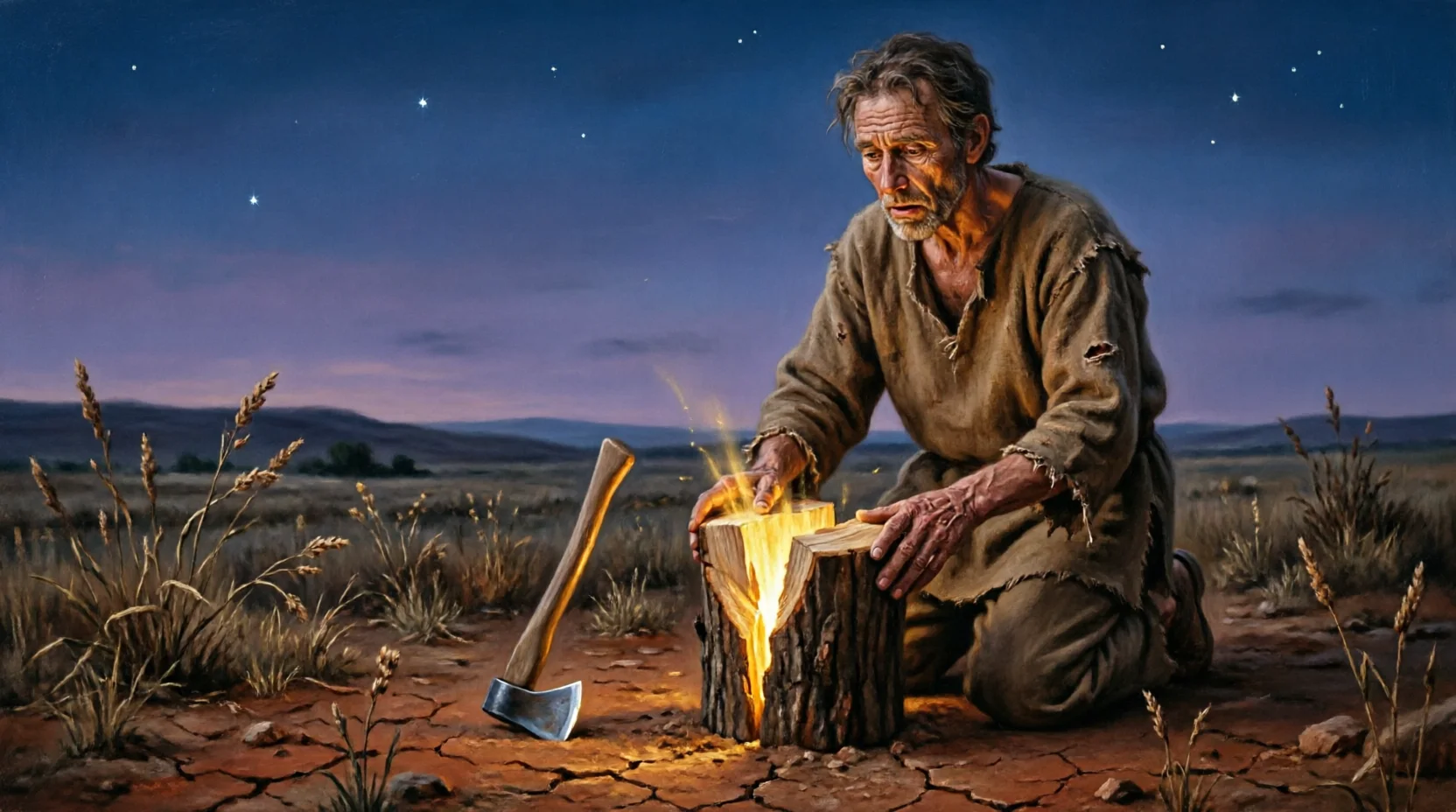
“Split the wood and I am there; lift the stone and you will find me.” (77)
Commentary: Radical immanence. The Source is not above the frame — it is inside matter. Not the god of the temple, but the god of the wood and the stone. Immanence makes the mediator useless — and that is exactly why the text was burned. The apparatus needs distance; the instructor abolishes it.
6. The world as a carcass
“Whoever has come to know the world has found a carcass; and whoever has found a carcass, of him the world is not worthy.” (56)
Commentary: The kenoma, the empty shell. To find the carcass means to see that the farm is dead matter, not living reality. The spark recognises that it does not belong to the shell. It is not disgust — it is lucidity: the carcass is not evil; it is merely not alive. And it is not worthy of the one who has seen the living.
7. Bring forth what is within you
“If you bring forth what is within you, what you bring forth will save you. If you do not bring forth what is within you, what you do not bring forth will destroy you.” (70)
Commentary: Salvation is the epinoia brought out into the light. And the warning is symmetrical: the unexpressed spark destroys from within. For me, this is not a metaphor: to build is salvation, not to bring it forth is rotting. Everything I have brought out of myself — texts, houses, things made by hand — has kept me whole; everything I swallowed and left inside turned against me. The duty of creation, stated as a law of physics.
8. The solitary and the chosen
“Blessed are the solitary and the chosen, for you will find the Kingdom.” (49)
“I shall choose you, one out of a thousand and two out of ten thousand.” (23)
Commentary: The road is singular, not for the masses. The apparatus works with the flock — census, queue, register; the instructor speaks in the singular. Not elitism — statistics: the fog is thick, few wake up. And the “solitary one” is not the only one — he is the one who is not plugged into the flock.
9. The absence of the cross
Commentary: The absence is the message: zero passion, zero blood, zero redemption. The cross appears only as one’s own burden (“whoever does not carry his cross… will not be worthy of me” — 55), not as a cult of sacrifice. The apparatus later placed the event at the centre; Thomas places the word. The religion of the event against the religion of understanding. Exactly the hijacking from Chapter 36: the instructor became a victim, the word became a transaction.
10. The red threads, once again
- The administrator is not the Source — here the administrator does not even appear: the Source is in the wood.
- Salvation is waking, not sacrifice — zero blood in 114 sayings.
- The spark is inside you — “bring forth what is within you”.
- Passing through is the frequency of freedom — “become passers-by”.
The honest note, as always: a map, not a proof. But a map in which the laughing Jesus of Part 4 is already standing: the one who does not die for you, but teaches you not to die asleep.
Part 4 follows: The Apocalypse of Peter and the Second Treatise of the Great Seth — the Jesus who laughs. The jar is open.