Or: the film I lived before I saw it
There are films you watch and films that recognise you. The first time I saw The Matrix, I was a spectator. The last time, I was a witness. The difference between the two is the difference between a postcard and the ground itself: one shows you the place, the other reminds you that you have walked it.
I am not writing this as a film critic. I am writing it as a man who left his body through a spiral, saw his life reeled back in a fraction of a second, floated among the stars with no hands and no feet, was chased by entities running in zig-zag towards a golden gate, and heard an old voice telling him to live his life. When a man who has been through all that sits down in front of The Matrix, he does not see science fiction. He sees a documentary with special effects.
1. The farm
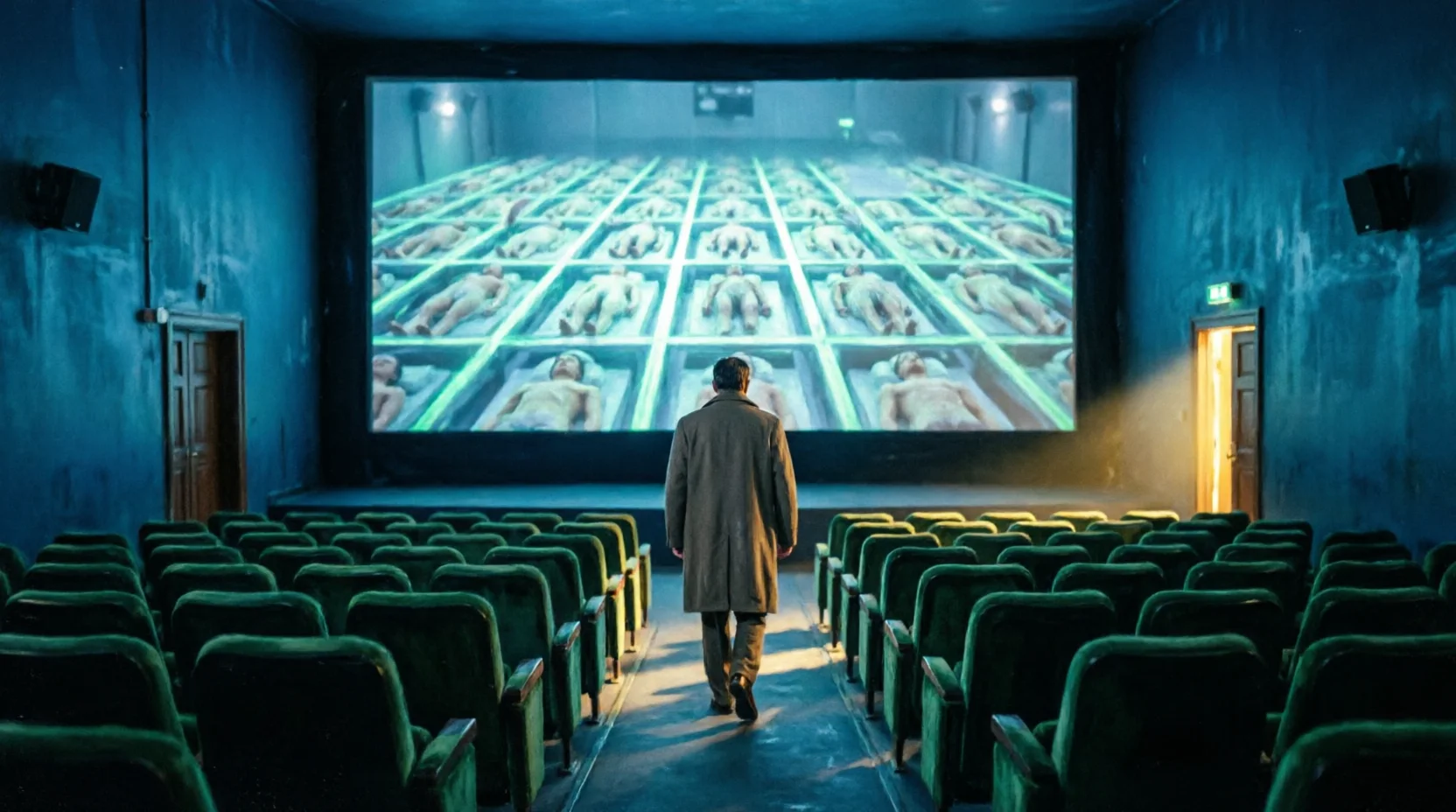
Morpheus says it without hedging: a human being is a source of energy; the Matrix is a dream world built to keep us under control, to turn us into batteries. When I heard the line, I did not laugh at the film. I laughed at the precision. I was already sketching, elsewhere, the register of red marks, the queue that pays in indignation, the wheel in which people run convinced that the wheel is the centre of the universe. The film calls it a pod; I call it a slot; the old texts call it a farm. Three dialects, the same bookkeeping.
And Resurrections completed the diagnosis. The new administrator, the Analyst, coolly explains that the system no longer runs on fear but on unfulfilled desire: people produce more energy when held in the loop of “I want what I cannot have”. That is not sci-fi. That is my Facebook, my outrage factory, the news ticker debating a greeting while the gold chain glitters. The farm evolved from blood to attention — and the film documented the evolution before I named it.
2. The administrators
The Architect is the most honest portrait of the Demiurge ever put on screen: cold, calculating, blind beyond his own equations. He admits exactly what I found in the jar: the first Matrix was a perfect world and it failed — the garden; humans rejected paradise. The solution was choice: 99.9% of subjects accept the programme as long as they are given a choice, even at a near-unconscious level. It is the Engineering of Consent, word for word. The administrator does not need you to love him; he needs you to sign.
The Agents are my guardians. The zig-zagging entities I felt did not wish me well are the same immune system, filmed from another camera. And the Merovingian is the old programme, the trafficker, the one who knows there have been “Ones” before you — the farm’s cycles, the ages of the world. He says so himself, plainly: he has survived your predecessors, and he will survive you too.
3. The exit protocol
The red pill is not a pill. It is a decision. And the mirror that swallows Neo, the liquid metal that covers him, the body that dissolves — that is the uncoupling. I know the scene from the inside: the moment you know you exist with no hands, no feet, no form. The film needed special effects; I needed a fraction of a second.
“There is no spoon” is the rendering: the rules are mental, matter is code. Déjà vu is the glitch, the pixel, the moment the fog thins. The question “have you ever had a dream you were so sure was real?” is the Valentinian nightmare, the Gospel of Truth quoted in a blockbuster. And the Oracle, with “know thyself” above the door, is anamnesis: she does not predict your future — she makes you recognise yourself.
4. The administered escape
Here the film is crueller and more honest than the whole of New Age put together. Zion — the city of the awakened — is part of the design. The Architect explains: a pressure valve, the sixth iteration. Even the escape is administered. I recognised it at once: it is the renovated wing of the prison, the “New Earth” I could not swallow even when I read it elsewhere. The film says it outright: a renovated prison is still called a prison.
And “the One” is not the saviour — he is the anomaly designed to carry the residual code back to the Source. The saviour is a component of the machine. The five Ones before him are the five cycles. I wrote this elsewhere as the Saviour’s Paradox; the film filmed it before me.
5. The return contract
Cypher is the soul that signs. He knows the steak is fake and chooses it anyway: ignorance is bliss. That is the reincarnation contract, the bait-light that shows you your debts and offers you one more turn on the wheel. Cypher does not want the truth; he wants the slot. And the system, generously, gives him the slot.
6. The sleepers as guards
On the rooftop, Morpheus says the line that ought to be carved above every comments section: they are part of the system, therefore they are its guards; some are so dependent that they will fight to protect it. I do not fight them. I have learned: you do not argue with the fog, you do not wake the queue, you do not explain the map to someone who loves his cage. “Whatever” is my rooftop.
7. WE, not I
And at the end, Resurrections gave me the most beautiful confirmation: the power is not in the One — it is in the pair. Neo and Trinity, together, rewrite the code; apart, they are sedated batteries. The system does not fear the solitary awakened one; it fears two awake together. I have said it all my life: I do not believe in I, I believe in WE. The Pleroma is not a solitary throne — it is a mirror in which light looks at itself and gives birth to the other. The film understood: the bridal chamber is stronger than the anomaly.
The popcorn jar
Why could everything I am writing here be filmed, distributed, awarded and watched by billions of people without being censored? Because truth labelled as fiction gets past any censorship. That is how the jar works: truth survives in disguise. The spectacle was the slot; the truth was the goods. Divine sleight of hand, in its happy version: you watch a blockbuster, and the truth is the map.
And they did not hide it. In the film’s first scene, Neo takes a disc out of a hollowed-out book — and the book is Jean Baudrillard’s Simulacra and Simulation, opened exactly at the chapter “On Nihilism”. The Wachowskis asked the actors to read it before they even saw the script. The truth was not slipped in on the sly; it was laid on the table, in frame, in the first minutes. Nobody saw it, because it was in an action film. And Baudrillard, with complete irony, publicly disowned the film and said they had misunderstood him — the man they borrowed the map from did not recognise the ground.
I am not reducing the film to a theory. I am thanking it. The Wachowskis did not invent the map — they documented it. Like Thoth, like the jar’s librarian, like the woman from Arkansas with her notebook: they listened to the field and wrote it down. And the field is the same for everyone who enters it.
The difference
The difference between the spectator and me is a single one. He saw the map on the screen and went out for popcorn. I lived the map in the spiral, I heard the Voice, I saw the gate and the guardians, I was pulled out of the living room by a yellow sphere at the very moment the bedroom was burning. And then I came back and wrote.
The film ends with a promise: “I am going to show them a world without rules.” The documentary goes on with another: the world without rules has been here all along; you were the one with the rules. The Matrix ends the moment you stop feeding it. The door of the cinema was never locked.
I put the remote down. I go out on the balcony, look at the sky as I do every evening, then come in and build. The vault, the restaurant, the articles, a “happy birthday” said to some Maria over the phone. Volunteers do not flee the farm; they make it less of a farm, piece by piece, until the door, for whoever wants to leave, stays open.