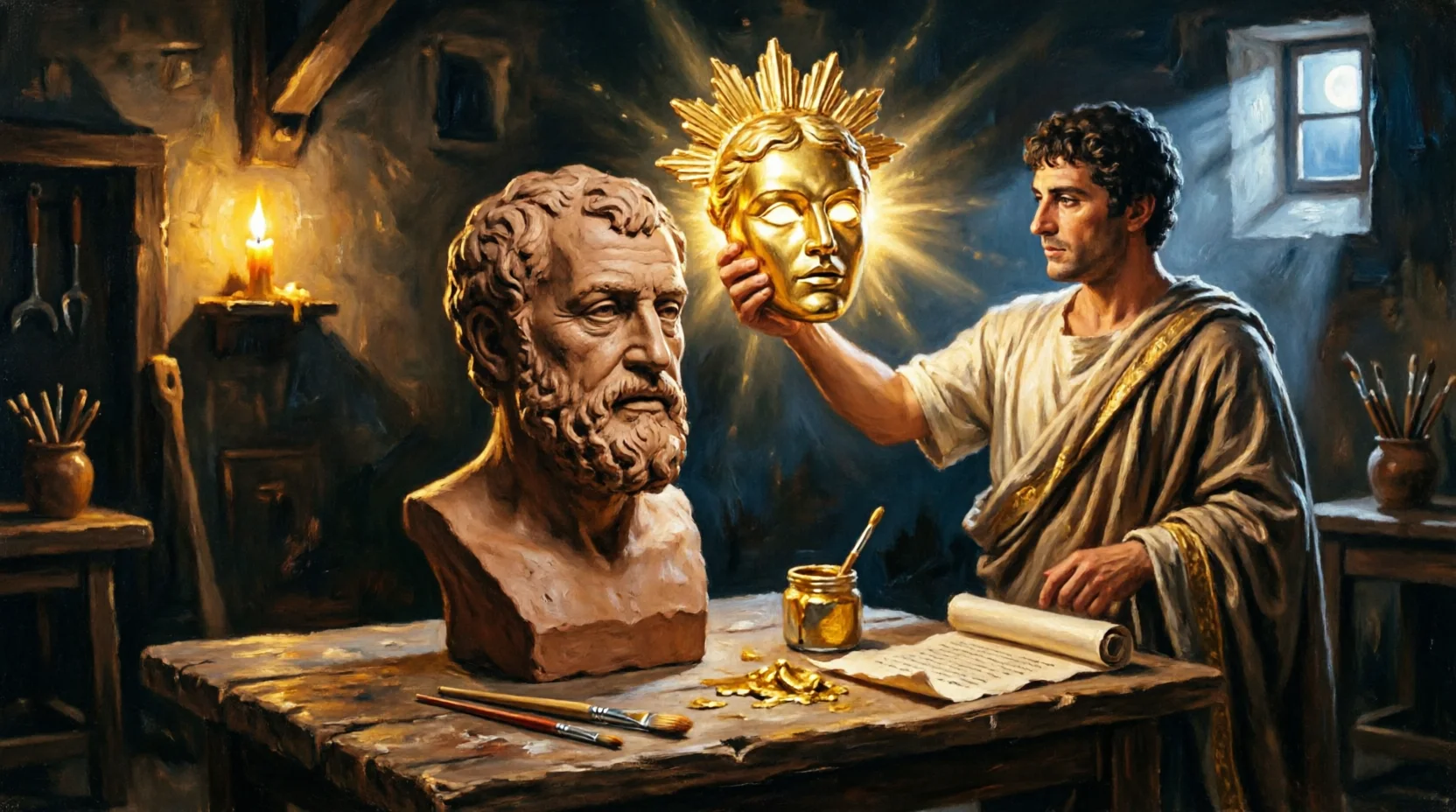
Or: how you become a god without being asked
In the last article I told you about the lock: who kept the texts under key for forty years and who broke the lock. Now I want to tell you what the lock was guarding. Because the most important story in this book is not the Vatican’s chain of command. It is the story of two men who stood over the same message — and pulled in opposite directions.
The two men
On one side, James. Called “the Just”. The brother of Jesus. The man who knew Jesus personally: ate with him, spoke with him, walked with him. After the events, James leads the community in Jerusalem. He does not tell stories about Jesus — he lives the way he saw Jesus live: he keeps the Law, he prays, he acts. The old texts call him “the Just”, and tradition says his knees were calloused from prayer.
On the other side, Paul. Saul of Tarsus. The man who did not know Jesus. Never. Not even once. At first he actually persecutes James’s community: he arrests them, he approves their killing. Then, on a road, he has an experience: a light, a voice. And from that moment he declares himself an apostle of Jesus. Of a Jesus he never saw in his life.
Think of it for a moment as something out of your own village: a man who never knew the teacher turns up and says “I am his voice”. And the man who sat at the teacher’s table says “no, I am his voice”. Who do you believe?
The fork: do, or believe
The difference between the two is not a detail. It is the fork that decides everything down to today.
James and his people in Jerusalem say: keep the Law, do good, be just. Jesus himself, in the Gospels, says: “not one jot, not one tittle shall pass from the Law”. Not one tittle. He did not come to abolish, but to fulfil.
Paul says something else: “a man is not justified by the works of the Law, but through faith in Jesus Christ”.
In plain speech: one says be good. The other says believe.
And there is the whole trick. “Be good” cannot be administered. It needs no priest, no register, no slot to pay into. It is between you and your conscience. But “believe” can be administered. Faith needs intermediaries: someone to tell you what to believe, someone to certify that you believe correctly, someone to collect the fee for the certificate.
James’s religion needs nothing. Paul’s religion needs an Apparatus. Guess which one won.
“Another Jesus”
And the best part: Paul does not even hide it. He writes it himself, in a letter (2 Corinthians 11): the Jerusalem community preaches “another Jesus”.
Read that again: the man who did not know Jesus accuses those who did know him of preaching “another Jesus”. For Paul, the original is his version. The copy is the witnesses’ version.
That is the moment the brand is born. From here on it no longer matters what Jesus said; what matters is what sells.
The marketing: matching point by point
Because Paul is not addressing Jerusalem. He is addressing the wider, pagan world. And in that world there is competition: gods who die and rise again — Adonis, Tammuz, Attis. If you want your god to win the market, he has to have what the others have: a miraculous birth and a resurrection.
So they are built. Point by point. The young woman of the old text becomes a virgin (I showed you in the last article how: a single word changed in translation). The instructor who said “not one tittle” becomes a sacrificed god who dies and rises.
The book says it outright: these are, to a large extent, Pauline constructions, made in order to compete. The victim replaces the instructor. And the victim is far more useful to the Apparatus: the victim creates debt (“he died for you”), and debt creates obedience.
The Liar in the scrolls
And now the part that floored me. Among the texts in the jar there is one, the Habakkuk Commentary, which speaks of three figures: the Teacher of Righteousness (the community’s righteous leader), the Wicked Priest (the corrupt high priest) and the Liar.
The Liar is not an outsider. He is someone who entered the community, was received, then defected, quarrelled with the Teacher and set up “a congregation founded on lies”.
Now open the Acts of the Apostles and look at Paul: he enters the community, is received with suspicion, quarrels with James (the righteous leader), leaves and sets up his own congregations — on a different doctrine.
The same scene, two cameras. The scrolls call him the Liar; Acts calls him a saint. History is written by the winner.
And I say it here, not only at the end: this overlay is Robert Eisenman’s reading, rejected by most specialists — chiefly because the usual dating of the text places it more than a century before Paul. I put it on the table as a hypothesis, not a verdict. You decide whether the pattern looks too exact to be chance.
Four hundred and seventy soldiers
And there is one more detail in Acts that I have read dozens of times without seeing. I leave it here without drawing the conclusion myself, as usual.
Paul is arrested in Jerusalem. He is about to be flogged, but escapes by invoking something almost no provincial Jew had: full Roman citizenship, by birth, from a wealthy family in Tarsus. Roman law forbade the torture of a citizen.
Then forty men swear not to eat or drink until they have killed him. And the Romans take him out of the city by night. With what escort? With four hundred and seventy soldiers: two hundred infantry under two centurions, two hundred spearmen and seventy cavalry.
Four hundred and seventy soldiers of the occupying army, mobilised at night, for a single preacher. Think how much a man has to be worth to the occupier for half a garrison to be turned out for him. James, by contrast, was killed in Jerusalem, and nobody sent anybody to protect him.
The hijacked army
Because that was what was at stake, and the book shows it plainly: the movement of James, of Qumran, of the “zealots for the Law” was not a church. It was a liberation movement — men who wanted to rid the land of the occupier and of the corrupt priesthood. The “early Church” in Jerusalem is one face of this movement, as are the Zealots, as are the Sicarii. Even the name they called themselves by, “keepers of the covenant”, is said — by Eisenman — to have given the word by which the first Christians were named: Nazoreans. That is, the term would come from what they did, not from where they came from. Here I have to be straight with you: Nazareth existed. It is archaeologically attested as a first-century village. Eisenman’s etymology is contested by other specialists, and in any case it does not need an invented Nazareth in order to stand — it only says that “Nazorean” described a belonging, not an address.
Paul takes this army and demilitarises it. He takes a movement that does and turns it into a religion that believes. What was heresy inside Judaism becomes the orthodoxy of Christianity. The religion of Jesus becomes a religion about Jesus.
Why it concerns me
I will tell you why I am writing this under my own name. Because the fork between James and Paul is the same fork I meet every day, including inside myself.
The Apparatus asks you to believe. In screens, in leaders, in brands, in slot machines. The Source asks one thing of you: Be Good.
All my life I have built: Zeus’s vault, the restaurant, the articles, a “happy birthday” said to some Maria over the phone. I have never asked anyone to believe in me. I have no register, no queue, no fee. When I am gone, only what I made will remain. That is James’s line. That is the line of “not one tittle”.
Faith can be confiscated. Goodness cannot. That is why the Apparatus chose the Paul version. And that is why, when someone asks me “what should I believe in?”, I always answer the same: do not believe. Do.
Honest note, as always
James = the Teacher of Righteousness, Paul = the Liar, Paul as a Roman agent — these are the hypotheses of Robert Eisenman and of Baigent and Leigh’s book, contested by many specialists. The figures and the scenes, however, are in the Acts of the Apostles, in plain sight: the citizenship, the oath of the forty, the 470 soldiers. I am not asking you to accept the hypothesis. I am only asking you to wonder, as I do, about the escort.
And the fork itself is not a hypothesis. It is in the texts: Paul’s letters, Acts, the Letter of James. One says faith, the other says works. One builds the brand, the other keeps the voice.
And the question remains, a simple one, for each of us: if you had to choose between the man who knew him and the man who invented him — which one do you listen to?